
Buy Algorand
ALGOPast performance is not indicative of future results. All prices are sourced from CoinJar Indices.
What is Algorand?
Algorand is a layer one blockchain launched in 2019 by Silvio Micali, an MIT cryptographer who shared the Turing Award in 2012 for foundational work in cryptography. ALGO is its native token, used to pay network fees and to secure the chain.
Algorand is one of the more technically distinctive networks in the market and one of the more commercially disappointing, and an honest page has to hold both of those at once. Our guide to altcoins explains where tokens like ALGO sit relative to Bitcoin.
Where did Algorand come from?
The project began in 2017 around Micali and a group of cryptographers and engineers, with mainnet launching in June 2019. The founding idea was to solve what the industry calls the blockchain trilemma: the trade off between decentralization, security and speed that forces most networks to give up one of the three.
Two organizations grew up around it. The Algorand Foundation holds the token supply, funds development and runs the incentive programs. A separate technology company built the core software. That structure matters for a reason covered further down: the Foundation is not a passive steward, it is an active and well resourced participant in how ALGO is distributed and rewarded.
Algorand's academic pedigree is real and unusual. It is also not a substitute for adoption, and the gap between the two is the central question about this asset.
How Algorand's consensus actually works
Algorand uses what it calls Pure Proof of Stake, and the mechanics are genuinely different from most proof of stake networks. The protocol documentation is the primary source.
Every block goes through three steps: propose, soft vote and certify vote. For each step, the network runs a cryptographic lottery called sortition using a verifiable random function. Accounts are selected in secret, in proportion to the ALGO they have online, and a selected account publishes proof of its own selection when it acts. Nobody knows in advance who will be chosen, which makes it very hard to bribe or attack the committee for a given block.
Three consequences are worth understanding.
Selection is weighted per token, not per account. Splitting a balance across many wallets gives you no advantage at all. Finality comes from certification, not from waiting. Once a certify vote committee reaches a quorum, the block is written and the round ends. There is no Bitcoin style waiting for confirmations to build up behind your transaction. There is no slashing. Algorand's design does not penalize participants by destroying their stake. That removes a risk that exists on many other proof of stake networks, and it also removes a deterrent those networks rely on.
The network has two distinct node roles. Participation nodes do the consensus work and anyone can run one. Relay nodes route traffic between them, and that layer has historically been a smaller and more curated set. Reducing the dependency on it through peer to peer networking has been an ongoing piece of work. It is a fair question to ask of any network describing itself as decentralized.
What is ALGO used for?
Network fees. The minimum transaction fee is 0.001 ALGO when the network is not congested, which is one of the lowest fixed minimums in the market. Securing the network. ALGO held in an online account with valid participation keys is what gives that account voting weight in consensus. Staking rewards. Covered in detail below, because what qualifies has changed substantially. Minimum balances. Every Algorand account must hold at least 0.1 ALGO, and that requirement increases with each additional asset the account holds.
Staking rewards on Algorand: read this before you assume anything
This is the part of Algorand most likely to be described incorrectly by older articles, and it directly affects what you get for holding the token.
Algorand originally paid rewards to ordinary holders simply for holding ALGO. That ended. It was followed by a quarterly Governance program in which you committed ALGO for a period, voted on proposals and received rewards for doing so. The Algorand Foundation's own material now states plainly that governance is no longer incentivized with rewards.
What exists today is a reward for actually participating in consensus. According to the Foundation's staking rewards page, an account needs at least 30,000 ALGO online in a participation node to be eligible for direct rewards, a threshold set by community vote. Holders below that can only access rewards through third party pooling or delegation applications, which are separate products with their own risks.
The funding of those rewards deserves attention, because it is not what most people assume. The reward paid when your account proposes a block is made up of half of the transaction fees on the network, plus a supplementary bonus funded by the Algorand Foundation from its own holdings. That bonus started at 10 ALGO per block and decays by one percent every millionth block, and the Foundation committed to providing it for roughly twenty four months.
In plain terms: a meaningful share of Algorand's current staking yield is a Foundation subsidy with a decay curve and an end date, not a permanent protocol emission. Any yield figure you see quoted should be read with that in mind.
CoinJar does not stake ALGO on your behalf. ALGO held in a CoinJar account is not run through a participation node, earns no consensus rewards and is not deposited into any third party staking product.
Tokens and assets built on Algorand
Algorand's token standard is the Algorand Standard Asset, and it is used for stablecoins, tokenized commodities and a range of financial instruments. Our guide to tokenizing real world assets covers that category.
One design feature is important and rarely mentioned. According to the asset documentation, an Algorand Standard Asset can be created with a freeze address and a clawback address. A freeze address can stop a specific account sending or receiving that asset. A clawback address can move the asset out of a holder's account entirely.
Whether that is a feature or a flaw depends on what you are holding. For a regulated stablecoin or a tokenized security it is a compliance requirement. For anything you expected to control absolutely, it is a meaningful limitation you should check before you hold it.
The native ALGO token is not an Algorand Standard Asset and does not carry those controls. Nobody can freeze or claw back your ALGO at the protocol level.
Two other practical points follow from the same design. An account must opt in to an asset before it can receive it, so tokens cannot be pushed into your wallet unsolicited. And each asset an account holds increases its minimum ALGO balance requirement.
What are the risks of holding ALGO?
Adoption has lagged the technology. Algorand has strong engineering credentials and a long history of partnership announcements. Turning those into sustained, measurable network usage has been the persistent difficulty, and much of the case for ALGO still rests on that changing. Foundation concentration and influence. The Algorand Foundation holds a large share of the supply, funds the bonus component of staking rewards and shapes the incentive structure. Decisions it makes about distribution and funding affect holders directly. Reward structure is not permanent. The Foundation funded bonus decays over time and was committed for a limited period. What replaces it, if anything, is a governance question rather than a protocol guarantee. Rewards require scale. Direct staking rewards need a substantial ALGO balance online. Smaller holders depend on third party products that carry smart contract and counterparty risk. No slashing cuts both ways. The absence of a stake penalty removes a risk for participants and removes a deterrent for the network. Relay layer dependency. The routing layer of the network has historically been narrower than the consensus layer. Third party wallet risk. In February 2023 users of MyAlgo, a widely used third party Algorand wallet, lost roughly nine million dollars of ALGO and stablecoins to an exploit. The Algorand protocol itself was not compromised, but it is a reminder that most losses in crypto happen at the wallet and application layer rather than the chain layer. Regulatory uncertainty. In its 2023 complaint against the exchange Bittrex, the Securities and Exchange Commission named ALGO among tokens it alleged were unregistered securities. That case was settled without a court ruling on the question, and US enforcement policy has since shifted, but no court has determined ALGO's status. Competition. Algorand competes with a large number of well funded layer one networks for developers, capital and attention, several of which have far larger ecosystems. Volatility. ALGO has fallen very heavily from its historic highs and has spent long periods well below them. No federal protection. Crypto assets are not covered by FDIC deposit insurance or SIPC protection. You should be prepared to lose everything you put in.
Buying ALGO with US dollars on CoinJar
CoinJar has operated since 2013 and lists ALGO against US dollars, so you can buy, sell and hold it without converting through another cryptocurrency first. Current charges are on our fees page, and live US dollar rates are on our cryptocurrency prices page.
CoinJar, Inc. is registered with FinCEN as a money services business and holds money transmitter licenses in a growing number of states, NMLS ID 2492913. You can check whether CoinJar operates in your state before signing up. Registration and licensing cover how CoinJar operates as a business. They are not an endorsement of any crypto asset listed on the platform.
How is ALGO taxed in the US?
The IRS treats crypto assets such as ALGO as property. A taxable disposal can occur when you sell ALGO for US dollars, exchange it for another crypto asset, spend it or give it away, and gains or losses are generally reported on your federal return.
The IRS sets out its approach on its digital assets page. Our guide to pulling a transaction history for tax reporting covers the practical side. This is general information, not tax advice. Consider speaking to a qualified tax professional about your circumstances.
Bank transfer (ACH and wire), or crypto?
Buy Algorand instantly with your bank account via ACH or deposit with wire transfer. Easily buy with ACH, wire cash to your account, or swap one cryptocurrency for another in a single click.

How to buy Algorand with CoinJar
Start your cryptocurrency portfolio with CoinJar by following these simple steps.
Download the app
Get the CoinJar app on iOS or Android.
Create an account
Sign up and verify your ID – it only takes a couple of minutes.
Make a purchase
Buy Algorand and more than 60 other cryptos using ACH or wire transfer.
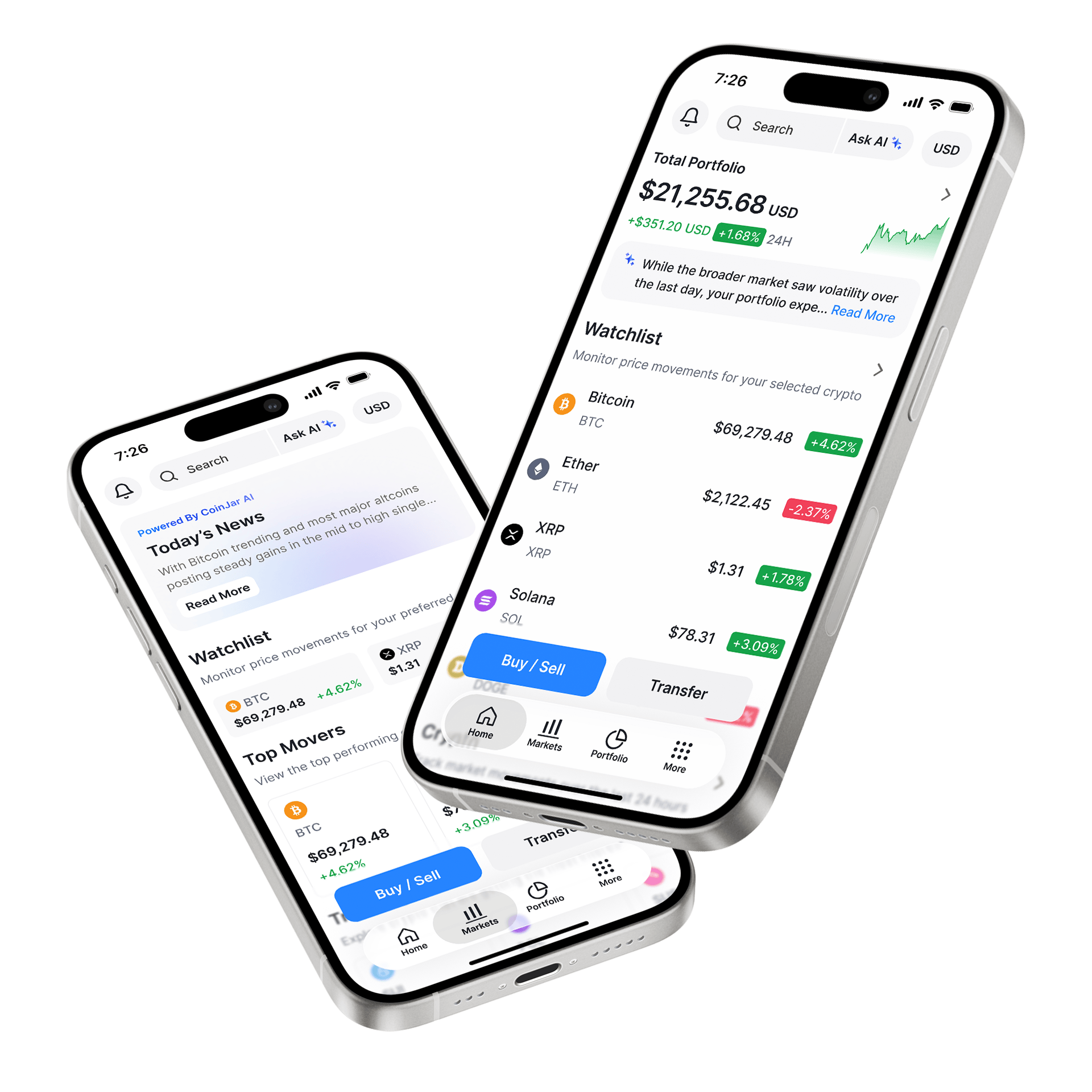
CoinJar App
Buy, sell and send your crypto with the favorite cryptocurrency app in the US.
Get the CoinJar appCoinJar App
Buy, sell and send your crypto with the favorite cryptocurrency app in the US.
Get the CoinJar app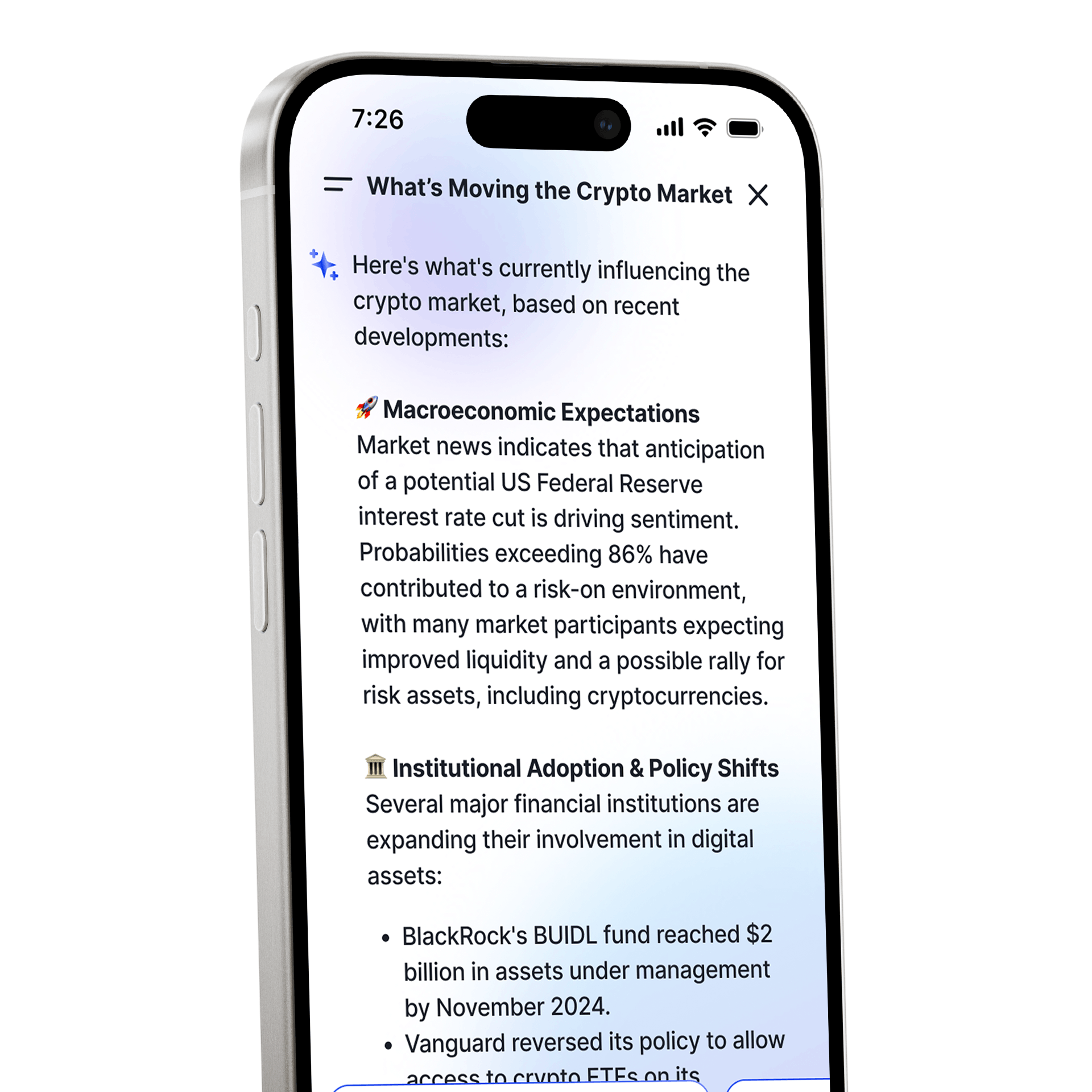
CoinJar AI
CoinJar AI understands your portfolio, tracks the market, and gives you insights that matter. Instead of searching for answers, simply ask a question to get the specific information you need.
Learn moreCoinJar AI
CoinJar AI understands your portfolio, tracks the market, and gives you insights that matter. Instead of searching for answers, simply ask a question to get the specific information you need.
Learn moreBuying, selling, and holding cryptocurrencies is subject to high market risk. The volatile and unpredictable nature of the price of cryptocurrencies may result in a significant loss. CoinJar, inc. is not responsible for any loss that you may incur from price fluctuations when you buy, sell, or hold cryptocurrencies. CoinJar, Inc. does not provide any investment, tax or legal advice; before making the decision to buy, sell or hold any cryptocurrencies, you should conduct your own due diligence and consult your financial, tax and/or legal advisor.
It is your responsibility to determine whether any investment, investment strategy or related transaction is appropriate for you according to your personal investment objectives, financial circumstances, and risk tolerance. Enter into a transaction only if you fully understand its nature, the contractual relationship into which you are entering, all relevant terms and conditions, and the nature and extent of your exposure to loss. Past performance is not a reliable indicator of future results. Geographic restrictions may apply. CoinJar does not endorse the content of, and cannot guarantee or verify the safety of any third party websites. Visit these websites at your own risk.

CoinJar
Get the app.