Coming soon to the USA! While our services may not be available yet, sign up now to stay in the loop as we bring our innovative crypto solutions to America.
Buy Sui (SUI) with CoinJar
Sui
SUI
Overview
What is Sui?
Buy Sui: Why do people buy the SUI token? What is the SUI ? How does this technology work? Let’s dig in.
Cryptocurrency, or digital money, isn't just about Bitcoin anymore. That's the idea behind the , a cutting-edge platform designed for the next generation of cryptocurrency and applications.
What is SUI all about?
The Sui blockchain is like a super-fast, super-efficient highway for digital information and value. Here’s what they aim for.
Speed
Sui can handle tons of transactions really quickly, making it perfect for busy applications like games and financial tools.
Security
It uses advanced cryptography to keep your digital assets safe and sound.
Flexibility
Developers can create all sorts of cool things on Sui, from unique digital collectibles (NFTs) to entirely new ways of managing money.
Cool stuff on Sui
Cosmocadia
This is a strategy game where players explore, colonise, and build empires. gather resources and build the ultimate utopia. Players can catch the critters roaming the island and build them a home to help them on their quest.
(CoinJar accepts no responsibility for the content on third-party websites.)
Project Eluüne
This is a MMORPG with a focus on exploration, crafting, and social interaction.
There are also DeFi dApps, and NFT marketplaces like , an NFT marketplace for sports collectibles.
And there’s even a SocialFi dApp, called Suia. This is a decentralised social media platform that allows users to earn rewards for their content.
Why are people buying Sui's token?
The Sui blockchain has its own digital money called the SUI token. People buy SUI for a few reasons:
Investing
They think the value of SUI will go up as the Sui blockchain becomes more popular. It's like buying stock in a promising company.
Using apps
Some apps on the Sui blockchain require SUI to work. It's like needing tokens to play games at an arcade.
Supporting the network
Owning SUI lets you participate in decisions about the future of the blockchain.
How does Sui work?
The Sui blockchain is built on some clever technology:
Objects
Everything on Sui, from money to game items, is represented as a digital object with unique properties.
Smart contracts
These are like self-executing agreements that make transactions automatic and trustworthy.
Move programming language
Sui has its own special language called Move, designed to make building secure applications easier.
Buy SUI
The Sui blockchain is still pretty new, but it's attracting a lot of attention. If you're interested in the future of crypto, it's worth learning more about. Just remember, investing in crypto is risky, so do your research and never invest more than you can afford to lose.
The future of Sui
With its focus on speed, security, and flexibility, the Sui blockchain aims to play a big role in shaping the future of crypto.
How to buy SUI on CoinJar
Buying SUI on CoinJar is a straightforward process even if you're new to crypto.
Start by signing up on the CoinJar website or downloading the app. You’ll need to provide some personal information and complete identity verification in line with local regulations.
Once your account is verified, you can link your bank account to buy SUI instantly via ACH, or deposit funds through Fedwire and use your balance to make a purchase.
Navigate to Sui (SUI), enter the amount you'd like to spend or the amount of SUI you'd like to buy. CoinJar will show the current exchange rate and any applicable fees. Review the details and confirm your transaction.


Bank transfer (ACH and wire), or crypto?
Buy Sui with your bank account via ACH or deposit with wire transfer. Easily buy with ACH, wire cash to your account, or swap one cryptocurrency for another in a single click.How to buy Sui with CoinJar
Start your cryptocurrency portfolio with CoinJar by following these simple steps.





Featured In

CoinJar App
All-in-one crypto wallet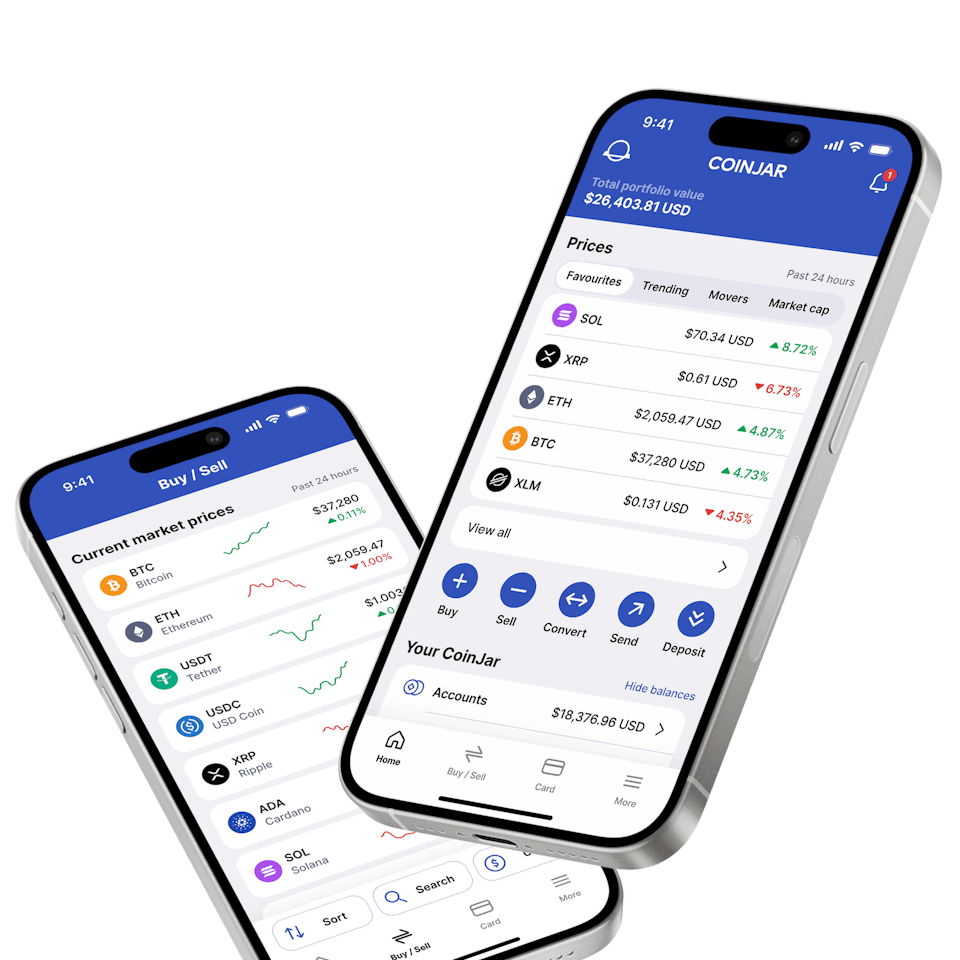
Frequently asked questions
What is the SUI token used for on the Sui network?
The SUI token is the native cryptocurrency of the Sui blockchain. It's used for paying gas fees, participating in stake rewards through delegated proof of stake (DPoS), and interacting with smart contracts on the network.
With CoinJar's user-friendly platform, secure bank transfers, and seamless trading experience, buying crypto including SUI is simple and convenient. Just link your bank account for instant purchases via ACH or deposit funds using Fedwire. Check the current price of SUI, place your order, and start trading in minutes.
How does Sui's transaction processing differ from other blockchains?
Sui leverages parallel processing to achieve high transaction speeds. Unlike traditional blockchain technology, which processes transactions sequentially, Sui can handle multiple transactions simultaneously, resulting in faster confirmation times.
What is the role of Mysten Labs in the Sui ecosystem?
Mysten Labs, co-founded by Evan Cheng, Adeniyi Abiodun, Sam Blackshear, George Danezis, and Kostas Chalkias, is the company behind the development of the Sui blockchain and the Move programming language.
Where can I buy SUI?
You can buy SUI on various cryptocurrency exchanges and platforms that Sui offers support for. Be sure to research and choose a reputable platform before making a purchase.
What is the Move programming language, and why is it important for Sui?
The Move programming language is a key component of the Sui blockchain. It's designed specifically for building secure and scalable smart contracts that manage digital assets on the network.
How does delegated proof of stake (DPoS) work on the Sui blockchain?
Sui uses DPoS as its consensus mechanism. SUI holders can delegate their tokens to validators, who are responsible for processing transactions and maintaining the security of the network. In return for their services, validators and those who delegate to them earn stake rewards.
What are the transaction fees on the Sui network, and what is a gas fee?
Transaction fees on Sui are generally low, thanks to its efficient transaction processing. The fees are calculated based on a gas fee, which varies depending on the complexity of the transaction and the current network demand.
Does the Sui network have a built-in exchange?
Yes, Sui features a native central limit order book (CLOB), which functions as a decentralized exchange (DEX) within the network. This allows users to trade digital assets directly on Sui without relying on external exchanges.

Your information is handled in accordance with CoinJar’s .
Copyright © 2025 CoinJar, Inc. All rights reserved.
CoinJar, Inc. is a registered Money Services Business with FinCEN and licensed as a money transmitter, NMLS #2492913. For a list of states in which CoinJar, Inc. is licensed or authorized to operate, please visit . In certain other states, money transmission services are provided by Cross River Bank, Member FDIC.
This site is protected by reCAPTCHA and the and apply.

