
Buy Synthetix
SNXPast performance is not indicative of future results. All prices are sourced from CoinJar Indices.
What is Synthetix?
Synthetix is one of the oldest projects in decentralized finance, and it is now a perpetual futures exchange running on Ethereum. SNX is its token.
The most useful thing to know before reading anything else about SNX is that Synthetix today has very little in common with the Synthetix that most articles describe. For roughly seven years it was a synthetic asset protocol, where you locked SNX as collateral to mint tokenized versions of dollars, ether and other assets. That model has now been dismantled, its stablecoin has been retired, and the project has rebuilt itself around derivatives trading on Ethereum mainnet. If you are looking at older material about SNX, you are almost certainly reading about a product that no longer exists. Our guide to decentralized finance covers the wider category, and our guide to altcoins explains where tokens like SNX sit relative to Bitcoin.
What Synthetix used to be
The project began in 2017 as Havven, founded by the Australian entrepreneur Kain Warwick, and raised roughly thirty million US dollars in a token sale in early 2018. It rebranded to Synthetix in December 2018.
The idea was genuinely original. Instead of matching a buyer with a seller, Synthetix let you lock SNX as collateral and mint synthetic assets called Synths: sUSD for dollars, sETH for ether, sBTC for bitcoin. Because everything settled against a shared pool of collateral, a trade could always be filled without a counterparty on the other side.
The catch was in the debt. SNX stakers did not simply borrow against their own collateral. They collectively took on the whole system's debt, and each staker's obligation moved with the value of every Synth in existence, not just the ones they had minted. Stakers had to hold collateral at a ratio far above what an ordinary lending protocol would demand, and they could end up worse off because of price moves in assets they had never touched. It worked, it was clever, and almost nobody found it easy to understand.
New SNX was issued every week to pay stakers for carrying that risk. That issuance ended in December 2023.
What went wrong, and how it was resolved
This is the part of the story that matters most, and it is not covered on most pages about SNX.
In January 2025 Synthetix passed SIP-420, which replaced individual staking with a protocol-owned pool. Stakers moved their SNX into the pool, the protocol took on their debt, and their obligations were to be written down over time in what the project called a debt jubilee. The intention was to remove the hardest part of the old system.
The consequence was that sUSD lost its peg. The old design had a natural stabilizer, because a staker could always profit by buying discounted sUSD and using it to repay debt. Once debt was being forgiven anyway, that incentive weakened, stakers sold sUSD, and it fell well below a dollar and stayed there. Synthetix spent more than a year trying to fix it: treasury purchases of sUSD, escalating requirements for stakers to hold sUSD in the pool in order to keep their debt forgiveness running, and incentive campaigns on outside platforms.
It did not hold. In June 2026 governance passed SIP-423, which retired legacy sUSD altogether. Transfers, minting and burning were frozen, a snapshot of holders was taken, and holders were given a claim on newly minted SNX at a ratio of four SNX for every sUSD, a ratio set by valuing sUSD at a quarter of its face value. The proposal authorized up to about 236 million new SNX for that purpose, with claims expiring after six months if not made. The debt jubilee was restructured at the same time, with remaining staker debt cleared over a four year lock followed by a one year vest, or repayable in full for an immediate exit.
Two things are worth taking from that. Synthetix chose to make sUSD holders whole in its own token rather than let them absorb the loss, which is a defensible decision. It also issued a very large amount of new SNX to do it, and every existing holder paid for that through dilution.
What Synthetix is today
Synthetix is now a perpetual futures venue. Perpetuals are leveraged contracts that track an asset's price without an expiry date, and they are the highest volume product in cryptocurrency.
The current exchange launched on Ethereum mainnet in December 2025 as an invitation only private beta, and has expanded through 2026. Its design is a deliberate break with everything that came before it.
It uses an order book, not a pool. Orders are matched off chain by a central matching engine for speed, then settled in batches on Ethereum. This is how centralized exchanges work, and it is faster than an on chain order book can be. It also means you are trusting an operator to match your orders fairly, which is a real trust assumption, even though funds sit on Ethereum and withdrawals are meant to stay permissionless. It runs on Ethereum, not a layer two. The project describes this as coming home. It also means users pay Ethereum fees. It is expanding beyond crypto. Through 2026 the roadmap has added multi collateral margin, commodity markets, foreign exchange markets and automated basis trading vaults, alongside a plan to rebuild sUSD as a dollar token backed by hedged trading positions rather than by SNX.
The 2026 roadmap is the clearest single statement of where the project says it is going. Read it as a plan. A good deal of it was not shipped at the time of writing.
What happened to all the other networks?
Synthetix spent years deployed across several layer twos, and it has spent the last two unwinding that.
Optimism functionality was shut down through 2025. Synths on Optimism were deprecated with swaps ending in January 2026 and a treasury redemption window that applies a rising discount before closing at the end of 2026. The Base and Arbitrum deployments were retired as part of the same consolidation. Snaxchain, the layer two Synthetix built for governance, is marked as sunset and no longer maintained.
If you hold legacy Synths or SNX on a network Synthetix has retired, the deadlines matter. Check the official announcements rather than assuming a position will still be redeemable.
What is SNX, technically?
It is an ERC-20 token on Ethereum. SNX transfers are Ethereum transactions with fees paid in ether, and Ethereum mainnet is now where the protocol itself lives. Its supply is not capped. SNX launched with a hundred million tokens and then inflated weekly for five years. That weekly issuance ended in December 2023. There is still no protocol level cap, however, and governance has minted large amounts since, most recently to compensate sUSD holders. It is bought back and burned with revenue. Synthetix directs a share of trading revenue to buying SNX on the open market and destroying it. This is a governance policy that depends on the exchange generating revenue, not a protocol guarantee. It carries no claim on revenue. Holding SNX does not entitle you to fees, a dividend or a share of the treasury. The buyback is the only mechanism connecting protocol revenue to the token, and it is indirect. Staking it now means locking it. Under the current structure, staked SNX sits in a protocol-owned arrangement with multi year lock and vesting terms rather than being freely withdrawable.
Who runs Synthetix?
The Synthetix Foundation was decommissioned in 2020 and governance moved to elected councils. That structure was itself replaced in 2025 by a proposal called SR-2, A Synthetix Reboot, which passed with near unanimous support.
SR-2 collapsed three councils and seventeen seats into a single seven seat Spartan Council. Four seats are elected by token holders on six month terms; the other three, covering strategy, technical and operations, are hired by the elected members and function as a leadership team that the council can replace. The proposal also set out plans to create a new Synthetix Foundation in a suitable jurisdiction to hold contracts and handle compliance.
Kain Warwick remains a prominent contributor and co-authored both SIP-420 and SIP-423, though he is not presented as a chief executive. He is also associated with Infinex, a separate project that is not part of Synthetix.
Be clear-eyed about what SR-2 did. A protocol that had distributed governance across seventeen elected seats concluded that this was hindering execution and consolidated it into seven, three of whom are appointed staff. That may well produce a better product. It is a move toward centralized decision making, not away from it.
What are the risks of holding SNX?
Repeated strategy changes. In the last three years Synthetix has changed its staking model, retired its stablecoin, abandoned its synthetic asset product, exited three layer twos, sunset its own chain and rebuilt its exchange from scratch. Each change may have been right. The pattern is still a risk in itself. Dilution by governance. SNX issuance is a governance decision, and governance has recently authorized a very large mint to resolve the sUSD problem. There is no protocol rule preventing it happening again. A damaged track record on stability. sUSD spent more than a year below its peg before being wound up, and the replacement design is not yet proven. Any future Synthetix dollar has to earn trust that the last one lost. Competition. Perpetual futures is the most contested market in cryptocurrency. Synthetix is entering it against established venues with deep liquidity and large user bases, and liquidity is the hardest thing to win. Execution and trust in the exchange. The new venue matches orders off chain through an operator, and much of the 2026 roadmap was still pending. Both the technology and the delivery are unproven at scale. No claim on the business. SNX produces no revenue for holders and holds no assets. The buyback is a policy, not an entitlement, and it depends on trading volume that does not yet exist in size. Governance concentration. Decisions now sit with a seven seat council, three of whom are appointed rather than elected. Legacy position risk. Synths and deployments on retired networks have redemption deadlines and rising discounts. Holders who do not act can lose value through inattention. Technical risk. Synthetix has been exploited before, most notably an oracle incident in 2019 that briefly produced an enormous synthetic ether position from a mispriced feed. Derivatives protocols, oracles and off chain matching engines are all attack surfaces. Volatility. SNX is not a stablecoin. Its value moves sharply and can fall substantially. No consumer protection. Crypto assets are not covered by FDIC or SIPC insurance, and there is no government compensation scheme that will make you whole if the value of SNX falls or a platform fails. You should be prepared to lose all the money you put in.
Buying SNX with US dollars on CoinJar
CoinJar has operated since 2013 and lists SNX against US dollars, so you can buy, sell and hold it without converting through another cryptocurrency first. Current charges are on our fees page, and live US dollar rates are on our cryptocurrency prices page.
CoinJar, Inc. is registered with FinCEN as a money services business, NMLS ID 2492913, and holds money transmitter licenses in a growing number of states. You can check whether CoinJar operates in your state before signing up. Registration and licensing cover how CoinJar operates as a business. They are not an endorsement of SNX or of any cryptocurrency listed on the platform.
How is SNX taxed in the US?
The IRS treats digital assets such as SNX as property. A taxable event can occur when you sell it for US dollars, exchange it for another cryptocurrency, spend it or receive it as income.
The IRS sets out its approach on its digital assets page. Our guide to downloading a transaction history report explains how to pull the records you need. This is general information, not tax advice. Consider speaking to a qualified tax professional about your circumstances.
Bank transfer (ACH and wire), or crypto?
Buy Synthetix instantly with your bank account via ACH or deposit with wire transfer. Easily buy with ACH, wire cash to your account, or swap one cryptocurrency for another in a single click.


How to buy Synthetix with CoinJar
Start your cryptocurrency portfolio with CoinJar by following these simple steps.
Download the app
Get the CoinJar app on iOS or Android.
Create an account
Sign up and verify your ID – it only takes a couple of minutes.
Make a purchase
Buy Synthetix and more than 60 other cryptos using ACH or wire transfer.
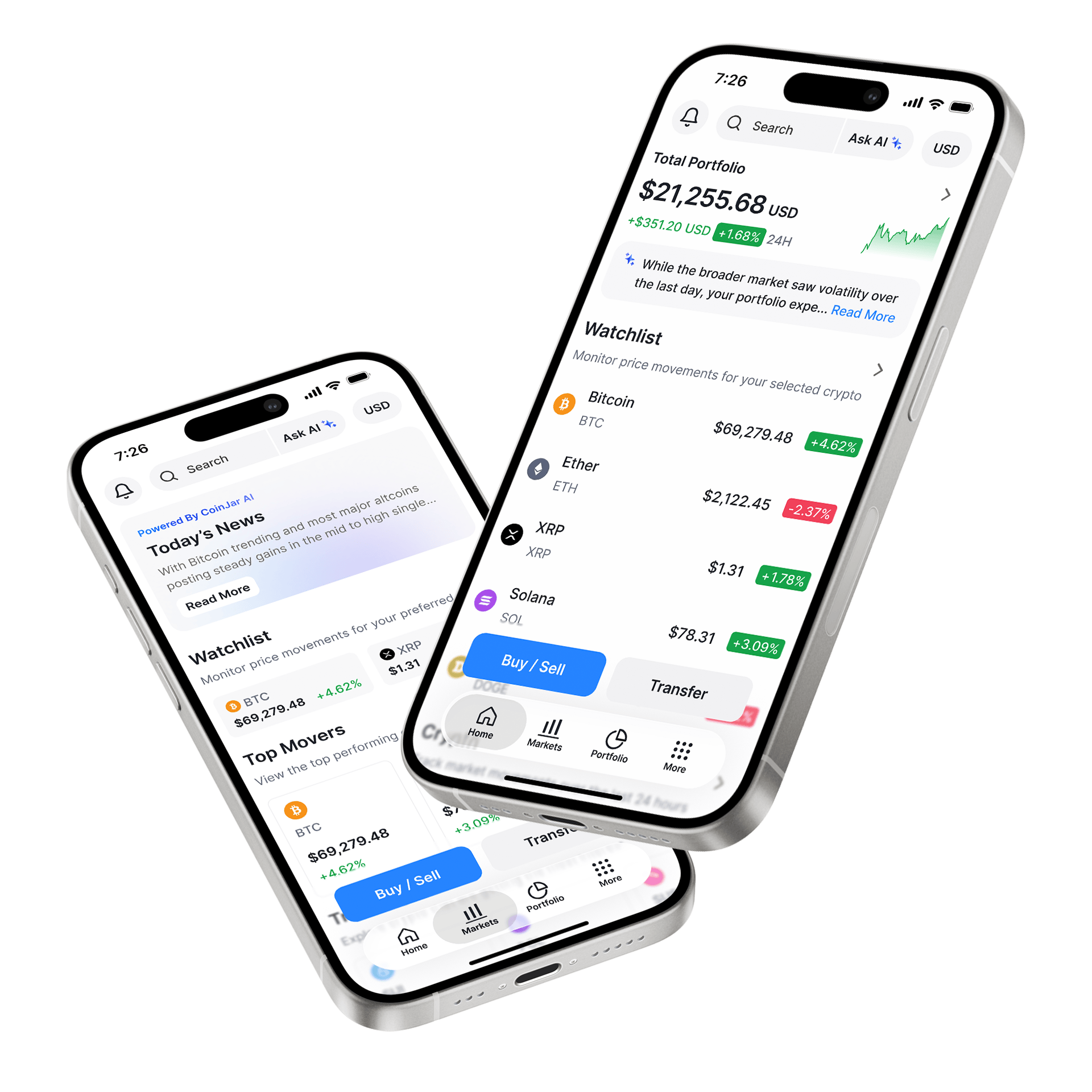
CoinJar App
Buy, sell and send your crypto with the favorite cryptocurrency app in the US.
Get the CoinJar appCoinJar App
Buy, sell and send your crypto with the favorite cryptocurrency app in the US.
Get the CoinJar app
CoinJar AI
CoinJar AI understands your portfolio, tracks the market, and gives you insights that matter. Instead of searching for answers, simply ask a question to get the specific information you need.
Learn moreCoinJar AI
CoinJar AI understands your portfolio, tracks the market, and gives you insights that matter. Instead of searching for answers, simply ask a question to get the specific information you need.
Learn moreBuying, selling, and holding cryptocurrencies is subject to high market risk. The volatile and unpredictable nature of the price of cryptocurrencies may result in a significant loss. CoinJar, inc. is not responsible for any loss that you may incur from price fluctuations when you buy, sell, or hold cryptocurrencies. CoinJar, Inc. does not provide any investment, tax or legal advice; before making the decision to buy, sell or hold any cryptocurrencies, you should conduct your own due diligence and consult your financial, tax and/or legal advisor.
It is your responsibility to determine whether any investment, investment strategy or related transaction is appropriate for you according to your personal investment objectives, financial circumstances, and risk tolerance. Enter into a transaction only if you fully understand its nature, the contractual relationship into which you are entering, all relevant terms and conditions, and the nature and extent of your exposure to loss. Past performance is not a reliable indicator of future results. Geographic restrictions may apply. CoinJar does not endorse the content of, and cannot guarantee or verify the safety of any third party websites. Visit these websites at your own risk.

CoinJar
Get the app.