
Is the future full of appchains, or is this just a phase?
As for another week, a frog meme coin called Pepe continues outperforming all the real builders in crypto; one can't help but feel like Logan Roy in Succession when looking at the crypto space.

Fortunately, unlike the integrity of Logan Roy's children, the builders persist and flock to two ecosystems in particular: Polkadot and Cosmos. Why is that?
What both ecosystems have in common is that they've built their infrastructure around the appchain thesis. Which brings us to the most obvious question:
What are appchains?
Appchain is short for application-specific chain and describes a blockchain dedicated to a single app. Imagine Netflix or Whatsapp, but built on top of their own blockchain instead of running servers on AWS.
Appchains usually run on top of existing layer-1 blockchains such as Ethereum, tapping into the Layer-1s security and development tools.
So far, so simple. But why exactly do projects decide to build appchains in the first place?
Reasons for appchains
While Ethereum has been host to the most vibrant DeFi ecosystem, every time the memecoins rally, so do gas fees. This isn't very sustainable for a dApp that has thousands of transactions to process and now must compete with others.
The more popular your dApp on a Layer-1, the more block space you use. Unfortunately, just like affordable housing in the metropoles of the world, block space is limited. Ethereum is a victim of its own success. If fewer people wanted to degen trade memecoins or buy NFTs, gas fees would never spike.
And while rollups and other scaling solutions flourish, some dApps have very specific requirements for their use case. That's when they go for an appchain.
Appchains offer:
- customizability: appchains provide freedom in making trade-offs as needed for one's industry or use case.
- performance: on an appchain, the only users are users of your app. There is no competition with other apps, providing a perfect environment to maintain low fees
- value capture: instead of paying fees to the layer-1 network, apps can capture more of the value created directly.
Gaming is often named a great fit for appchains as it requires a high volume of small transactions, and users don't get all maxi about which chain their game is on. Quite the opposite. If we've learned anything from game studios exploring NFTs, it's that gamers aren't very bullish on web3 anyway, so not naming blockchain in your game description might be a smooth move.
And it's not just games that benefit from running on their own chain. Last year, dydx announced they'd move away from Ethereum L1 and build an appchain. The derivatives trading platform chose Comos for its appchain as it enables seamless communication between chains in its ecosystem and allows dydx to optimize for high-volume trading.
However, because appchains shift from a supply to a demand-driven model, they don't make sense for apps that don't have market fit yet. And then there is another fact: getting appchains right is hard. Cosmos and Polkadot both took 5 years of development until launching their first full version.
They've also both seen their fair share of drama, which might have contributed to their continued appeal. After all, watching the Cosmos community beef over a lawsuit brought forward by one of their founders is roughly as entertaining as Succession minus the cinematic value.
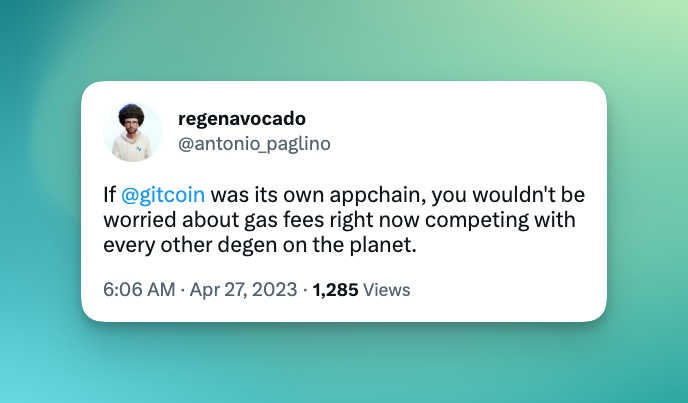
Despite the drama, the building continues, and increasingly people point out that certain apps would benefit from not being in competition with the memecoins. And who is to say that Layer-2s and appchains have to compete?
In the future, we might have it all live peacefully in co-existence while users reap the benefits.
- Naomi from CoinJar
Warning: Past performance is not a reliable guide to future performance. If you invest in this product, you may lose some, or all, of the money you invest. The above information is not to be read as investment, legal or tax advice and takes no account of particular personal or market circumstances; all readers should seek independent investment, legal and tax advice before investing in cryptocurrencies. There are no government or central bank guarantees in the event something goes wrong with your investment. This information is provided for general information and/or educational purposes only. No responsibility or liability is accepted for any errors of fact or omission expressed therein. CoinJar Europe Limited makes no representation or warranty of any kind, express or implied, regarding the accuracy, validity, reliability, availability, or completeness of any such information. CoinJar Europe Limited is authorised by the Central Bank of Ireland as a crypto-asset service provider (registration number C496731).