
Buy Bitcoin
BTCFigures shown refer to the past. Past performance is not a reliable indicator of future results. Pricing data is provided by CoinJar.
What is Bitcoin?
Bitcoin (BTC) is a digital currency that runs on a public network of computers rather than through a bank. It was the first cryptocurrency ever created, launching in January 2009, and every transaction since then has been recorded on a public ledger called a blockchain that anyone can inspect.
Bitcoin's design came from a person or group using the name Satoshi Nakamoto, who published the Bitcoin whitepaper in October 2008 and then stepped away from the project. Their identity has never been confirmed.
If you want the fuller mechanics, our guide on what Bitcoin is and how it works covers it in more depth.
Bitcoin at a glance
- Ticker: BTC
- Launched: January 2009
- Maximum supply: 21 million BTC
- Mined so far: about 20.1 million BTC, roughly 95.5% of the total (July 2026)
- Current block reward: 3.125 BTC
- Next halving: expected around April or May 2028
- Average block time: about 10 minutes
- Smallest unit: one satoshi, or 0.00000001 BTC
Why do people buy Bitcoin?
- Fixed supply. Bitcoin's protocol limits supply to 21 million BTC, and changing this would need broad agreement across the network.
- Track record. Bitcoin has run continuously since 2009 through several severe downturns and remains the most liquid, widely held cryptocurrency.
- Accessibility. Bitcoin settles every day of the year and can be sent internationally without a bank as an intermediary (network fees apply, and a transfer sent to the wrong address can't be reversed).
- Diversification. Some people hold a small allocation because Bitcoin has historically moved differently from shares and bonds, though that relationship changes over time and has broken down in past sell-offs.
None of this removes the risk. Bitcoin has lost half its value or more within a year on multiple occasions, and it can fall to zero. Only money you can afford to lose entirely should go into it.
Can I buy part of a Bitcoin?
Yes. Each Bitcoin divides into 100 million satoshis, so you can buy a small fraction rather than a whole coin. Owning 0.01 BTC gives you the same asset and the same price exposure as owning a whole coin, just less of it. Most exchanges, including CoinJar, let you start from a small amount rather than requiring a full coin.
Buying gradually with Recurring Buy
If you'd rather buy over time than pick a single moment, a Recurring Buy places the same order on a set schedule. Spreading purchases across different prices reduces the impact of any single day, though it doesn't protect against a sustained decline and it doesn't make a losing position profitable. Our article on when to buy Bitcoin looks at how this plays out in practice.
Keeping your Bitcoin safe
You can leave Bitcoin with a registered exchange, which manages the private keys and security infrastructure for you, or move it to a wallet you control, which puts you in charge of the keys and the consequences of losing them. A few habits reduce your exposure either way: use an authenticator app rather than SMS for two-factor authentication, keep any recovery phrase offline rather than in a photo or cloud note, and treat unsolicited investment offers or giveaways as scams. Our guide on how to store cryptocurrency compares the options in detail.
Risks to understand before you buy
- Volatility. Double-digit percentage moves in a week are normal for Bitcoin.
- No FSCS protection. Cryptoassets are not covered by the Financial Services Compensation Scheme, and you will not have access to the Financial Ombudsman Service in relation to them. Transactions cannot be reversed.
- Regulatory change. UK rules on cryptoassets are still developing, and tax and custody rules differ by country. The FCA's guidance on crypto investments is a useful starting point.
- Self-custody risk. If you hold your own keys and lose them, the coins are gone permanently.
- Scams. Fake exchanges and phishing sites remain the most common way people lose cryptocurrency.
Buying Bitcoin with CoinJar in the UK
- CoinJar UK Limited is registered with the Financial Conduct Authority as a cryptoasset exchange provider and custodian wallet provider under the Money Laundering Regulations 2017 (Firm Reference No. 928767).
- CoinJar has operated since 2013 and serves more than 800,000 customers across the UK, Australia, Europe and the US.
- Free GBP deposits and withdrawals by Faster Payments.
- Customer Bitcoin is held largely in cold storage under multi-signature controls, with no single party able to move assets alone.
Buy Bitcoin in GBP With FPS or a Card
Buy Bitcoin with an eligible debit or credit card, or transfer GBP to CoinJar for free via Faster Payments and buy using your GBP balance. Buy, sell and hold crypto with CoinJar, trusted by over 800,000 investors worldwide.


How to buy Bitcoin with CoinJar
Get started with CoinJar by following these steps.
Create your account
Sign up and securely verify your identity.
Fund your account
Pay with an eligible card (fees apply), or deposit GBP via Faster Payments bank transfer.
Complete checks and start investing
Answer a few questions about your experience and wait out a 24-hour cooling-off period, as required for new UK customers. And then access crypto assets through CoinJar.
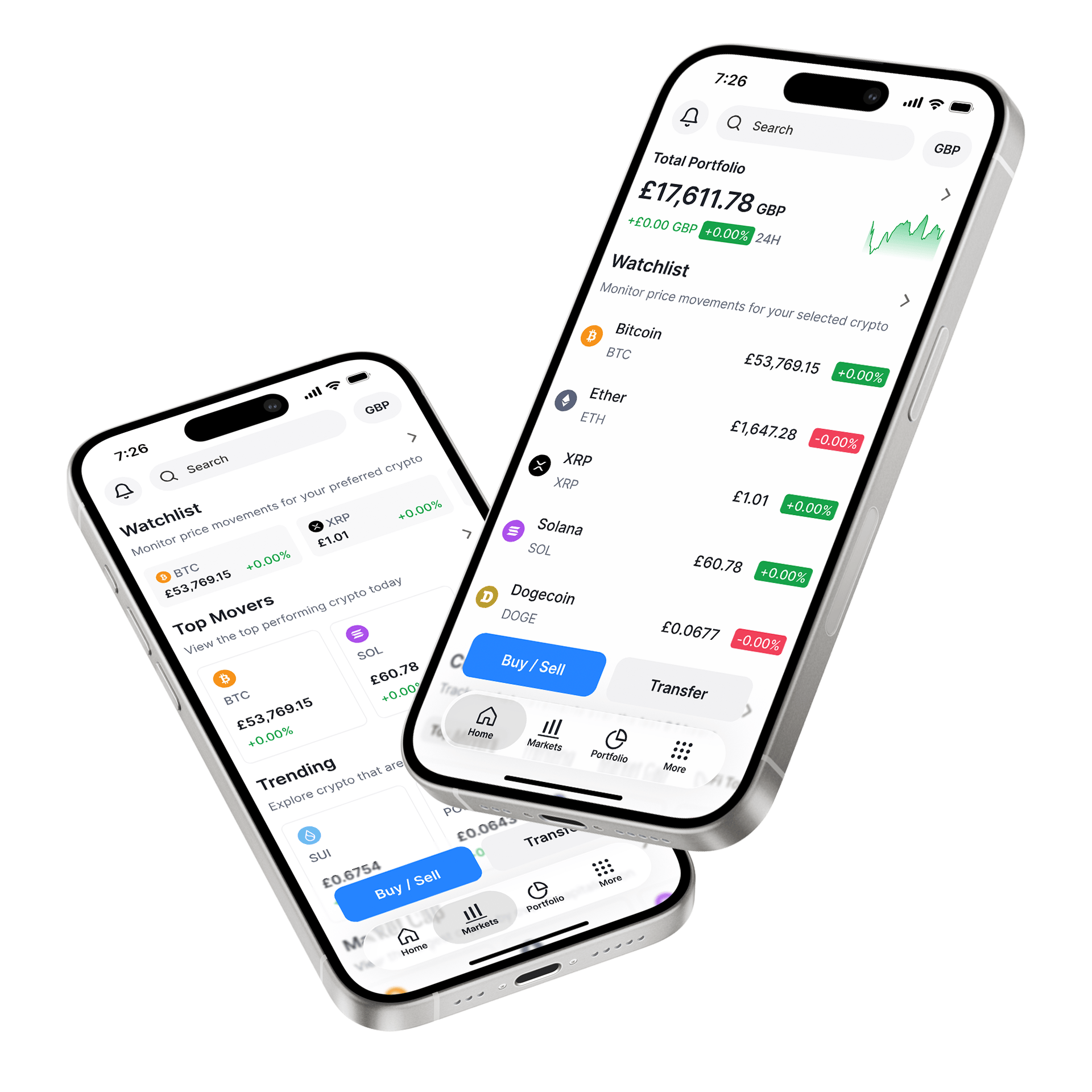
CoinJar App
Buy, sell and send your cryptocurrency with the CoinJar App. Track popular cryptocurrencies, swap one for another in a single step (fees apply), and store everything in your CoinJar Wallet.
Get the CoinJar appCoinJar App
Buy, sell and send your cryptocurrency with the CoinJar App. Track popular cryptocurrencies, swap one for another in a single step (fees apply), and store everything in your CoinJar Wallet.
Get the CoinJar appPast performance is not a reliable indicator of future results. Figures shown are for illustrative purposes only and are not actual market data.
Finder Awards Winner 2024
CoinJar was named the Best Exchange for Value in the UK as part of Finder's Crypto Trading Platform Awards - second year running! Check out our blog to see why Finder chose us over the competition.
See why Finder chose CoinJarFinder Awards Winner 2024
CoinJar was named the Best Exchange for Value in the UK as part of Finder's Crypto Trading Platform Awards - second year running! Check out our blog to see why Finder chose us over the competition.
See why Finder chose CoinJar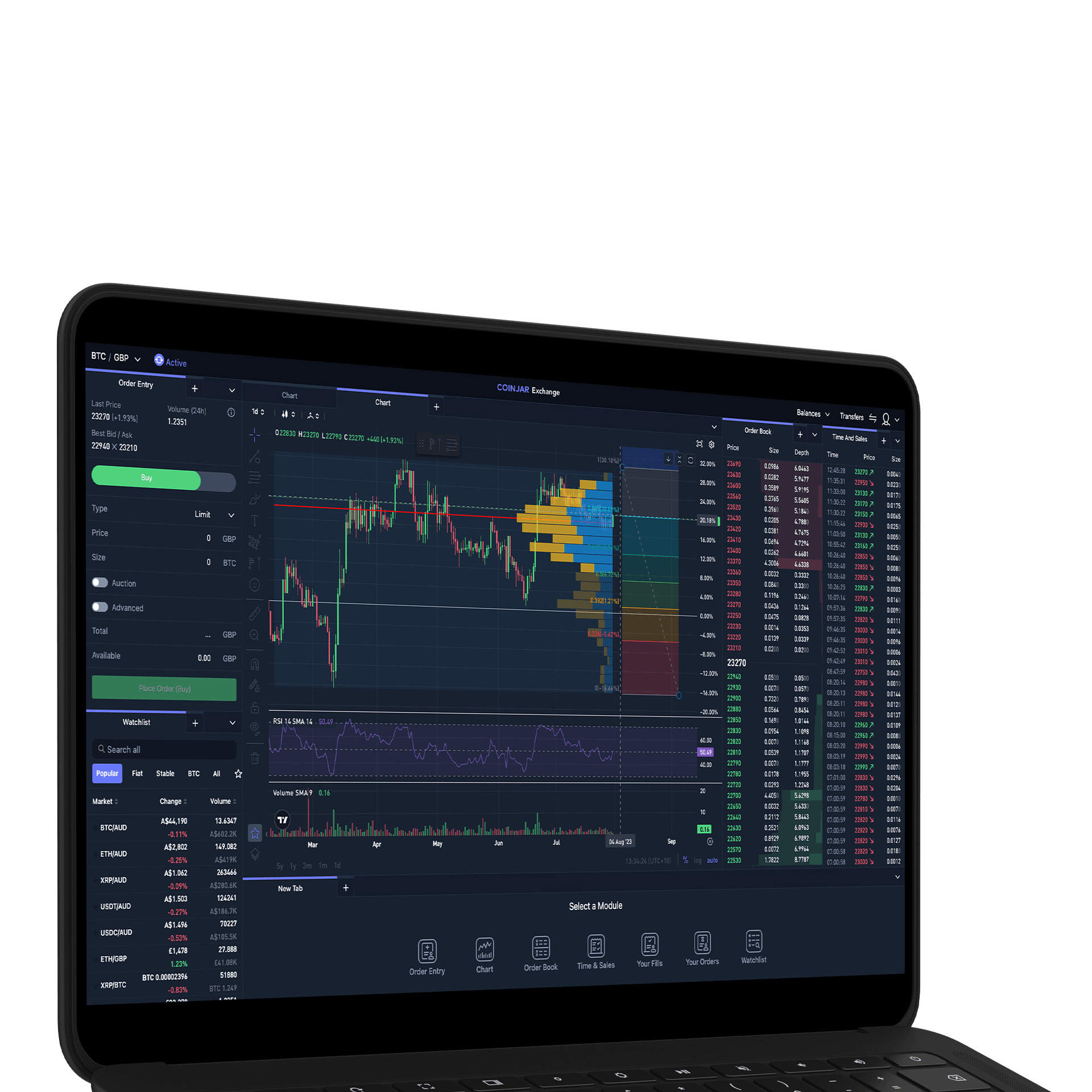
CoinJar Exchange
Trade with fees from 0-0.1%, using market, limit and stop-limit orders. Connect to TradingView to trade directly from your charts, or use CoinJar Exchange’s interface with advanced order types and charting, built for active traders, market makers and institutions.
Explore CoinJar ExchangeCoinJar Exchange
Trade with fees from 0-0.1%, using market, limit and stop-limit orders. Connect to TradingView to trade directly from your charts, or use CoinJar Exchange’s interface with advanced order types and charting, built for active traders, market makers and institutions.
Explore CoinJar Exchange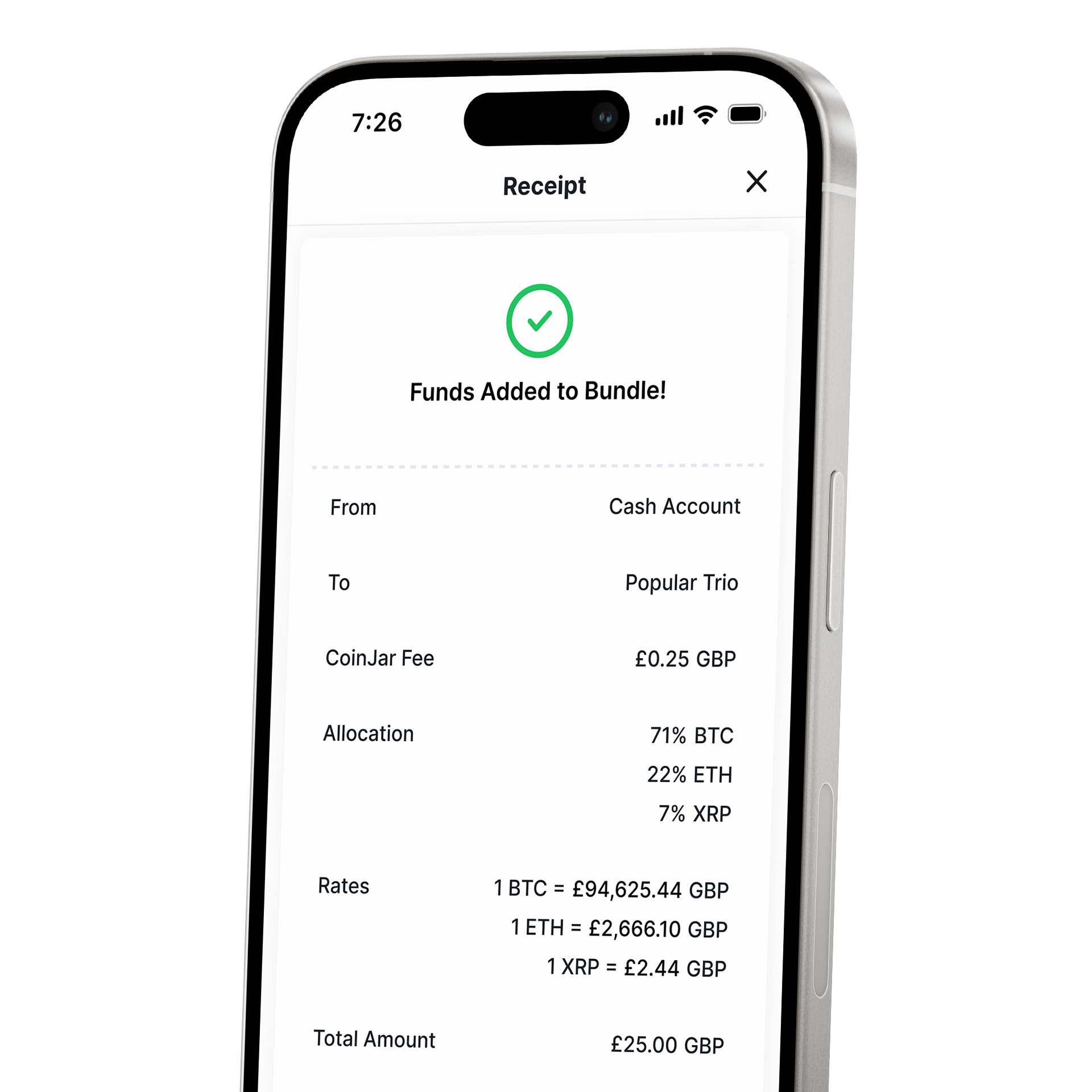
DCA with Recurring Buy
Schedule automatic purchases weekly, fortnightly or monthly to dollar-cost average into individual cryptocurrencies or CoinJar Bundles. Manage your investment amount and schedule, with the flexibility to adjust or pause purchases as your circumstances change.
DCA with Recurring BuyDCA with Recurring Buy
Schedule automatic purchases weekly, fortnightly or monthly to dollar-cost average into individual cryptocurrencies or CoinJar Bundles. Manage your investment amount and schedule, with the flexibility to adjust or pause purchases as your circumstances change.
DCA with Recurring Buy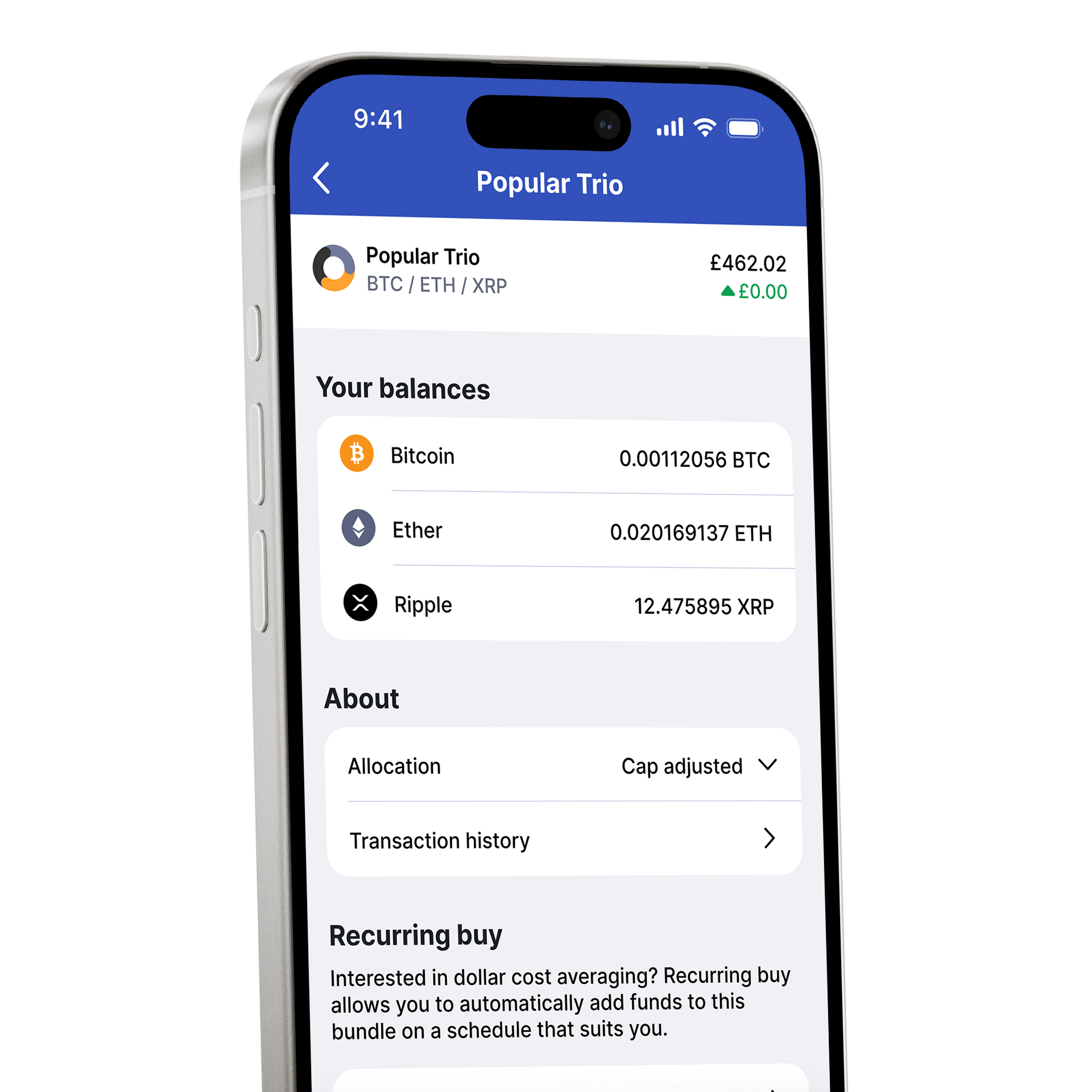
CoinJar Bundles
Pick your Bundle in the CoinJar app. Review each Bundle's asset allocation, add to your holdings and rebalance when required. Sell your Bundle or unbundle it to manage the assets individually.
Learn moreCoinJar Bundles
Pick your Bundle in the CoinJar app. Review each Bundle's asset allocation, add to your holdings and rebalance when required. Sell your Bundle or unbundle it to manage the assets individually.
Learn more
CoinJar OTC
For cryptocurrency trades above US$50,000, CoinJar OTC gives you a dedicated VIP team and a single representative to support you on the trade from quote to settlement.
Discover OTC ServicesCoinJar OTC
For cryptocurrency trades above US$50,000, CoinJar OTC gives you a dedicated VIP team and a single representative to support you on the trade from quote to settlement.
Discover OTC ServicesFrequently Asked Questions
Standard Risk Warning: The above article is not to be read as investment, legal or tax advice and it takes no account of particular personal or market circumstances; all readers should seek independent investment advice before investing in cryptocurrencies.
The article is provided for general information and educational purposes only, no responsibility or liability is accepted for any errors of fact or omission expressed therein. Past performance is not a reliable indicator of future results.
We use third party banking, safekeeping and payment providers, and the failure of any of these providers could also lead to a loss of your assets. We recommend you obtain financial advice before making a decision to use your credit card to purchase cryptoassets or to invest in cryptoassets. Capital Gains Tax may be payable on profits.
CoinJar's digital currency exchange services are operated in the UK by CoinJar UK Limited (company number 8905988), registered by the Financial Conduct Authority as a Cryptoasset Exchange Provider and Custodian Wallet Provider in the United Kingdom under the Money Laundering, Terrorist Financing and Transfer of Funds (Information on the Payer) Regulations 2017, as amended (Firm Reference No. 928767). In the UK, it's legal to buy, hold, and trade crypto, however cryptocurrency is not regulated in the UK.
It's vital to understand that once your money is in the crypto ecosystem, there are no rules to protect it, unlike with regular investments. You should not expect to be protected if something goes wrong. So, if you make any crypto-related investments, you're unlikely to have recourse to the Financial Services Compensation Scheme (FSCS) or the Financial Ombudsman Service (FOS) if something goes wrong.
The performance of most cryptocurrency can be highly volatile, with their value dropping as quickly as it can rise. Past performance is not an indication of future results. Remember: Don't invest unless you're prepared to lose all the money you invest. This is a high-risk investment and you should not expect to be protected if something goes wrong. Take 2 mins to learn more at: https://www.coinjar.com/uk/risk-summary.
UK residents are required to complete an assessment to show they understand the risks associated with what crypto/investment they are about to buy, in accordance with local legislation. Additionally, they must wait for a 24-hour "cooling off" period, before their account is active, due to local regulations. If you use a credit card to buy cryptocurrency, you would be putting borrowed money at a risk of loss.
We recommend you obtain financial advice before making a decision to use your credit card to purchase cryptoassets or to invest in cryptoassets.
Specific risks associated with DeFi tokens Decentralised Finance (or 'DeFi') tokens (e.g. UNI, AAVE) are crypto-assets linked to financial applications and protocols built on decentralised blockchain technology. DeFi tokens carry the following risks:
Smart contract risk: DeFi relies heavily on smart contracts. Even a minor coding error or oversight can lead to a contract being exploited, potentially resulting in significant losses for DeFi tokens.
Regulatory risk: DeFi operates in a decentralised manner, often without intermediaries or financial crime controls. Regulatory bodies across jurisdictions might introduce new regulations impacting the use, value, or legality of certain DeFi protocols or assets.
Rug-pulls / Exit scams: Some DeFi projects might be launched by anonymous or pseudonymous teams, increasing the risk of "rug pulls" where developers abandon the project and withdraw funds, leaving investors with worthless tokens.
Data/oracle risk: DeFi protocols often rely on external data sources or 'oracles. Manipulation or inaccuracies in these data sources can lead to unintended financial outcomes within the protocols. Protocol complexity: The complexity of some DeFi protocols can make it difficult for average users to fully understand the mechanisms and associated risks.
Specific risks associated with meme coins:
'Meme coins' (e.g. DOGE, SHIB, PEPE) are crypto-assets whose value is driven primarily by community interest and online trends.
Meme coins carry the following risks:
Volatility risk: Meme coins can have extreme price volatility, often experiencing rapid and unpredictable price fluctuations within short periods. The value of meme coins can be influenced by social media trends, celebrity endorsements, and other factors unrelated to traditional investment fundamentals. Lack of utility: Meme coins often lack intrinsic value or utility, being primarily driven by community interest, online trends, and speculative trading.
Market manipulation: Meme coins may be susceptible to increased risk of market manipulation including 'pump-and-dump' schemes, where the price is artificially inflated followed by a sudden crash.
Lack of transparency: Meme coins may have limited available information about their development teams, goals, and financials. This lack of transparency can make it challenging to assess the credibility and potential of a meme coin accurately.
Emotional investing: Meme coins often garner strong emotional reactions from investors, leading to impulsive decisions. Emotional trading activity can amplify losses.
Specific risks associated with stablecoins:
There is a risk that any particular stablecoin may not hold their value as against any fiat currency; or may not hold their value as against any other asset. Stablecoins carry the following risks:
Depegging events: Depegging events may occur with stablecoins that fail to maintain adequate controls and risk mitigants. A depegging event is when the value of the stablecoin no longer matches the value of the underlying asset. This could result in a loss of some or all of your investment.
Counterparty risk: Counterparty risk arises when an asset is backed by collateral, involving a third party maintaining the collateral, which introduces risk if the party becomes insolvent or fails to maintain it.
Redemption risk: Redemption risk refers to the possibility that an asset's ability to be redeemed for underlying collateral may not be as anticipated during market fluctuations or operational issues.
Collateral risk: Collateral risk refers to the possibility of the collateral's value declining or becoming volatile, potentially impacting the asset's stability, particularly when it is another crypto-asset.
Exchange rate fluctuations: Stablecoins, often denominated in US Dollars, expose investors to fluctuations in the USD:GBP exchange rate. Algorithmic risk: Algorithm risk refers to the possibility of an asset's stability being compromised due to unexpected failure or behaviour of the underlying algorithm, potentially leading to loss of value.
CoinJar does not endorse the content of, and cannot guarantee or verify the safety of any third-party websites. Visit these websites at your own risk.

CoinJar
Get the app.