
Buy Tether
USDTFigures shown refer to the past. Past performance is not a reliable indicator of future results. Pricing data is provided by CoinJar.
What is Tether?
Tether (USDT) is a stablecoin designed to hold a value of one US dollar, backed by reserves held by its issuer, Tether Limited. It is one of the earliest and largest stablecoin in circulation, and it settles more daily trading volume than any other cryptocurrency, including Bitcoin. UK customers typically hold USDT to move value between platforms quickly, to price trades against a dollar-denominated asset, or to step out of a volatile position without converting back to pounds.
How does Tether (USDT) operate?
USDT is a token that represents a claim on US dollar reserves rather than a blockchain of its own. Tether launched the token in 2014 under the name Realcoin, built on Bitcoin's Omni Layer, and renamed it Tether later that year. At a time when very few exchanges could hold reliable banking relationships, USDT became the workaround: a dollar-equivalent unit that could move between exchanges on a blockchain instead of through the banking system.
That original purpose still explains most of its use today. USDT gives traders a stable unit of account inside the cryptocurrency system, which is why it appears as the base pair for thousands of markets worldwide. If you want the broader picture of how price-stable tokens work, our guide to what a stablecoin is covers the main designs and how they differ.
How does USDT stay at one US dollar?
USDT holds its peg through issuance and redemption rather than any algorithm. Verified corporate customers can create new USDT by sending US dollars to Tether, or redeem USDT back for dollars, subject to a minimum redemption amount of US$100,000. When USDT trades slightly below a dollar on the open market, those customers can buy it cheaply and redeem it at par, and that arbitrage pulls the price back toward one dollar.
Retail customers do not redeem directly with Tether. You access the peg through exchanges and liquidity pools, which is why USDT can drift a fraction of a cent either side of a dollar during volatile periods before arbitrage closes the gap. There is no guarantee the peg holds, and it has broken before.
Why the pound sterling price of USDT moves
USDT tracks the US dollar, not the pound. One USDT is worth roughly one US dollar converted into GBP at the prevailing exchange rate, so the price you see in pounds moves with the currency pair even when the peg is holding perfectly. Holding USDT in the UK is effectively holding US dollar exposure, which carries foreign exchange risk against your home currency, and you can lose money in pound terms while the token remains at one dollar.
What backs USDT?
Tether reports its reserves each quarter in an attestation prepared by an external accounting firm, published on the Tether transparency page alongside the tokens on issue. The majority of those reserves sit in US Treasury bills and equivalent short-term instruments such as reverse repurchase agreements and money market funds. The remainder is spread across gold, Bitcoin, secured loans and other investments.
There is an important distinction to understand here. An attestation confirms balances at a single point in time under agreed procedures. A full financial audit examines the underlying controls and records across a reporting period. Tether historically relied on quarterly attestations alone. In August 2026 it announced that KPMG had completed a full audit of its 2025 financial statements. An audit covers a past period and does not guarantee the reserves today, so check the transparency page for the latest reports.. By comparison, USDC's issuer, Circle, is a listed US company that reports its reserves monthly, which is one reason some holders treat the two stablecoins differently despite both tracking the dollar.
What do people use USDT for?
- Trading. USDT is the most common base pair on global exchanges, so most altcoin prices are quoted against it.
- Moving value between platforms. Blockchain settlement runs continuously, including weekends and bank holidays, when Faster Payments and international transfers may not.
- Stepping out of volatility. Traders park funds in USDT during a drawdown instead of converting back to fiat currency, though in the UK that swap is still a taxable disposal.
- Cross-border payments. USDT is widely used for remittances in economies with limited banking access or high local currency inflation.
- Collateral in decentralised finance. Lending markets and liquidity pools use USDT as a dollar-denominated deposit.
Which blockchain network is USDT on?
Tether issues USDT on many networks, including Ethereum, Tron, Solana, Polygon, Avalanche and several Ethereum layer 2s. These are not interchangeable. USDT held on one network can only be sent to an address on that same network, and sending it to a platform that does not support that network is one of the most common ways people permanently lose stablecoins.
CoinJar supports USDT as an ERC-20 token on the Ethereum network. Before you deposit or withdraw, confirm the network on both sides of the transfer against our list of supported cryptocurrencies and networks, and read what happens if you send crypto to the wrong network so you know what is and is not recoverable.
What are the risks of holding USDT?
Stable does not mean risk free. USDT is a high-risk investment and you should be prepared to lose the money you put into it. The main risks are structural rather than price driven.
- No consumer protection. Cryptoassets are not covered by the Financial Services Compensation Scheme, and the Financial Ombudsman Service cannot consider complaints about cryptoasset activities.
- Issuer risk. Tether Limited is a private company, not a bank. USDT is not a bank deposit and carries no deposit guarantee.
- Transparency. Quarterly attestations are less frequent and less rigorous than a completed annual audit, and reserves include assets such as Bitcoin, gold and secured loans that can fall in value.
- Depeg risk. USDT has broken its peg before, most notably on 12 May 2022, during the collapse of Terra, it briefly fell to around US0.95 on some exchanges before recovering towards US$1 later that day.
- Redemption terms. Tether's terms of service allow it to delay or suspend redemptions in certain circumstances, including illiquidity of its reserves.
- Freezing. Tether can freeze USDT at the smart contract level and regularly does so at the request of law enforcement agencies. Tokens in a frozen address cannot be moved.
- No yield. Holding USDT pays you nothing by default, while the reserves behind it earn interest for the issuer.
The Bank for International Settlements has published useful neutral analysis of these structural questions in its bulletin on stablecoin growth and policy challenges. Our UK investor education page sets out the risks of cryptoasset investing in more detail.
Is USDT regulated in the UK?
Tether is issued offshore and is not authorised by the FCA. UK regulation currently applies to the businesses you deal with rather than to the token itself: cryptoasset firms must be registered with the FCA under the Money Laundering Regulations, and that registration covers anti-money laundering compliance rather than the safety or performance of any cryptoasset. CoinJar UK Limited is registered with the FCA as a cryptoasset exchange provider and custodian wallet provider, firm reference number 928767.
The UK is phasing in a broader regime that will require issuers of qualifying stablecoins based in the UK to be authorised, with the Bank of England overseeing any stablecoin judged systemic. USDT is issued outside the UK and does not sit inside that authorisation regime, so it remains an unregulated cryptoasset from a UK holder's point of view.
How is USDT taxed in the UK?
HMRC treats cryptoassets, including stablecoins, as chargeable assets for capital gains tax rather than as foreign currency. Exchanging one token for another is a disposal, so swapping Bitcoin for USDT is a taxable event and you calculate the gain or loss in pounds sterling at the time of the trade, even though no GBP changed hands. Selling USDT for pounds is also a disposal, and because USDT is dollar-denominated, a gain or loss can arise purely from movements in the GBP/USD rate.
HMRC sets out the rules in its guidance on paying tax when you sell cryptoassets, and our guide to crypto tax in the UK explains how it applies in practice. This is general information, not tax advice, so speak to a qualified accountant about your own position.
Why Tether matters
USDT is the settlement layer most of the cryptocurrency market runs on. Its size and liquidity are what make it useful, and its offshore, privately issued structure is what makes it worth understanding before you hold a large balance. Treat it as a dollar-denominated instrument with a specific issuer behind it, keep an eye on the reserve reporting, and always confirm the network before you move it.
Buy Tether in GBP With FPS or a Card
Buy Tether with an eligible debit or credit card, or transfer GBP to CoinJar for free via Faster Payments and buy using your GBP balance. Buy, sell and hold crypto with CoinJar, trusted by over 800,000 investors worldwide.


How to buy Tether with CoinJar
Get started with CoinJar by following these steps.
Create your account
Sign up and securely verify your identity.
Fund your account
Pay with an eligible card (fees apply), or deposit GBP via Faster Payments bank transfer.
Complete checks and start investing
Answer a few questions about your experience and wait out a 24-hour cooling-off period, as required for new UK customers. And then access crypto assets through CoinJar.
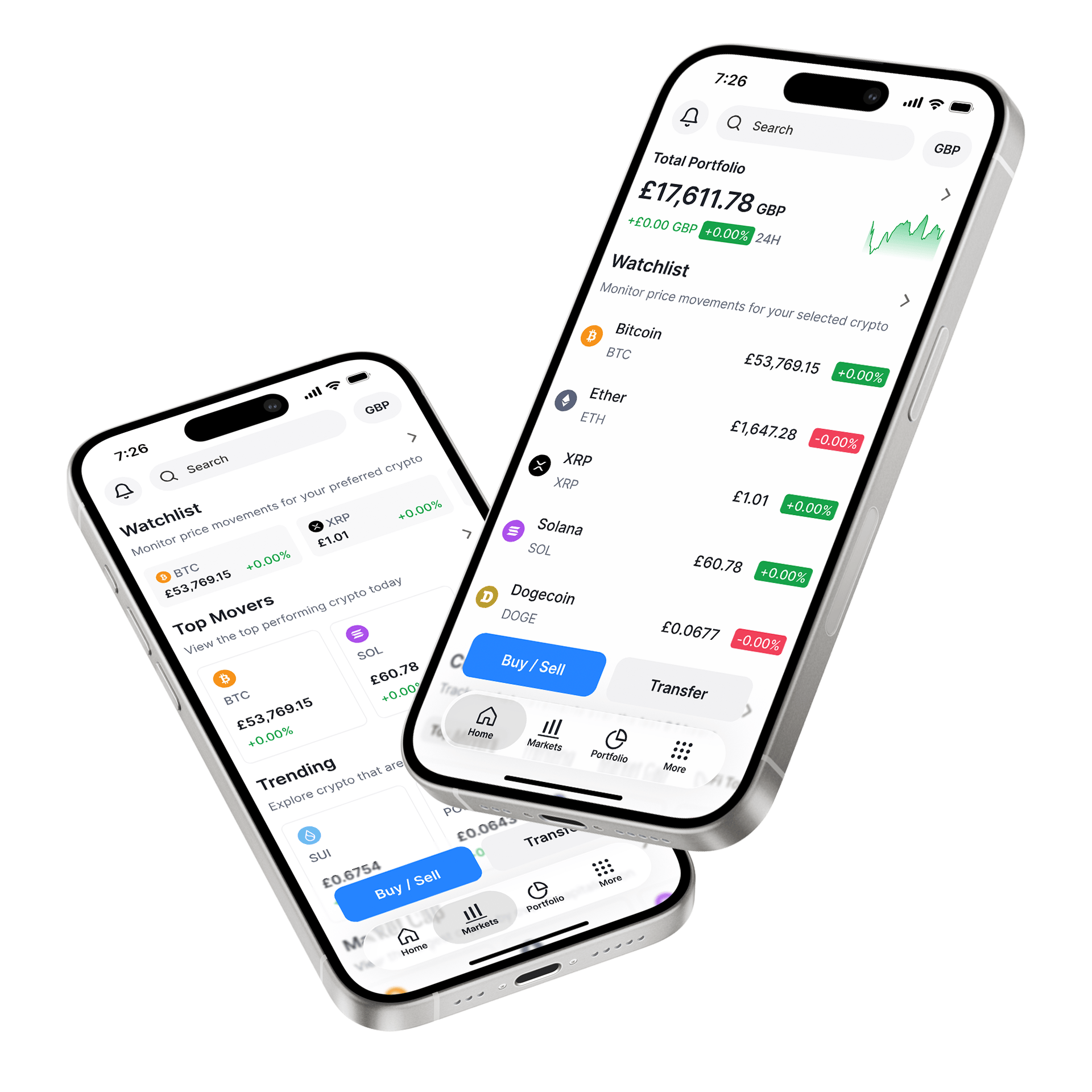
CoinJar App
Buy, sell and send your cryptocurrency with the CoinJar App. Track popular cryptocurrencies, swap one for another in a single step (fees apply), and store everything in your CoinJar Wallet.
Get the CoinJar appCoinJar App
Buy, sell and send your cryptocurrency with the CoinJar App. Track popular cryptocurrencies, swap one for another in a single step (fees apply), and store everything in your CoinJar Wallet.
Get the CoinJar appPast performance is not a reliable indicator of future results. Figures shown are for illustrative purposes only and are not actual market data.
Finder Awards Winner 2024
CoinJar was named the Best Exchange for Value in the UK as part of Finder's Crypto Trading Platform Awards - second year running! Check out our blog to see why Finder chose us over the competition.
See why Finder chose CoinJarFinder Awards Winner 2024
CoinJar was named the Best Exchange for Value in the UK as part of Finder's Crypto Trading Platform Awards - second year running! Check out our blog to see why Finder chose us over the competition.
See why Finder chose CoinJar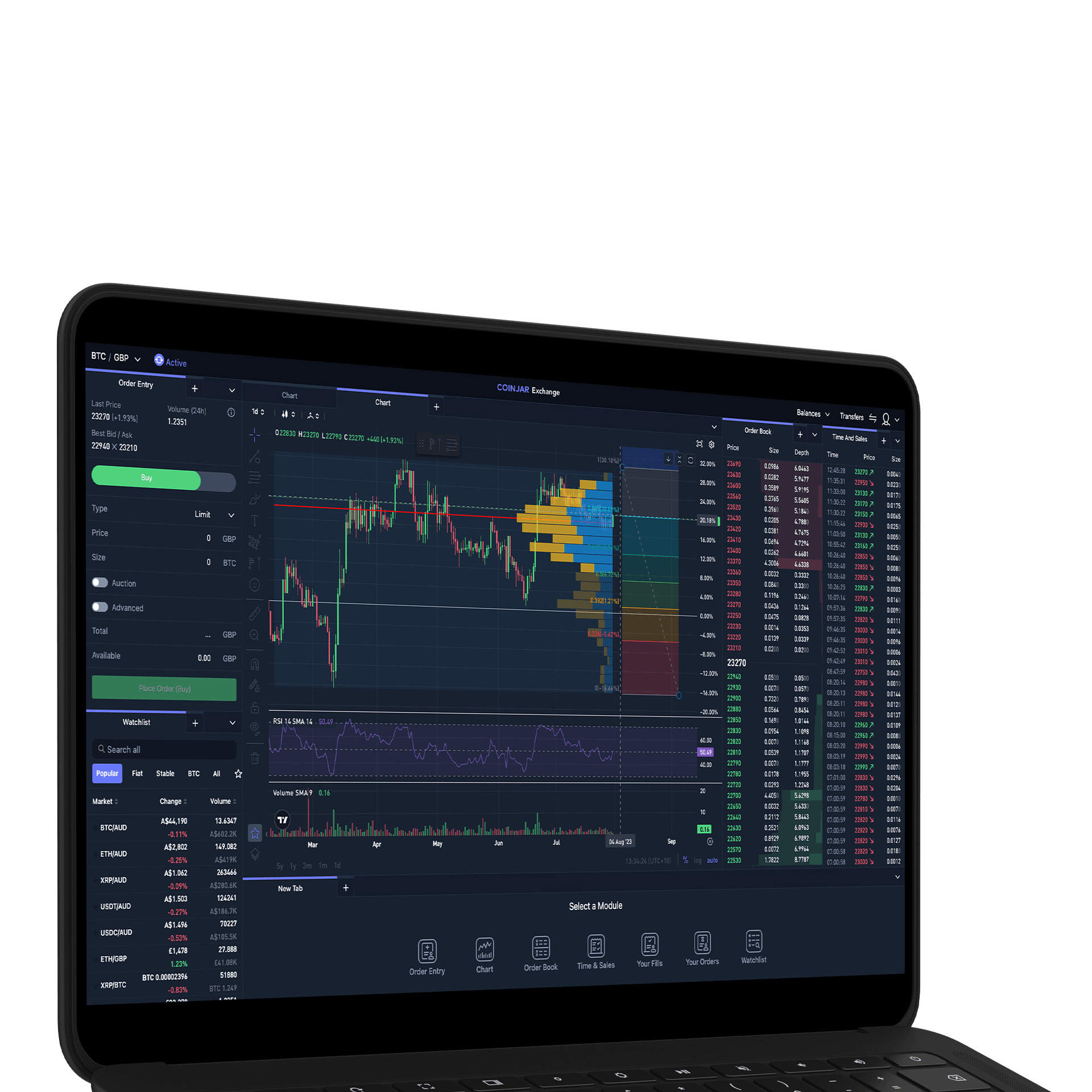
CoinJar Exchange
Trade with fees from 0-0.1%, using market, limit and stop-limit orders. Connect to TradingView to trade directly from your charts, or use CoinJar Exchange’s interface with advanced order types and charting, built for active traders, market makers and institutions.
Explore CoinJar ExchangeCoinJar Exchange
Trade with fees from 0-0.1%, using market, limit and stop-limit orders. Connect to TradingView to trade directly from your charts, or use CoinJar Exchange’s interface with advanced order types and charting, built for active traders, market makers and institutions.
Explore CoinJar Exchange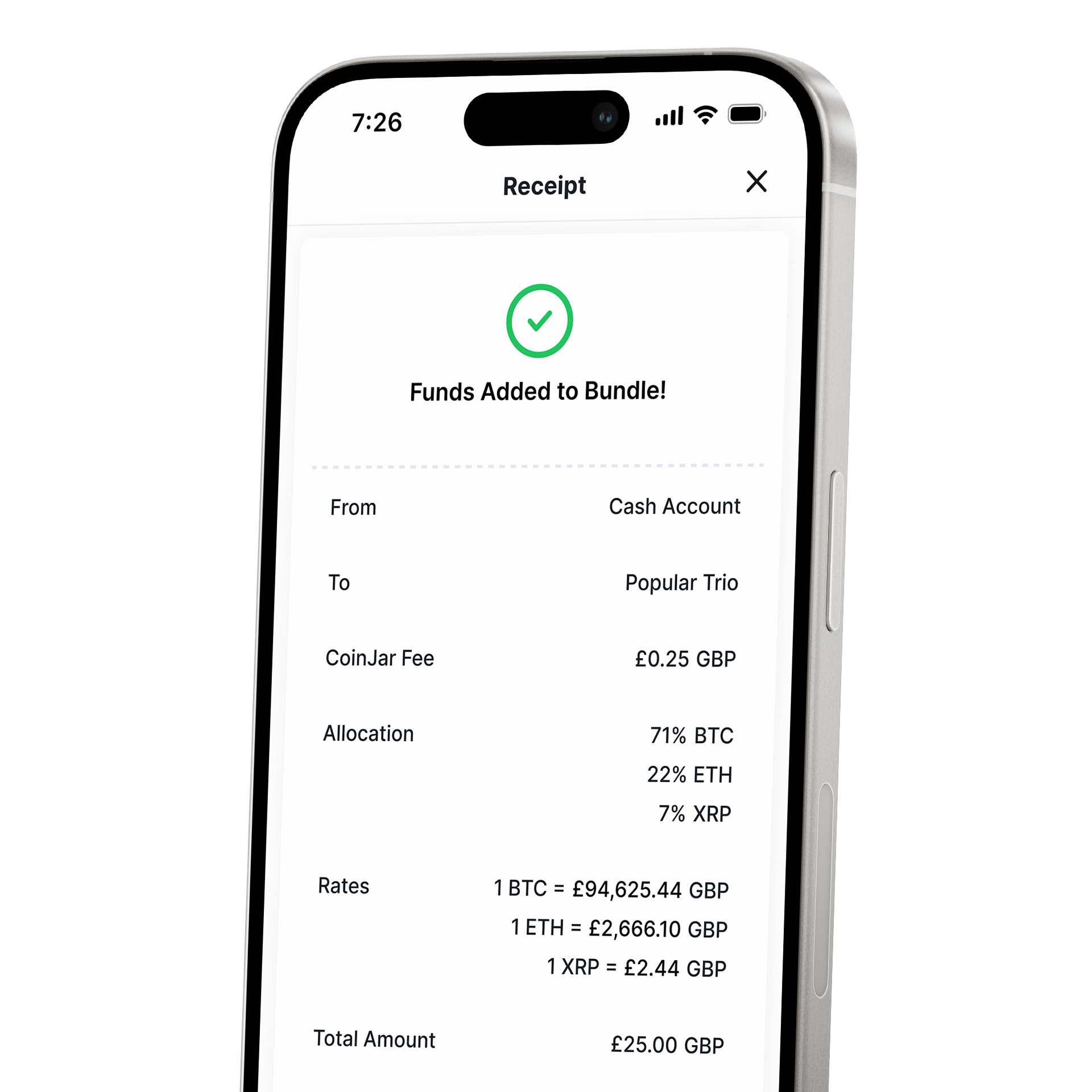
DCA with Recurring Buy
Schedule automatic purchases weekly, fortnightly or monthly to dollar-cost average into individual cryptocurrencies or CoinJar Bundles. Manage your investment amount and schedule, with the flexibility to adjust or pause purchases as your circumstances change.
DCA with Recurring BuyDCA with Recurring Buy
Schedule automatic purchases weekly, fortnightly or monthly to dollar-cost average into individual cryptocurrencies or CoinJar Bundles. Manage your investment amount and schedule, with the flexibility to adjust or pause purchases as your circumstances change.
DCA with Recurring Buy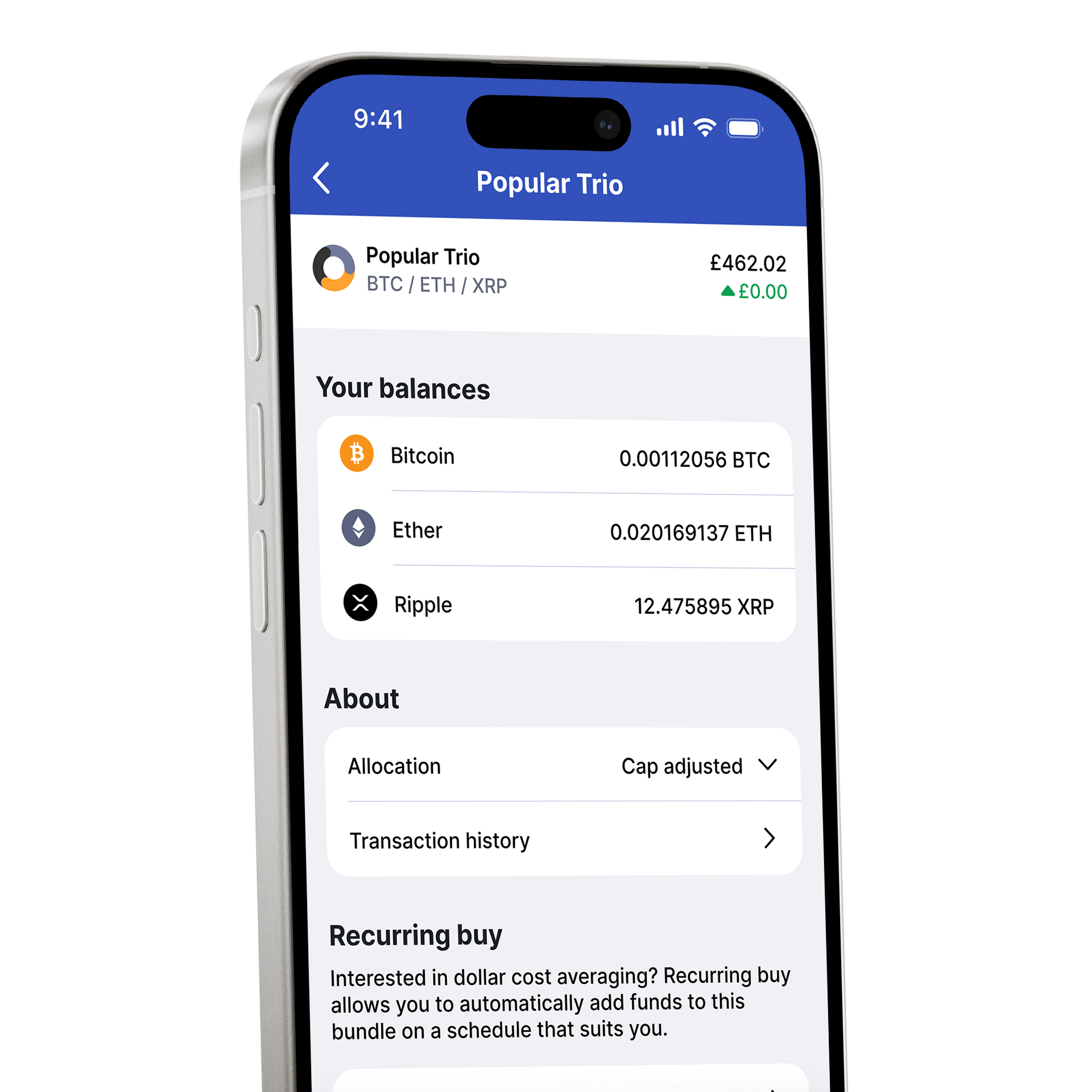
CoinJar Bundles
Pick your Bundle in the CoinJar app. Review each Bundle's asset allocation, add to your holdings and rebalance when required. Sell your Bundle or unbundle it to manage the assets individually.
Learn moreCoinJar Bundles
Pick your Bundle in the CoinJar app. Review each Bundle's asset allocation, add to your holdings and rebalance when required. Sell your Bundle or unbundle it to manage the assets individually.
Learn more
CoinJar OTC
For cryptocurrency trades above US$50,000, CoinJar OTC gives you a dedicated VIP team and a single representative to support you on the trade from quote to settlement.
Discover OTC ServicesCoinJar OTC
For cryptocurrency trades above US$50,000, CoinJar OTC gives you a dedicated VIP team and a single representative to support you on the trade from quote to settlement.
Discover OTC ServicesFrequently Asked Questions
Standard Risk Warning: The above article is not to be read as investment, legal or tax advice and it takes no account of particular personal or market circumstances; all readers should seek independent investment advice before investing in cryptocurrencies.
The article is provided for general information and educational purposes only, no responsibility or liability is accepted for any errors of fact or omission expressed therein. Past performance is not a reliable indicator of future results.
We use third party banking, safekeeping and payment providers, and the failure of any of these providers could also lead to a loss of your assets. We recommend you obtain financial advice before making a decision to use your credit card to purchase cryptoassets or to invest in cryptoassets. Capital Gains Tax may be payable on profits.
CoinJar's digital currency exchange services are operated in the UK by CoinJar UK Limited (company number 8905988), registered by the Financial Conduct Authority as a Cryptoasset Exchange Provider and Custodian Wallet Provider in the United Kingdom under the Money Laundering, Terrorist Financing and Transfer of Funds (Information on the Payer) Regulations 2017, as amended (Firm Reference No. 928767). In the UK, it's legal to buy, hold, and trade crypto, however cryptocurrency is not regulated in the UK.
It's vital to understand that once your money is in the crypto ecosystem, there are no rules to protect it, unlike with regular investments. You should not expect to be protected if something goes wrong. So, if you make any crypto-related investments, you're unlikely to have recourse to the Financial Services Compensation Scheme (FSCS) or the Financial Ombudsman Service (FOS) if something goes wrong.
The performance of most cryptocurrency can be highly volatile, with their value dropping as quickly as it can rise. Past performance is not an indication of future results. Remember: Don't invest unless you're prepared to lose all the money you invest. This is a high-risk investment and you should not expect to be protected if something goes wrong. Take 2 mins to learn more at: https://www.coinjar.com/uk/risk-summary.
UK residents are required to complete an assessment to show they understand the risks associated with what crypto/investment they are about to buy, in accordance with local legislation. Additionally, they must wait for a 24-hour "cooling off" period, before their account is active, due to local regulations. If you use a credit card to buy cryptocurrency, you would be putting borrowed money at a risk of loss.
We recommend you obtain financial advice before making a decision to use your credit card to purchase cryptoassets or to invest in cryptoassets.
Specific risks associated with DeFi tokens Decentralised Finance (or 'DeFi') tokens (e.g. UNI, AAVE) are crypto-assets linked to financial applications and protocols built on decentralised blockchain technology. DeFi tokens carry the following risks:
Smart contract risk: DeFi relies heavily on smart contracts. Even a minor coding error or oversight can lead to a contract being exploited, potentially resulting in significant losses for DeFi tokens.
Regulatory risk: DeFi operates in a decentralised manner, often without intermediaries or financial crime controls. Regulatory bodies across jurisdictions might introduce new regulations impacting the use, value, or legality of certain DeFi protocols or assets.
Rug-pulls / Exit scams: Some DeFi projects might be launched by anonymous or pseudonymous teams, increasing the risk of "rug pulls" where developers abandon the project and withdraw funds, leaving investors with worthless tokens.
Data/oracle risk: DeFi protocols often rely on external data sources or 'oracles. Manipulation or inaccuracies in these data sources can lead to unintended financial outcomes within the protocols. Protocol complexity: The complexity of some DeFi protocols can make it difficult for average users to fully understand the mechanisms and associated risks.
Specific risks associated with meme coins:
'Meme coins' (e.g. DOGE, SHIB, PEPE) are crypto-assets whose value is driven primarily by community interest and online trends.
Meme coins carry the following risks:
Volatility risk: Meme coins can have extreme price volatility, often experiencing rapid and unpredictable price fluctuations within short periods. The value of meme coins can be influenced by social media trends, celebrity endorsements, and other factors unrelated to traditional investment fundamentals. Lack of utility: Meme coins often lack intrinsic value or utility, being primarily driven by community interest, online trends, and speculative trading.
Market manipulation: Meme coins may be susceptible to increased risk of market manipulation including 'pump-and-dump' schemes, where the price is artificially inflated followed by a sudden crash.
Lack of transparency: Meme coins may have limited available information about their development teams, goals, and financials. This lack of transparency can make it challenging to assess the credibility and potential of a meme coin accurately.
Emotional investing: Meme coins often garner strong emotional reactions from investors, leading to impulsive decisions. Emotional trading activity can amplify losses.
Specific risks associated with stablecoins:
There is a risk that any particular stablecoin may not hold their value as against any fiat currency; or may not hold their value as against any other asset. Stablecoins carry the following risks:
Depegging events: Depegging events may occur with stablecoins that fail to maintain adequate controls and risk mitigants. A depegging event is when the value of the stablecoin no longer matches the value of the underlying asset. This could result in a loss of some or all of your investment.
Counterparty risk: Counterparty risk arises when an asset is backed by collateral, involving a third party maintaining the collateral, which introduces risk if the party becomes insolvent or fails to maintain it.
Redemption risk: Redemption risk refers to the possibility that an asset's ability to be redeemed for underlying collateral may not be as anticipated during market fluctuations or operational issues.
Collateral risk: Collateral risk refers to the possibility of the collateral's value declining or becoming volatile, potentially impacting the asset's stability, particularly when it is another crypto-asset.
Exchange rate fluctuations: Stablecoins, often denominated in US Dollars, expose investors to fluctuations in the USD:GBP exchange rate. Algorithmic risk: Algorithm risk refers to the possibility of an asset's stability being compromised due to unexpected failure or behaviour of the underlying algorithm, potentially leading to loss of value.
CoinJar does not endorse the content of, and cannot guarantee or verify the safety of any third-party websites. Visit these websites at your own risk.

CoinJar
Get the app.