
Buy ApeCoin
APEPast performance is not indicative of future results. All prices are sourced from CoinJar Indices.
What is ApeCoin?
ApeCoin is the token of the Bored Ape ecosystem. It launched in March 2022, was airdropped to holders of Bored Ape Yacht Club and Mutant Ape Yacht Club NFTs, and was presented as the property of a decentralised community rather than of Yuga Labs, the company that created those collections.
That framing no longer applies. In 2025, APE holders voted to abolish their own governance, dissolve the organisation that held the treasury and hand both to a company controlled by Yuga Labs. Understanding that vote is the whole of understanding APE today. Our guide to NFTs covers the collections APE grew out of, and our guide to Ethereum covers the network it lives on.
Where APE came from
Yuga Labs launched Bored Ape Yacht Club in 2021, and it became the most commercially successful NFT collection of that cycle. APE followed in March 2022, distributed by airdrop to Bored Ape and Mutant Ape holders and allocated in large blocks to Yuga Labs, the founders, launch contributors and a treasury.
The token was deliberately structured at arm's length. A Cayman Islands entity, the APE Foundation, held the treasury and administered decisions, an elected Special Council oversaw it, and holders voted on Ape Improvement Proposals. Yuga Labs said repeatedly that ApeCoin was separate from the company.
The separation was real on paper and thin in practice. Yuga held a large allocation, the token's uses were almost entirely Yuga projects, and the ecosystem's direction followed Yuga's roadmap.
The vote that ended the DAO
In June 2025, Yuga Labs chief executive Greg Solano put a proposal to the DAO titled Sunsetting the DAO and Launching ApeCo. He described the existing governance as sluggish, noisy and often unserious governance theatre that had funded vanity proposals.
The proposal, AIP-596, did what its title said. It wound down the ApeCoin DAO, ended token holder voting, closed the working groups and the proposal process, and transferred the Foundation's treasury, contracts and domains to ApeCo, a new Cayman entity controlled by Yuga Labs. It set aside an allocation for the staking contract and another for legal and transition costs.
It passed in late June 2025 with more than ninety nine per cent of votes cast in favour. Turnout in these votes is always a fraction of the supply, but the result was not close and it was not contested.
What that leaves is unusual and worth stating without euphemism. APE is a token whose holders voted to give up governance. There is no DAO, no proposal process and no vote attached to the token. Decisions are made by a private company, and the treasury that was assembled to fund an ecosystem is now on that company's balance sheet.
What is APE, technically?
It is an ERC-20 token on Ethereum. Transfers on Ethereum are Ethereum transactions with fees paid in ETH. APE is also the native asset of ApeChain, and bridged representations exist elsewhere.
One billion tokens exist and no more can be created. The supply was fixed at launch and the contract has no issuance mechanism.
The unlock schedule is finished. Allocations to Yuga Labs, the founders, launch contributors and the treasury released over forty eight months from launch, and that period ended in March 2026. There are no scheduled unlocks left, which removes a source of supply pressure that dominated the token's first four years.
It carries no governance rights. That changed in 2025 and has not been reinstated.
It carries no claim on anything. APE does not entitle you to Yuga Labs revenue, ApeChain revenue, treasury assets, a Bored Ape, or any part of the intellectual property.
ApeChain, and what it actually is
ApeChain launched in October 2024 as the ecosystem's own network, built with Arbitrum Orbit and using APE as its gas token. Every transaction burns APE, and ApeCo has committed to matching the amount burned, which is the closest thing the token has to a structural demand mechanism.
The architecture deserves a clear look, because "layer three built on Arbitrum" sounds more finished than it is. The independent research site L2BEAT classifies ApeChain as an optimium rather than a rollup, meaning transaction data is not published in full to a public chain but held by an external data availability committee. It does not meet even the first stage of L2BEAT's decentralisation framework. A small multisig can upgrade the critical contracts immediately, with no delay and no window for users to exit. The sequencer that orders transactions is centralised, and only whitelisted parties can propose or challenge the network's state, so the fraud proof system is not open to the public. A change to how data is published was scheduled during 2026, which would improve one part of that picture.
None of this is unusual for a young application chain. It does mean that assets held on ApeChain sit behind meaningfully weaker guarantees than assets held on Ethereum, and anyone bridging should understand that before they do it. Our guide to blockchain layers explains how these networks relate to the chains beneath them.
Otherside: announcement and delivery
Otherside is the virtual world the ecosystem has been building since 2022. Its land sale in April and May of that year, selling Otherdeed NFTs, was so heavily contested that it congested Ethereum and pushed transaction fees to extraordinary levels for hours. It remains one of the most cited examples of an NFT mint imposing costs on everybody else using the network.
Four years on, Otherside exists in pieces. A public alpha area opened in mid 2025, another area followed later that year, a development kit has been released for people building on it, and a resource system has been signposted for Otherdeed holders. What has not arrived is the finished, persistently populated world the land sale was priced against.
That is the pattern to watch across this ecosystem. Things do get built, slowly and partially, and consistently later and smaller than the announcement implied.
Where Yuga Labs is now
Yuga has narrowed sharply. It divested the Meebits collection in early 2025 and transferred the CryptoPunks intellectual property to a non-profit foundation in May 2025, keeping Bored Ape Yacht Club, Otherside and ApeChain. The company has also reduced headcount.
For a holder, the read is double edged. A narrower company is more focused on the things APE is actually attached to. It is also a smaller company, with fewer properties to drive attention toward a token whose value depends almost entirely on attention.
What are the risks of holding APE?
No governance and no claim. Holders voted away their rights in 2025. APE now confers no vote, no revenue share and no ownership of anything. Its value rests on demand for the token itself.
Dependence on one private company. Yuga Labs, through ApeCo, controls the treasury, the roadmap and the brands. There is no mechanism for holders to influence, review or reverse its decisions.
Treasury discretion. A very large pool of APE sits with ApeCo and can be spent, sold or allocated at its discretion. Supply reaching the market is now a corporate decision rather than a published schedule.
Concentration. The original allocation gave large blocks to the company, the founders and early contributors. A small number of parties can move the market.
NFT market exposure. APE is a bet on the Bored Ape brand and the wider NFT market, both far below their 2021 and 2022 peaks. Attention in this category has proven to rotate rather than compound.
ApeChain risk. The chain that gives APE its clearest use has centralised upgrade control, a centralised sequencer, permissioned state validation and off chain data availability. It is early stage infrastructure.
Delivery risk. Otherside has been in development for years and is not finished. The ecosystem's history is one of large announcements and partial delivery.
Utility that is optional. Nothing forces anyone to acquire APE. It is one way to pay for things inside a specific ecosystem rather than a requirement for a large recurring activity.
Legal and regulatory uncertainty. APE has been the subject of United States class action litigation alleging it was an unregistered security. The classification of tokens tied to a company's products remains unsettled in several jurisdictions.
Volatility. APE is not a stablecoin. Its value moves sharply and can fall substantially.
No consumer protection. Cryptocurrency held with CoinJar is not covered by the Financial Claims Scheme. If the value of APE falls, there is no compensation scheme to make you whole.
Buying APE with Australian dollars on CoinJar
CoinJar has operated since 2013 and lists APE against Australian dollars, so you can buy, sell and hold it without converting through another cryptocurrency first. Current charges are on our fees page, and live Australian dollar rates are on our cryptocurrency prices page.
CoinJar Australia Pty Ltd is registered with AUSTRAC as a digital currency exchange provider, Registration Number DCE100749118-001. That registration covers anti money laundering and counter terrorism financing obligations. It is not an endorsement of CoinJar's products and it is not approval of any cryptocurrency listed on the platform.
How is APE taxed in Australia?
The ATO generally treats APE as a capital gains tax asset. A CGT event can occur when you sell it for Australian dollars, exchange it for another cryptocurrency, spend it or give it away.
The ATO sets out its approach on its crypto asset investments page. Our guide to crypto tax in Australia provides a practical overview. This is general information, not tax advice. Consider speaking to a registered tax agent about your circumstances.
Fund Your Account Your Way
Buy ApeCoin instantly using Visa or Mastercard, or deposit Australian dollars via bank transfer, PayID or PayPal. Buy, sell and convert between supported cryptocurrencies through your CoinJar account.


How to buy ApeCoin with CoinJar
Start your portfolio with Australia's longest-running crypto exchange with these simple steps.
Sign up to CoinJar
Get the CoinJar app on iOS or Android, create an account and verify your ID.
Deposit funds
Deposit AUD fee-free via PayID, Osko or bank transfer. You can also use PayPal or pay instantly by card.
Buy your first crypto
Buy ApeCoin and other popular cryptos using cash or credit card in minutes.




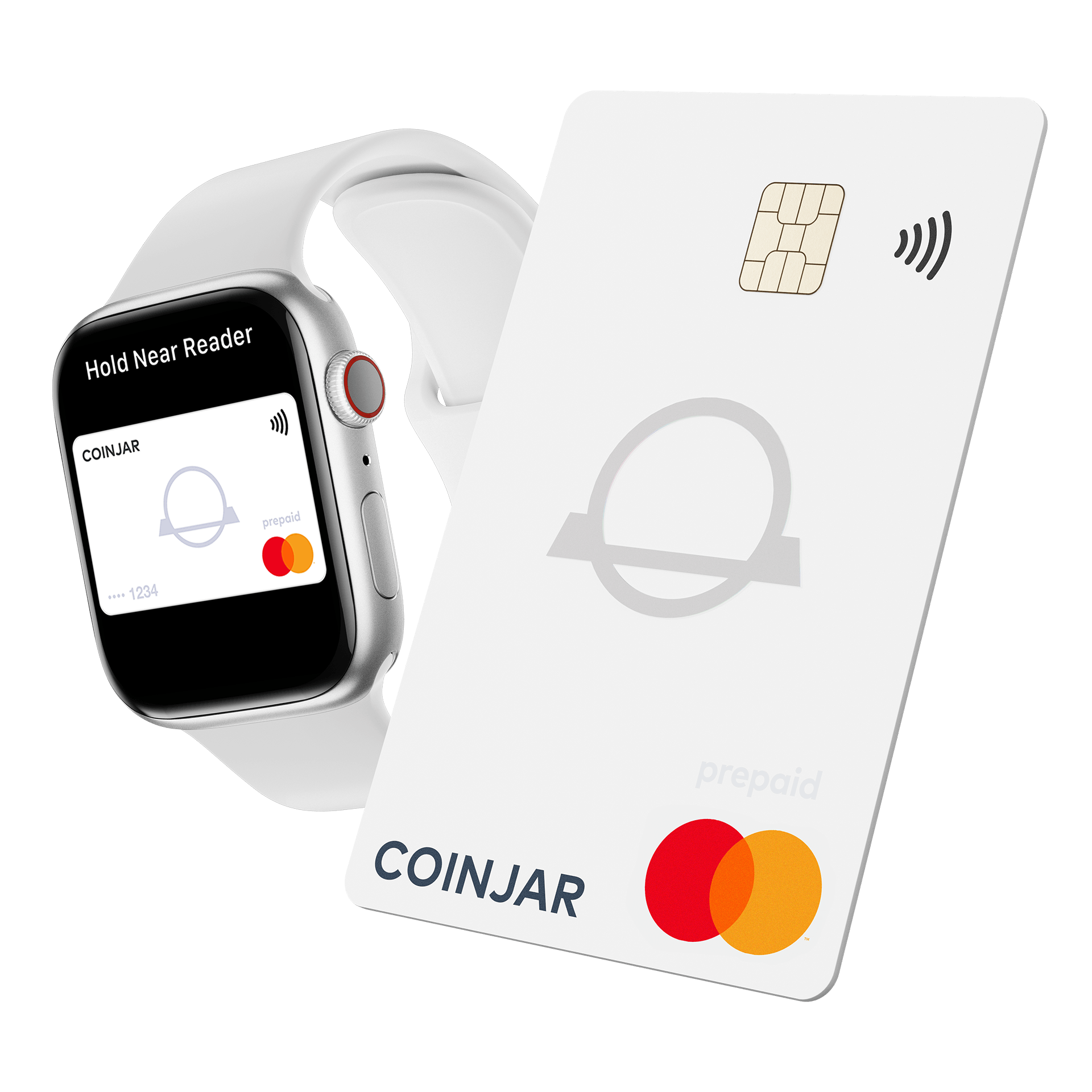
CoinJar Card
Use CoinJar Card, powered by Mastercard, for purchases online and in store, including through Apple Pay and Google Pay. No setup or monthly fee. A 1% purchase fee applies and is returned as CoinJar Rewards points, with one point earned per $1 spent. Available in Australia only.
Get your CoinJar Card for freeCoinJar Card
Use CoinJar Card, powered by Mastercard, for purchases online and in store, including through Apple Pay and Google Pay. No setup or monthly fee. A 1% purchase fee applies and is returned as CoinJar Rewards points, with one point earned per $1 spent. Available in Australia only.
Get your CoinJar Card for free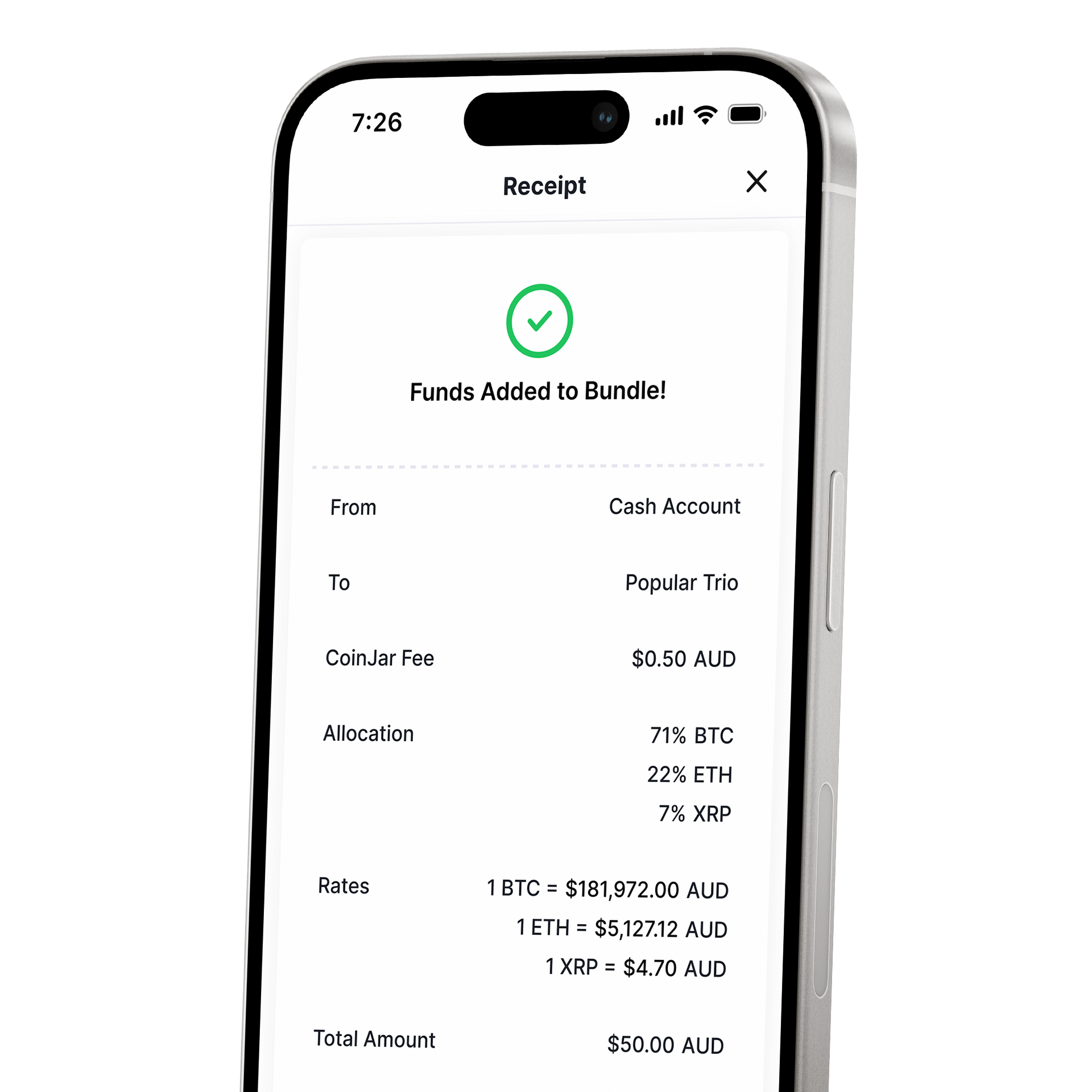
CoinJar Recurring Buy
Schedule automatic purchases weekly, fortnightly or monthly to dollar-cost average into individual cryptocurrencies or CoinJar Bundles. Manage your investment amount and schedule, with the flexibility to adjust or pause purchases as your circumstances change.
DCA with Recurring BuyCoinJar Recurring Buy
Schedule automatic purchases weekly, fortnightly or monthly to dollar-cost average into individual cryptocurrencies or CoinJar Bundles. Manage your investment amount and schedule, with the flexibility to adjust or pause purchases as your circumstances change.
DCA with Recurring Buy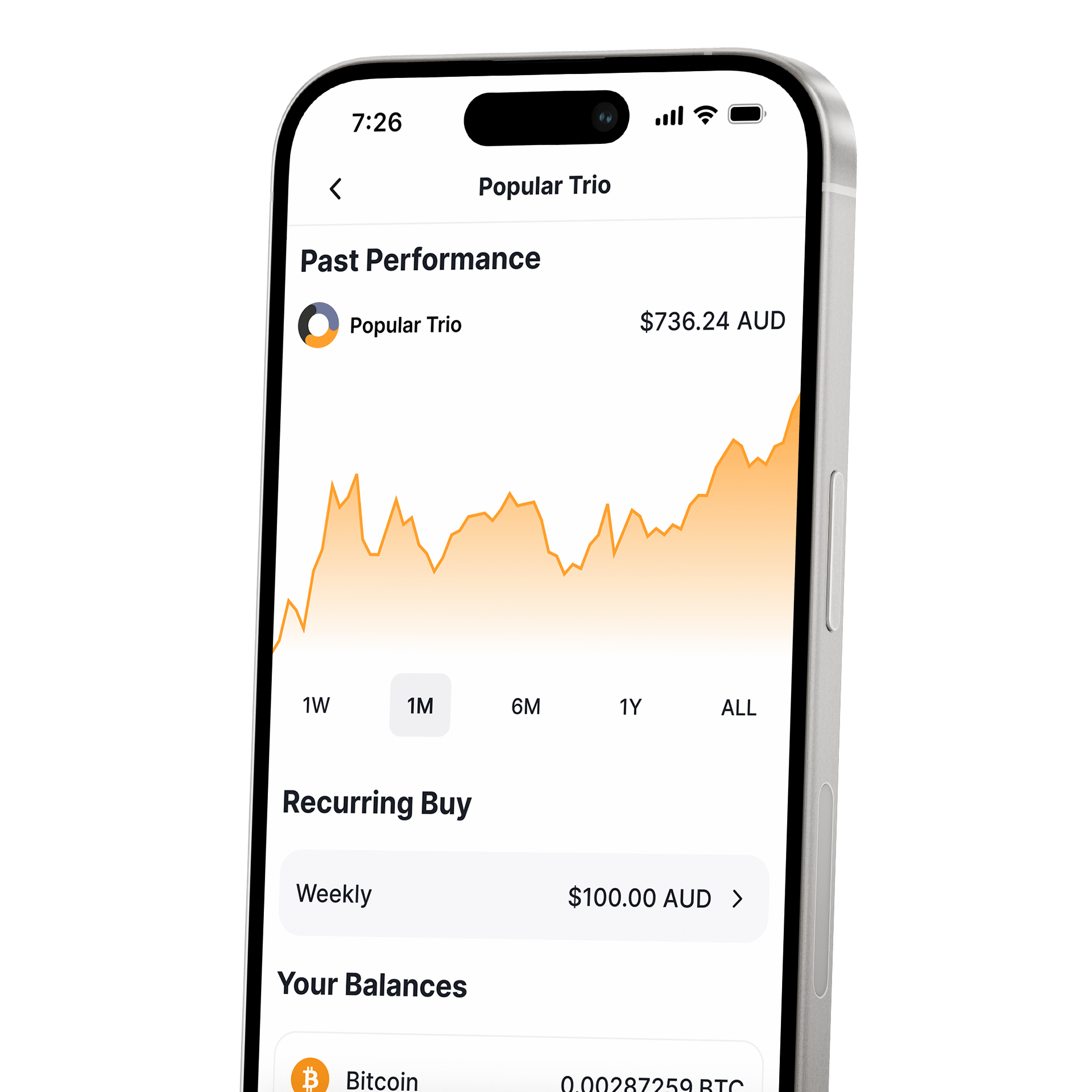
CoinJar Bundles
Pick your Bundle in the CoinJar app. Review each Bundle’s asset allocation, add to your holdings and rebalance when required. Sell your Bundle or unbundle it to manage the assets individually.
Learn moreCoinJar Bundles
Pick your Bundle in the CoinJar app. Review each Bundle’s asset allocation, add to your holdings and rebalance when required. Sell your Bundle or unbundle it to manage the assets individually.
Learn more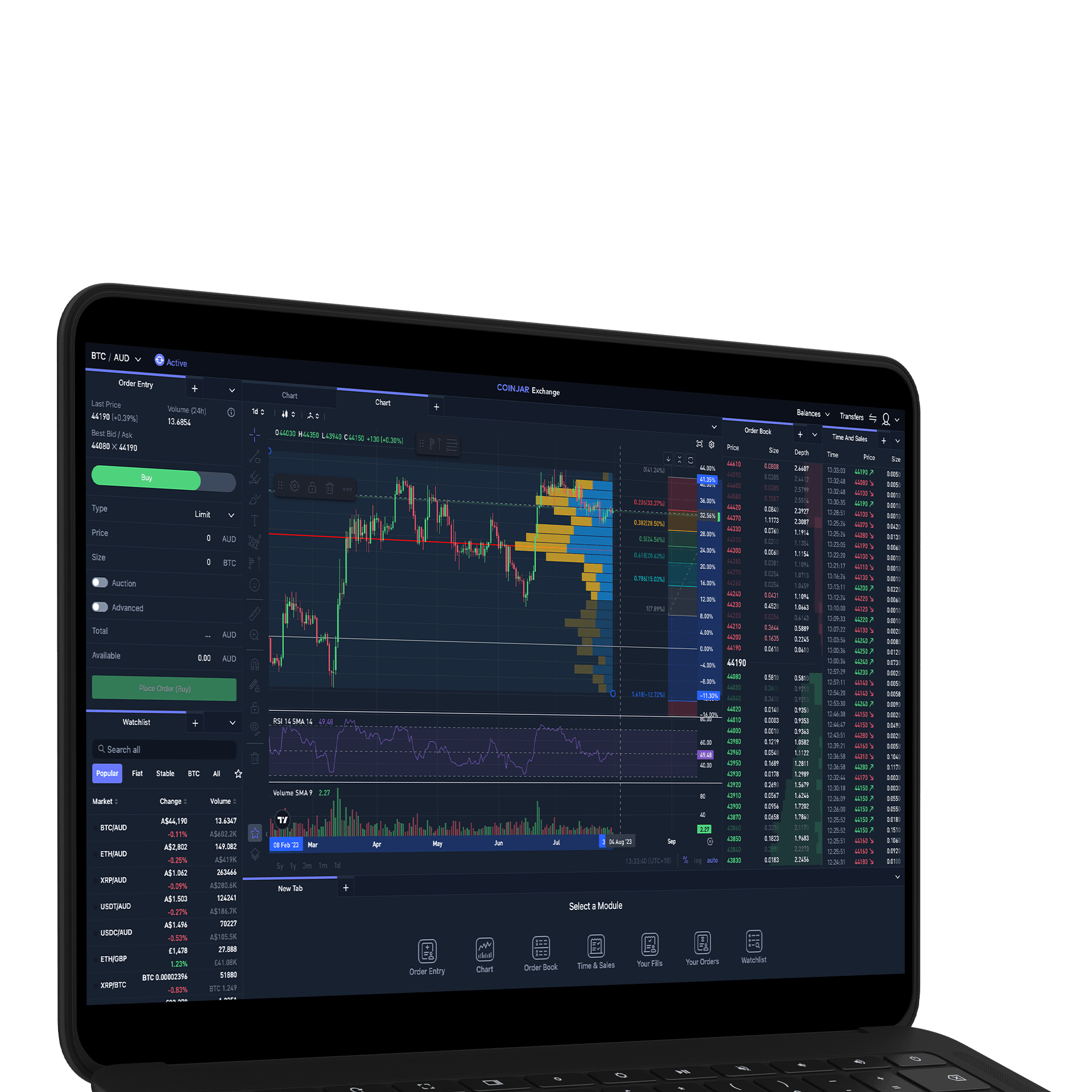
CoinJar Exchange
Trade with fees from 0-0.1%, using market, limit and stop-limit orders. Connect to TradingView to trade directly from your charts, or use CoinJar Exchange’s high-performance interface, built for active traders, market makers and institutions.
Explore CoinJar ExchangeCoinJar Exchange
Trade with fees from 0-0.1%, using market, limit and stop-limit orders. Connect to TradingView to trade directly from your charts, or use CoinJar Exchange’s high-performance interface, built for active traders, market makers and institutions.
Explore CoinJar Exchange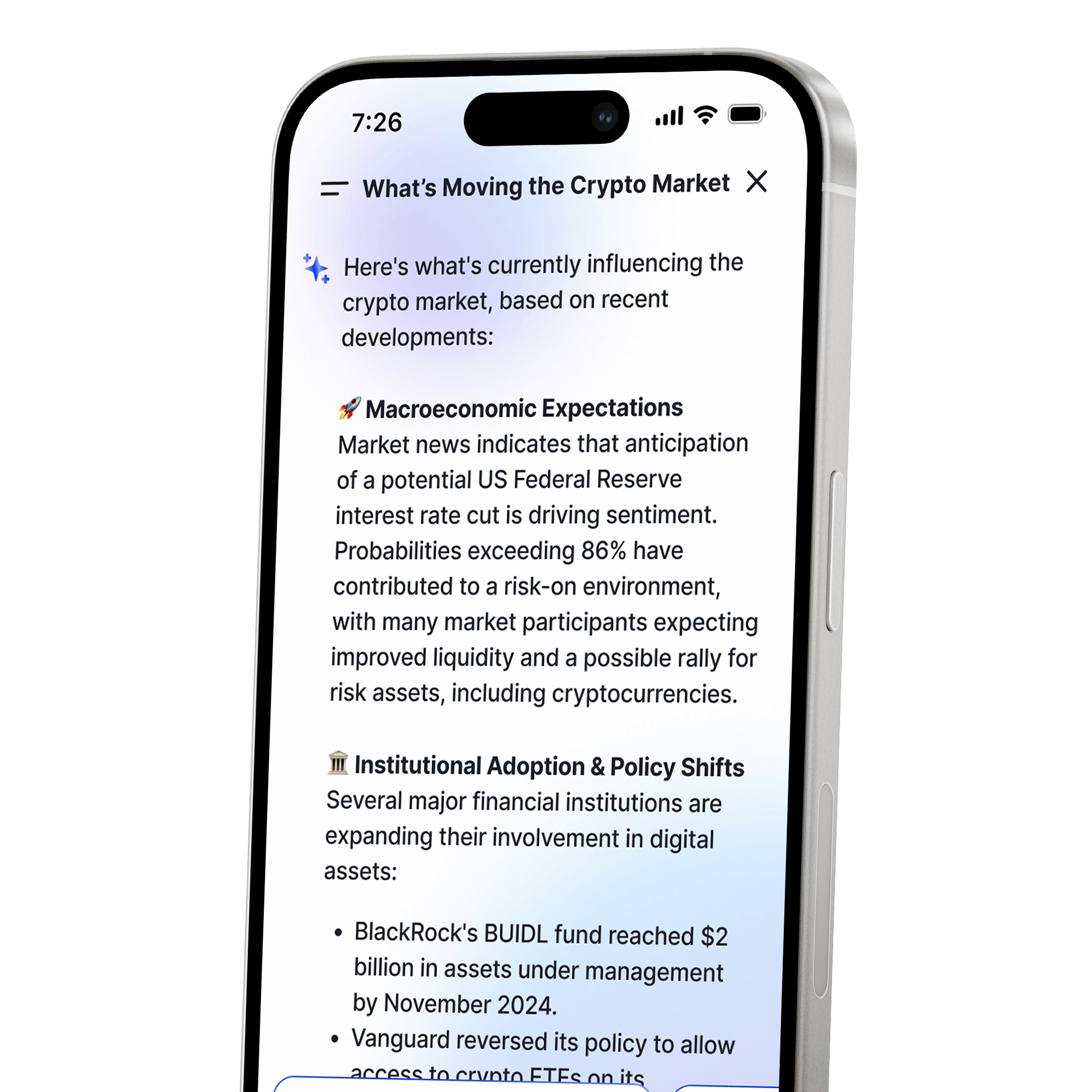
CoinJar AI
Access information about your holdings and the wider cryptocurrency market through CoinJar AI. Ask questions about portfolio changes, market developments or individual cryptocurrencies, with responses informed by your CoinJar holdings.
Learn moreCoinJar AI
Access information about your holdings and the wider cryptocurrency market through CoinJar AI. Ask questions about portfolio changes, market developments or individual cryptocurrencies, with responses informed by your CoinJar holdings.
Learn more
CoinJar OTC
For cryptocurrency trades above $50,000, CoinJar’s OTC desk provides personalised service and access to globally sourced liquidity. Work directly with a dedicated team to arrange and execute your purchase or sale. Discover OTC Services
Learn moreCoinJar OTC
For cryptocurrency trades above $50,000, CoinJar’s OTC desk provides personalised service and access to globally sourced liquidity. Work directly with a dedicated team to arrange and execute your purchase or sale. Discover OTC Services
Learn moreCoinJar does not endorse the content of, and cannot guarantee or verify the safety of any third-party websites. Visit these websites at your own risk.

CoinJar
Get the app.