Buy Cartesi
CTSIPast performance is not indicative of future results. All prices are sourced from CoinJar Indices.
What is Cartesi?
Cartesi is infrastructure for building blockchain applications in ordinary software, rather than in the narrow programming environment most smart contracts are written for. It lets a developer run a full Linux system inside a verifiable execution environment, with the result settled on Ethereum. CTSI is the network's token.
That is a developer tools proposition rather than a consumer one, and it is worth being clear about that up front. Buying CTSI is a bet on whether developers choose this approach to building applications. Our guide to blockchain layers explains where rollups sit, and our guide to Ethereum covers the network Cartesi settles to.
What problem is Cartesi trying to solve?
Smart contracts on Ethereum run in the Ethereum Virtual Machine, which is deliberately constrained. Computation is expensive, memory is limited, and developers write in Solidity using libraries built specifically for that environment. Anything computationally heavy, such as a physics engine, a machine learning model or a complex simulation, is impractical to run there.
Cartesi's answer is the Cartesi Machine: a deterministic virtual machine based on the open RISC-V instruction set, capable of booting Linux. Because it runs a real operating system, developers can use mainstream languages and libraries rather than rewriting everything for the blockchain.
The computation happens off chain, where it is cheap. What goes on chain is the claim about the result, plus a mechanism for anyone to challenge that claim if it is wrong.
How Cartesi Rollups work
Rather than putting every application on one shared chain, Cartesi gives each application its own rollup with its own dedicated compute.
Inputs are submitted to contracts on Ethereum, so the ordering of transactions inherits Ethereum's censorship resistance. A node runs those inputs through the Cartesi Machine and produces the new state, along with any outputs such as token withdrawals. Those outputs are validated on chain before they can be executed.
Cartesi Rollups are modular in how they are deployed. An application can run as a layer two settling directly to Ethereum, as a layer three on top of another rollup, or as a sovereign rollup, and it can use different data availability arrangements. That flexibility is a feature for builders, but it also means "an application built on Cartesi" does not describe a single, uniform set of security properties. Each deployment has to be assessed on its own configuration.
Fraud proofs and what Stage 2 means
An optimistic rollup assumes the results submitted on chain are correct unless someone proves otherwise. That only works if the proving mechanism actually functions and anyone is allowed to use it. Many rollups in the market still rely on a permissioned set of proposers or a security council that can override outcomes.
Cartesi's dispute system is called Permissionless Refereed Tournaments, and a second generation algorithm known as Dave has been developed to improve on it, particularly against attackers who try to win by causing delays. Participants post a bond to raise a dispute, which is what makes spamming challenges expensive.
The project tested this in public with the Honeypot: an application on mainnet holding a bounty that anyone is invited to steal by breaking the system. The independent research site L2BEAT, which classifies rollups by how much trust they require, has recognised the Honeypot as a Stage 2 deployment, its highest maturity classification and one held by very few projects.
The honest reading of that includes the failure. A stress test in late 2025 exposed a liveness bug in the dispute implementation, which was fixed before the system returned. Finding a bug in a live bounty environment is the intended outcome of a honeypot, and it is also a reminder that this technology is new.
What is CTSI actually used for?
Staking. CTSI is staked in a proof of stake contract on Ethereum. Stakers can run a node or delegate to a staking pool, and rewards are distributed by block production, weighted by share of total stake. Our guide to crypto staking explains the general model. Governance. Staked CTSI carries voting rights on proposals, including grant funding for ecosystem work. Voting is run through Snapshot, so it signals holder preference rather than executing changes automatically. Security bonds and bounties. CTSI is used for bonds in the dispute system and for bounties such as the Honeypot. Validator incentives. A validator marketplace, in which holders delegate to validators serving specific applications, has long been part of the design and is not fully in place.
There is one thing CTSI is not, and it is the most common misunderstanding about the asset. It is not the gas token that users of Cartesi applications must pay. Applications settle to Ethereum and pay Ethereum fees, and a developer building on Cartesi is not required to use CTSI in their product. That gap between network usage and token demand is central to assessing CTSI.
Supply, the reserve, and where rewards come from
CTSI's supply was fixed at one billion tokens when the project launched, with a large portion set aside in a reserve to fund staking rewards over time.
This means staking rewards are paid out of a pre-allocated pool rather than created by ongoing inflation, and that pool is finite. Once it is exhausted, continuing to pay rewards at any level would require a decision to change the token's economics, which is a governance and foundation matter rather than something guaranteed by the protocol. Anyone holding CTSI for staking rewards should treat the current arrangement as a policy that can change, not a permanent feature.
Governance and who actually steers the project
Direction comes from a combination of the Cartesi Foundation, which holds treasury funds and publishes transparency reports on its spending, and community voting by stakers on proposals and grants.
This is a common structure and it has a common weakness. Snapshot voting is off chain and non binding in a technical sense, participation in token votes is usually concentrated among a small number of large holders, and the foundation retains significant practical influence through funding decisions. It is more accountable than a purely private company and considerably less so than the on chain governance of a large network.
Which network is your CTSI on?
CTSI is natively an ERC-20 token on Ethereum. Bridged representations also exist on other networks, including BNB Chain, and those are separate tokens tracking the same asset rather than the same token in two places.
Addresses are not interchangeable across networks. Sending CTSI to an address on a network the receiving wallet or exchange does not support is one of the most common ways people permanently lose tokens. Before any transfer, confirm which network the destination expects and make sure the network you are sending from matches. Our guide to sending crypto on the wrong network covers what can and cannot be recovered.
What are the risks of holding CTSI?
Adoption risk. The technology is capable, but the case for the token depends on applications being built and used at scale. Developer infrastructure projects can be technically excellent and still fail to attract builders. Weak link between usage and token value. Applications built with Cartesi are not required to use CTSI, so growth in usage does not automatically translate into demand for the token. Reward sustainability. Staking rewards come from a finite reserve. What happens when it runs down is a governance decision, not a protocol guarantee. Competition. Rollup frameworks, app specific chain toolkits and general purpose high performance networks all compete for the same developers, and several are far better funded and more widely used. Technical risk. Fraud proof systems, bridges and rollup contracts are complex and relatively new. A liveness bug has already been found in the dispute system in live conditions, and further bugs are possible. Governance concentration. Voting power follows stake, and foundation funding decisions carry substantial weight. Liquidity and volatility. CTSI is a small capitalisation altcoin. It can move sharply, and market depth can be thin when conditions turn. No consumer protection. Crypto assets are high risk, your capital is at risk, and CTSI is not a financial product covered by the Australian Government's Financial Claims Scheme. You should be prepared to lose the money you put in.
Buying CTSI with Australian dollars on CoinJar
CoinJar has operated since 2013 and lists CTSI against Australian dollars, so you can buy, sell and hold it without converting through another cryptocurrency first. Current charges are on our fees page, and live Australian dollar rates are on our cryptocurrency prices page.
CoinJar Australia Pty Ltd is registered with AUSTRAC as a digital currency exchange provider, Registration Number DCE100749118-001.
How is CTSI taxed in Australia?
The ATO generally treats CTSI as a capital gains tax asset. A CGT event can occur when you sell it for Australian dollars, exchange it for another cryptocurrency, spend it or give it away.
The ATO explains these rules on its crypto asset investments guidance page. Our guide to crypto tax in Australia provides a practical overview. This is general information, not tax advice. Consider speaking to a registered tax agent about your circumstances.
Fund Your Account Your Way
Buy Cartesi instantly using Visa or Mastercard, or deposit Australian dollars via bank transfer, PayID or PayPal. Buy, sell and convert between supported cryptocurrencies through your CoinJar account.
How to buy Cartesi with CoinJar
Start your portfolio with Australia's longest-running crypto exchange with these simple steps.
Sign up to CoinJar
Get the CoinJar app on iOS or Android, create an account and verify your ID.
Deposit funds
Deposit AUD fee-free via PayID, Osko or bank transfer. You can also use PayPal or pay instantly by card.
Buy your first crypto
Buy Cartesi and other popular cryptos using cash or credit card in minutes.

CoinJar Card
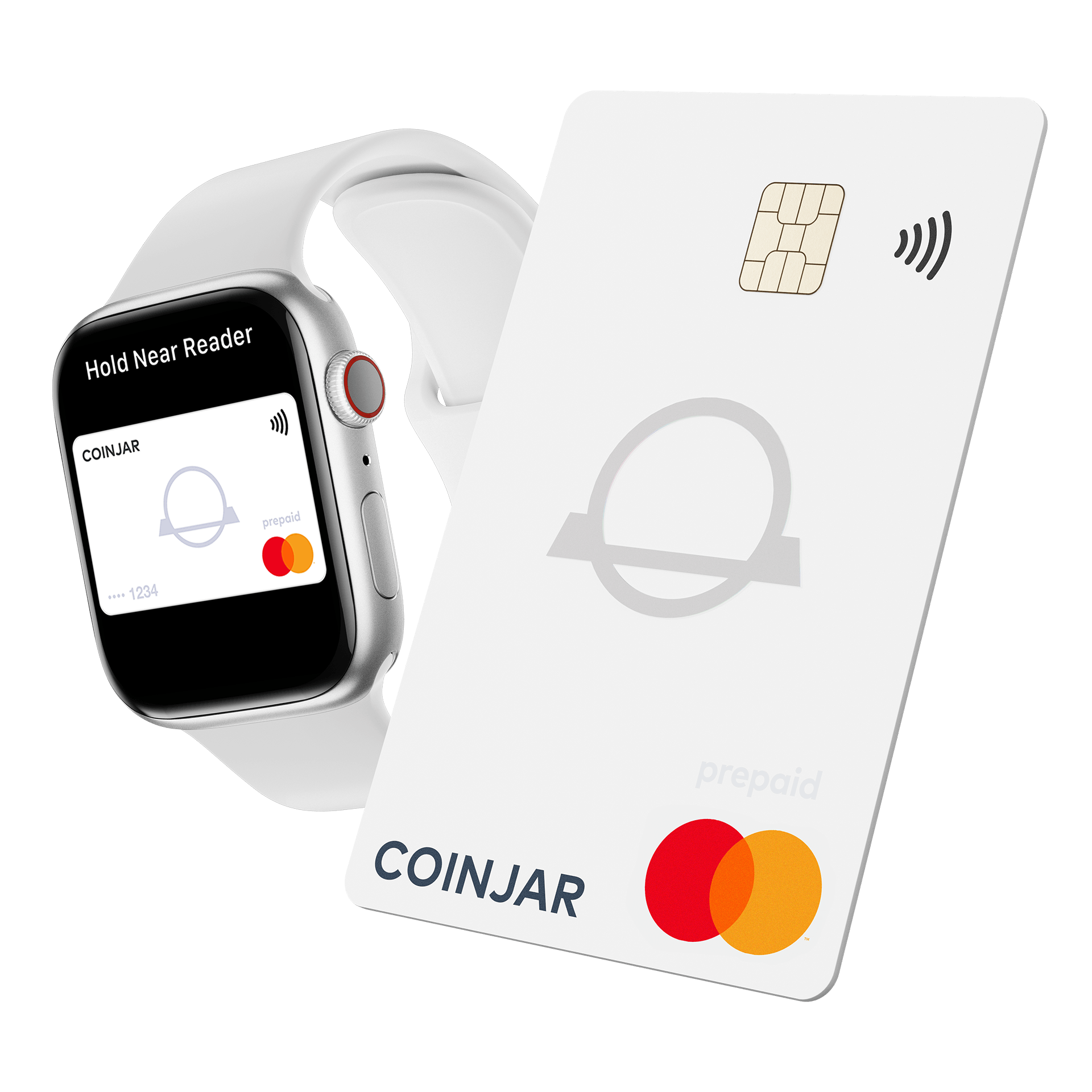
Use CoinJar Card, powered by Mastercard, for purchases online and in store, including through Apple Pay and Google Pay. No setup or monthly fee. A 1% purchase fee applies and is returned as CoinJar Rewards points, with one point earned per $1 spent. Available in Australia only.
Get your CoinJar Card for free
CoinJar Card
Use CoinJar Card, powered by Mastercard, for purchases online and in store, including through Apple Pay and Google Pay. No setup or monthly fee. A 1% purchase fee applies and is returned as CoinJar Rewards points, with one point earned per $1 spent. Available in Australia only.
Get your CoinJar Card for free
CoinJar Recurring Buy
Schedule automatic purchases weekly, fortnightly or monthly to dollar-cost average into individual cryptocurrencies or CoinJar Bundles. Manage your investment amount and schedule, with the flexibility to adjust or pause purchases as your circumstances change.
DCA with Recurring BuyCoinJar Recurring Buy
Schedule automatic purchases weekly, fortnightly or monthly to dollar-cost average into individual cryptocurrencies or CoinJar Bundles. Manage your investment amount and schedule, with the flexibility to adjust or pause purchases as your circumstances change.
DCA with Recurring Buy

CoinJar Bundles
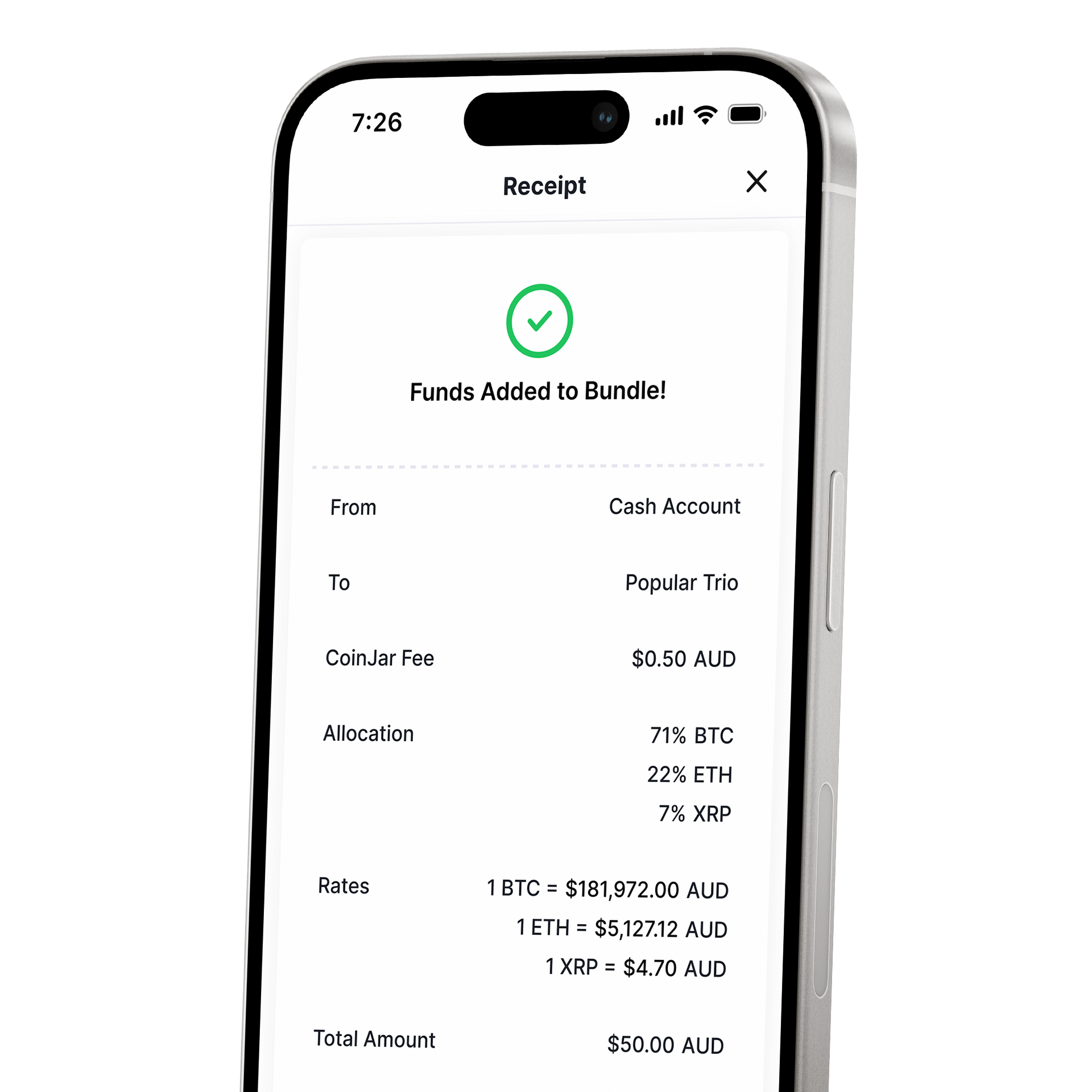
Pick your Bundle in the CoinJar app. Review each Bundle’s asset allocation, add to your holdings and rebalance when required. Sell your Bundle or unbundle it to manage the assets individually.
Learn more
CoinJar Bundles
Pick your Bundle in the CoinJar app. Review each Bundle’s asset allocation, add to your holdings and rebalance when required. Sell your Bundle or unbundle it to manage the assets individually.
Learn more
CoinJar Exchange
Trade with fees from 0-0.1%, using market, limit and stop-limit orders. Connect to TradingView to trade directly from your charts, or use CoinJar Exchange’s high-performance interface, built for active traders, market makers and institutions.
Explore CoinJar ExchangeCoinJar Exchange
Trade with fees from 0-0.1%, using market, limit and stop-limit orders. Connect to TradingView to trade directly from your charts, or use CoinJar Exchange’s high-performance interface, built for active traders, market makers and institutions.
Explore CoinJar Exchange

CoinJar AI
Access information about your holdings and the wider cryptocurrency market through CoinJar AI. Ask questions about portfolio changes, market developments or individual cryptocurrencies, with responses informed by your CoinJar holdings.
Learn moreCoinJar AI
Access information about your holdings and the wider cryptocurrency market through CoinJar AI. Ask questions about portfolio changes, market developments or individual cryptocurrencies, with responses informed by your CoinJar holdings.
Learn more

CoinJar OTC
For cryptocurrency trades above $50,000, CoinJar’s OTC desk provides personalised service and access to globally sourced liquidity. Work directly with a dedicated team to arrange and execute your purchase or sale. Discover OTC Services
Learn moreCoinJar OTC
For cryptocurrency trades above $50,000, CoinJar’s OTC desk provides personalised service and access to globally sourced liquidity. Work directly with a dedicated team to arrange and execute your purchase or sale. Discover OTC Services
Learn more
CoinJar does not endorse the content of, and cannot guarantee or verify the safety of any third-party websites. Visit these websites at your own risk.
CoinJar
Get the app.