
Buy Curve DAO
CRVPast performance is not indicative of future results. All prices are sourced from CoinJar Indices.
What is Curve DAO?
Curve is a decentralised exchange built for a narrow job: swapping between assets that are meant to be worth the same thing. Stablecoins against other stablecoins, staked Ether wrappers against Ether, one wrapped Bitcoin against another. Doing that with an ordinary exchange formula wastes liquidity, so Curve uses a different one, and that single design choice made it one of the most heavily used pieces of plumbing in decentralised finance.
CRV is the Curve DAO token. The thing to understand early is that CRV does very little sitting in a wallet. Almost everything it does, it does only after you lock it away. Our guide to decentralised finance covers the category, our guide to stablecoins covers the assets Curve mostly trades, and our guide to altcoins explains where tokens like CRV sit relative to Bitcoin.
Where did Curve come from?
Curve was built by Michael Egorov, a physicist by training, and launched in January 2020 as StableSwap before taking the Curve name. It arrived at the right moment: stablecoin trading was growing fast and nothing else handled it efficiently.
The token launch was stranger. CRV was scheduled for release in mid August 2020, but an anonymous developer deployed the Curve DAO and token contracts a day early, without permission and without the team's involvement. Rather than abandon the deployment and start again, the team verified the contracts and accepted them as the official launch. It is a useful piece of context: the token that governs a protocol handling enormous volume was put into the world by someone nobody has identified.
What does Curve actually do?
Trading assets that track each other. Curve's original formula blends a constant sum curve, which gives very low slippage while a pool stays near balance, with a constant product curve, which keeps the pool functioning when it does not. An amplification parameter controls how flat the curve is. The result is that large stablecoin trades cost far less on Curve than on a general purpose exchange. Curve later added designs for volatile pairs as well.
Liquidity pools and emissions. Anyone can deposit assets into a pool and earn a share of trading fees. Pools that have been approved by governance also receive newly issued CRV, which is how Curve attracts liquidity.
crvUSD. Curve issues its own overcollateralised stablecoin, launched in May 2023. Its distinguishing feature is a liquidation engine called LLAMMA, which converts a borrower's collateral gradually as the price falls rather than closing the position in one forced sale, and converts it back if the price recovers.
Lending. Curve's lending product, branded LlamaLend, runs isolated markets using the same liquidation machinery. A second version launched on Optimism in mid 2026 and reached Ethereum in July 2026, widening it beyond crvUSD borrowing into open markets with market specific risk settings.
Curve runs on Ethereum and on a long list of other networks. The Curve documentation is the primary technical source.
CRV does almost nothing unless you lock it
This is the single most important thing about the asset, and the part most descriptions skip.
CRV held loosely can be traded and nothing else. To use it, you lock it in a voting escrow contract for anywhere from one week to four years, and receive veCRV in return. The amount of veCRV you get depends on how much you lock and for how long, and a maximum length lock gives roughly one veCRV per CRV. That balance then decays steadily towards zero as the lock runs down, so holding voting power means continually relocking.
veCRV is what actually carries the rights:
Governance. veCRV votes on proposals, parameters and spending. Gauge weight votes. Each week veCRV holders decide how newly issued CRV is split between pools and markets. This is the real prize, because it determines where liquidity goes. Boosted rewards. A liquidity provider holding veCRV earns emissions at a higher rate on their own deposits, commonly cited as up to two and a half times the base rate. A share of protocol fees. Curve directs a share of trading fees to veCRV holders, historically described as half, paid today in crvUSD rather than the pool token used in earlier years.
Two consequences matter for anyone buying CRV. First, unlocked CRV has no claim on Curve's revenue at all. Second, veCRV is not transferable and a lock cannot be shortened, so choosing four years means four years, whatever happens to the price in between.
Where does new CRV come from?
CRV has a maximum supply of a little over three billion tokens, and most of it was never issued at launch. The original allocation put the largest share aside for liquidity providers, with smaller portions for shareholders and investors, employees and a community reserve, the investor and team portions vesting over years.
Emissions run on a declining schedule, cut by roughly sixteen per cent at each annual step. The reduction that took effect in August 2026 brought scheduled annual issuance below one hundred million CRV for the first time. That still means new CRV every week, distributed through gauges, and gauge allocation is a governance decision rather than a fixed rule. CRV is not a fixed supply asset in any practical sense.
The Curve wars: who controls the emissions
Because gauge votes direct real money, a whole economy grew up around acquiring them.
Convex Finance was the most successful attempt. It takes deposits of CRV, locks them permanently for veCRV, issues its own liquid receipt tokens, and pools the resulting voting power. Locking Convex's own token gives a say over how that power is used, and other protocols pay for those votes through vote incentive marketplaces, in what the sector cheerfully calls bribes. Yearn and Stake DAO built comparable positions.
The practical effect is that a large share of Curve's voting power is held by a small number of intermediaries rather than by individual CRV holders. That is not hidden and it is not necessarily against holders' interests, but anyone buying CRV to influence Curve should understand what they are competing with. The vote market is smaller and more fragmented than at its 2021 and 2022 peak, but it has not gone away.
crvUSD, LlamaLend and what happened in October 2025
Soft liquidation is a genuinely clever design and it is not a guarantee. During the market wide liquidation cascade of 10 October 2025, one LlamaLend market, the one lending against CRV itself, came out short. Lenders in that market were left unable to withdraw in full, with the vault backed at roughly seventy per cent and a shortfall of around seven hundred thousand US dollars.
What happened next is worth reading in full, because it says something about how Curve governs itself. Rather than covering the loss from the treasury, the approach put forward in April 2026 was to tokenise the impaired claims and create a Curve pool where affected lenders could sell them and speculators could buy them, on the reasoning that the claims recover value if CRV rises. Curve's risk advisers recommended treating it as a monitored pilot rather than a solution. The governance thread was still active in August 2026.
The lesson for a holder is not that crvUSD failed, because it did not. It is that lending markets on Curve can and do produce bad debt, that there is no backstop that automatically makes lenders whole, and that CRV itself was the collateral that caused the problem.
Who builds Curve, and the Yield Basis question
Curve's core code is maintained by a company, Swiss Stake AG, funded by grants from the DAO. That relationship has become contested. In December 2025 the DAO rejected a request for 17.4 million CRV to fund a year of development, with about 54 per cent voting against, before approving a smaller two phase structure with an initial tranche of 8,725,000 CRV. By March 2026 the team was back asking for the next phase plus a top up, on the grounds that CRV's fall had shortened the runway the first tranche was meant to buy. A protocol whose token pays for its own development has an obvious problem when the token falls.
Separately, Egorov has built a second protocol, Yield Basis, aimed at earning yield on Bitcoin without impermanent loss. It has its own token and its own investors. In September 2025 Curve's governance approved a 60 million crvUSD credit line to it, in exchange for a stream of Yield Basis tokens flowing back to Curve. The vote passed comfortably on high turnout, and it drew pointed objections about conflicts of interest, since people voting in Curve governance also had positions in the protocol receiving the credit.
None of that is an accusation of wrongdoing. It is the shape of the thing you are buying: a protocol with a founder who is also building elsewhere, a development company funded by token grants, and a governance process where the largest voters are intermediaries.
What are the risks of holding CRV?
Unlocked CRV has no claim on anything. Fees, boosts and votes all require locking. If you are not prepared to lock, you are holding an asset whose main utility you are not using. Locking is a one way door. Voting escrow positions cannot be transferred or shortened, and the maximum term is four years. That is a long time to be unable to sell. Continuing emissions. New CRV is issued every week. The schedule declines, but supply grows and governance controls where it goes. Governance concentration. A large share of voting power sits with Convex and similar vote aggregators, and turnout on important votes can be thin. Founder and funding concentration. Development depends on a grant funded company, the founder runs a separate protocol that Curve has extended credit to, and past liquidations of the founder's own CRV backed loans moved the market hard. Bad debt and liquidation risk. LlamaLend markets have produced losses that lenders bore, including in a market collateralised by CRV. Smart contract risk. In July 2023 a flaw in a specific version of the Vyper compiler let attackers drain several Curve pools, with losses across affected protocols reported at around seventy million US dollars, a substantial part of it later returned. Front end and phishing risk. Curve's website has been attacked twice: a cloned site in August 2022, and a registrar level hijack of the old curve.fi domain in May 2025. The contracts held both times, but users signing transactions on a fake site did not. Curve now operates from curve.finance. Complexity. veCRV, gauges, wrappers, vote markets, crvUSD and isolated lending markets add up to a system most holders will not fully model. Complexity is itself a risk. Volatility. CRV is not a stablecoin. Its value moves sharply and can fall substantially. No consumer protection. Crypto assets are not covered by the Australian Government's Financial Claims Scheme, and AUSTRAC registration is not an endorsement of any asset listed on an exchange. You should be prepared to lose the money you put in.
Buying CRV with Australian dollars on CoinJar
CoinJar has operated since 2013 and lists CRV against Australian dollars, so you can buy, sell and hold it without converting through another cryptocurrency first. Current charges are on our fees page, and live Australian dollar rates are on our cryptocurrency prices page.
CoinJar Australia Pty Ltd is registered with AUSTRAC as a digital currency exchange provider, Registration Number DCE100749118-001.
How is CRV taxed in Australia?
The ATO generally treats CRV as a capital gains tax asset. A disposal can occur when you sell it for Australian dollars, trade it for another crypto asset, spend it or give it away.
The ATO sets out its approach in its crypto asset investments guidance. Our guide to crypto tax in Australia provides a practical overview. This is general information, not tax advice. Consider speaking to a qualified tax adviser about your circumstances.
Fund Your Account Your Way
Buy Curve DAO instantly using Visa or Mastercard, or deposit Australian dollars via bank transfer, PayID or PayPal. Buy, sell and convert between supported cryptocurrencies through your CoinJar account.


How to buy Curve DAO with CoinJar
Start your portfolio with Australia's longest-running crypto exchange with these simple steps.
Sign up to CoinJar
Get the CoinJar app on iOS or Android, create an account and verify your ID.
Deposit funds
Deposit AUD fee-free via PayID, Osko or bank transfer. You can also use PayPal or pay instantly by card.
Buy your first crypto
Buy Curve DAO and other popular cryptos using cash or credit card in minutes.


CoinJar Card
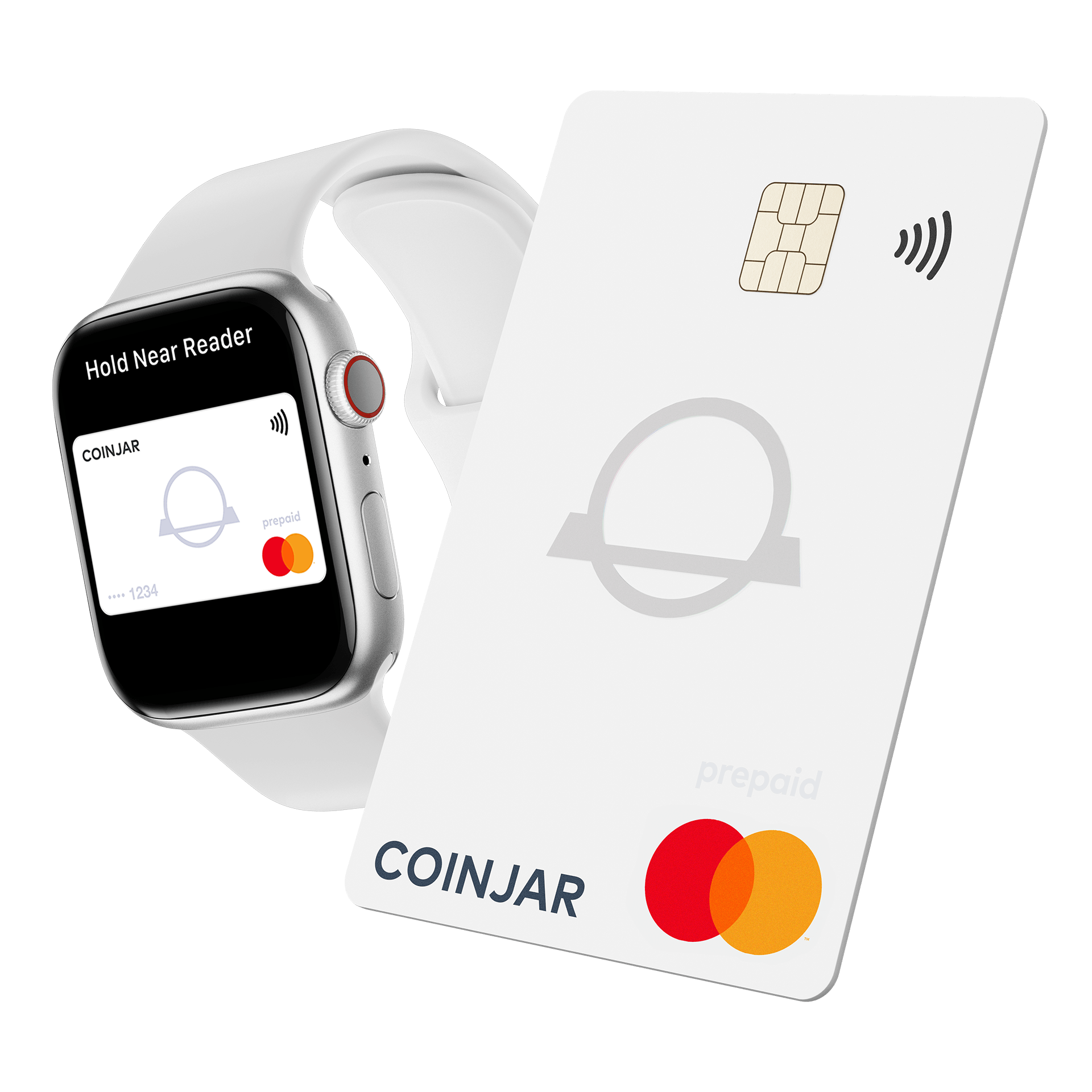
Use CoinJar Card, powered by Mastercard, for purchases online and in store, including through Apple Pay and Google Pay. No setup or monthly fee. A 1% purchase fee applies and is returned as CoinJar Rewards points, with one point earned per $1 spent. Available in Australia only.
Get your CoinJar Card for freeCoinJar Card
Use CoinJar Card, powered by Mastercard, for purchases online and in store, including through Apple Pay and Google Pay. No setup or monthly fee. A 1% purchase fee applies and is returned as CoinJar Rewards points, with one point earned per $1 spent. Available in Australia only.
Get your CoinJar Card for free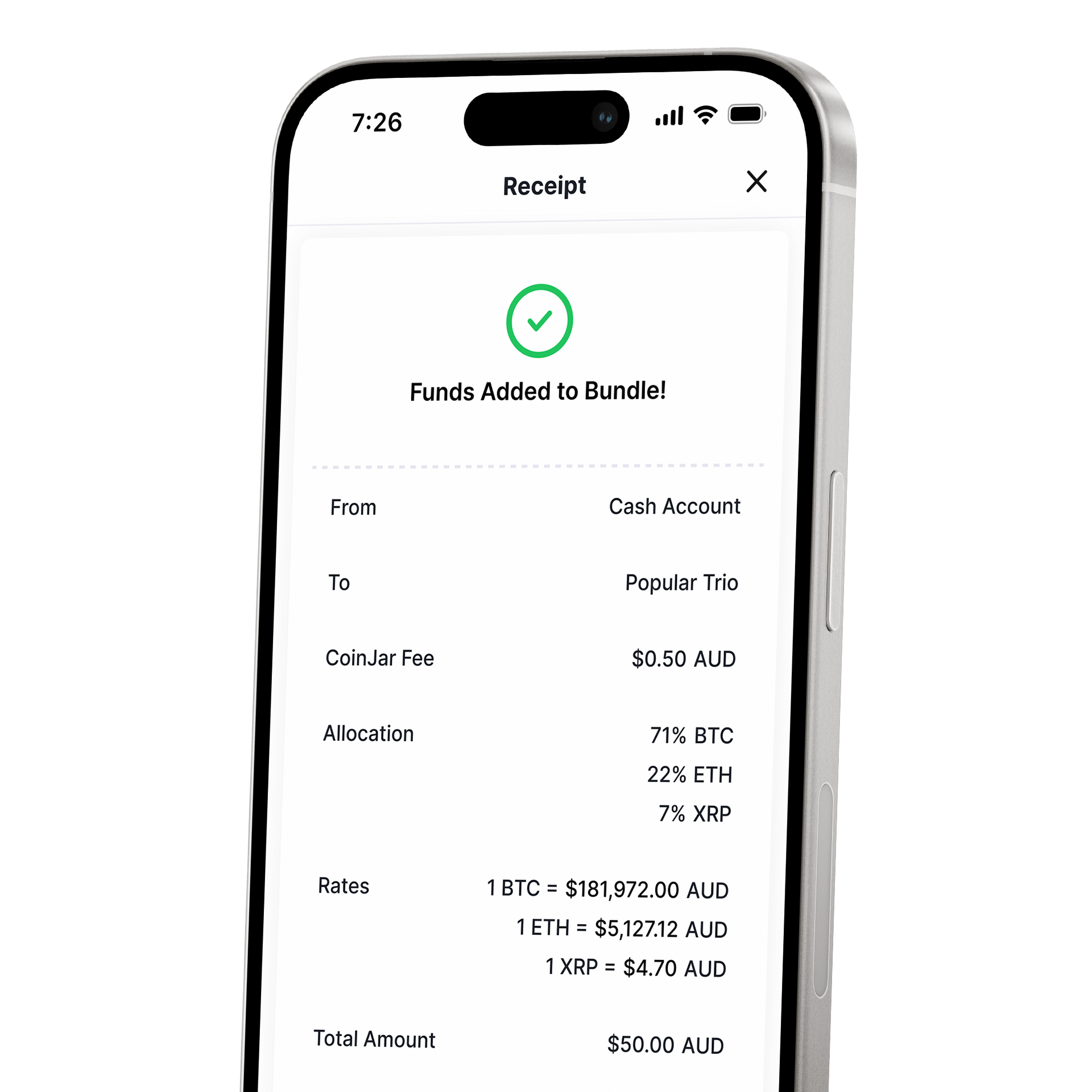
CoinJar Recurring Buy
Schedule automatic purchases weekly, fortnightly or monthly to dollar-cost average into individual cryptocurrencies or CoinJar Bundles. Manage your investment amount and schedule, with the flexibility to adjust or pause purchases as your circumstances change.
DCA with Recurring BuyCoinJar Recurring Buy
Schedule automatic purchases weekly, fortnightly or monthly to dollar-cost average into individual cryptocurrencies or CoinJar Bundles. Manage your investment amount and schedule, with the flexibility to adjust or pause purchases as your circumstances change.
DCA with Recurring Buy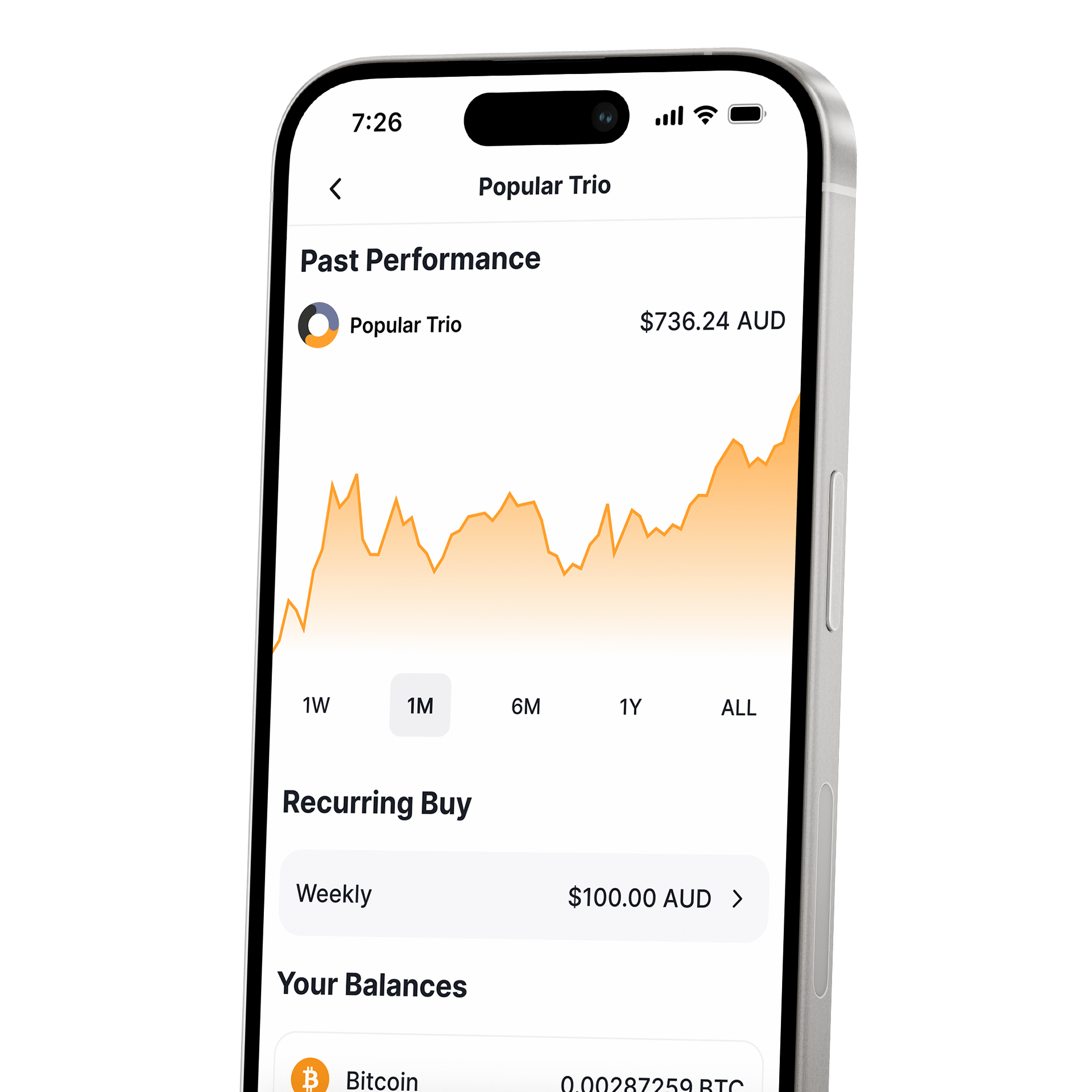
CoinJar Bundles
Pick your Bundle in the CoinJar app. Review each Bundle’s asset allocation, add to your holdings and rebalance when required. Sell your Bundle or unbundle it to manage the assets individually.
Learn moreCoinJar Bundles
Pick your Bundle in the CoinJar app. Review each Bundle’s asset allocation, add to your holdings and rebalance when required. Sell your Bundle or unbundle it to manage the assets individually.
Learn more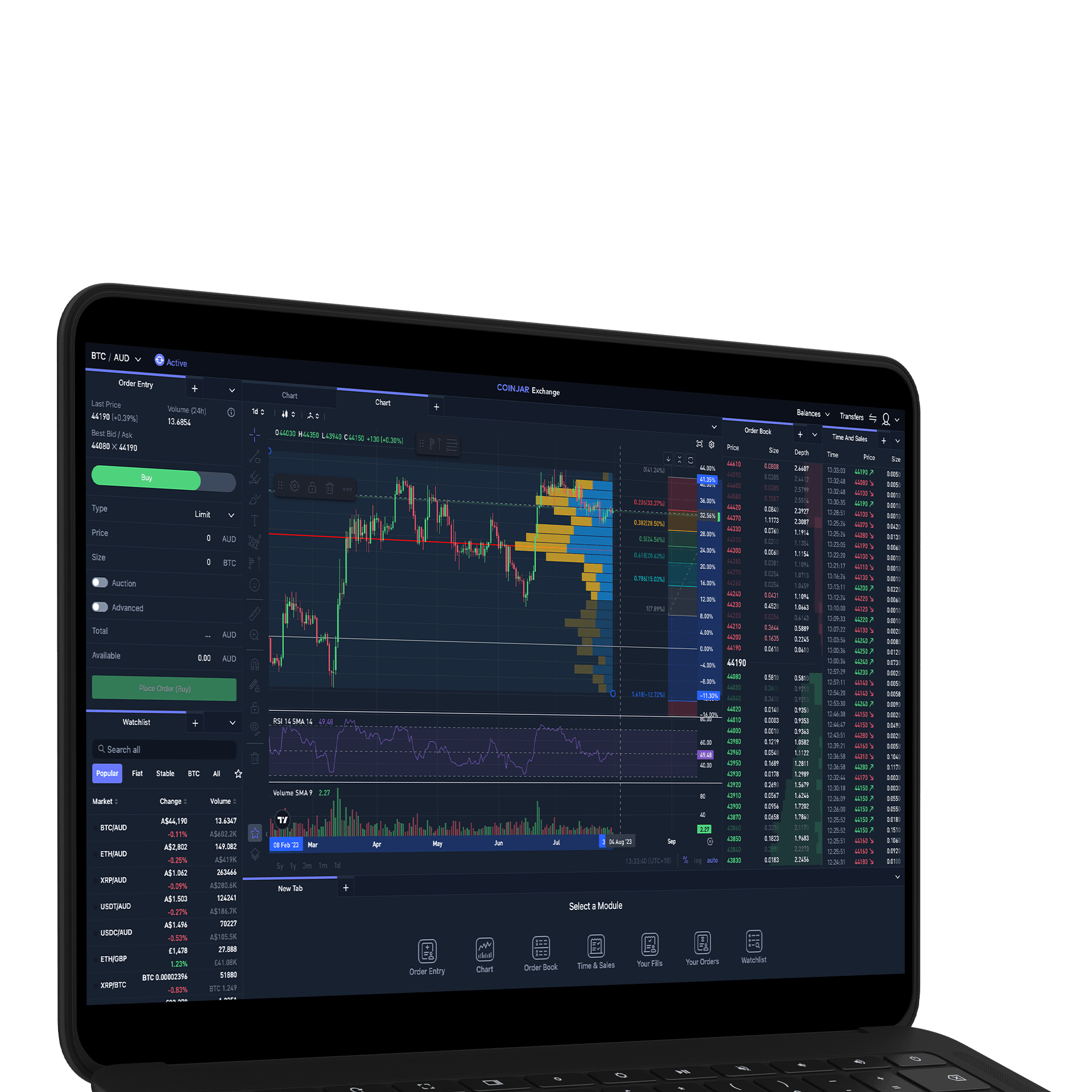
CoinJar Exchange
Trade with fees from 0-0.1%, using market, limit and stop-limit orders. Connect to TradingView to trade directly from your charts, or use CoinJar Exchange’s high-performance interface, built for active traders, market makers and institutions.
Explore CoinJar ExchangeCoinJar Exchange
Trade with fees from 0-0.1%, using market, limit and stop-limit orders. Connect to TradingView to trade directly from your charts, or use CoinJar Exchange’s high-performance interface, built for active traders, market makers and institutions.
Explore CoinJar Exchange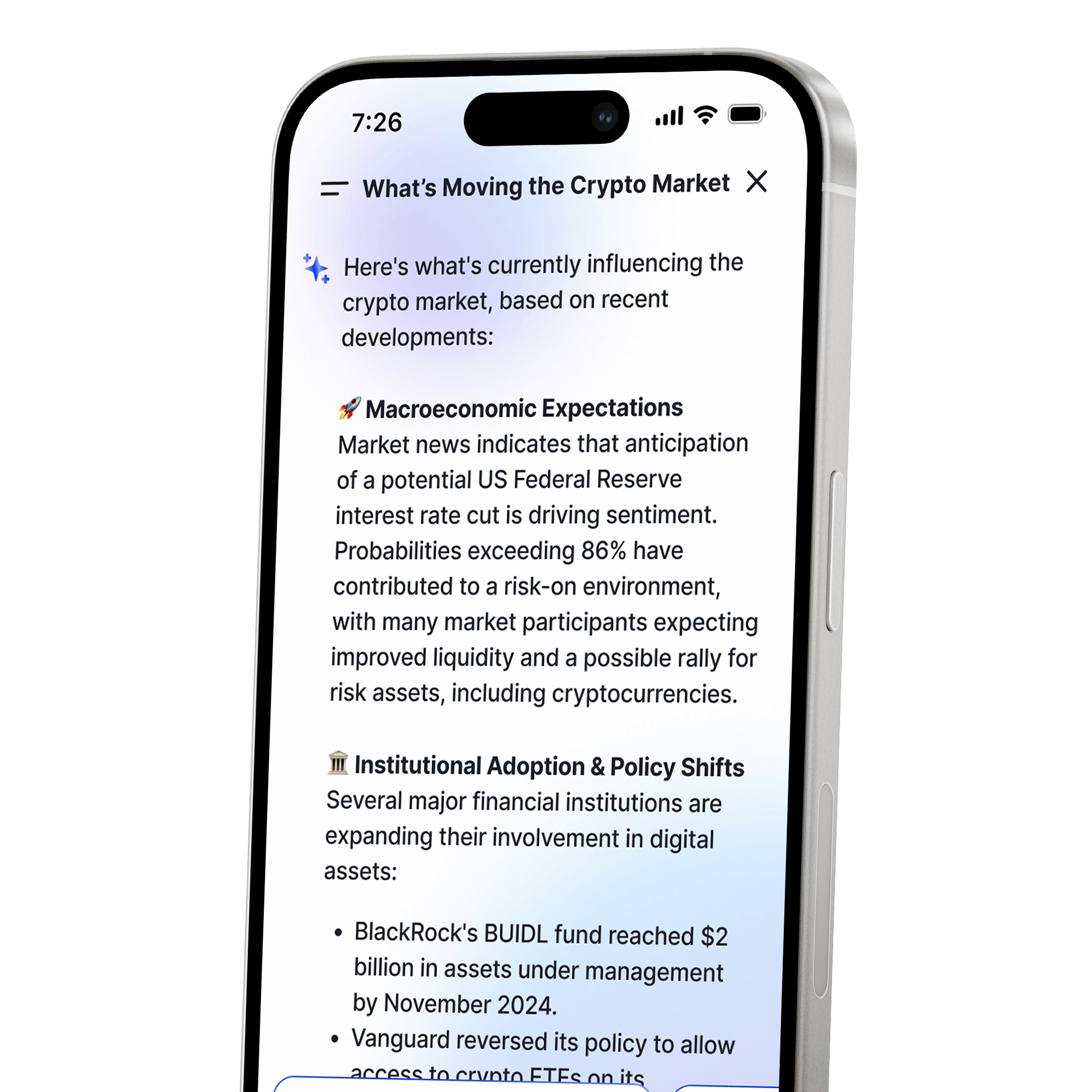
CoinJar AI
Access information about your holdings and the wider cryptocurrency market through CoinJar AI. Ask questions about portfolio changes, market developments or individual cryptocurrencies, with responses informed by your CoinJar holdings.
Learn moreCoinJar AI
Access information about your holdings and the wider cryptocurrency market through CoinJar AI. Ask questions about portfolio changes, market developments or individual cryptocurrencies, with responses informed by your CoinJar holdings.
Learn more
CoinJar OTC
For cryptocurrency trades above $50,000, CoinJar’s OTC desk provides personalised service and access to globally sourced liquidity. Work directly with a dedicated team to arrange and execute your purchase or sale. Discover OTC Services
Learn moreCoinJar OTC
For cryptocurrency trades above $50,000, CoinJar’s OTC desk provides personalised service and access to globally sourced liquidity. Work directly with a dedicated team to arrange and execute your purchase or sale. Discover OTC Services
Learn moreCoinJar does not endorse the content of, and cannot guarantee or verify the safety of any third-party websites. Visit these websites at your own risk.

CoinJar
Get the app.