
Buy The Graph
GRTPast performance is not indicative of future results. All prices are sourced from CoinJar Indices.
What is The Graph?
The Graph is infrastructure. It indexes blockchain data and makes it queryable, so that applications can ask a blockchain a question and get an answer quickly, rather than reading through the chain themselves. GRT is the token that pays for that service and secures the network providing it.
This is not a consumer product and you will probably never use it directly. It sits underneath other applications, which is worth knowing before buying the token: demand for GRT depends on developers choosing to pay for the service rather than on anything a retail holder does. Our guide to blockchains covers the underlying technology, and our guide to altcoins explains where tokens like this sit.
What problem does The Graph actually solve?
Blockchains are excellent at recording things and poor at answering questions about them.
A node can tell you the current state of a contract and it holds the entire history, but that history is stored as raw blocks and encoded logs. Asking something as ordinary as "list every trade this wallet made on this exchange, newest first, with prices" means downloading a great many blocks, decoding the events inside them, handling reorganisations when the chain reshuffles recent blocks, and maintaining your own database of the result. Every team that needed this used to build and run that machinery themselves.
The Graph turns that work into a shared resource. A developer writes a subgraph, which is an open specification describing which contract events to collect and how to organise them. Independent operators run the indexing, and anyone can then query the resulting data using GraphQL, a standard query language. Because subgraphs are public, one team's work can be reused by everyone else rather than rebuilt.
Who does what on the network?
Indexers run the actual infrastructure. They stake a minimum of 100,000 GRT of their own, index subgraphs, serve queries and earn both query fees and newly issued GRT as indexing rewards. They can be penalised for serving incorrect data.
Delegators contribute GRT to an indexer without running anything themselves, increasing that indexer's capacity, and receive a share of what it earns after its commission.
Curators signal GRT on subgraphs they believe are worth indexing, which is how indexers know where to direct their resources, and earn a share of the query fees those subgraphs generate.
Developers and consumers build subgraphs, publish them and pay query fees in GRT when their applications read the data.
The protocol began on Ethereum and from 2023 moved most of its operations to Arbitrum One, because doing frequent staking and allocation transactions on Ethereum was too expensive to be practical. GRT exists on both networks, with different contract addresses on each.
What changed in 2024?
For its first years, The Graph ran a free hosted service operated centrally by the core team, alongside the decentralised network it was building. Most developers used the hosted service, because it was easier.
That ended. Through an upgrade called Sunrise, subgraphs were migrated across, and the hosted service was shut down in June 2024. Everything now runs on the decentralised network. This was a genuine milestone, and it also means developers now need an API key and a billing arrangement where previously they had something free.
How does the GRT supply work?
The initial supply was 10 billion GRT, and the protocol issues new tokens to pay indexing rewards at a target of 3 per cent a year, a figure governance can change.
Against that, several mechanisms burn GRT permanently. Delegating incurs a 0.5 per cent tax on the amount delegated. Curating incurs a 1 per cent tax on the signal. One per cent of all query fees is burned. Indexers penalised for misbehaviour have part of the penalty burned as well. The tokenomics documentation sets out the parameters.
The honest summary is that GRT is inflationary by design. The Graph's own documentation puts total burning at roughly 1 per cent of supply a year against an issuance target of 3 per cent. That is a deliberate choice rather than an oversight, because the issuance pays the people running the infrastructure, but anyone assuming the burns make GRT scarce has the arithmetic backwards.
Where does demand for GRT come from?
This is the question that decides whether the token works, and it deserves a direct answer.
Indexers are paid from two sources: query fees from customers, and indexing rewards from new issuance. Independent research through 2025 found that although the network served an enormous number of queries, the fees actually paid for them were a small fraction of the value of the indexing rewards being issued over the same period. In other words, the network's operators are substantially paid by inflation rather than by customers.
That is normal for infrastructure at this stage and it is not evidence of failure. But it does mean the case for GRT rests on paid demand growing into the subsidy, and it is fair to ask why a developer would pay for a decentralised service when centralised providers offer something similar with less friction.
How is The Graph governed?
By a Graph Council, which operates a six of ten multi signature arrangement and represents indexers, users, researchers, supporters and core developers. Proposals are discussed publicly through a Graph Improvement Proposal process, with community feedback and non binding signalling, and the Council approves them. The governance page describes the process.
It is worth being clear about what this means, because it is often described loosely. GRT is a work and payment token, not a governance token. Holding it does not give you a vote on protocol changes. Final authority sits with ten signers.
What about the move into artificial intelligence?
Since 2025 The Graph has extended beyond subgraphs into streaming data products and packaged APIs, and has positioned itself as a data layer for artificial intelligence agents, including work on letting agents query and pay for data automatically.
Treat this as direction rather than delivery. The products exist, but whether agent driven demand becomes a material source of paid queries is unproven. Our guide to AI and cryptocurrency covers how often that narrative outruns the reality.
What are the risks of holding GRT?
Revenue gap. Paid query fees have been small relative to the rewards issued to indexers. If that does not change, the network is subsidised by dilution. Net inflation. Issuance exceeds burning by design. Holders who do not delegate are diluted over time. Competition. Developers can get blockchain data from centralised providers such as Alchemy, Infura and QuickNode, and from rival indexing services. Convenience frequently wins over decentralisation. No governance rights. GRT does not vote. Protocol direction rests with a small council. Delegation mechanics. Delegating costs a tax on entry, locks tokens through a thawing period of roughly 26 days on exit, and depends on the indexer's commission, which the indexer sets and can change. Two networks. GRT exists on both Ethereum and Arbitrum One with different contracts, and moving between them means using a bridge. Our guide to bridges explains the risk. Execution. The move into streaming data and artificial intelligence services is a strategy, not a result. Concentration of development. A small number of teams write the software, and the roadmap depends on them. Volatility. GRT is not a stablecoin. Its value moves sharply and can fall substantially. No consumer protection. Cryptoassets are not covered by the Financial Claims Scheme and are not protected in the way a bank deposit is. You should be prepared to lose the money you put in.
Buying GRT with Australian dollars on CoinJar
CoinJar has operated since 2013 and lists GRT against Australian dollars, so you can buy, sell and hold it without converting through another cryptocurrency first. Current charges are on our fees page, and live Australian dollar rates are on our cryptocurrency prices page.
CoinJar is registered with AUSTRAC as a digital currency exchange provider, Registration Number DCE100749118-001. That registration covers anti money laundering and counter terrorism financing obligations. It is not an endorsement of any cryptoasset listed on the platform.
How is GRT taxed in Australia?
The ATO generally treats GRT as a capital gains tax asset. A disposal can occur when you sell it for Australian dollars, exchange it for another cryptoasset, spend it or give it away.
The ATO sets out its approach on its crypto asset investments pages. Our guide to crypto tax in Australia provides a practical overview. This is general information, not tax advice. Consider speaking to a registered tax agent about your circumstances.
Fund Your Account Your Way
Buy The Graph instantly using Visa or Mastercard, or deposit Australian dollars via bank transfer, PayID or PayPal. Buy, sell and convert between supported cryptocurrencies through your CoinJar account.


How to buy The Graph with CoinJar
Start your portfolio with Australia's longest-running crypto exchange with these simple steps.
Sign up to CoinJar
Get the CoinJar app on iOS or Android, create an account and verify your ID.
Deposit funds
Deposit AUD fee-free via PayID, Osko or bank transfer. You can also use PayPal or pay instantly by card.
Buy your first crypto
Buy The Graph and other popular cryptos using cash or credit card in minutes.



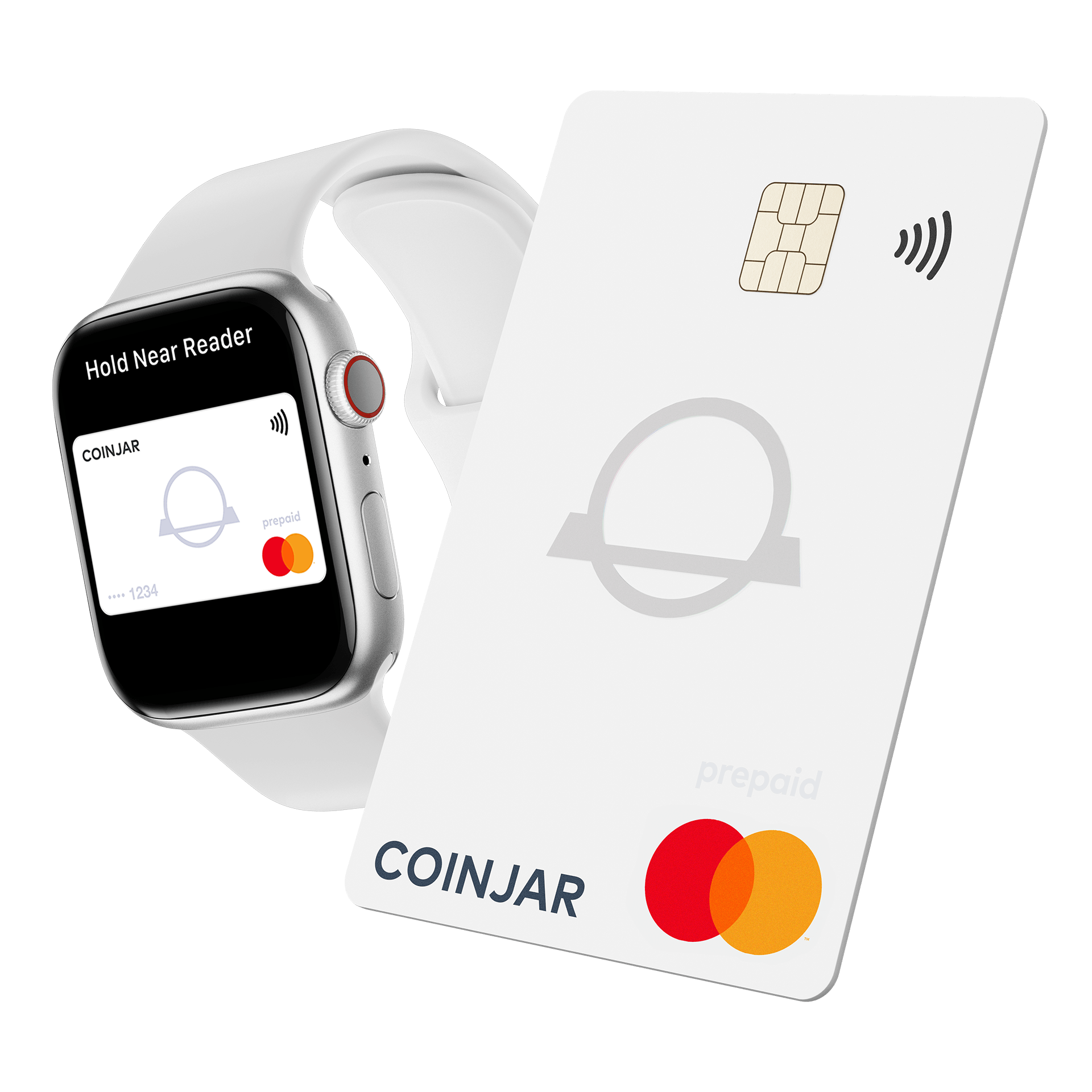
CoinJar Card
Use CoinJar Card, powered by Mastercard, for purchases online and in store, including through Apple Pay and Google Pay. No setup or monthly fee. A 1% purchase fee applies and is returned as CoinJar Rewards points, with one point earned per $1 spent. Available in Australia only.
Get your CoinJar Card for freeCoinJar Card
Use CoinJar Card, powered by Mastercard, for purchases online and in store, including through Apple Pay and Google Pay. No setup or monthly fee. A 1% purchase fee applies and is returned as CoinJar Rewards points, with one point earned per $1 spent. Available in Australia only.
Get your CoinJar Card for free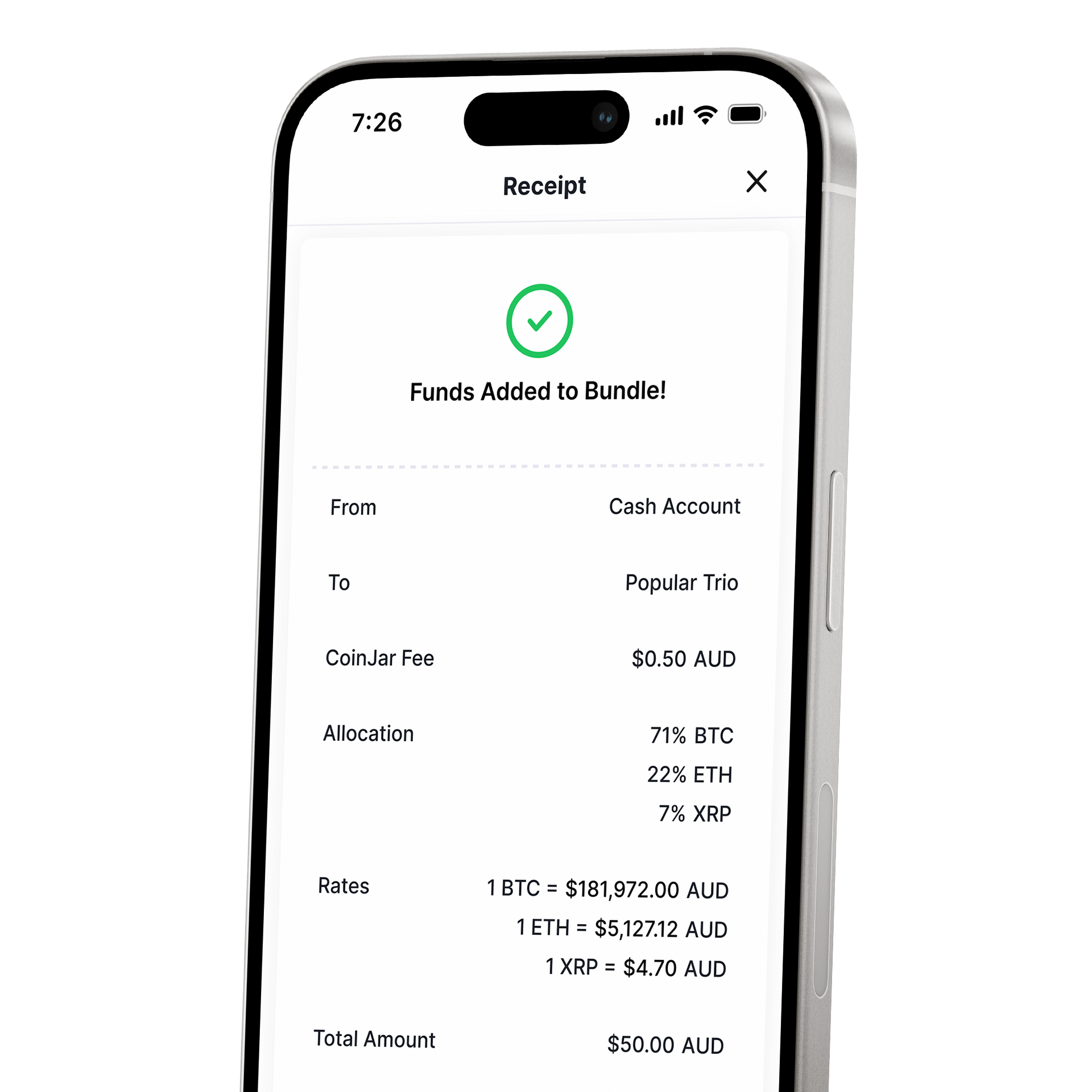
CoinJar Recurring Buy
Schedule automatic purchases weekly, fortnightly or monthly to dollar-cost average into individual cryptocurrencies or CoinJar Bundles. Manage your investment amount and schedule, with the flexibility to adjust or pause purchases as your circumstances change.
DCA with Recurring BuyCoinJar Recurring Buy
Schedule automatic purchases weekly, fortnightly or monthly to dollar-cost average into individual cryptocurrencies or CoinJar Bundles. Manage your investment amount and schedule, with the flexibility to adjust or pause purchases as your circumstances change.
DCA with Recurring Buy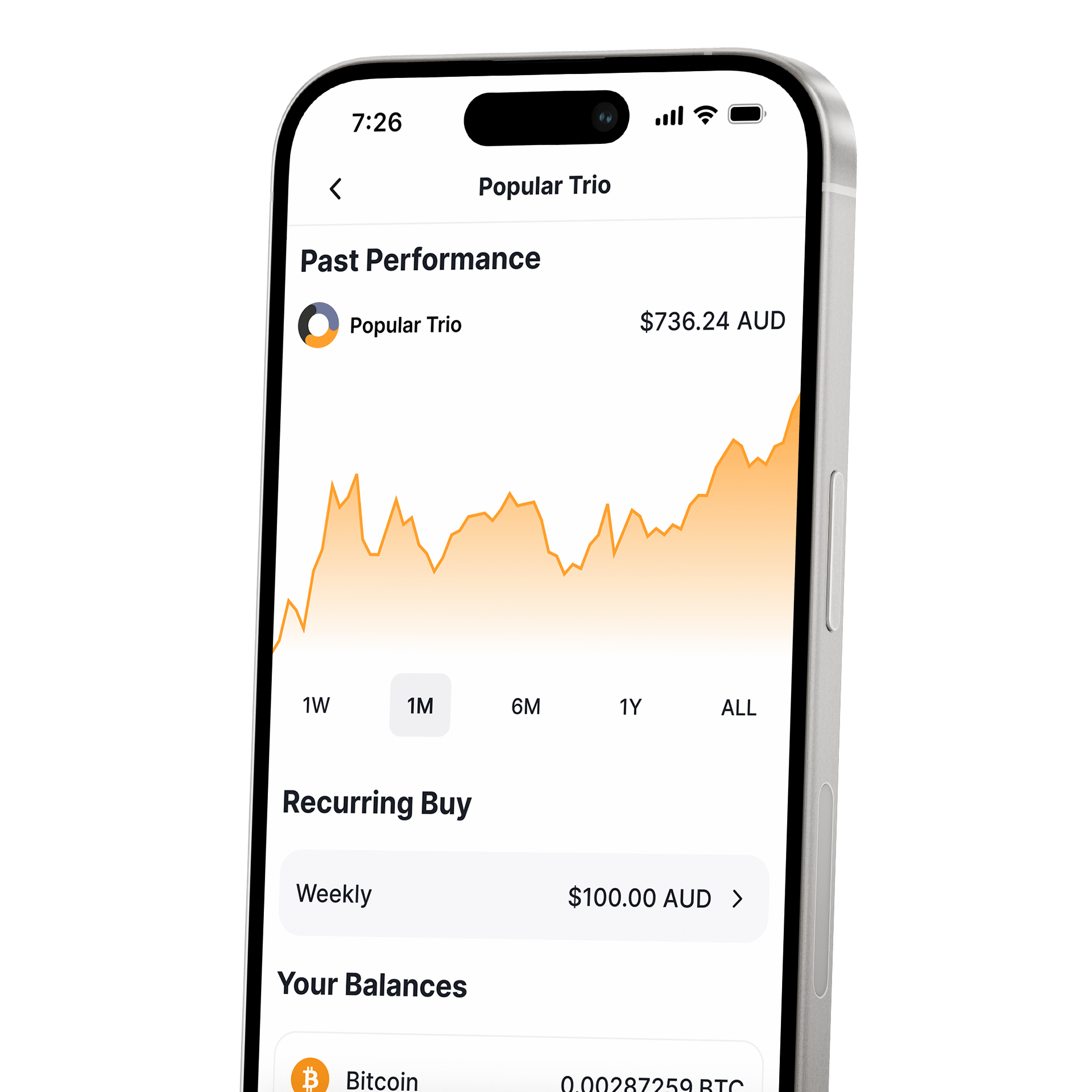
CoinJar Bundles
Pick your Bundle in the CoinJar app. Review each Bundle’s asset allocation, add to your holdings and rebalance when required. Sell your Bundle or unbundle it to manage the assets individually.
Learn moreCoinJar Bundles
Pick your Bundle in the CoinJar app. Review each Bundle’s asset allocation, add to your holdings and rebalance when required. Sell your Bundle or unbundle it to manage the assets individually.
Learn more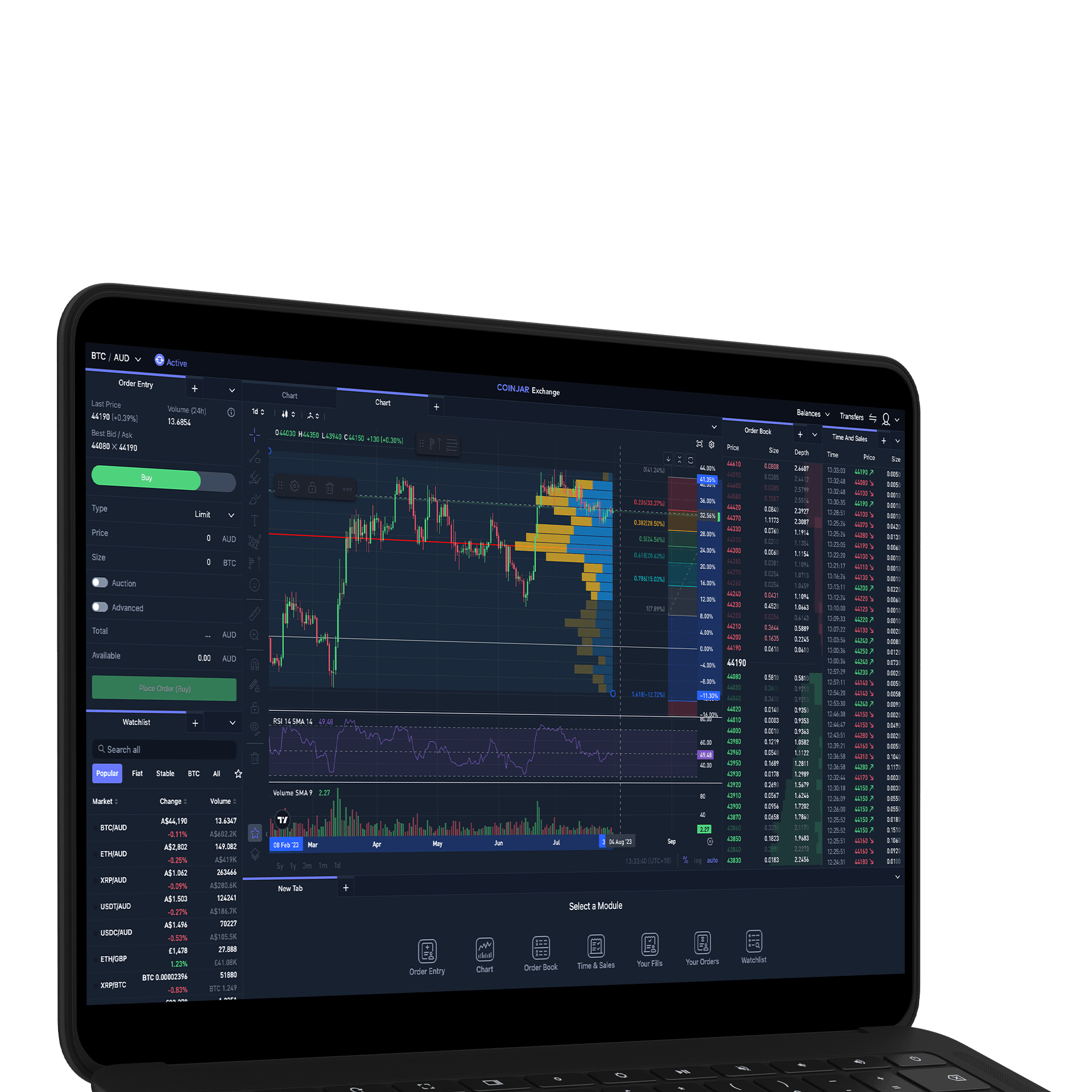
CoinJar Exchange
Trade with fees from 0-0.1%, using market, limit and stop-limit orders. Connect to TradingView to trade directly from your charts, or use CoinJar Exchange’s high-performance interface, built for active traders, market makers and institutions.
Explore CoinJar ExchangeCoinJar Exchange
Trade with fees from 0-0.1%, using market, limit and stop-limit orders. Connect to TradingView to trade directly from your charts, or use CoinJar Exchange’s high-performance interface, built for active traders, market makers and institutions.
Explore CoinJar Exchange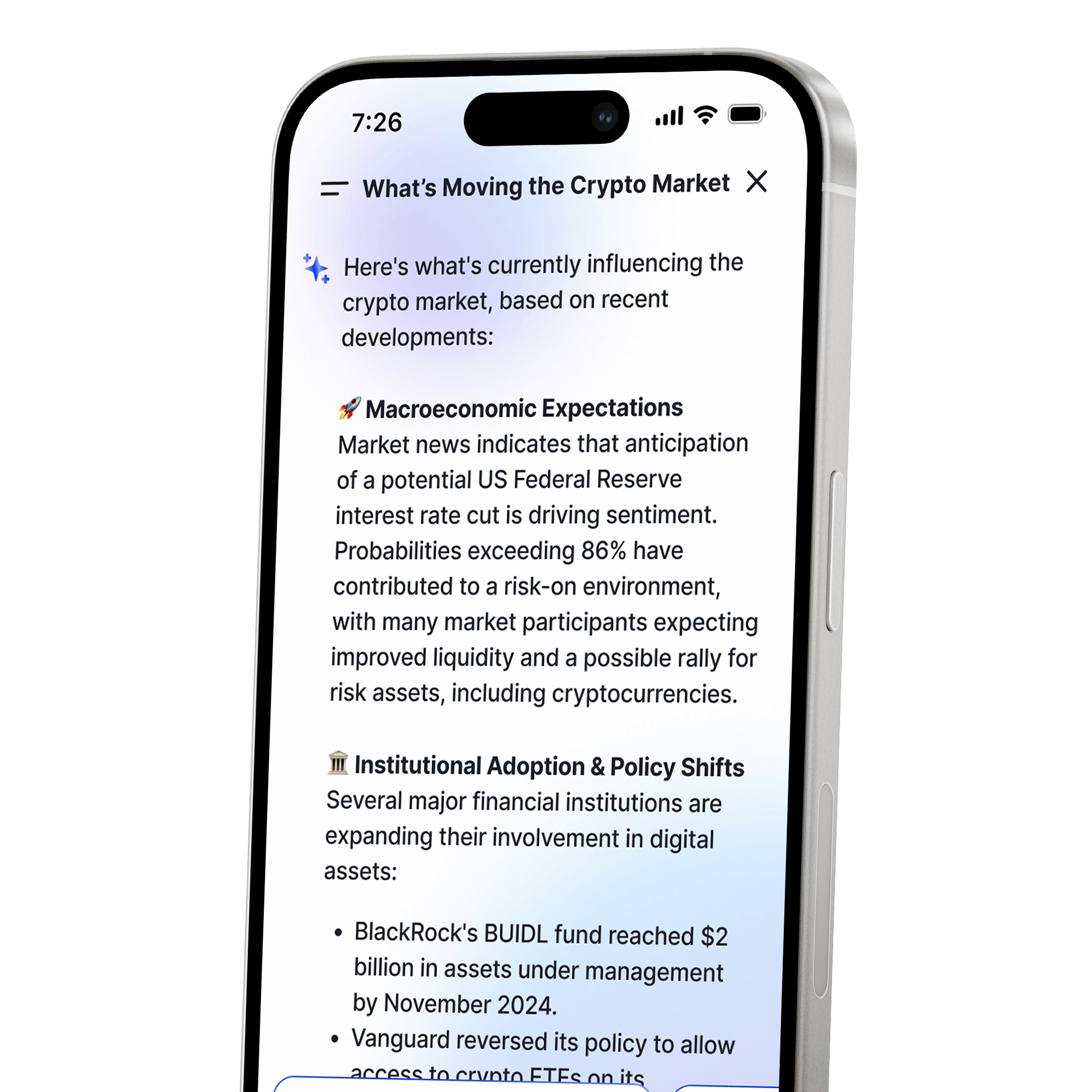
CoinJar AI
Access information about your holdings and the wider cryptocurrency market through CoinJar AI. Ask questions about portfolio changes, market developments or individual cryptocurrencies, with responses informed by your CoinJar holdings.
Learn moreCoinJar AI
Access information about your holdings and the wider cryptocurrency market through CoinJar AI. Ask questions about portfolio changes, market developments or individual cryptocurrencies, with responses informed by your CoinJar holdings.
Learn more
CoinJar OTC
For cryptocurrency trades above $50,000, CoinJar’s OTC desk provides personalised service and access to globally sourced liquidity. Work directly with a dedicated team to arrange and execute your purchase or sale. Discover OTC Services
Learn moreCoinJar OTC
For cryptocurrency trades above $50,000, CoinJar’s OTC desk provides personalised service and access to globally sourced liquidity. Work directly with a dedicated team to arrange and execute your purchase or sale. Discover OTC Services
Learn moreCoinJar does not endorse the content of, and cannot guarantee or verify the safety of any third-party websites. Visit these websites at your own risk.

CoinJar
Get the app.