The world seems quite chaotic these days, and so does crypto, which is increasingly turning to agents to become the next billion users. That is, without even having figured out how to make it fail-safe for humans.
Story One
The crack in DeFi
We’ve come a long way in DeFi, but once in a while, events happen that make you realize we still have a long way to go. The last such event occurred when a trader holding $50 million in aETHUSDT on Aave decided to swap their collateral for Aave.
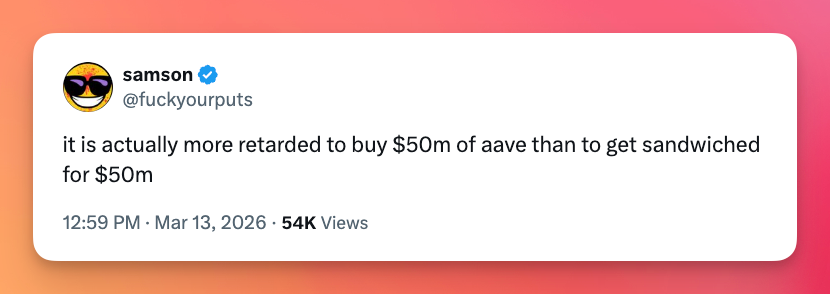
Like any proper degenerate, they initiated the trade on their phone, checked the warning boxes that popped up, and hit sign. A few minutes later, they probably regretted their laissez-faire attitude, as it left them with only $37k worth of Aave in return for their $50 million. Or put otherwise, the largest execution loss of its kind.
What had happened? The Aave frontend routed the trade through CoWswap, an exchange that relies on solvers to offer different quotes at the best price. In the end, because of the order size, an illiquid market, and a problem with their settings, the best quote didn’t win, and one trader got royally rekt.
The money didn’t disappear, but it’s now in the hands of a block builder who made $34 million from the trade and an MEV bot that gained $10 million. While Aave has been quick to point at the trader for accepting the 99% slippage, most on CT seem to agree that this is just horrible UX.

Takeaway: Even if one can lose their money self-sovereignly in crypto, it doesn’t mean that projects should just add checkboxes and call it a day. Be careful when ticking boxes.
Story Two
Do androids dream of agentic commerce?
Yes, because why wouldn't people proud of not having introspection want agents to make their purchasing decisions? That aside, the big remaining question with agents doing commerce isn’t who they’re doing it for, but where.
Enter Tempo, the pet project of Stripe and crypto-VC fallen off grace: Paradigm. It’s the name of a major tissue brand and, now, of a blockchain aiming to become the default payment layer for humans and agents alike. In preparation for the launch, the team has engaged with countless TradFi players to define a machine payment protocol.
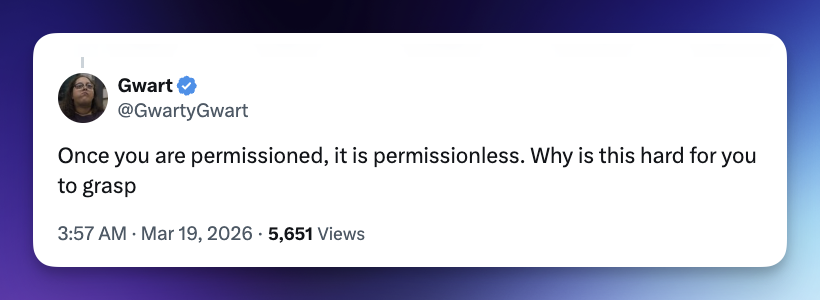
This open standard allows agents to interact not only with Tempo but also with other gateways such as Visa, Stripe, and Lightspark. Tempo is trying to capture the market before it fragments by positioning itself as supposedly neutral. Yet its actions suggest otherwise. After all, if permissionless, why can’t anyone run a validator?
Takeaway: This probably won’t be the last attempt to run a successful blockchain that’s antithetical to web3. If past performance of such chains is anything to go by, it ain’t gonna go far (Just google CordaR3, IBM Hyperledger, Quorum…)
Story Three
The divine money glitch
I’d go out on a limb and claim that much of crypto investment is driven by a desire to unlock a glitch to gain, if not infinite, at least a significant amount of money.

This is, of course, impossible unless you have no conscience and know your way around hacking DeFi protocols.
Last weekend, Reserve Labs halted its protocol to quickly fix a bug in the code that allowed one exploiter to mint $80 million worth of the USR stablecoin against just $100k collateral. As the exploiter proceeded to sell their USR, the coin de-pegged, falling to as low as $0.14 before recovering. So far, the team seems committed to continue running their operations.
While some point to the need for real-time monitoring, the security firm Pashov, which had audited some of Resolve Labs’ modules, noted that the entire exploit sounded like a private key compromise. Once again, exposing humans as the weakest link in the chain.
Takeaway: What’s the point of audits if you can’t audit how responsible teams are handling their private keys? Surely there’s some room for improvement there.
Fact of the Week: ICYMI, all the headings in this newsletter are inspired by novels written by Philip K. Dick. One of them (Do Androids Dream of Electric Sheep?) inspired the movie Blade Runner. It was a major flop, grossing just $41.5 m on release in 1982 on a budget of $30m. In the decades since, however, it's grown in popularity to become a much-appreciated classic to the point where we got a sequel featuring Ryan Gosling.
Naomi for CoinJar
CoinJar’s digital currency exchange services are operated by CoinJar Australia Pty Ltd ACN 648 570 807, a registered digital currency exchange provider with AUSTRAC.
CoinJar Card is a prepaid Mastercard issued by EML Payment Solutions Limited ABN 30 131 436 532 AFSL 404131 pursuant to license by Mastercard. CoinJar Australia Pty Ltd is an authorised representative of EML Payment Solutions Limited (AR No 1290193). We recommend you consider the Product Disclosure Statement and Target Market Determination before making any decision to acquire the product. Mastercard and the circles design are registered trademarks of Mastercard International Incorporated.
Google Pay is a trademark of Google LLC. Apple Pay is a trademark of Apple Inc.
This site is protected by reCAPTCHA and the Google Privacy Policy and Terms of Service apply.