
Story One
Crypto Social for Sale
Been an interesting time to observe what happens to the still-standing crypto social networks.
Aave, a leading DeFi protocol and creator of Lens, shared that they'd be stepping back, leaving Mask Network, a decentralized ID project, to steward the "future of SocialFi". Barely anyone blinked an eye over this on X, which can't be said about the next crypto social team announcing its departure: Farcaster
After DWR, its founder, shared that the protocol is being acquired by Neynar (an infra provider), Crypto Twitter was quick to condemn it, competing for the most deranged takes on a product they'd never bothered to try, completely neglecting that this acquisition might actually be a net positive.

The slander went so far that DWR posted a tweet addressing all the allegations, clarifying that they were returning investor funds and that he'd bought his house, which rose to fame after a feature on Architectural Digest - with proceeds from the Coinbase IPO.
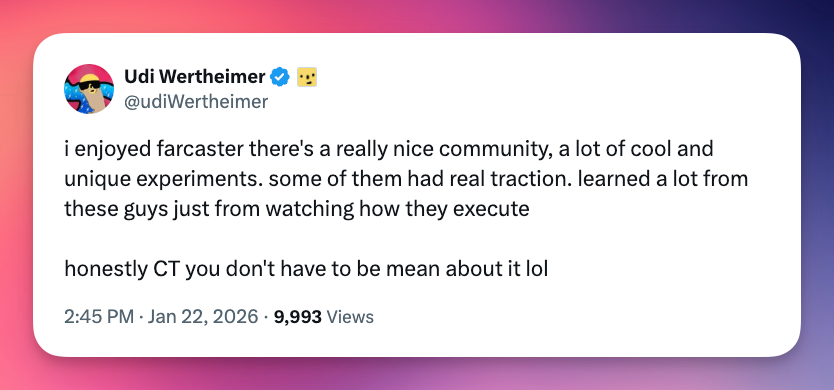
Takeaway: It's funny to see how angry people on X are over a team exiting that at least gave it a very honest shot and built a platform with over 250k monthly active users. Social is hard, and maybe we're not up for the task with so much hater energy.
Story Two
More tokenized securities
Ever so often, crypto people get excited about the prospect of tokenizing everything, whether it be under the label of RWAs (Real World Assets) or in the form of prediction markets that turn every event into something tradeable. But it's not just crypto people; well-established financial institutions, too, have gained a taste for using it for PR purposes.
The latest is the New York Stock Exchange, which revealed that it was developing a tokenized securities platform to provide 24/7 trading, instant settlement, and stablecoin funding for US equities and ETFs. When the world's oldest stock exchange pitches its onchain adventures, it's easy to get your hopes up, spreading the gospel of how Tradfi has recognized the awesomeness of blockchain.
Yet, before you do, I suggest reading the announcement and asking yourself: what aren't they telling us? For one, they haven't gone into any specifics beyond referring to "private blockchains". Neither do we get any idea of the fee structure; after all, it is a for-profit company, not like most crypto businesses that exist as tools to burn VC funds.
Takeaway: Let them build, and when actual details about the platform they're revealing are available, we can have a serious debate.
Story Three
The worst auditor you know wants to go public
If you watched the news recently, you'll have seen coverage from Davos, where Macron's aura-farming served as a boost to European morale and the stock of one Sunglass maker.

The Davos interview you haven't heard of is the one with the co-founder of Certik, who announced they were considering taking Certik public.
Why should you care? Because Certik is by far the worst auditor in the entire crypto industry.
Established in 2018, the company began as a smart contract auditor, serving projects that wanted another pair of eyes to help avoid smart contract vulnerabilities and exploits. Despite a terrible track record that led to the in-joke that anything just Certik-audited was sure to be exploited, they persisted.
Not least because they're not picky with how to make money, including working with a marketplace recently linked to human trafficking and running what looked like a black hat attack on Kraken.
Takeaway: The not-so-secret ingredient is crime. Certik is, at best, a walking cyber insecurity company.
Fact of the Week: Returning to the theme of Architectural Digest, if you ever watched those celebrity home tours, you've probably wondered: Why do all of them have limes at home? I can't answer that, but I can tell you that lime was once a military secret, used by the British Navy to keep its sailors from getting scurvy, giving them a direct advantage over the competition. Perhaps this contributed to the reach of the British Empire.
Naomi for CoinJar
CoinJar’s digital currency exchange services are operated by CoinJar Australia Pty Ltd ACN 648 570 807, a registered digital currency exchange provider with AUSTRAC.
CoinJar Card is a prepaid Mastercard issued by EML Payment Solutions Limited ABN 30 131 436 532 AFSL 404131 pursuant to license by Mastercard. CoinJar Australia Pty Ltd is an authorised representative of EML Payment Solutions Limited (AR No 1290193). We recommend you consider the Product Disclosure Statement and Target Market Determination before making any decision to acquire the product. Mastercard and the circles design are registered trademarks of Mastercard International Incorporated.
Google Pay is a trademark of Google LLC. Apple Pay is a trademark of Apple Inc.
This site is protected by reCAPTCHA and the Google Privacy Policy and Terms of Service apply.