
Buy Ethereum
ETHPast performance is not indicative of future results. All prices are sourced from CoinJar Indices.
What is Ethereum?
Ethereum is a decentralized blockchain network that runs programs called smart contracts, and Ether (ETH) is the cryptocurrency that powers it. ETH is the second-largest cryptocurrency by market capitalization after Bitcoin, and it is the asset you use to pay for transactions, secure the network through staking, and interact with thousands of applications built on Ethereum.
You can buy Ethereum with US dollars on CoinJar, a platform operating since 2013. CoinJar, Inc. is registered with the Financial Crimes Enforcement Network as a money services business and is licensed as a money transmitter, NMLS #2492913. Availability varies by state. Digital assets are not legal tender, are not backed by any government, and are not covered by FDIC or SIPC protection.
What is the Ethereum blockchain?
Ethereum is a public blockchain designed to run code, not just record payments. It launched in July 2015, based on a white paper written by Vitalik Buterin in 2013 and developed with co-founders including Gavin Wood and Joseph Lubin. No company owns it. It is maintained by an open community of developers and thousands of independent validators around the world.
Bitcoin proved a blockchain could track ownership of money without a bank. Ethereum extended that idea to anything a contract can describe, which is why it is often called a programmable blockchain. Lending markets, stablecoins, digital collectibles, exchanges, games, and tokenized real-world assets all run on it. If you want a deeper explainer before you buy, read our guide to what Ethereum is and how it works.
What is ETH used for?
Ether has four main jobs on the network.
- Paying gas fees. Every action on Ethereum, from sending ETH to trading on a decentralized exchange, costs a fee denominated in ETH.
- Securing the network. Validators lock up ETH to confirm transactions and earn rewards for doing so honestly.
- Acting as collateral. ETH is the most widely used collateral asset in decentralized finance, backing loans and stablecoins.
- Settling value between applications. ETH is the common unit of account across Ethereum apps and the Layer 2 networks built on top of it.
How does Ethereum work?
Ethereum runs on a Proof-of-Stake consensus mechanism. Instead of miners competing with computing power, validators deposit 32 ETH each and are selected to propose and verify blocks. Honest validators earn newly issued ETH. Validators that go offline or act maliciously lose part of their stake, a penalty known as slashing.
This design change happened in September 2022 in an upgrade called The Merge, which cut Ethereum's energy use by up to 99.95% according to the Ethereum Foundation's energy consumption analysis. It is the reason Ethereum's environmental footprint is now closer to that of a large web service than a mining industry.
Gas fees and the ETH burn
Gas fees rise and fall with demand for block space. Each transaction pays a base fee that is permanently destroyed, or burned, and a priority fee that goes to the validator. Because ETH is burned with every transaction while new ETH is issued to validators at a low rate, total supply can shrink during periods of heavy use. There are around 120 million ETH in circulation, and unlike Bitcoin there is no fixed maximum supply, just a balance between issuance and burning that shifts with network activity.
Layer 2 networks
Most everyday Ethereum activity now happens on Layer 2 networks such as Arbitrum, Optimism, and Base. These are separate chains that process transactions cheaply and then post compressed data back to Ethereum for final settlement, inheriting its security. The Dencun upgrade in March 2024 introduced a dedicated cheap data format called blobs, which cut Layer 2 fees by more than 95%, and later upgrades including Pectra in May 2025 and Fusaka in December 2025 expanded that capacity further.
Layer 2 fees are still paid in ETH, so this activity feeds back into demand for the asset. Our explainer on blockchain layers breaks down how L1, L2, and L3 fit together.
Ethereum vs Bitcoin: what is the difference?
| Bitcoin (BTC) | Ethereum (ETH) | |
|---|---|---|
| Primary purpose | Store and transfer value | Run programs and settle value |
| Consensus | Proof of Work (mining) | Proof of Stake (staking) |
| Supply | Capped at 21 million | No cap, with a fee burn offsetting issuance |
| Launched | 2009 | 2015 |
| Built on top | Limited | Stablecoins, DeFi, NFTs, Layer 2 networks |
Bitcoin and Ethereum are often held together rather than treated as competitors, since they solve different problems.
Why do people buy Ethereum?
Investors generally buy ETH for one of three reasons. Some want exposure to the infrastructure layer of the digital asset economy rather than a single application, on the view that fees and settlement demand flow to ETH as usage grows. Some want to use the network itself, which requires ETH to pay for anything from swapping tokens to minting an NFT. Others hold it for staking, where locked ETH earns protocol rewards, with rates that vary depending on how much ETH is staked in total.
Institutional access has widened considerably in the United States. Spot Ethereum exchange-traded funds began trading in July 2024 after the SEC approved the first eight issuers, staking-enabled versions followed from late 2025, and a growing number of publicly listed companies now hold ETH on their balance sheets.
None of this makes ETH a low-risk asset. Price swings of 30% or more in a month are common, other smart contract platforms compete directly with Ethereum, applications built on it can be exploited, and the regulatory treatment of tokens and staking continues to change at both federal and state level. Only invest what you can afford to lose.
Buying Ethereum in the US
You can buy Ethereum on CoinJar with US dollars using several payment methods, and hold it in your CoinJar account or withdraw it to a wallet you control. If you would rather hold ETH as part of a diversified position than as a single asset, CoinJar Bundles group multiple cryptocurrencies into one purchase, including a bundle built around ERC-20 tokens that run on Ethereum.
Cash, credit or crypto?
Buy Ethereum instantly using Visa or Mastercard. Get cash in your account fast with bank transfer, Faster Payments, PayID or Osko. Convert crypto-to-crypto with a single click.







How to buy Ethereum with CoinJar
Start your cryptocurrency portfolio with CoinJar by following these simple steps.
Download the app
Get the CoinJar app on iOS or Android.
Create an account
Sign up and verify your ID – it only takes a couple of minutes.
Make a purchase
Buy Bitcoin and more than 60 other cryptos using cash or credit card.
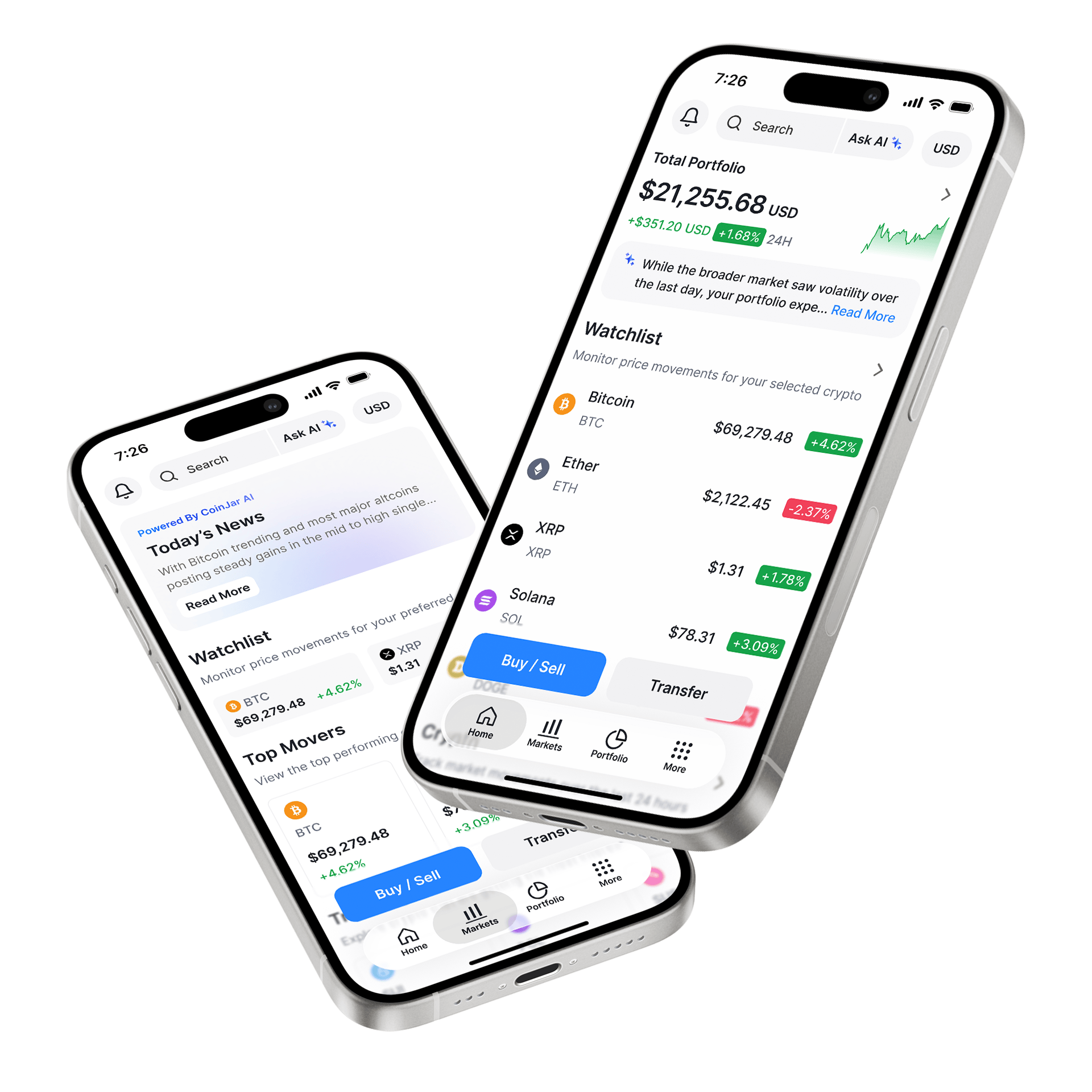
CoinJar App
Buy, sell, send and even spend your crypto with Australia’s favourite cryptocurrency app.
Get the CoinJar appCoinJar App
Buy, sell, send and even spend your crypto with Australia’s favourite cryptocurrency app.
Get the CoinJar app
CoinJar Exchange
With one of the fastest matching engines in the world, CoinJar Exchange is purpose-built for institutions, market makers and professional traders. Features global liquidity, ultra-thin spreads and some of Australia and the UK’s most competitive fees.
Explore CoinJar ExchangeCoinJar Exchange
With one of the fastest matching engines in the world, CoinJar Exchange is purpose-built for institutions, market makers and professional traders. Features global liquidity, ultra-thin spreads and some of Australia and the UK’s most competitive fees.
Explore CoinJar Exchange
CoinJar
Get the app.