
Buy Universal Market Access
UMAPast performance is not indicative of future results. All prices are sourced from CoinJar Indices.
What is Universal Market Access?
UMA is an optimistic oracle: a system for putting answers to real-world questions on a blockchain. Instead of continuously publishing data, it lets somebody make a claim, gives other people time to challenge it and accepts the claim if nobody objects. Disputed claims go to people who have staked UMA, the protocol's token, for a vote.
That model can resolve questions that a conventional price feed cannot, such as whether an event happened, whether an insurance claim is valid or which side won a prediction market. It is also subjective by design. The quality of an answer depends on how the question was written, whether somebody notices a bad claim and how token holders vote when evidence is contested. Our guide to blockchain explains the systems UMA supplies with data, and our guide to decentralized finance covers the wider category UMA operates in.
Where did UMA come from?
UMA was co-founded by former Goldman Sachs traders Hart Lambur and Allison Lu. The project was announced in 2018 and initially focused on Universal Market Access in the literal sense: contracts that could create synthetic exposure to almost any measurable asset without a central issuer.
The UMA token launched in April 2020 through an initial Uniswap offering. An initial supply of 100 million tokens was allocated among the public sale, founders and investors, developers and future token sales. The supply is not fixed because the protocol issues UMA as rewards for staking and voting.
The synthetic-asset tools were the original product, but they are no longer the center of the project. UMA now presents itself primarily as an oracle and dispute-resolution system. Risk Labs Foundation is the core organization behind both UMA and the separate Across bridge protocol.
How does UMA's Optimistic Oracle work?
An integration defines a question and its resolution rules. The process then follows a challenge model.
An assertion is submitted. A person or application proposes an answer and posts a bond in the collateral token selected by the integration. A liveness window begins. Other participants have a fixed period to inspect the claim and its evidence. An undisputed claim settles. If nobody challenges it before the window closes, the protocol accepts the proposed answer without a token-holder vote. A disputed claim escalates. A challenger posts a matching bond and the question is sent to UMA's Data Verification Mechanism. UMA stakers vote. They use a commit-and-reveal process so votes are hidden initially, then revealed in the next phase. The winning side determines the oracle's answer and the bonds are distributed according to the integration's rules.
The bond does not normally have to be UMA. An application can choose a stablecoin or another approved ERC-20 token, and it sets the amount and challenge period according to the value and complexity of the question. UMA is needed at the final voting layer, not for every assertion.
The current UMA documentation describes this as an escalation game. Its security depends on making dishonest claims expensive enough to challenge and making corrupting the final vote more costly than any profit from doing so.
What is the DVM?
The Data Verification Mechanism, or DVM, is UMA's backstop when an optimistic claim is challenged. UMA holders stake tokens and vote on the answer they believe the wider community will recognise as correct.
Voting uses commit and reveal phases. During the first phase, the vote is encrypted. During the second, the voter reveals it. This is intended to reduce copying and late coordination.
Correct participation can earn emissions and a share of penalties. Missing a vote, failing to reveal it or voting against the resolved outcome can reduce a staker's position, with the value redistributed to correct voters. The detailed thresholds and penalty settings are governance parameters and can change.
This is not proof of stake for a blockchain. UMA stakers do not produce blocks or validate Ethereum transactions. They provide economic security for disputed data requests and governance decisions.
What is UMA used for in 2026?
Prediction markets. Markets use UMA to resolve event outcomes when the answer is not available from a simple price feed. Across. The Across cross-chain protocol uses UMA's oracle as a settlement and dispute backstop for claims about transfers. Insurance and claims. Contracts can ask whether a defined event occurred and release funds based on the answer. Data and financial contracts. Applications can request prices or other facts that are difficult to publish through a continuous feed. Governance. UMA holders can vote on protocol upgrades, supported collateral, contract changes and treasury decisions.
One product has explicitly ended. oSnap let decentralized organizations execute successful Snapshot proposals from a Safe wallet using UMA's optimistic process. Support ended on 15 December 2025, and it can no longer execute transactions from a DAO treasury. Old pages presenting oSnap as a current product are out of date.
UMA's original synthetic-asset contracts also remain part of its history rather than its main current pitch. The protocol has not been wound down, but its focus has narrowed to verifying claims.
What does the UMA token actually do?
UMA has two active roles.
Staking and voting. A holder can stake UMA in the voting application and participate when assertions reach the DVM. Correct participation earns protocol emissions and can receive value taken from incorrect or inactive voters.
Governance. Staked token holders vote on upgrades, parameters and administrative proposals.
Simply holding UMA pays nothing. Using an application that relies on UMA also does not normally require the user to own it. Proposers and challengers use whatever bond asset the application selected, while only DVM voters need staked UMA.
The token is inflationary. Rewards are created to encourage enough voting participation to secure the oracle, and governance can change the emission rate. Community discussions in 2025 and 2026 proposed reducing emissions and adding stronger value capture, but I found no live buyback, burn or automatic distribution of protocol revenue to every UMA holder.
What is the relationship between UMA and Across?
Across is a cross-chain protocol built by the same core organization, Risk Labs Foundation. It uses UMA as an oracle and final dispute layer, but it has its own ACX token, governance and economics.
UMA holders do not own Across. Across fees do not automatically flow to UMA holders, and ACX has not been converted into UMA. More Across activity can create more work for UMA's oracle, but that is an indirect connection rather than a revenue right.
In March 2026 Risk Labs proposed restructuring Across into a United States company and offering ACX holders a possible equity exchange or cash exit. The proposal was presented for discussion and did not migrate UMA, close its oracle or change the UMA token.
This shared-team structure is both a strength and a risk. Across gives UMA a substantial real integration, but the organization's attention and commercial value can accumulate around Across without necessarily benefiting UMA holders.
Why prediction-market resolutions have been controversial
UMA's oracle does not discover an objective truth by itself. It enforces the resolution rules supplied by the application, and ambiguous wording can produce an outcome that traders consider unfair.
A Polymarket dispute in March 2025 became the best-known example. A large UMA holder supplied a substantial share of the voting power in a disputed market concerning a Ukraine minerals agreement, and the market resolved in a way many traders contested. Critics described the result as whale manipulation.
This was not reported as a smart-contract exploit. It was the governance system producing a valid onchain result under concentrated voting and disputed interpretation. That distinction does not make the concern disappear. It shows the central risk in token-weighted truth: enough voting power can determine what the contracts accept, even when outside observers disagree.
UMA has commit-and-reveal voting, participation thresholds, bonds and penalties to make corruption difficult. None guarantees that every subjective market will resolve in the way ordinary readers expect.
Who controls UMA?
UMA governance can approve contract upgrades, parameter changes and treasury actions. Token holders participate through the DVM's voting system.
The protocol also has administrative and emergency mechanisms intended to stop malicious proposals or respond to a critical problem. Those powers involve specialized contracts, proposers and operational signers rather than every token holder acting directly.
Risk Labs develops the software, maintains interfaces and proposes much of the roadmap. Governance can control defined onchain functions, but the foundation and core team remain important dependencies for development, communication and integrations.
UMA publishes security reviews and maintains a bug bounty. The audit and bug bounty page lists reviews of its oracle and related contracts. Audits reduce the chance of a defect but cannot resolve ambiguous questions or prevent token holders voting strategically.
Regulatory position
I found no enforcement action naming UMA or Risk Labs as the issuer of an unlawful asset in the sources reviewed for this page.
UMA was not among the crypto assets named as digital commodities in the joint interpretation published by the United States Securities and Exchange Commission and Commodity Futures Trading Commission on 17 March 2026. That is not a finding against UMA. It means the asset was not addressed either way.
Prediction markets and cross-chain services operate in areas that attract regulatory scrutiny. Action against an application using UMA can reduce demand for the oracle even when the protocol itself is not the target.
What are the risks of holding UMA?
Token-weighted truth. A sufficiently large or coordinated voting bloc can determine disputed outcomes. Economic incentives do not guarantee a commonsense result. Question ambiguity. The oracle answers the question it receives. Poor wording, unclear evidence or conflicting sources can create controversy without any code failing. No compulsory user demand. Most people using a UMA-powered application do not need UMA. Bonds are generally posted in another token. Inflation. UMA is not hard capped. New tokens fund staking and voting rewards, diluting holders who do not participate. No automatic revenue right. Holding UMA does not provide a claim on Risk Labs, Across revenue or every bond and fee paid through the oracle. Staking penalties. Stakers can lose value for missing votes, failing to reveal or voting against the final outcome. Voting requires ongoing attention and judgment. Across dependence. One of UMA's most important integrations is built by the same organization. Problems or restructuring at Across can reduce oracle activity. Product retirement. oSnap was discontinued, and the original synthetic-asset focus has receded. Other integrations can also be withdrawn. Governance and administrative risk. Upgrades and emergency mechanisms depend on token voting, specialized contracts and operational participants. Smart contract risk. A defect in the oracle, an adapter or an integrating application can misdirect funds or make resolution impossible. Competition. UMA competes with Chainlink, Pyth, Reality.eth and application-specific resolution systems. Not every data problem needs an optimistic human vote. Liquidity. UMA trades thinly compared with major assets, which can widen spreads and increase the cost of getting out. Volatility. UMA is not a stablecoin. Its value moves sharply and can fall substantially. No consumer protection. Crypto assets held on a trading platform are not bank deposits. UMA is not covered by FDIC deposit insurance or by SIPC protection. You should be prepared to lose the money you put in.
Buying UMA with US dollars on CoinJar
CoinJar has operated since 2013 and lists UMA against US dollars, so you can buy, sell and hold it without converting through another cryptocurrency first. Current charges are on our fees page, and live US dollar rates are on our cryptocurrency prices page.
CoinJar, Inc. is registered with FinCEN as a money services business, NMLS ID 2492913, and holds money transmitter licenses in a growing number of states. You can check whether CoinJar operates in your state before signing up.
How is UMA taxed in the United States?
The IRS treats digital assets such as UMA as property. A taxable disposal can occur when you sell it for US dollars, trade it for another cryptocurrency, spend it or give it away.
The IRS sets out its approach on its digital assets page. Our guide to reporting your transaction history explains how to get the records you need. This is general information, not tax advice. Consider speaking to a qualified tax adviser about your circumstances.
Cash, credit or crypto?
Buy Universal Market Access instantly using Visa or Mastercard. Get cash in your account fast with bank transfer, Faster Payments, PayID or Osko. Convert crypto-to-crypto with a single click.







How to buy Universal Market Access with CoinJar
Start your cryptocurrency portfolio with CoinJar by following these simple steps.
Download the app
Get the CoinJar app on iOS or Android.
Create an account
Sign up and verify your ID – it only takes a couple of minutes.
Make a purchase
Buy Bitcoin and more than 60 other cryptos using cash or credit card.
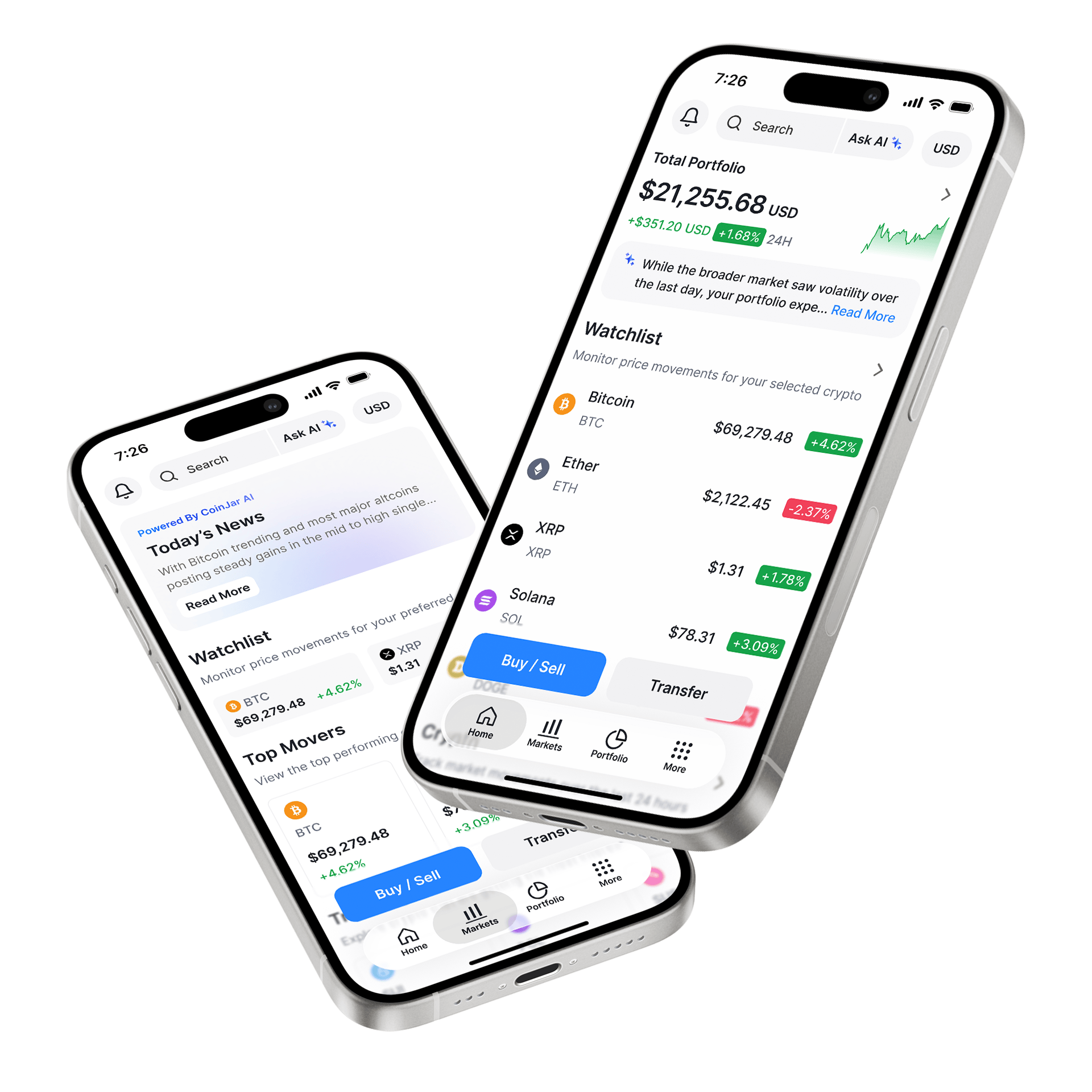
CoinJar App
Buy, sell, send and even spend your crypto with Australia’s favourite cryptocurrency app.
Get the CoinJar appCoinJar App
Buy, sell, send and even spend your crypto with Australia’s favourite cryptocurrency app.
Get the CoinJar app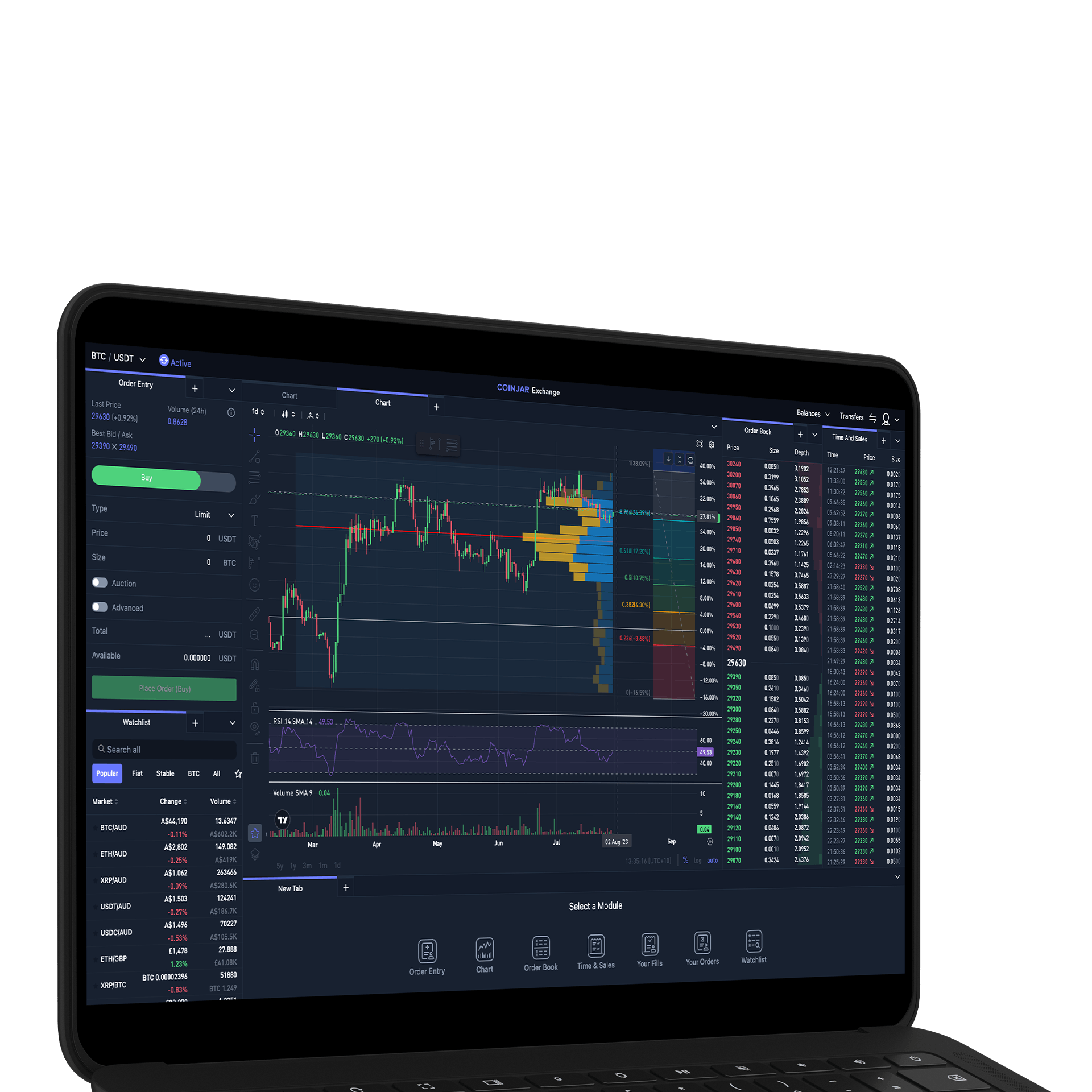
CoinJar Exchange
With one of the fastest matching engines in the world, CoinJar Exchange is purpose-built for institutions, market makers and professional traders. Features global liquidity, ultra-thin spreads and some of Australia and the UK’s most competitive fees.
Explore CoinJar ExchangeCoinJar Exchange
With one of the fastest matching engines in the world, CoinJar Exchange is purpose-built for institutions, market makers and professional traders. Features global liquidity, ultra-thin spreads and some of Australia and the UK’s most competitive fees.
Explore CoinJar Exchange
CoinJar
Get the app.