
Buy Balancer
BALPast performance is not indicative of future results. All prices are sourced from CoinJar Indices.
What is Balancer?
Balancer is a decentralized exchange protocol and, more accurately, a toolkit for building automated market makers. Instead of one fixed pool design, it lets anyone create liquidity pools with custom rules: different numbers of tokens, uneven weightings, and specialized math for assets that are meant to track each other. BAL is its governance token.
Two things about it have changed materially and both matter more than any general description of the protocol. Balancer's version two contracts were exploited in November 2025, and in 2026 the project restructured its token economics and its organisation. Both are covered below. Our guide to decentralized finance explains the wider category, and our guide to Ethereum covers the network Balancer started on.
What makes Balancer different from other exchanges
Most automated market makers give you one pool shape: two tokens, split evenly by value. Balancer's original idea was to loosen that.
Custom weights. A pool can hold two tokens at eighty and twenty percent, or several tokens at whatever split the creator chooses, and the pool rebalances itself through trading rather than through a manager. More than two assets. A single pool can hold multiple tokens, which lets a pool behave something like a self rebalancing index. Pools for correlated assets. Stable pools use different math suited to assets designed to hold the same value, such as stablecoins or staked versions of the same token. Yield bearing liquidity. Boosted pools are built so that idle liquidity can sit in yield bearing tokens rather than doing nothing between trades.
The practical result is that Balancer has often been used as infrastructure by other projects, which build their liquidity on it, rather than as a destination people visit to swap tokens.
Balancer version three
Version three reorganized where the complexity lives. A single vault holds the tokens and does the accounting for every pool, while each pool contract handles only the math specific to its design. That makes new pool types much simpler to build.
The other significant addition is hooks: optional code that runs before or after a pool's core operation, allowing a builder to attach custom behaviour such as dynamic fees or access rules. Version three also handles rate scaling for yield bearing tokens at the vault level, so the yield those tokens accrue is not quietly captured by arbitrage traders.
Hooks cut both ways. They make pools far more flexible, and they mean two pools on the same protocol can carry very different risk. A pool is only as safe as the code attached to it.
The November 2025 exploit
On 3 November 2025 an attacker drained Balancer version two composable stable pools across several networks. Public estimates of the loss ranged from roughly one hundred million to well over that, and protocols that had forked Balancer's code were hit at the same time.
The cause was not a stolen key or a governance takeover. It was a rounding error. In a specific swap path the pool's math rounded a value in the wrong direction, and by chaining a large number of tiny swaps the attacker compounded that fractional error into a distortion of the pool's price, then extracted the difference.
Some funds were recovered by white hat actors and by teams working during the attack, and the DAO subsequently worked through a plan to distribute rescued assets back to affected liquidity providers on a per pool basis. Recovery was partial. Most of what was taken was not returned.
Two lessons sit in this for anyone assessing BAL. Audited, long running, heavily used contracts can still contain deep flaws, and precision bugs in financial math are among the hardest to find. And the exploit hit version two, the older code base, which is a reminder that a protocol's risk lives in whatever is still deployed and holding money, not only in its newest release.
What BAL is, after the 2026 restructuring
BAL began as a liquidity mining token, emitted continuously to reward people who supplied liquidity, and later as veBAL, a vote escrowed model in which holders locked tokens for up to a year to direct those emissions and receive a share of protocol fees.
That model has been dismantled. Through governance decisions taken in 2026, emissions were halted entirely, veBAL was discontinued, all protocol fees now route to the DAO treasury rather than to lockers, and voting moved to a straightforward one token one vote model on Snapshot using BAL held across the chains where it is deployed. The proposals also authorized a voluntary buyback, funded from treasury stablecoins and priced against the treasury's net asset value per token, with purchased BAL burned.
Be very clear about what this leaves. BAL is a governance token with a supply capped by its contract at one hundred million, no ongoing issuance, and no protocol fee stream flowing to holders. Its value rests on governance rights over a treasury and a protocol, and on whatever the market judges those to be worth. Any article describing veBAL lock ups, gauge voting, bribes or a holder fee share is out of date. The Balancer documentation is the current reference.
Who actually runs Balancer now
Balancer Labs, the company that built the protocol, was wound down as part of the same restructuring. Operations were consolidated into a smaller structure with a reduced budget, run through a foundation and an operating entity with a service provider handling day to day execution, and on chain actions carried out by multisignature wallets.
Governance is off chain signaling. BAL holders vote on Snapshot, proposals are discussed on a public forum first, and there is a quorum requirement. Major changes such as new pool factories, new chain deployments and anything affecting the token supply go to a vote, while operational matters sit with the core team under a mandate.
That is a lean structure, and lean cuts both ways. It reduces the risk of a large team burning through a treasury, and it concentrates a great deal of practical influence in a small group and in the keys that execute decisions.
Which network is your BAL on?
BAL is natively an ERC-20 token on Ethereum, and the Balancer protocol is deployed on a number of other networks compatible with the Ethereum Virtual Machine. Representations of BAL exist on several of those chains.
Addresses are not interchangeable between networks. Sending BAL to an address on a network the receiving wallet or exchange does not support is one of the most common ways people permanently lose tokens, and it usually cannot be reversed. Before any transfer, confirm which network the destination expects and make sure the network you are sending from matches. Our guide to sending crypto on the wrong network covers what can and cannot be recovered.
What are the risks of holding BAL?
No income to holders. Protocol fees go to the treasury, not to BAL holders. Holding the token pays nothing, and there is no yield attached to it. Governance value is hard to price. BAL's remaining function is a vote. That is worth something only if the protocol and treasury it governs remain worth something. Demonstrated smart contract risk. Balancer suffered a major exploit in November 2025 in code that had been live and audited for years. Automated market makers are complex, and hooks and custom pools add more surface area. Reputational and liquidity damage. A large exploit drives liquidity providers away, and liquidity is the product for an exchange protocol. Recovering it takes time and is not guaranteed. Restructuring risk. The project now runs on a reduced budget with a small team. That is a deliberate response to a difficult year, and it lowers the capacity available to build and defend the protocol. Concentrated execution. Votes are signaled off chain and executed by multisignature wallets. Voter participation in tokens like BAL is typically low and concentrated. Competition. Decentralised exchange liquidity is fiercely contested, and the largest venues have far more of it. Volatility and liquidity. BAL can move sharply, and market depth can thin out quickly in a downturn. No consumer protection. Crypto assets are high risk and your capital is at risk. BAL is not insured by the Federal Deposit Insurance Corporation and it is not protected by the Securities Investor Protection Corporation. You should be prepared to lose all the money you put in.
Buying BAL with US dollars on CoinJar
CoinJar has operated since 2013 and lists BAL against US dollars, so you can buy, sell and hold it without converting through another cryptocurrency first. Current charges are on our fees page, and live US dollar rates are on our cryptocurrency prices page.
CoinJar, Inc. is registered with FinCEN as a money services business and holds money transmitter licenses in a growing number of states, NMLS ID 2492913. You can check whether CoinJar operates in your state before you sign up.
How is BAL taxed in the US?
The IRS generally treats BAL as property. A taxable event can occur when you sell it for US dollars, exchange it for another cryptocurrency, spend it or give it away.
The IRS explains these rules on its digital assets guidance page. Our guide to downloading your transaction history for tax shows how to get the records you need. This is general information, not tax advice. Consider speaking to a qualified tax professional about your circumstances.
Cash, credit or crypto?
Buy Balancer instantly using Visa or Mastercard. Get cash in your account fast with bank transfer, Faster Payments, PayID or Osko. Convert crypto-to-crypto with a single click.







How to buy Balancer with CoinJar
Start your cryptocurrency portfolio with CoinJar by following these simple steps.
Download the app
Get the CoinJar app on iOS or Android.
Create an account
Sign up and verify your ID – it only takes a couple of minutes.
Make a purchase
Buy Bitcoin and more than 60 other cryptos using cash or credit card.
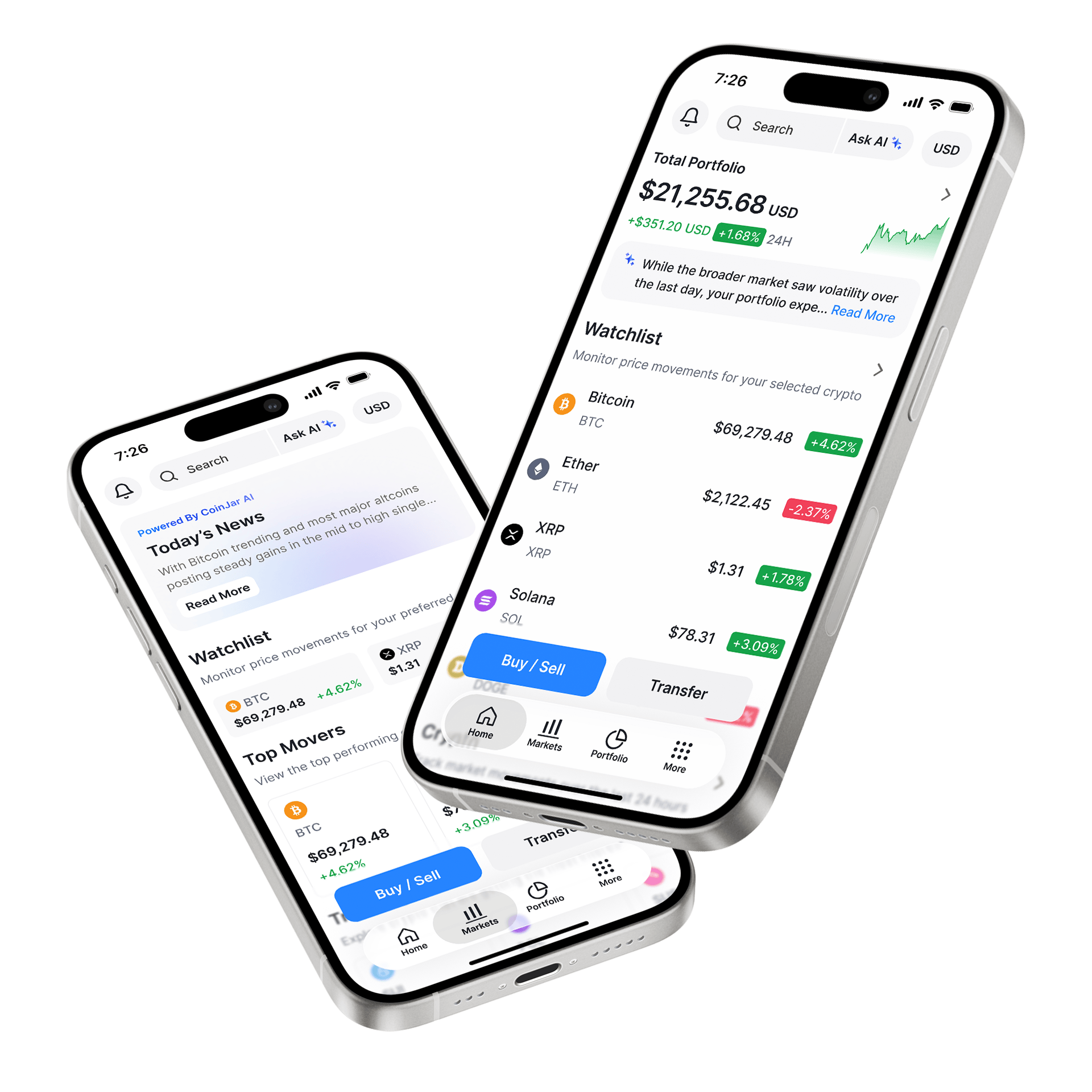
CoinJar App
Buy, sell, send and even spend your crypto with Australia’s favourite cryptocurrency app.
Get the CoinJar appCoinJar App
Buy, sell, send and even spend your crypto with Australia’s favourite cryptocurrency app.
Get the CoinJar app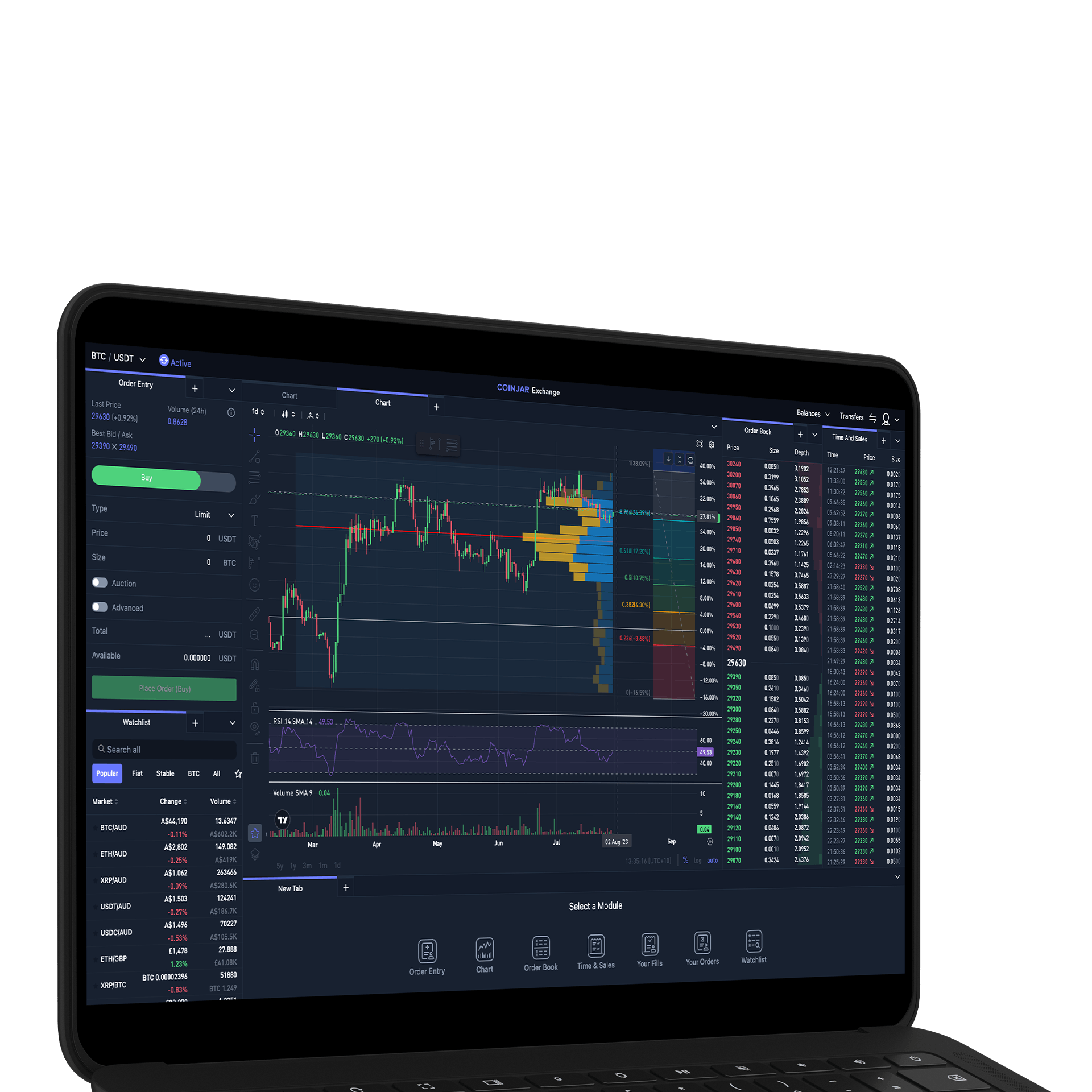
CoinJar Exchange
With one of the fastest matching engines in the world, CoinJar Exchange is purpose-built for institutions, market makers and professional traders. Features global liquidity, ultra-thin spreads and some of Australia and the UK’s most competitive fees.
Explore CoinJar ExchangeCoinJar Exchange
With one of the fastest matching engines in the world, CoinJar Exchange is purpose-built for institutions, market makers and professional traders. Features global liquidity, ultra-thin spreads and some of Australia and the UK’s most competitive fees.
Explore CoinJar Exchange
CoinJar
Get the app.