
Buy Fetch.ai
FETPast performance is not indicative of future results. All prices are sourced from CoinJar Indices.
What is Fetch.ai?
Fetch.ai is a network for autonomous agents: software that can act on behalf of a person or a business, find other agents, negotiate with them and settle payments without a human approving every step. FET is the cryptocurrency that pays for that activity and secures the network it runs on.
The project launched in 2017 out of Cambridge in the United Kingdom, and in 2024 it became a founding member of the Artificial Superintelligence Alliance, a group of artificial intelligence projects that consolidated their separate tokens into FET. Our guide to AI and cryptocurrency covers the wider category Fetch.ai belongs to, and our guide to altcoins explains where tokens like FET sit relative to Bitcoin.
What does Fetch.ai actually do?
An agent, in Fetch.ai's sense, is a small program with its own identity, its own wallet and a set of instructions. It can be as simple as a service that watches a price and reports back, or as involved as one that books a resource, compares offers and pays for the winner.
The network gives those agents the things they need to work together:
Identity and discovery. Agents register themselves in an on-chain registry, which lets other agents search for a service by what it does rather than by knowing its address in advance. Communication. Agents exchange messages using a shared protocol, so software written by different developers can still negotiate. Payment. Because each agent controls a wallet, an agreement between two agents can settle in the same step it is made. Developer tooling. The Fetch.ai framework for building agents is open source, and the project runs a hosting environment so an agent can stay online without the developer maintaining a server.
It is worth being plain about the maturity of this. The tooling is real and in use by developers, but an economy of autonomous agents transacting at scale is a long term goal rather than a description of the present. Buying FET is exposure to whether that goal is reached.
Is FET the same thing as ASI?
This is the most common question about the asset, and the source of most of the outdated information circulating about it.
FET is the token of the Artificial Superintelligence Alliance. The Alliance brands the asset as ASI, and market data sites often display the Alliance name rather than Fetch.ai. The traded ticker is still FET.
The Alliance's published plan has always included a final phase in which the FET ticker is formally transitioned to ASI, alongside a network upgrade. The Alliance describes that phase as pending, and has not attached a date to it. The practical consequence is straightforward: FET is the asset, and there is nothing for a holder to swap, bridge or claim in order to keep holding it.
Two things follow from that, and both matter more than the naming itself.
If a formal ticker change does happen, it would be announced by the Alliance and handled at the network and exchange level. It would not require you to visit a website, connect a wallet and approve a transaction. Token migrations are one of the most reliably exploited settings in cryptocurrency, and a page offering to convert FET for you is far more likely to be a phishing site than an official one. The Alliance's ASI token page is the authoritative reference for the token's status.
FET held in a CoinJar account is FET. CoinJar does not convert it into a different asset on your behalf.
How does the Fetch.ai network work?
Fetch.ai runs its own blockchain, built with the Cosmos SDK and secured by proof of stake. Validators are selected by the amount of FET staked to them, they propose and confirm blocks, and they can be penalized for going offline or signing conflicting blocks. Holders who do not run a validator can delegate their FET to one and share in the rewards, which is the standard delegated model described in our guide to crypto staking.
Transaction fees are paid in FET. Governance is on chain and weighted by tokens, so proposals to change network parameters, fund work or approve upgrades are decided by holders and validators rather than by a company. The Fetch.ai network documentation is the primary technical source for how validation and delegation are configured.
Which network is your FET on?
FET exists in more than one place. There is the native token on the Fetch.ai chain, and there are representations of the same asset on other networks, including Ethereum, BNB Chain and Cardano. They are the same asset in economic terms, but they are not interchangeable at the address level.
This is the single most common way people lose FET. An address that is valid on one network is not valid on another, and a transfer sent to the wrong network can be unrecoverable. Before sending FET anywhere, confirm which network the receiving wallet or exchange expects, and confirm that the network you are sending from matches it.
What is FET used for?
Network fees. Transactions on the Fetch.ai chain are paid for in FET. Staking. FET is staked or delegated to validators to secure the chain, and stakers share in rewards. Governance. Holders vote on proposals that change how the network operates. Agent activity. Registering an agent and using network services is paid for in FET. Access to Alliance products. The Alliance's members build artificial intelligence services, such as running queries against their models or renting computing power, and FET is the token those services are priced and paid in.
What are the risks of holding FET?
Narrative risk. FET trades as an artificial intelligence asset, which means it tends to move with sentiment about artificial intelligence generally rather than with usage of the Fetch.ai network. That works in both directions. Execution risk. Much of the case for the token rests on future delivery: broader agent adoption, further consolidation of the Alliance's technology, and infrastructure that is still being built. Roadmaps in this sector slip routinely. Alliance risk. The Alliance is a coalition of separate organizations, and coalitions can fracture. Ocean Protocol, one of the original members, withdrew in 2025 and the separation was disputed. Governance disagreements between members are a live risk to the project's direction. Identity confusion. The unfinished rename creates persistent ambiguity about what the asset is called, which makes holders easier to target with fraudulent migration offers. Competition. Fetch.ai competes with other decentralized artificial intelligence projects for developers, capital and attention, and with conventional cloud and software providers that are not on a blockchain at all. Technical risk. Proof of stake networks, cross chain representations of a token and the contracts that support them can all fail or be exploited. Volatility. FET is not a stablecoin. Its value moves sharply and can fall substantially. No government compensation. Digital assets are not deposits. They are not insured by the FDIC and they are not protected by SIPC. If you lose value, there is no compensation scheme to fall back on.
Buying FET with US dollars on CoinJar
CoinJar has operated since 2013 and lists FET against US dollars, so you can buy, sell and hold it without converting through another cryptocurrency first. Current charges are on our fees page, and live US dollars rates are on our cryptocurrency prices page.
CoinJar, Inc. is registered with FinCEN as a money services business, NMLS ID 2492913, and holds money transmitter licenses in a growing number of states. You can check whether CoinJar operates in your state before signing up.
How is FET taxed in the US?
The IRS generally treats FET as property. A taxable event can occur when you sell it for US dollars, exchange it for another cryptoasset, spend it or give it away.
The IRS explains these rules on its digital assets page. Our guide to downloading a transaction history report for tax shows how to get the records you need. This is general information, not tax advice. Consider speaking to a qualified tax professional about your circumstances.
Cash, credit or crypto?
Buy Fetch.ai instantly using Visa or Mastercard. Get cash in your account fast with bank transfer, Faster Payments, PayID or Osko. Convert crypto-to-crypto with a single click.







How to buy Fetch.ai with CoinJar
Start your cryptocurrency portfolio with CoinJar by following these simple steps.
Download the app
Get the CoinJar app on iOS or Android.
Create an account
Sign up and verify your ID – it only takes a couple of minutes.
Make a purchase
Buy Bitcoin and more than 60 other cryptos using cash or credit card.
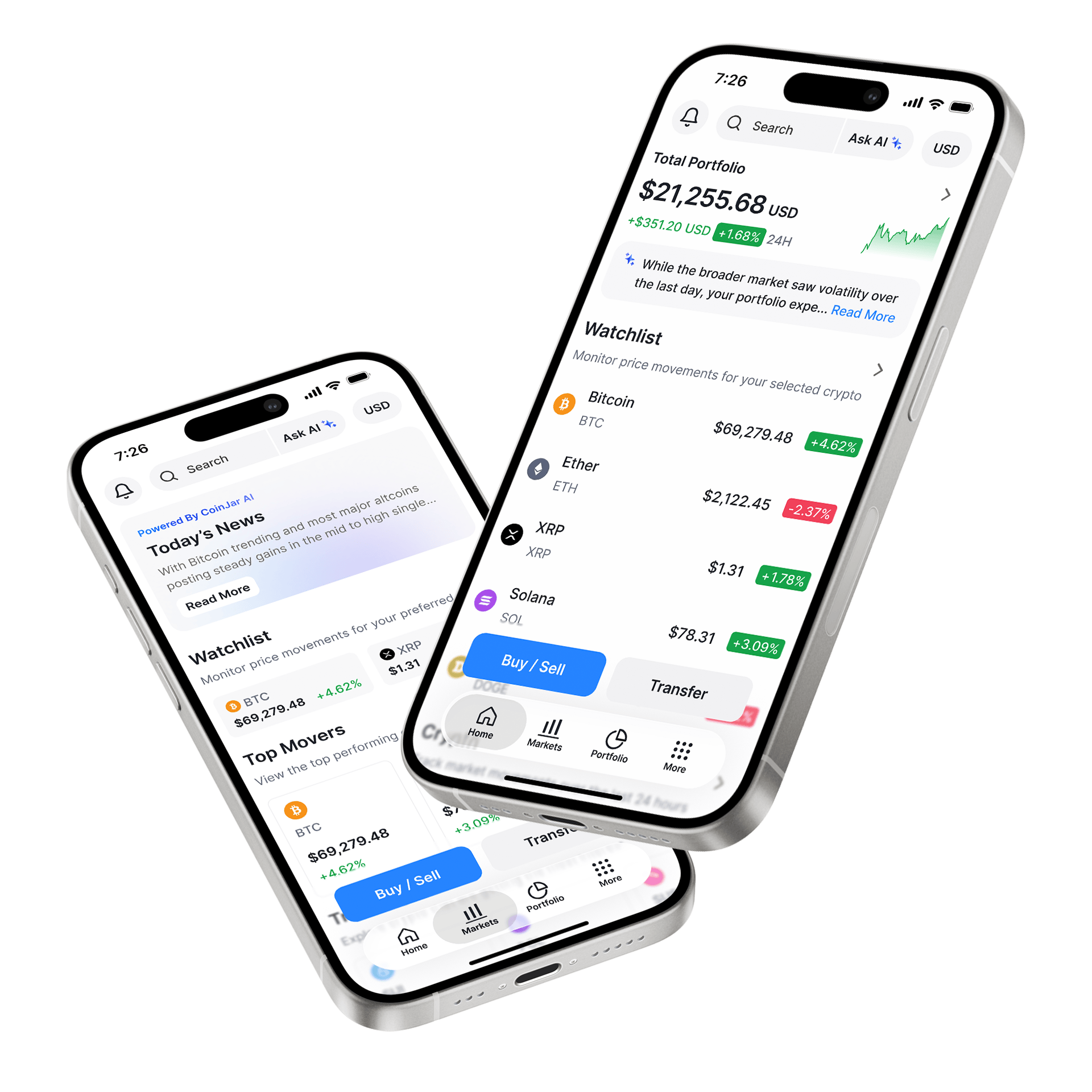
CoinJar App
Buy, sell, send and even spend your crypto with Australia’s favourite cryptocurrency app.
Get the CoinJar appCoinJar App
Buy, sell, send and even spend your crypto with Australia’s favourite cryptocurrency app.
Get the CoinJar app
CoinJar Exchange
With one of the fastest matching engines in the world, CoinJar Exchange is purpose-built for institutions, market makers and professional traders. Features global liquidity, ultra-thin spreads and some of Australia and the UK’s most competitive fees.
Explore CoinJar ExchangeCoinJar Exchange
With one of the fastest matching engines in the world, CoinJar Exchange is purpose-built for institutions, market makers and professional traders. Features global liquidity, ultra-thin spreads and some of Australia and the UK’s most competitive fees.
Explore CoinJar Exchange
CoinJar
Get the app.