
Buy Jupiter
JUPPast performance is not indicative of future results. All prices are sourced from CoinJar Indices.
What is Jupiter?
Jupiter is a group of trading and decentralized finance apps built on the Solana blockchain. It started as a swap aggregator. When you trade one Solana token for another, Jupiter compares prices across many decentralized exchanges and routes the order through whichever path gives the best result. It has since added limit orders, recurring buys, perpetual futures, lending through Jupiter Lend, a mobile wallet and other products.
JUP is Jupiter's token. It launched in January 2024 through an airdrop to people who had used the platform. Buying JUP gives you exposure to Jupiter as a whole rather than to any single product.
What JUP is, and what it isn't
At the contract level, JUP is a standard SPL token on Solana. Its mint and freeze authorities have been removed, so no new JUP can be created and nobody can freeze holders' tokens. Supply can still fall, because burns remove tokens permanently.
You don't need JUP to use Jupiter. Swaps, perpetual futures and lending are paid for in Solana or in the tokens being traded, not in JUP.
JUP's main role is governance. Holders who stake it can vote in the Jupiter DAO and earn rewards for taking part. Holding JUP gives you no equity in the companies behind Jupiter and no direct share of its fees, as Jupiter's token documentation explains.
How the Litterbox Trust works
Jupiter links JUP to platform activity through a buyback. A share of its onchain revenue is used to buy JUP on the open market, and those tokens go into the Litterbox Trust, a long-term reserve.
The tokens are held, not paid out to holders. What happens to them is decided separately. In November 2025 DAO voters approved burning the tokens the trust had collected up to that point, and any further burn needs a further decision. The share of revenue used for buybacks is not fixed by code and can change.
Staking and governance
Staking JUP lets you vote on DAO proposals, which mostly cover how community token reserves are used and how many new tokens are released. Stakers who vote earn Active Staking Rewards, paid in JUP. Unstaking is not instant: there is a cooldown before you can claim your tokens, explained in Jupiter's staking guide.
Governance has been uneven. In June 2025 the Jupiter team paused all DAO votes for the rest of the year, saying the structure had led to a breakdown in trust, as CoinDesk reported. Voting returned in 2026, when the DAO approved a net-zero emissions plan. It suspended new team token emissions, postponed the annual airdrop and committed Jupiter to buy back tokens to offset unlocks by early investors.
Who controls Jupiter
Jupiter was co-founded by a pseudonymous developer known as Meow and by Siong Ong. The Jupiter interface is provided by Block Raccoon S.A., and its terms of use are governed by the laws of Panama.
The core team builds and runs the apps and the onchain programs behind them. DAO votes cover token matters, not day-to-day product decisions. Team and community token allocations sit in multisig wallets rather than on a schedule fixed by code, so when those tokens are released depends on team decisions and DAO votes.
Track record
Jupiter has become one of the most used apps on Solana. Its history also includes several setbacks:
- Supply reset, January 2025. Jupiter burned a large part of the unreleased team and community allocation, almost all of it tokens that had not yet entered circulation. A community audit lists the transactions.
- Social media hack, February 2025. Attackers took over Jupiter's main X account and used it to promote scam memecoins. People who bought those coins lost money. The incident involved social media accounts, not Jupiter's onchain programs. CoinMarketCap covered what happened.
- Jupiter Lend dispute, December 2025. Jupiter had described the vaults in its lending product as isolated, with no risk of losses spreading between them. A rival Solana lending protocol challenged this. Kash Dhanda, Jupiter's COO, later said the claim was not fully correct and confirmed that collateral is reused within the protocol, while defending how the vaults are designed. FinanceFeeds covered the dispute.
- Airdrop postponed, 2026. The DAO postponed the annual airdrop as part of its plan to limit new supply, and the tokens set aside for it went back to a community reserve.
Risks to understand
- Volatility. JUP's price can move sharply in both directions, and it tends to follow trading activity on Solana.
- No revenue right. Buybacks go into a reserve rather than to holders, and their size depends on Jupiter's revenue and on decisions that can change.
- Unreleased reserves. Large team and community allocations have not yet been released. Pausing emissions was a DAO decision, and a later vote could release tokens again.
- Concentrated control. A small team runs the products, has strong influence over governance and has paused voting before.
- Product risk. Jupiter runs perpetual futures, lending and other complex products. A failure in any of them could damage the platform and the token.
- Regulatory risk. Jupiter does not serve some countries, including the United States, and rules for DeFi platforms continue to change.
- No government protection. JUP is not a bank deposit. It is not FDIC insured and not SIPC protected.
Send JUP on the right network
JUP is a Solana token. Use the network CoinJar specifies for deposits and withdrawals, and only send it to a wallet that supports Solana tokens. Fake tokens using the Jupiter name are common, so check the contract address rather than the ticker. The genuine JUP mint address is JUPyiwrYJFskUPiHa7hkeR8VUtAeFoSYbKedZNsDvCN.
Our guides to transferring crypto on the wrong network and setting up a Phantom wallet explain what to check.
Buying JUP on CoinJar
CoinJar has operated since 2013 and lists JUP against US dollars, so you can buy, sell and hold it without converting through another cryptocurrency first. Current charges are on our fees page, and live US dollar rates are on our cryptocurrency prices page. Before you buy, check whether CoinJar operates in your state.
Cash, credit or crypto?
Buy Jupiter instantly using Visa or Mastercard. Get cash in your account fast with bank transfer, Faster Payments, PayID or Osko. Convert crypto-to-crypto with a single click.


How to buy Jupiter with CoinJar
Start your cryptocurrency portfolio with CoinJar by following these simple steps.
Download the app
Get the CoinJar app on iOS or Android.
Create an account
Sign up and verify your ID – it only takes a couple of minutes.
Make a purchase
Buy Bitcoin and more than 60 other cryptos using cash or credit card.
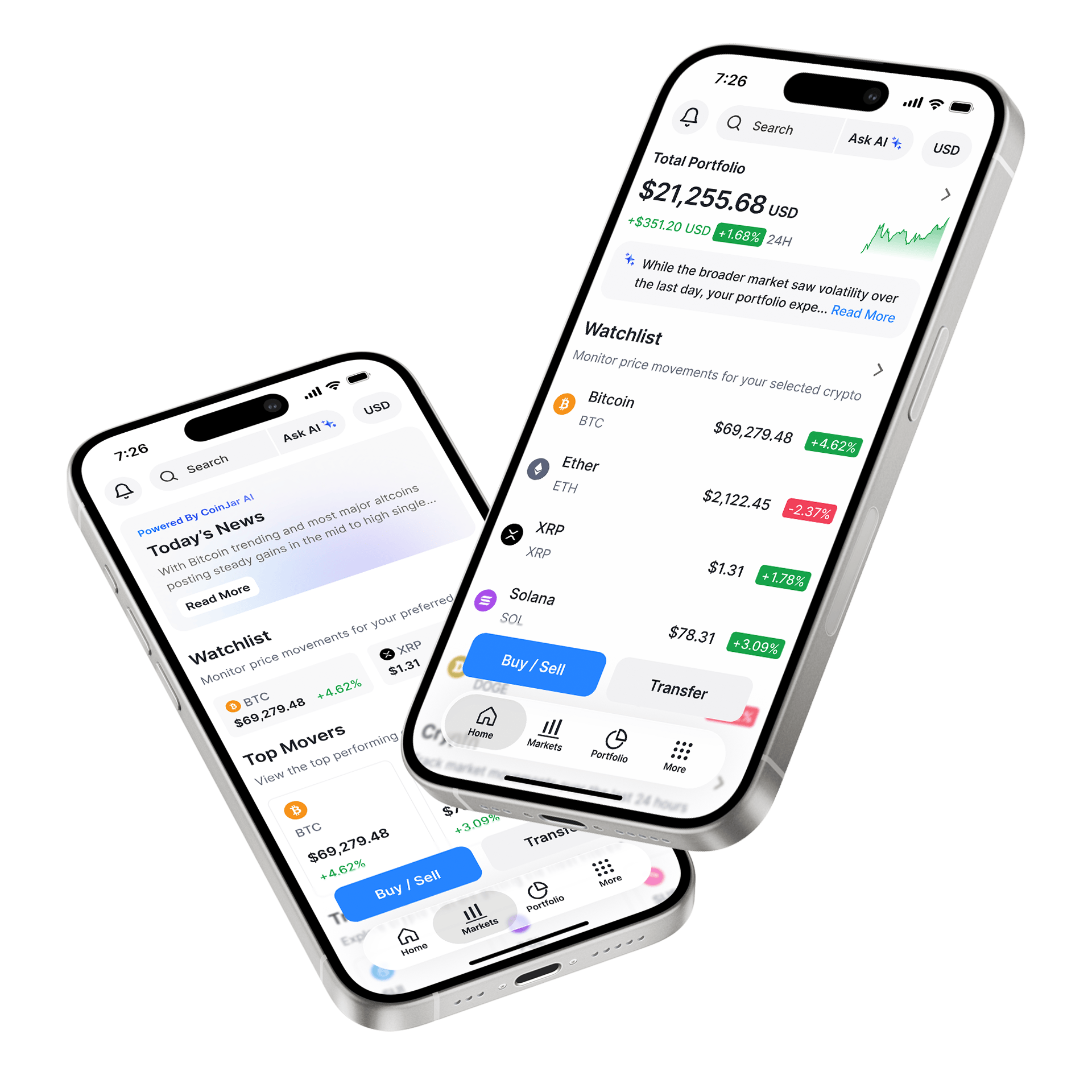
CoinJar App
Buy, sell, send and even spend your crypto with Australia’s favourite cryptocurrency app.
Get the CoinJar appCoinJar App
Buy, sell, send and even spend your crypto with Australia’s favourite cryptocurrency app.
Get the CoinJar app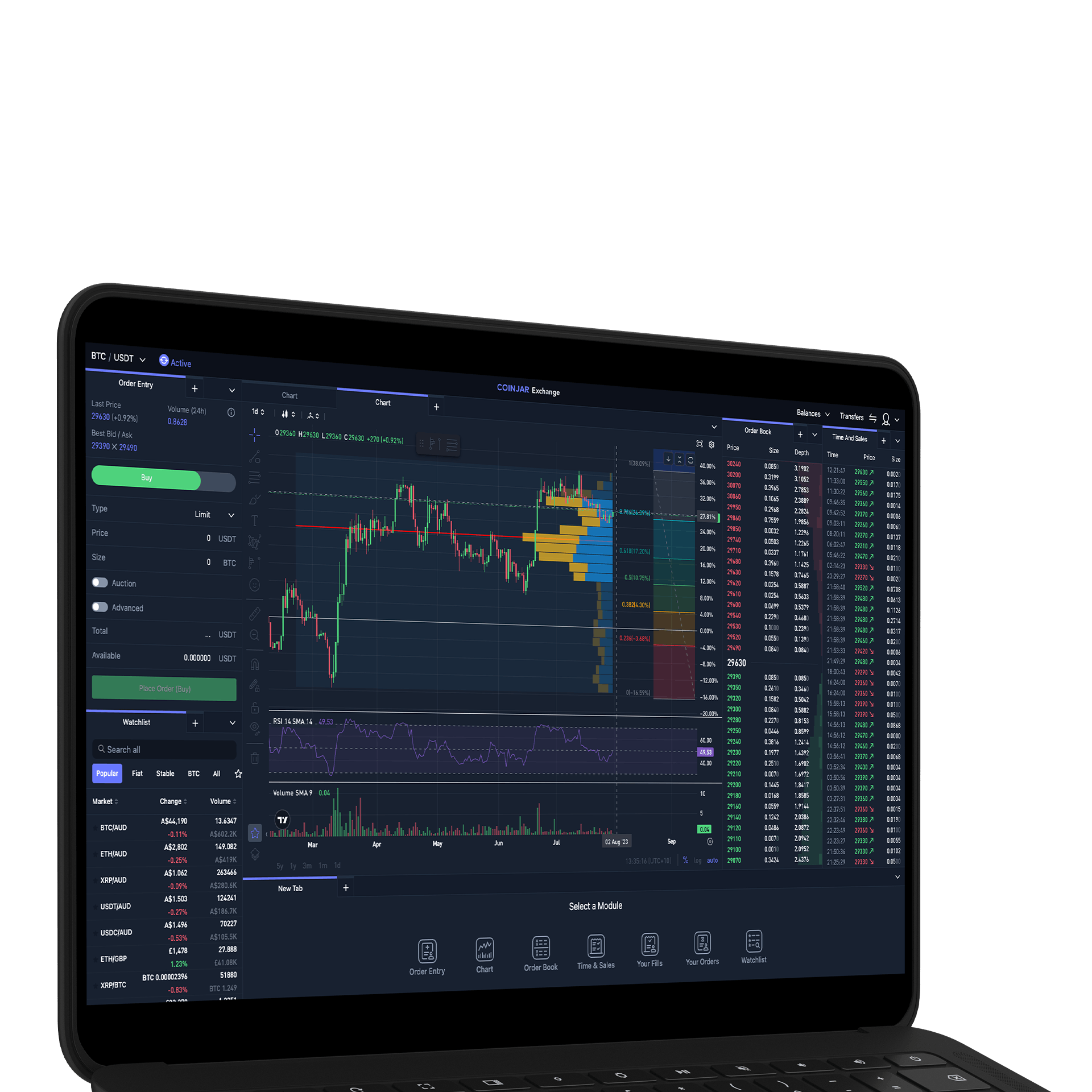
CoinJar Exchange
With one of the fastest matching engines in the world, CoinJar Exchange is purpose-built for institutions, market makers and professional traders. Features global liquidity, ultra-thin spreads and some of Australia and the UK’s most competitive fees.
Explore CoinJar ExchangeCoinJar Exchange
With one of the fastest matching engines in the world, CoinJar Exchange is purpose-built for institutions, market makers and professional traders. Features global liquidity, ultra-thin spreads and some of Australia and the UK’s most competitive fees.
Explore CoinJar ExchangeFrequently Asked Questions

CoinJar
Get the app.