
Buy Orchid
OXTPast performance is not indicative of future results. All prices are sourced from CoinJar Indices.
What is Orchid?
Orchid is a marketplace for network services, bought and sold in tiny increments. Its best known application is a virtual private network that you pay for by the second rather than by the month, using a stream of very small payments instead of a subscription. OXT is the token that underpins the marketplace.
The interesting part of Orchid is not the VPN itself, which is a mature and competitive product category, but the payment system beneath it. Sending payments small enough to cover a few seconds of bandwidth is normally impossible on a blockchain, because the network fee would dwarf the payment. Orchid's answer to that problem is genuinely novel and is explained below. Our guide to Ethereum covers the network OXT lives on, and our guide to altcoins explains where tokens like OXT sit relative to bitcoin.
Probabilistic nanopayments, explained
Orchid pays bandwidth providers using what it calls tickets, and the easiest way to understand them is as lottery tickets.
Instead of sending a payment worth a fraction of a cent, which would cost far more in network fees than it is worth, your software sends a ticket that has a small chance of being worth a much larger amount. Most tickets are worth nothing. Occasionally one wins, and that payment settles on chain.
Over any meaningful period the math works out so that the provider receives close to the amount actually owed, while the number of transactions that touch the blockchain is a tiny fraction of the number of payments made. The provider carries some variance in the short term and is compensated correctly in the long run.
This is the core of Orchid's design and it is a legitimately clever piece of engineering. It is also a solution to a problem that fewer people turned out to have than the project hoped.
How the marketplace works
Bandwidth providers stake OXT to enter the market. When a user needs a connection, the protocol selects a provider at random, weighted by how much OXT each has staked, so a provider that stakes more receives proportionally more of the traffic.
The stake is what makes the market work without trust. A provider has capital committed and something to lose from misbehaving, and users are not required to research or trust any individual operator before connecting.
Orchid also lets a user route through more than one provider in sequence, so that no single operator sees both who you are and where you are going. Against that, the network uses a curated list of verified providers to make sure users connect to properly configured servers, which is a sensible engineering decision and also a point where the system is less permissionless than the description suggests.
More recently Orchid has extended the same marketplace and payment machinery beyond bandwidth, toward decentralized storage and artificial intelligence services.
Do you need OXT to use Orchid?
This is the most important question for anyone considering the token, and the honest answer is no.
An Orchid account can be funded with OXT on Ethereum, but it can also be funded with other assets, including on the Gnosis chain where fees are low. The mobile applications additionally sell prepaid access through ordinary in app purchases, so a user can pay with a card and never handle a token at all. Funds in those prepaid accounts are intended for use in the app rather than for withdrawal.
That design is good for adoption and awkward for the token. If users can pay with a credit card and providers are the main parties that must hold OXT, then growth in usage does not translate directly into demand for OXT the way it would if the token were mandatory for every transaction.
Supply, staking and what OXT does not do
OXT was created in a single fixed issuance of one billion tokens on Ethereum, and the supply is not designed to grow. There is no mining, no protocol inflation and no new tokens minted to pay rewards.
That has a direct consequence that is frequently misunderstood. Staking OXT is not a yield product. Providers stake as working capital to compete for traffic in the marketplace, and what they earn comes from selling bandwidth, not from token issuance. There is no protocol staking rate available to an ordinary holder, and holding OXT pays nothing.
OXT also carries no formal governance rights over a protocol treasury in the way many decentralized finance tokens do.
OXT and past United States regulatory action
In June 2023 the United States Securities and Exchange Commission brought an enforcement action against a large American cryptocurrency exchange, alleging it had operated without the registrations the Commission said were required. As part of that case the Commission named a list of tokens it considered to be securities, and OXT was among the assets named.
Orchid was not itself a defendant, and no action was brought against the project or its token. In February 2025 the Commission announced the dismissal of that enforcement action.
The dismissal ended that particular case. It is not a determination about how any regulator in any jurisdiction may treat this or any other asset in future, and nothing on this page is legal advice.
Which network is your OXT on?
OXT is natively an ERC-20 token on Ethereum. Orchid's payment accounts also operate on other networks, notably the Gnosis chain, and representations of the token can exist elsewhere.
Addresses are not interchangeable between networks. Sending OXT to an address on a network the receiving wallet or exchange does not support is one of the most common ways people permanently lose tokens, and it usually cannot be reversed. Before any transfer, confirm which network the destination expects and make sure the network you are sending from matches. Our guide to sending crypto on the wrong network covers what can and cannot be recovered.
What are the risks of holding OXT?
Weak link between usage and token demand. Users can pay for Orchid services without holding OXT. Adoption of the product does not automatically create buying pressure for the token. A brutally competitive product category. Conventional virtual private networks are cheap, easy to use and heavily marketed. A pay as you go decentralized alternative has to overcome habit as well as price. No yield and no income. OXT pays holders nothing. Staking is provider collateral rather than a reward mechanism. Adoption risk. The technology works. What has never been demonstrated at scale is sustained demand from ordinary users for a crypto denominated VPN. Concentration and curation. The provider list is curated, and staking weight determines traffic, both of which concentrate the market among a small number of operators. Regulatory exposure. Virtual private networks are restricted or illegal in a number of countries, which limits addressable demand and creates legal complexity in those markets. Smart contract risk. The staking, account and nanopayment contracts are the usual attack surface for anything built on a blockchain. Liquidity and volatility. OXT is a small altcoin. It can move sharply, and market depth can be thin when conditions deteriorate. No consumer protection. Crypto assets are high risk and your capital is at risk. OXT is not insured by the Federal Deposit Insurance Corporation and it is not protected by the Securities Investor Protection Corporation. You should be prepared to lose all the money you put in.
Buying OXT with US dollars on CoinJar
CoinJar has operated since 2013 and lists OXT against US dollars, so you can buy, sell and hold it without converting through another cryptocurrency first. Current charges are on our fees page, and live US dollar rates are on our cryptocurrency prices page.
CoinJar, Inc. is registered with FinCEN as a money services business and holds money transmitter licenses in a growing number of states, NMLS ID 2492913. You can check whether CoinJar operates in your state before you sign up.
How is OXT taxed in the US?
The IRS generally treats OXT as property. A taxable event can occur when you sell it for US dollars, exchange it for another cryptocurrency, spend it or give it away.
The IRS explains these rules on its digital assets guidance page. Our guide to downloading your transaction history for tax shows how to get the records you need. This is general information, not tax advice. Consider speaking to a qualified tax professional about your circumstances.
Cash, credit or crypto?
Buy Orchid instantly using Visa or Mastercard. Get cash in your account fast with bank transfer, Faster Payments, PayID or Osko. Convert crypto-to-crypto with a single click.







How to buy Orchid with CoinJar
Start your cryptocurrency portfolio with CoinJar by following these simple steps.
Download the app
Get the CoinJar app on iOS or Android.
Create an account
Sign up and verify your ID – it only takes a couple of minutes.
Make a purchase
Buy Bitcoin and more than 60 other cryptos using cash or credit card.
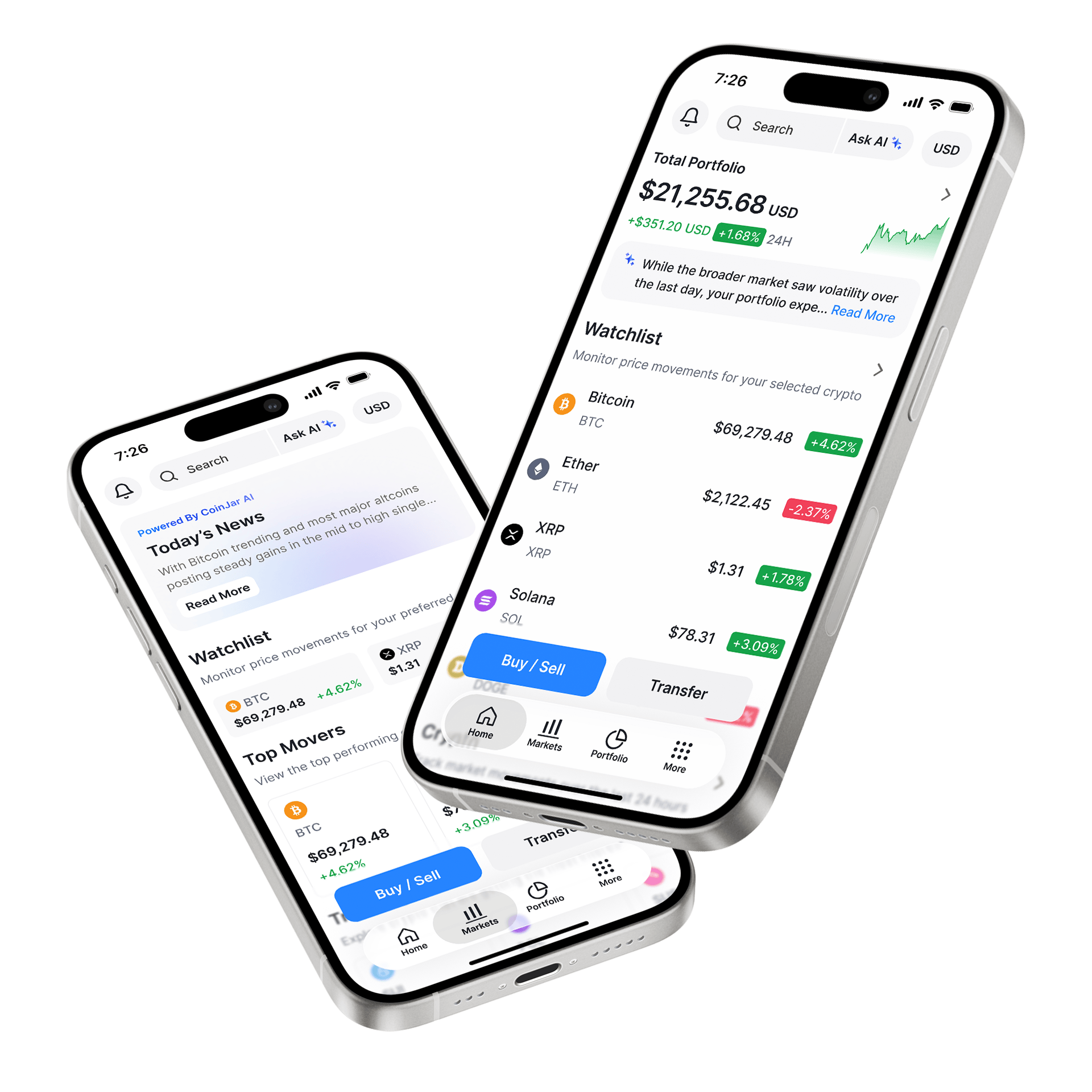
CoinJar App
Buy, sell, send and even spend your crypto with Australia’s favourite cryptocurrency app.
Get the CoinJar appCoinJar App
Buy, sell, send and even spend your crypto with Australia’s favourite cryptocurrency app.
Get the CoinJar app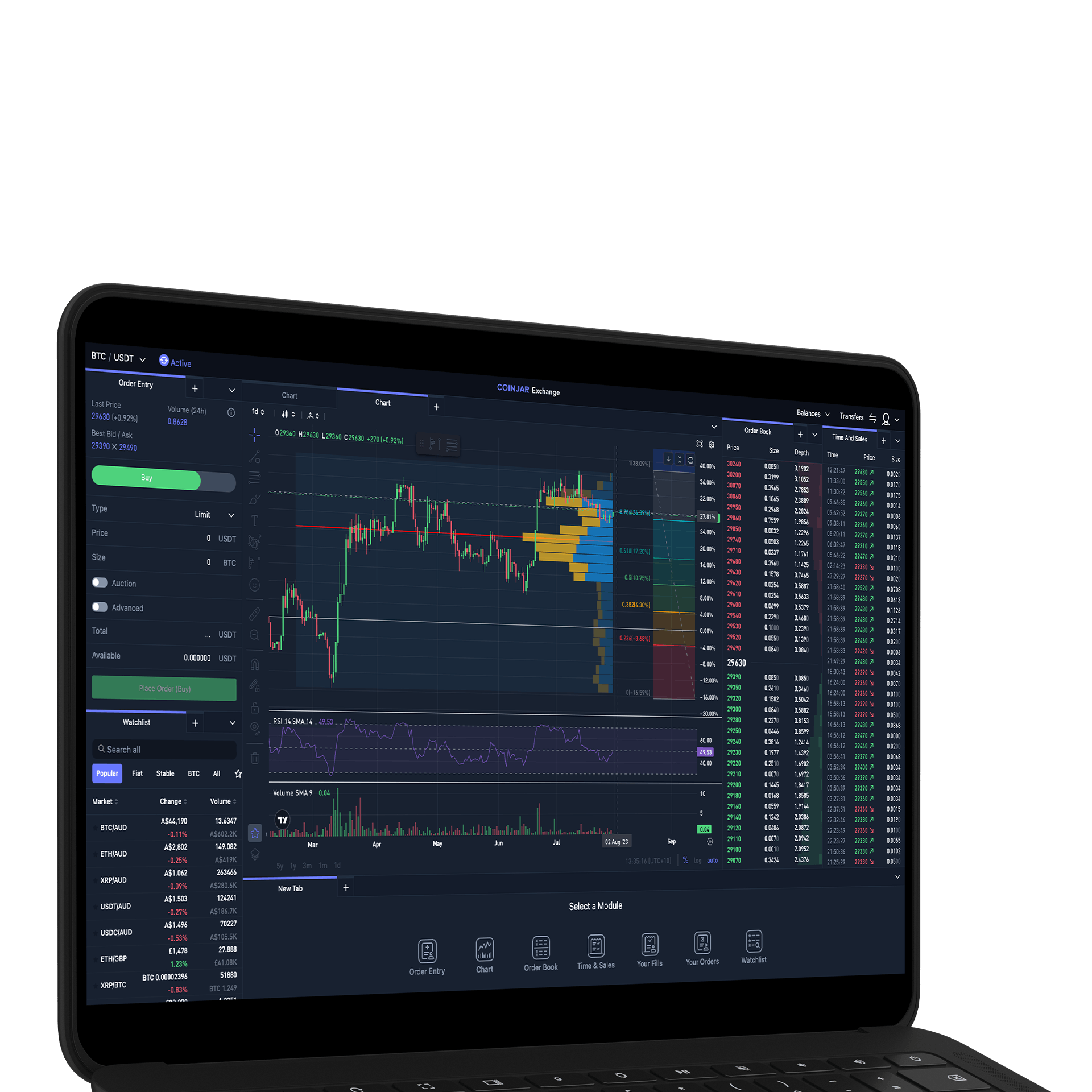
CoinJar Exchange
With one of the fastest matching engines in the world, CoinJar Exchange is purpose-built for institutions, market makers and professional traders. Features global liquidity, ultra-thin spreads and some of Australia and the UK’s most competitive fees.
Explore CoinJar ExchangeCoinJar Exchange
With one of the fastest matching engines in the world, CoinJar Exchange is purpose-built for institutions, market makers and professional traders. Features global liquidity, ultra-thin spreads and some of Australia and the UK’s most competitive fees.
Explore CoinJar Exchange
CoinJar
Get the app.