
Buy Render
RENDERPast performance is not indicative of future results. All prices are sourced from CoinJar Indices.
What is Render?
RENDER is the token of the Render Network, a marketplace for graphics processing power. People with spare graphics cards sell their capacity to people who need it, mostly for rendering three dimensional graphics and, increasingly, for running artificial intelligence workloads. RENDER is how the work is paid for.
The token also has a naming history that trips people up. It was called RNDR and lived on Ethereum. It is now called RENDER and lives on Solana. Our guide to artificial intelligence and cryptocurrency covers the wider category this asset trades in, and if the network change is what brought you here, our guide to the RNDR to RENDER upgrade deals with it directly.
What the Render Network actually does
Rendering is the step where a three dimensional scene becomes a finished image. It is enormously expensive in computing terms, which is why film and advertising work has always been sent to render farms, and why an independent artist with one workstation waits overnight for something a studio finishes in minutes.
Render's answer is to break a job into pieces and distribute them across graphics cards belonging to strangers. The artist gets studio scale capacity without owning it. The owner of the hardware earns something from a card that would otherwise be idle.
The project comes out of a real business rather than a whitepaper. It was conceived in 2009 by Jules Urbach, whose company OTOY makes OctaneRender, a renderer widely used in film, television and advertising. The token was sold in 2017 and the network opened for public use in 2020. That lineage is Render's genuine advantage over most decentralized computing projects: it arrived with software professionals already used, and with the relationships that come with it.
From RNDR to RENDER
In 2023 the project moved its token from Ethereum to Solana, through the governance proposals that also introduced its current token economics. The old ERC-20 was RNDR. The new Solana token is RENDER, swapped one for one. The move was made because the token's new design needed cheap, frequent transactions, which is the practical difference our guide to Solana and Ethereum describes.
Some things about that migration are still worth knowing years later.
The legacy tokens still exist. RNDR on Ethereum, and a version that briefly existed on Polygon, were not destroyed. They are unsupported, they cannot be used on the Render Network, and holders convert them through an official upgrade portal that remains open. The conversion runs one way only: RENDER cannot be turned back into RNDR.
The ticker change is not a new asset. Anyone who held RNDR holds a claim on the same thing. Exchanges handled the change for their customers in different ways and at different times, which is why old articles, old wallet balances and old price charts disagree with each other.
How a render job works
A creator submits a job and it is priced in ordinary currency rather than in tokens, then paid for in RENDER. Jobs are offered at different tiers: a premium tier priced near what a commercial cloud provider charges, with tighter checks and trusted operators, through to an economy tier for work that can wait. Capacity is measured with OctaneBench, OTOY's own benchmark for graphics card performance, so a job can be matched to hardware that will actually finish it.
Payment is held in escrow while the work is done, results are watermarked until approved, and completed frames are checked by a combination of automated verification and human review before funds are released. Both operators and creators carry reputation scores that determine what work they can access.
One detail deserves emphasis, because it is often left out. Render is not a permissionless network. Node operators apply and are approved before they can take work. That is a deliberate choice, and it cuts both ways: curated supply is easier to sell to a studio with a deadline, and it is a long way from the open participation the word decentralized usually implies.
How the token works
Render uses a model called burn and mint equilibrium, and understanding it is the difference between understanding this asset and guessing at it.
Payments burn tokens. When a creator pays for a job, the RENDER used is destroyed rather than passed to the operator who did the work. Usage therefore removes tokens from circulation. Rewards mint new tokens. Separately, the network issues new RENDER each period and distributes it to node operators, to artists, to liquidity provision and to the Foundation. Operators are paid from this issuance, not from the tokens the customer burned. The two are meant to balance. If usage is high, burning exceeds issuance and supply falls. If usage is low, issuance dominates and supply grows. The issuance schedule declines over time, and it is set by governance rather than fixed in the token itself.
The supply history matters here. The original token was capped at just under 537 million after a much larger planned supply was cut and burned. Adopting burn and mint equilibrium added an issuance allowance of roughly a further 107 million tokens, taking the stated maximum to a little under 645 million. So the cap has already been raised once, by vote.
There is also a point about that cap that is worth stating plainly, because no promotional material mentions it. Reading the token's own record on Solana shows that it retains both a live mint authority and a live freeze authority: the keys that can create new tokens and that can freeze individual balances have not been given up. A live mint authority is necessary for a design that issues tokens every period, so this is not evidence of bad intent. It does mean the supply limit is a policy commitment enforced by whoever holds those keys, rather than a rule the token contract enforces on its own.
Rendering, and now artificial intelligence
Graphics cards are also what artificial intelligence models run on, and Render has moved to sell into that demand. Governance proposals through 2025 added compute for AI work, first on consumer hardware and then on the enterprise accelerators that serious training and inference require. OTOY has committed to using that capacity for its own products.
Two honest caveats. The AI compute network runs separately from the rendering network, and hardware cannot serve both at once, so this is closer to two businesses sharing a token than one network doing more. And the project does not publish a breakdown of how much of its activity is rendering versus AI, or what customers spend in ordinary currency. Token burns are visible on chain, and burning has grown, but the composition of the work behind it is not disclosed. Anyone telling you what share of Render's activity is now artificial intelligence is estimating.
Who controls Render
Three entities matter and they are not the same thing.
OTOY is Jules Urbach's private company. It owns OctaneRender and much of the software the network depends on, and it is also the network's most active partner and customer. Render's greatest strength and its concentration risk are the same fact. The Render Network Foundation is a Cayman Islands not for profit, spun out of OTOY in 2023, which holds the protocol code and the brand. Token holders vote through the Render Network Proposal process, on proposals published openly in the project's governance repository, with votes weighted by RENDER held. Proposals need both a majority and a minimum share of supply participating.
The limit on that last point should be understood before treating RENDER as a governance asset. The Foundation's own documents provide for its directors to take the actions needed to give effect to a token holder vote, which means the vote directs the directors rather than executing itself. Holders also have no claim on the network's revenue. RENDER is a payment and governance token, not a share.
What are the risks of holding RENDER?
The token is not a claim on the business. Render can grow while the token does not. Holders receive no revenue, and the link between activity and token value runs entirely through the burn mechanism. Issuance can outpace burning. Burn and mint equilibrium reduces supply only when usage is high enough. In quiet periods the network still issues rewards, and supply grows. The cap is a policy, not a property. It has been raised once by vote, and the token retains a live mint authority. A live freeze authority exists. Individual balances on Solana can be frozen by whoever holds that key. Concentration. The network depends on one private company for its core software, its benchmark and a significant share of its demand, and on a foundation whose directors execute governance outcomes. Narrative sensitivity. RENDER trades as an artificial intelligence asset, so it moves with sentiment about artificial intelligence rather than with rendering demand. That works in both directions. Disclosure gaps. The project does not publish customer spending or the split between rendering and artificial intelligence work, which makes the network's real scale hard to assess from outside. Competition. Render competes with other decentralized computing networks, with the large cloud providers, and with conventional render farms that have no token at all. Volatility. RENDER is not a stablecoin. Its value moves sharply and can fall substantially, as our guide to altcoins explains. No consumer protection. Cryptoassets are high risk and your capital is at risk. RENDER is not covered by FDIC or SIPC protection. You should be prepared to lose all the money you put in.
Buying RENDER with US dollars on CoinJar
CoinJar has operated since 2013 and lists RENDER against US dollars, so you can buy, sell and hold it without converting through another cryptocurrency first. Current charges are on our fees page, and live US dollar rates are on our cryptocurrency prices page.
CoinJar, Inc. is registered with FinCEN as a money services business and holds money transmitter licenses in a growing number of states, NMLS ID 2492913. That registration and those licenses cover anti money laundering obligations and the transmission of money. They are not approval of any cryptoasset listed on the platform. You can check whether CoinJar operates in your state before signing up.
How is RENDER taxed in the US?
The IRS treats RENDER as property. A taxable event can occur when you sell it for US dollars, exchange it for another cryptoasset, spend it or give it away.
The IRS sets out its position on its digital assets pages. Our guide to transaction history and tax reporting explains how to get the records you need. This is general information, not tax advice. Consider speaking to a qualified tax adviser about your circumstances.
Cash, credit or crypto?
Buy Render instantly using Visa or Mastercard. Get cash in your account fast with bank transfer, Faster Payments, PayID or Osko. Convert crypto-to-crypto with a single click.







How to buy Render with CoinJar
Start your cryptocurrency portfolio with CoinJar by following these simple steps.
Download the app
Get the CoinJar app on iOS or Android.
Create an account
Sign up and verify your ID – it only takes a couple of minutes.
Make a purchase
Buy Bitcoin and more than 60 other cryptos using cash or credit card.
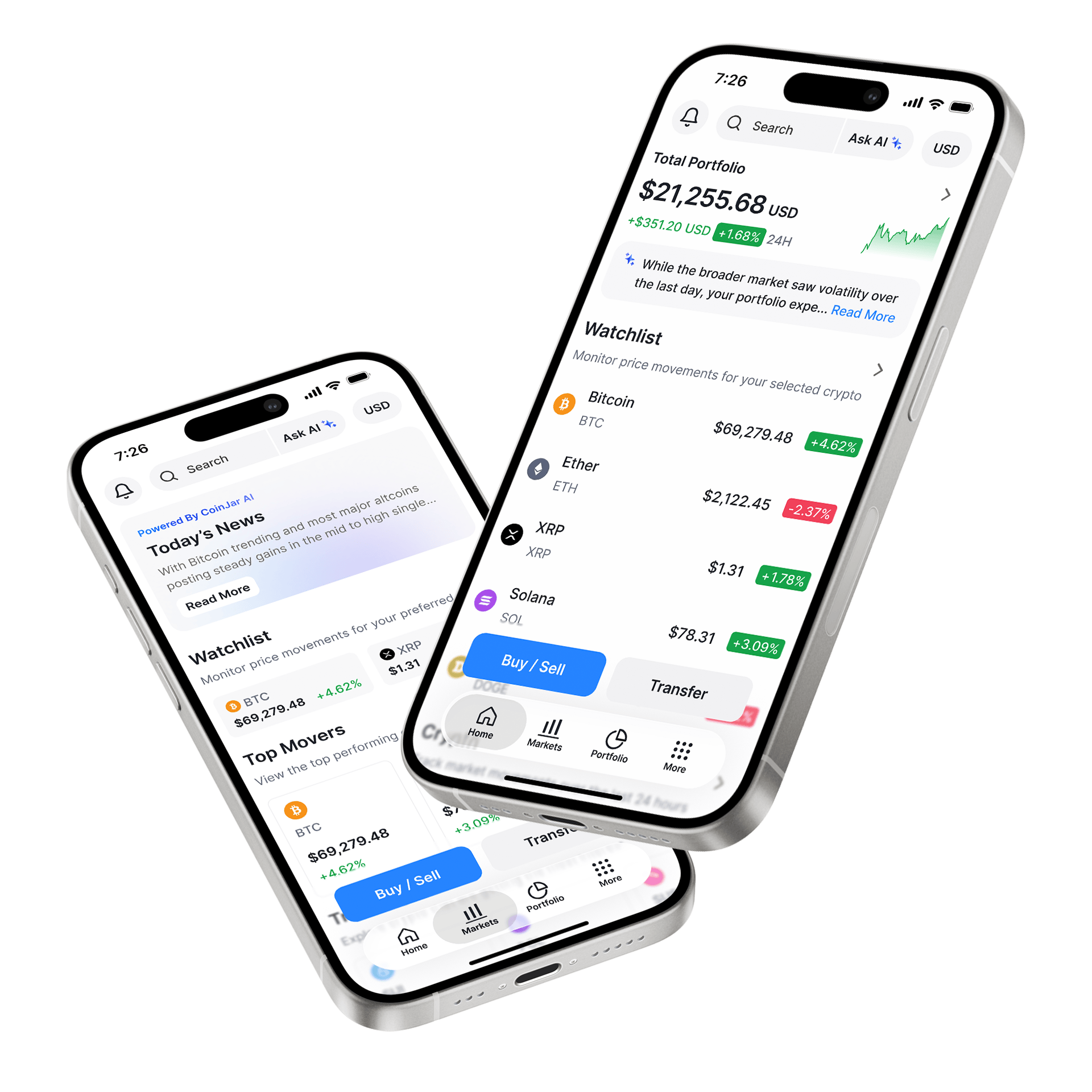
CoinJar App
Buy, sell, send and even spend your crypto with Australia’s favourite cryptocurrency app.
Get the CoinJar appCoinJar App
Buy, sell, send and even spend your crypto with Australia’s favourite cryptocurrency app.
Get the CoinJar app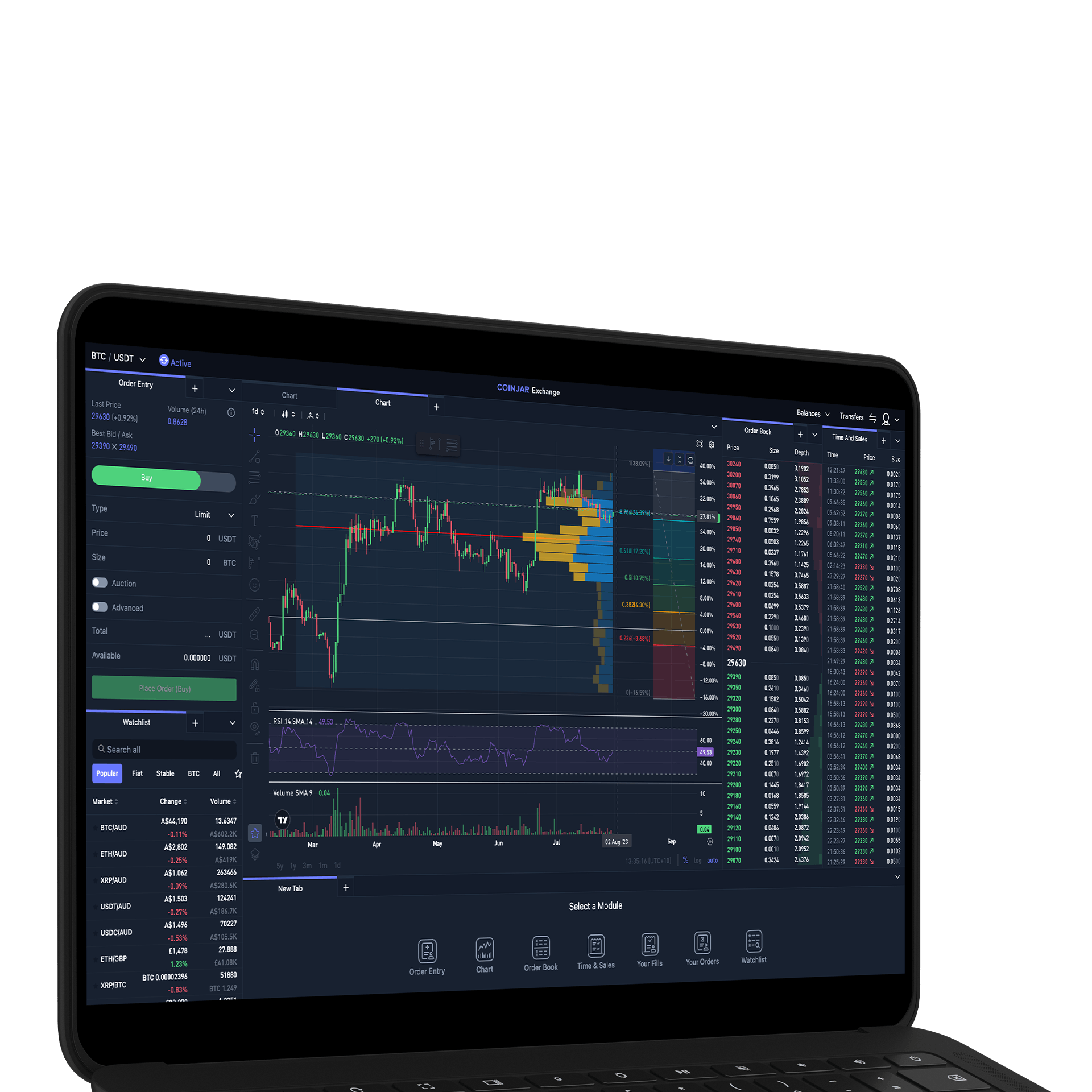
CoinJar Exchange
With one of the fastest matching engines in the world, CoinJar Exchange is purpose-built for institutions, market makers and professional traders. Features global liquidity, ultra-thin spreads and some of Australia and the UK’s most competitive fees.
Explore CoinJar ExchangeCoinJar Exchange
With one of the fastest matching engines in the world, CoinJar Exchange is purpose-built for institutions, market makers and professional traders. Features global liquidity, ultra-thin spreads and some of Australia and the UK’s most competitive fees.
Explore CoinJar Exchange
CoinJar
Get the app.