
Buy Avalanche
AVAXPast performance is not indicative of future results. All prices are sourced from CoinJar Indices.
What is Avalanche?
Avalanche is a layer one blockchain platform, and AVAX is the cryptocurrency that powers it. It launched in 2020, built by Ava Labs, and it was designed around one core problem: how to make a public blockchain settle transactions quickly and cheaply without handing control to a small group of operators.
Where Bitcoin is a single chain doing one job, Avalanche is closer to a platform for launching chains. Developers build applications on it, and organizations launch their own purpose built networks on top of it. Our guide to blockchain layers explains where a layer one sits in the wider stack.
How does Avalanche work?
Avalanche is not one chain. Its Primary Network is made of three, each doing a different job.
- The C-Chain, or Contract Chain. This is where smart contracts and applications run, and it is the chain almost everyone interacts with. It is compatible with the Ethereum Virtual Machine, so developers can port applications written for Ethereum with little modification, and wallets built for Ethereum work with it.
- The X-Chain, or Exchange Chain. Handles the creation and transfer of assets.
- The P-Chain, or Platform Chain. Coordinates validators, staking, and the registry of every custom chain built on Avalanche.
Splitting the work this way means the demands of asset transfers, smart contracts and network coordination do not compete for the same block space. If Ethereum and the EVM are unfamiliar, our Ethereum explainer is a useful companion.
What makes Avalanche consensus different?
Avalanche uses a family of consensus protocols known as Snow, with the linear version called Snowman. Instead of every participant hearing every vote, each validator repeatedly asks a small random sample of other validators what they prefer. Those samples build on each other, and the network converges on one answer very quickly.
This produces two properties worth understanding. Finality is fast, so transactions settle in a short, predictable window rather than needing many confirmations. And finality is probabilistic rather than absolute, meaning the chance of a settled transaction being reversed is made vanishingly small by the protocol's parameters rather than being mathematically impossible.
That is a genuine design difference from Bitcoin, which uses mining and where confidence grows as blocks pile up, and from classical Byzantine fault tolerant systems, which need a leader and need to know every participant. The original Avalanche consensus paper sets out the mechanism in full.
Avalanche is a proof of stake network. Validators bond AVAX to take part, and their influence over decisions is proportional to the amount staked. Our guide to staking covers how proof of stake works generally.
What are Avalanche L1s?
Anyone can launch a sovereign blockchain on Avalanche with its own rules, its own validator set and, if required, its own permissioning. These were originally called Subnets and were renamed Avalanche L1s following the Avalanche9000 upgrade in December 2024, which also decoupled these chains from the Primary Network so that launching one no longer requires validating the main network.
The practical effect is that a business can run a chain that behaves the way it needs it to, including restricting who can validate or transact, while still connecting to the wider Avalanche ecosystem. In practice these chains have been used for three things: games that need high transaction volume and low cost, applications like order book exchanges that need dedicated capacity, and permissioned institutional networks. Several large financial institutions have run tokenized real world asset pilots on permissioned Avalanche chains. The official Avalanche documentation is the primary source on how these chains are configured.
What is AVAX used for?
AVAX has four jobs on the network.
- Paying transaction fees. Every action on the C-Chain costs AVAX.
- Securing the network. Validators stake AVAX, and holders can delegate their AVAX to a validator instead of running one.
- Paying for infrastructure. Launching and operating an Avalanche L1 is paid for in AVAX.
- Acting as the common unit across the ecosystem. AVAX is the shared asset that links the Primary Network and the chains built on it.
Two features of the token's design matter for anyone holding it. AVAX has a hard maximum supply of 720 million, fixed by the protocol, so it cannot be inflated indefinitely. And the base fee on every C-Chain transaction is burned rather than paid to validators, which permanently removes AVAX from supply as the network is used. More network activity therefore means more AVAX destroyed.
Which network do you use to send AVAX?
AVAX on the C-Chain uses the same 0x address format as Ethereum. That is convenient, and it is also the single most common way people lose funds.
An address that looks identical can exist on Ethereum, on Avalanche and on other EVM networks, so the address alone does not tell you which network you are on. When you withdraw AVAX, select the Avalanche C-Chain specifically, and confirm the receiving wallet or exchange supports it. Sending to the wrong network can make funds unrecoverable unless you control the same private key on the destination chain. The X-Chain and P-Chain use a different address format that begins with X-avax or P-avax, which is a useful signal that you are not on the C-Chain.
Wrapped and bridged versions of AVAX also exist on other networks. These are separate tokens issued by a bridge, not the native asset, and they carry the risk of the bridge that issued them. Our guide to crypto bridges explains that risk.
What are the risks of holding AVAX?
- Competition. Avalanche competes with Ethereum layer twos and with other layer ones such as Solana. Layer twos inherit Ethereum's security and liquidity, which is a real advantage for some applications, and developer attention shifts between ecosystems. Our Solana and Ethereum comparison covers some of the same trade offs.
- Fragmentation. A token issued on one Avalanche L1 is not automatically the same asset on another. Moving value between chains requires bridging, which adds cost and risk.
- Bridge risk. Cross chain bridges have been a repeated target of large exploits across the industry.
- Supply overhang. AVAX has a long running vesting schedule, so tokens allocated at launch continue to unlock over time. That is a known and documented source of sell pressure.
- Volatility. AVAX is not a stablecoin. Its value moves sharply and can fall substantially.
- No federal protection. Digital assets held with CoinJar are not deposits and are not insured by the FDIC, and they are not protected by SIPC. If you lose value, there is no compensation scheme to fall back on.
Buying AVAX with US dollars on CoinJar
CoinJar has operated since 2013 and lists AVAX against US dollars, so you can buy, sell and hold it without converting through another cryptocurrency first. Current charges are on our fees page, and live US dollar rates are on our cryptocurrency prices page.
CoinJar, Inc. is registered with FinCEN as a money services business, NMLS ID 2492913, and holds money transmitter licenses in a growing number of states. Before you sign up, check whether CoinJar operates in your state.
How is AVAX taxed in the US?
The IRS generally treats AVAX as property. A taxable disposal can occur when you sell it for US dollars, exchange it for another digital asset or spend it.
The IRS explains these rules on its digital assets guidance page. Our guide to exporting your transaction history for tax purposes shows how to pull the records you will need. This is general information, not tax advice. Consider speaking to a qualified tax professional about your circumstances.
Cash, credit or crypto?
Buy Avalanche instantly using Visa or Mastercard. Get cash in your account fast with bank transfer, Faster Payments, PayID or Osko. Convert crypto-to-crypto with a single click.







How to buy Avalanche with CoinJar
Start your cryptocurrency portfolio with CoinJar by following these simple steps.
Download the app
Get the CoinJar app on iOS or Android.
Create an account
Sign up and verify your ID – it only takes a couple of minutes.
Make a purchase
Buy Bitcoin and more than 60 other cryptos using cash or credit card.
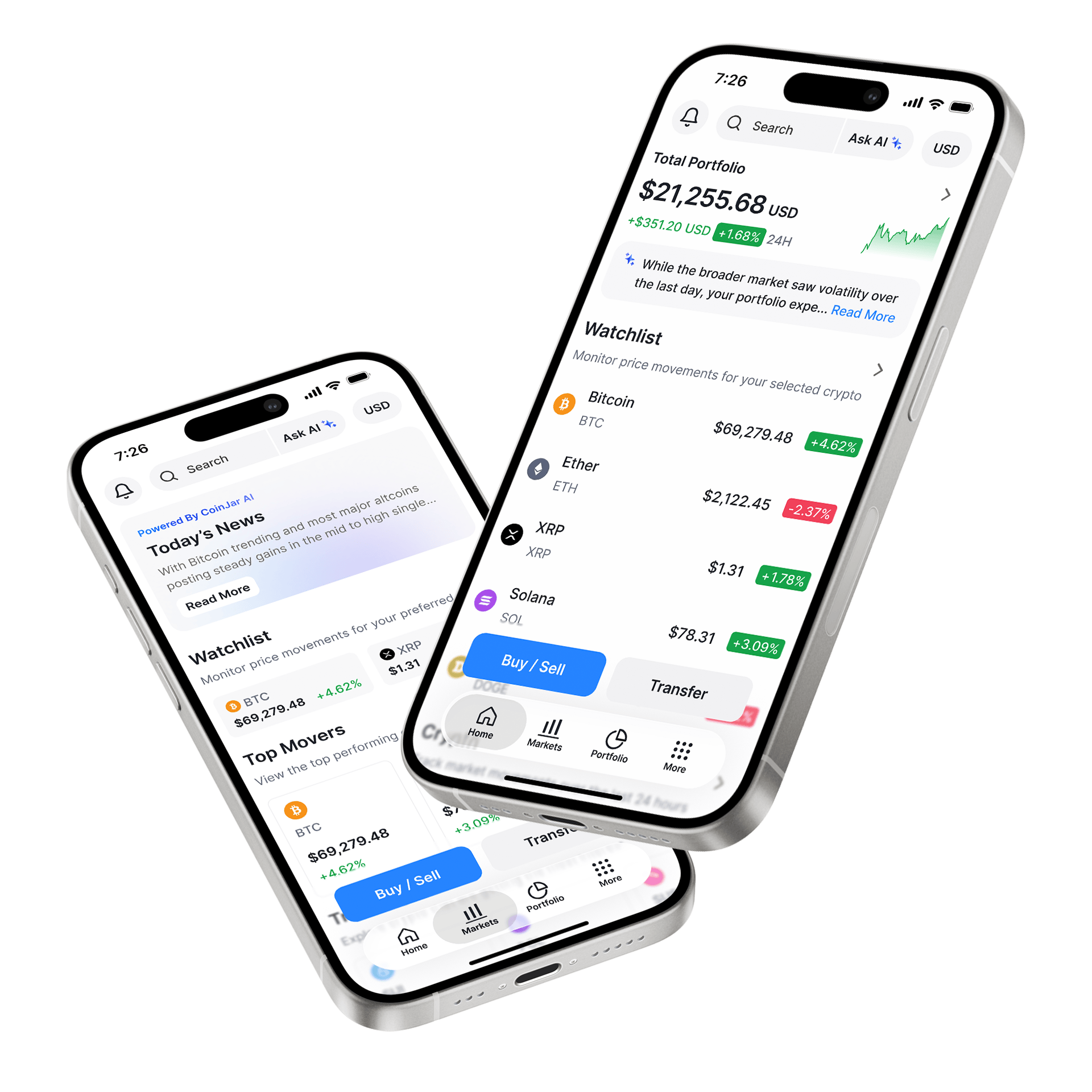
CoinJar App
Buy, sell, send and even spend your crypto with Australia’s favourite cryptocurrency app.
Get the CoinJar appCoinJar App
Buy, sell, send and even spend your crypto with Australia’s favourite cryptocurrency app.
Get the CoinJar app
CoinJar Exchange
With one of the fastest matching engines in the world, CoinJar Exchange is purpose-built for institutions, market makers and professional traders. Features global liquidity, ultra-thin spreads and some of Australia and the UK’s most competitive fees.
Explore CoinJar ExchangeCoinJar Exchange
With one of the fastest matching engines in the world, CoinJar Exchange is purpose-built for institutions, market makers and professional traders. Features global liquidity, ultra-thin spreads and some of Australia and the UK’s most competitive fees.
Explore CoinJar Exchange
CoinJar
Get the app.