
Buy Tezos
XTZPast performance is not indicative of future results. All prices are sourced from CoinJar Indices.
What is Tezos?
Tezos is a proof of stake blockchain with one genuinely unusual property: it can rewrite its own rules. Where most networks change through hard forks that require everyone to install new software and risk splitting the chain, Tezos has a voting process written into the protocol itself. Proposals are submitted on chain, voted on by the people securing the network, tested, voted on again, and then activated automatically.
XTZ, often called tez, is the asset that makes that work. It pays transaction fees, it is what participants put at risk to secure the network, and it is what carries the vote. Our guide to staking covers the general mechanism, and our guide to blockchain layers is relevant because Tezos has spent the last few years rebuilding itself around a layered design.
Where did Tezos come from?
Tezos was designed by Arthur and Kathleen Breitman and funded through a token sale in July 2017 that raised somewhere around 232 million dollars, one of the largest of that era.
What followed was not smooth. A public dispute broke out between the Breitmans and the president of the Swiss foundation holding the funds, the launch was delayed by roughly a year, and contributors who had expected tokens in months waited far longer. The network finally went live in September 2018.
Investors sued in the United States, alleging the sale had been an unregistered securities offering. The consolidated case settled in 2020 for 25 million dollars, without any finding on the merits about whether the tokens were securities.
The project today is not run by a single company. The Tezos Foundation in Switzerland funds work and issues grants, while core protocol engineering is done by independent organizations including Nomadic Labs and Trilitech. Crucially, none of them can push an upgrade to the network on their own. They write proposals, and the network votes.
What does self-amending actually mean?
This is the part worth understanding properly, because it is the whole argument for Tezos and it is more concrete than most protocol claims.
Upgrades move through five consecutive periods, each fourteen cycles long. In the proposal period, delegates submit protocol proposals and vote for the ones they want considered. The leading proposal moves to an exploration period, where delegates vote yea, nay or pass. If it clears the thresholds it enters a cooldown period for testing on test networks, then a promotion period for a final vote, then an adoption period during which infrastructure operators update. At the end, the network activates the new protocol by itself.
Two thresholds apply at the voting stages. A dynamic quorum sets how much of the network's voting power has to participate, adjusting over time based on recent turnout. A supermajority requires yea votes to exceed 80 percent of yea and nay combined, with pass votes excluded. The Tezos documentation sets out the mechanics.
Voting power is not one token one vote in the way people often assume. Only delegates vote, and a delegate's weight is their own staked tez plus everything delegated to them. If you delegate to a baker, you are handing that baker your voting weight along with your stake.
The process has been used repeatedly. Tezos has adopted more than twenty protocol upgrades since launch, named alphabetically. The most recent, Ushuaia, activated on 30 June 2026 and increased the network's data availability bandwidth substantially while cutting layer one confirmation times.
This is a real advantage and also a real risk. The network can ship meaningful change without fracturing, which no major chain has managed as consistently. It also means the rules you buy under are not the rules you will hold under, and the people who set them are the people with the most stake.
Baking, delegating and staking
Tezos calls block production baking and the people who do it bakers. Three levels of participation exist and the differences matter.
Baking. Running a baker requires a minimum baking power, currently 6,000 tez, plus infrastructure that stays online. Bakers propose and attest blocks and are paid for it.
Delegating. You can delegate your XTZ to a baker without locking it or giving up custody. Your coins stay liquid and spendable, they count toward the baker's power, and the baker typically shares rewards. Delegated coins are not at risk of protocol penalties.
Staking. Since the Paris upgrade in 2024 there has been a second, stronger option. Staked XTZ is frozen, earns a higher share of rewards, and is exposed to slashing if your baker misbehaves. Unstaking is not instant: funds remain frozen for a number of cycles before they can be finalized and moved.
Slashing on Tezos applies to specific provable faults, principally signing two conflicting blocks or attestations, rather than to ordinary downtime. The staking documentation covers the current parameters, and they are changed by protocol vote, so check them rather than trusting an article.
The short version for a buyer: delegating is low risk and lower reward, staking is higher reward and puts your coins at risk of penalties for someone else's mistake, and both require you to hold XTZ in a Tezos wallet rather than on an exchange.
Adaptive Issuance, and why XTZ has no supply cap
XTZ is not capped. New tez are created continuously to pay the people securing the network, which is the same basic arrangement as most proof of stake chains.
What is unusual is that Tezos does not use a fixed schedule. Adaptive Issuance, introduced in 2024, adjusts the rate of new issuance according to how much of the supply is staked, aiming at a target of 50 percent. If less than that is staked, issuance rises to attract more. If more is staked, issuance falls. The rate is bounded, with a floor well below one percent and a ceiling of ten percent, and the effective ceiling tightens as the staked ratio approaches the target. The protocol documentation contains the actual formulas.
The design intent is to buy exactly as much security as the network needs and no more. The consequence for a holder is straightforward and worth being blunt about: if you hold XTZ and do not stake or delegate, new issuance dilutes you in favor of those who do.
Smart Rollups, the DAL and Etherlink
Tezos has spent recent years rebuilding around layers rather than trying to do everything on the base chain.
Smart Rollups are the mechanism, and they are enshrined, meaning the rollup machinery is part of the layer one protocol rather than a set of contracts deployed on top of it. Anyone can originate and operate one. The Data Availability Layer is the accompanying system for publishing the data those rollups need, and expanding its capacity has been the focus of several recent upgrades.
Etherlink is the flagship result: an EVM compatible layer two that runs as a Smart Rollup on Tezos. Ethereum tooling works on it, confirmations are sub second, and fees are very low.
One point of confusion is worth clearing up directly. Etherlink is a layer two on Tezos, not on Ethereum. It does not inherit Ethereum's security and it does not appear on the layer two trackers that cover Ethereum rollups. Its security comes from Tezos, through a permissionless challenge process in which anyone can run a node and dispute an incorrect state commitment. Its sequencer, the component that orders transactions and delivers fast confirmations, is a separate matter and is subject to governance rather than being fully open.
What is Tezos X?
Tezos X is the name for where the project says it is going: a single execution layer supporting both EVM and Tezos native contracts on a shared ledger, with layer one reduced to a lean, fast consensus layer underneath it.
Parts of it have shipped. Layer one has been progressively optimized for that role, Smart Rollups and the DAL are in production, and Etherlink demonstrates the execution layer pattern. The project's own account of the progress is worth reading with the usual caution applied to roadmaps.
It is not finished. Anyone buying XTZ on the strength of Tezos X is buying an architectural direction that is partly built, not a completed system.
An honest look at adoption
Tezos has a genuine and durable niche in digital art. Low fees and low energy use made it the default chain for a generation of generative artists, and marketplaces built around that community have outlasted most NFT platforms elsewhere.
Outside that, the picture is harder. Tezos ran high profile sports sponsorships during the last cycle, including with a Formula One team and an English football club, and both lapsed without renewal. Developer activity and application usage have not translated the technical work into the kind of ecosystem the technology was aiming at. The upgrades keep landing on schedule and the attention has largely gone elsewhere.
That gap is the central question for anyone considering XTZ. The engineering is well regarded. Whether well regarded engineering eventually attracts users is not something the protocol can vote on.
What are the risks of holding XTZ?
Adoption risk. This is the main one. Tezos has shipped consistently for years without translating that into large scale usage, and there is no guarantee that changes.
Dilution. XTZ has no supply cap, and holders who do not stake or delegate are diluted by ongoing issuance.
Governance risk. The rules can be changed by vote, including the rules about issuance, staking and penalties. Voting power is concentrated among large bakers, and holders who delegate hand their voting weight to them.
Staking and slashing risk. Staked XTZ can be penalized for a baker's misbehavior, and unstaking is not immediate. Delegation avoids this but earns less.
Roadmap risk. Tezos X is partly delivered. Layered architectures are complex, and the parts that are not finished may take longer or arrive differently.
Layer two risk. Etherlink depends on Tezos for security and on a sequencer for its performance. Rollups across the industry have proved harder to decentralize than promised.
Regulatory uncertainty. The 2017 sale was the subject of United States litigation that settled without a merits ruling, and XTZ was named in a 2023 SEC action against an exchange over its staking service, an action the SEC dismissed in 2025. Classification of proof of stake assets and staking services remains unsettled in several jurisdictions.
Volatility. XTZ is not a stablecoin. Its value moves sharply and can fall substantially.
No consumer protection. Cryptocurrency held with CoinJar is not covered by FDIC or SIPC protection. If the value of XTZ falls, there is no compensation scheme to make you whole.
Buying XTZ with US dollars on CoinJar
CoinJar has operated since 2013 and lists XTZ against US dollars, so you can buy, sell and hold it without converting through another cryptocurrency first. Current charges are on our fees page, and live US dollar rates are on our cryptocurrency prices page.
CoinJar, Inc. is registered with the Financial Crimes Enforcement Network as a money services business, NMLS ID 2492913, and holds money transmitter licenses in a growing number of states. That registration covers anti money laundering obligations. It is not an endorsement of CoinJar's products and it is not approval of any cryptocurrency listed on the platform. You can check whether CoinJar operates in your state before signing up.
How is XTZ taxed in the US?
The IRS treats cryptocurrency as property. A disposal can occur when you sell XTZ for US dollars, trade it for another cryptocurrency, spend it or give it away.
The IRS sets out its approach on its digital assets page. Our guide to pulling your transaction history together at tax time provides a practical overview. This is general information, not tax advice. Consider speaking to a qualified tax professional about your circumstances.
Cash, credit or crypto?
Buy Tezos instantly using Visa or Mastercard. Get cash in your account fast with bank transfer, Faster Payments, PayID or Osko. Convert crypto-to-crypto with a single click.






How to buy Tezos with CoinJar
Start your cryptocurrency portfolio with CoinJar by following these simple steps.
Download the app
Get the CoinJar app on iOS or Android.
Create an account
Sign up and verify your ID – it only takes a couple of minutes.
Make a purchase
Buy Bitcoin and more than 60 other cryptos using cash or credit card.
CoinJar App
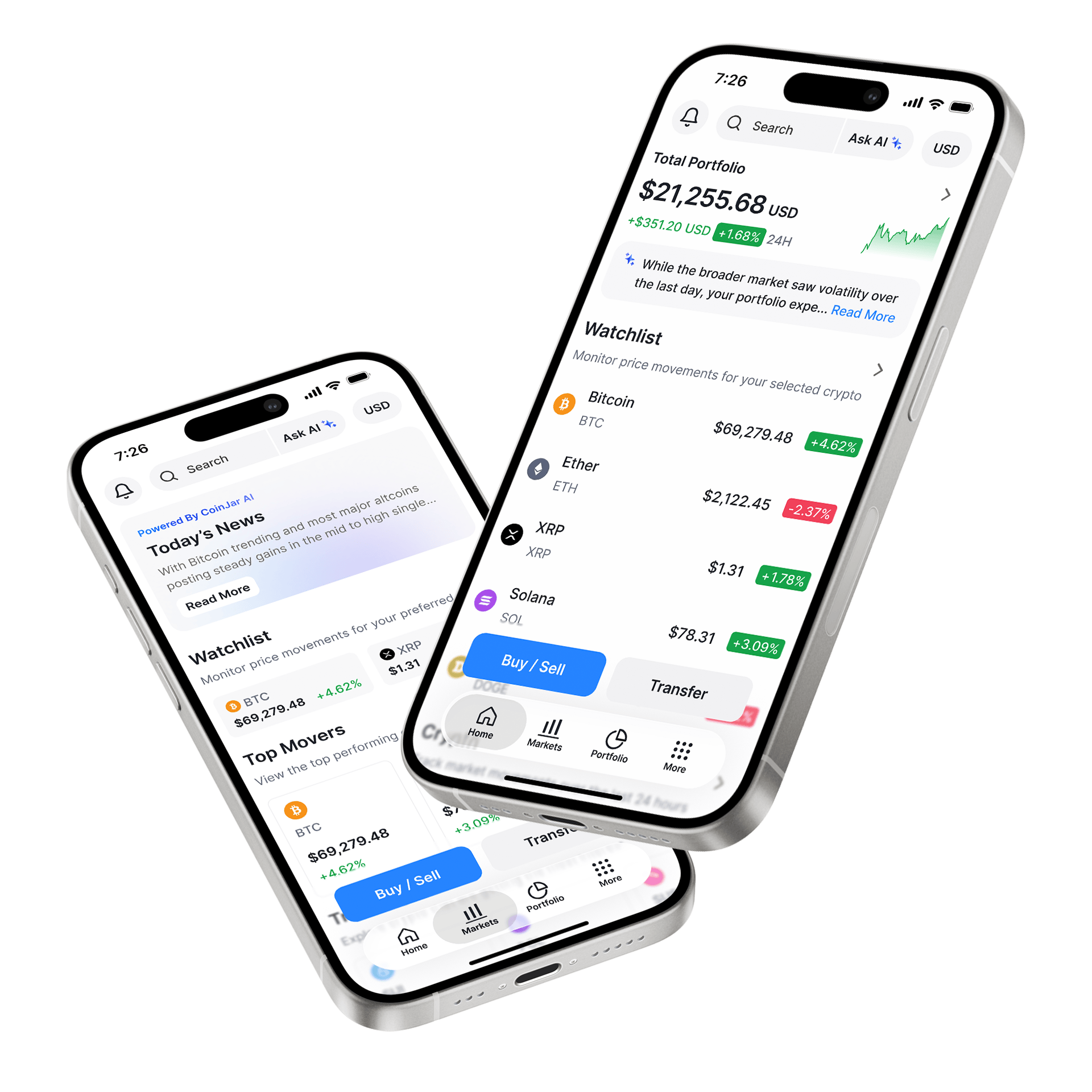
Buy, sell, send and even spend your crypto with Australia’s favourite cryptocurrency app.
Get the CoinJar appCoinJar App
Buy, sell, send and even spend your crypto with Australia’s favourite cryptocurrency app.
Get the CoinJar app
CoinJar Exchange
With one of the fastest matching engines in the world, CoinJar Exchange is purpose-built for institutions, market makers and professional traders. Features global liquidity, ultra-thin spreads and some of Australia and the UK’s most competitive fees.
Explore CoinJar ExchangeCoinJar Exchange
With one of the fastest matching engines in the world, CoinJar Exchange is purpose-built for institutions, market makers and professional traders. Features global liquidity, ultra-thin spreads and some of Australia and the UK’s most competitive fees.
Explore CoinJar Exchange
CoinJar
Get the app.