Outside of hacks, the common theme of crypto these days seems to be a preference for relying on the legal system to sort one’s mess.
Story One
Aave recovery efforts stalling
A few weeks ago, North Korean Hackers exploited Kelp DAO. The end of the story was that Aave ended up with $230 million in bad debt by allowing the exploiters to swap their loot for real ETH. The hackers also deposited roughly $71 million in ETH on Arbitrum One, which the security council decided to freeze using its emergency powers.
In the aftermath, crypto came together to pledge more than $300 million to Stani’s “DeFi United”, aimed at making affected users whole again. It could have put a beautiful end to a bad exploit, until a controversial law firm appeared.
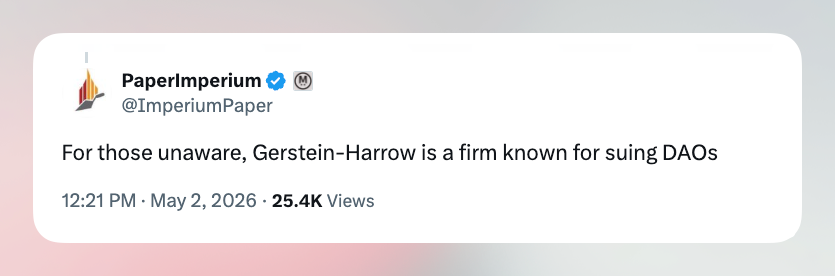
Gerstein Harrow served a restraining notice on Arbitrum DAO forbidding it from transferring any funds. They argue that the frozen funds are the property of Lazarus and therefore could be seized to satisfy their clients’ requests for damages instead. In response, Aave filed an emergency motion arguing that thieves don’t own what they steal.
Takeaway: It’s not Gerstin Harrow’s first rodeo; they’ve tried this playbook multiple times before. As it turns out, directly exploiting protocols isn’t the only way to make money. Being a bogus law firm is just about as effective.
Story Two
Too close to the Sun
In the myth, flying too close to the sun is Icarus’s demise. In crypto, we have an entrepreneur called Sun with seemingly equal powers. Justin Sun, the founder of Tron, has somehow come out on top of all the allegations thrown at him. You might remember him as the guy who bought the banana taped to the wall and ate it, or you might not know him at all (good for you).
Either way, his latest move might be where he bit off more than he could chew. In November 2024, he invested $30 million into World Liberty Financial (WLFI), the crypto project co-founded by the Trump family. When the token first became tradable, naturally, he started transferring funds. Yet on September 4ᵗʰ WLFI froze his wallets due to “suspected misappropriation”.
Sun finally publicly blew off in April and decided to sue the project. In response, the WLFI account tweeted that you can’t believe anything Justin Sun says and that they’d see him in court. Justin Sun appears relaxed at the prospect of a defamation lawsuit.

Takeaway: You can go from friend to foe real quick with the Trump-affiliated projects. That said, it’s just ridiculous to see shady actors suing each other.
Story Three
In the court of public opinion…
Crypto remains a questionable asset to invest in, and an even worse pillar for your identity.
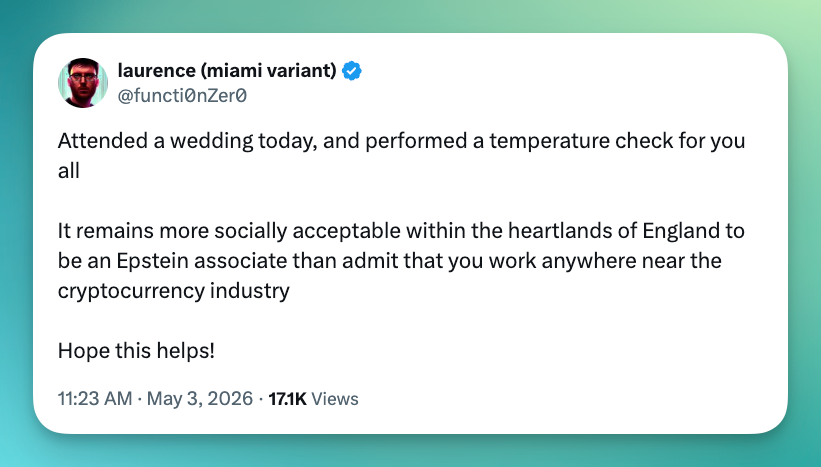
It probably doesn’t help that each late-night TV show format has by now picked up on prediction markets’ ties to crypto, associating it even further with speculating on weird things. That aside, there’s now even more data to prove that crypto might be annoying to normal people.
Ever since X introduced their snooze feature, crypto has quickly risen to the top, even beating politics as the most-muted topic. Another hit to people on CT who’ve already had to deal with the X API blocking apps that paid users to engage, and the suspicion that X’s head of product was destroying Crypto Twitter on purpose.
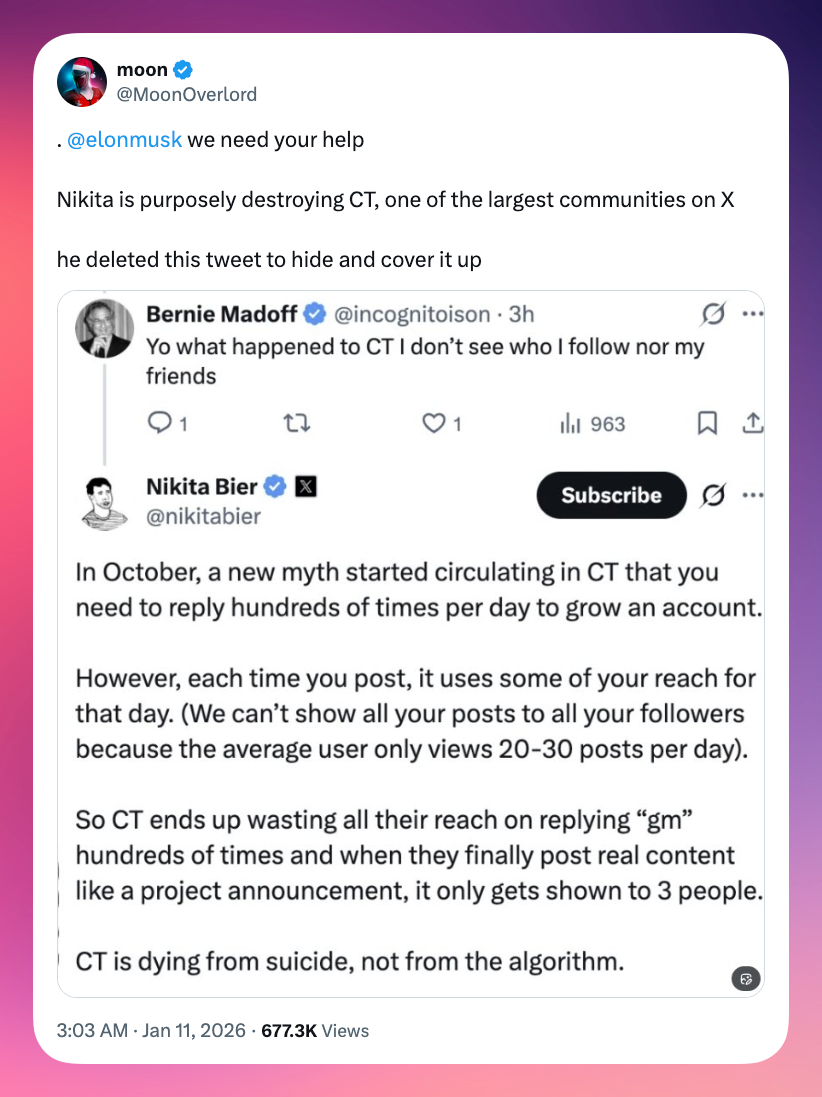
What speaks against the conspiracy theory that X is destroying CT is its recent launch of Smart Cashtags, which allow users to view real-time prices for stocks and crypto. Overall, the reason CT is less active might have less to do with the algo, and more with market sentiment.
Takeaway: When going to a wedding, perhaps don’t mention working in crypto.
Fact of the Week: Speaking of the law and such, did you know that the Brits stick to an array of their outdated laws, such as forbidding shaking a carpet in the metropolitan police district or handling salmon in suspicious circumstances. For a more fun introduction to bizarre still-existing UK laws, check out this video.
Naomi for CoinJar
Warning: Past performance is not a reliable guide to future performance. If you invest in this product, you may lose some, or all, of the money you invest. The above information is not to be read as investment, legal or tax advice and takes no account of particular personal or market circumstances; all readers should seek independent investment, legal and tax advice before investing in cryptocurrencies. There are no government or central bank guarantees in the event something goes wrong with your investment. This information is provided for general information and/or educational purposes only. No responsibility or liability is accepted for any errors of fact or omission expressed therein. CoinJar Europe Limited makes no representation or warranty of any kind, express or implied, regarding the accuracy, validity, reliability, availability, or completeness of any such information. CoinJar Europe Limited is authorised by the Central Bank of Ireland as a crypto-asset service provider (registration number C496731).