
2026 has been off to a strong start, with constant drama from the White House. But it’s not on Trump alone to keep our cholesterol levels high. Crypto is contributing its part.
Story One
Zcash devs said: f*ck this shit
At least in regards to the corporate structure they had to labor under, which was called Electric Coin Company and had been operating as the de facto entity for Zcash development for years. Since late 2025, Zcash has been having a moment as crypto people jumped on the privacy train - aided by an increase in governments seeking to turn their states into a panopticon.

On January 7th, the developers sent a shockwave through the community when they collectively resigned over differences with the board. In essence, the developers felt their working environment had changed in a way that made it impossible to continue delivering a protocol that’s resistant to censorship and surveillance.
In the aftermath of the announcement, the price dropped by 20%, halted by shills on CT, who pointed out that this was a rejection of bureaucracy and that the devs would continue working on the protocol.
Takeaway: Probably not the last time corporate compliance runs up against cypherpunk ethos-maintaining developers. It did, however, expose that the tech is not the only thing chains have to worry about.
Story Two
If you know, you know
In 2026, the best way to make money is the same way it’s been for Nancy Pelosi for years. All you need is insider information and an account on one of the many prediction markets sprouting faster than the mold on the abandoned cheese sandwich at the bottom of your kids' bag during the holidays.
From the get-go, one concern around prediction markets has been that they’d become a haven for insiders. The capture of Maduro has once again lit a fire under the debate over whether that’s how people use these markets, with one new account making nearly half a million dollars betting that Maduro will be out of office by the end of January.
Crypto Twitter has taken note, and some have made a sport of finding Polymarket accounts with an immaculate track record of 100% correct predictions. The second-biggest market in the game, Kalshi, was quick to point fingers, accusing that all this insider trading could never happen on their platform. It’s the unregulated ones we have to worry about.
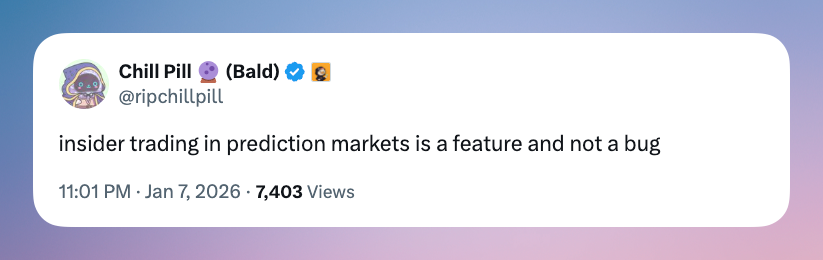
Let’s be real, if part of the selling point of these markets is that they accurately predict what will happen, who better to rely on than insiders?
Takeaway: Trump’s son is an advisor to both the biggest prediction markets. Do we really think they’ll face regulatory restrictions? I doubt it.
Story Three
We did it
The blockchain trilemma has been solved. This is a phrase usually uttered by new L-1 blockchains trying to collect venture funding. This time, it’s different. It was Vitalik, the creator of Ethereum, who posted a long tweet explaining how we did it; it’s real now.
The trilemma assumes that blockchains could never have all three: decentralization, safety, and scalability. Vitalik essentially explains that the trilemma isn’t real anymore; it can’t hurt us. With the code Ethereum has, it’s on the best path to move beyond such limitations.
So how did Ethereum get to this point? It’s through the addition of Data Availability Sampling, a fancy word to say that instead of checking the whole chain, nodes can sample probabilistically, and the progressing development of zkEVMs.
Some view this as an admission that the entire L2 thing didn’t work out as planned. It doesn’t help their cause that mainnet Ethereum fees have been very cheap recently.
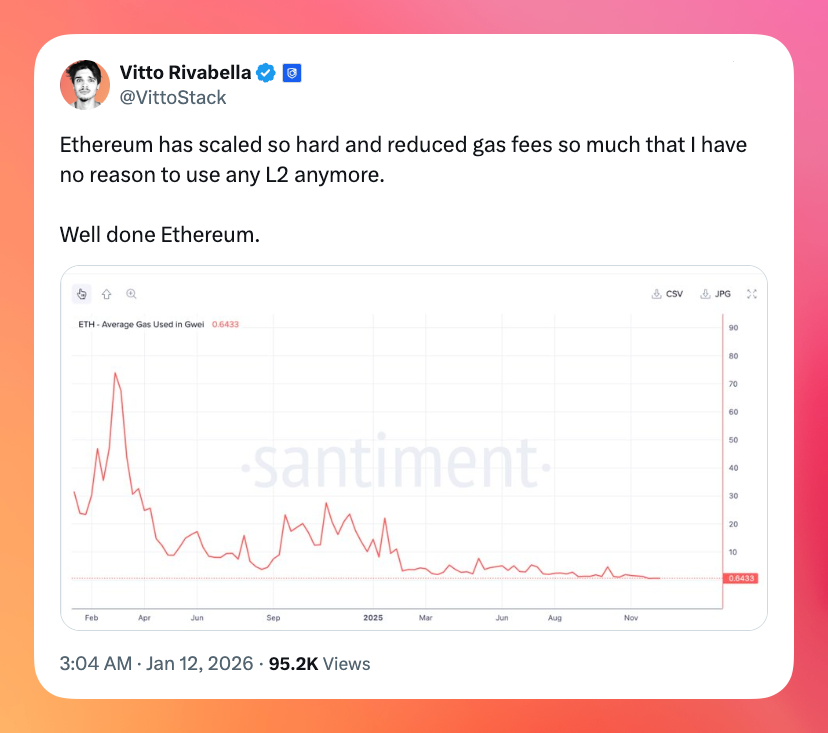
Takeaway: Admittedly, the trilemma isn’t entirely solved, but it makes for a good feeling when the guy at the top says that we're actually fixing things. Rip to the L2s.
Fact of the Week: Speaking of high cholesterol levels, did you know that chronic stress will shrink your hippocampus, worsening memory, focus, and your ability to learn? Consider this before getting rage-baited.
Naomi for CoinJar
Don’t invest unless you’re prepared to lose all the money you invest. This is a high‑risk investment and you should not expect to be protected if something goes wrong. Take 2 mins to learn more.
The article is an opinion expressed by the author at a point in time and does not represent the views of CoinJar UK Limited or CoinJar Australia Pty Ltd. Take care to consider the date of this article and be aware that this opinion is based on circumstances at the time of publishing. No responsibility or liability is accepted for any errors of fact or omission expressed therein. Past performance is not a reliable indicator of future results.
This above article is not to be read as investment, legal or tax advice and it takes no account of particular personal or market circumstances; all readers should seek independent investment advice before investing in cryptocurrencies.
We recommend you obtain financial advice before making a decision to use your credit card to purchase cryptoassets or to invest in cryptoassets.In the UK, it's legal to buy, hold, and trade crypto, however cryptocurrency is not regulated in the UK. It's vital to understand that once your money is in the crypto ecosystem, there are no rules to protect it, unlike with regular investments.
You should not expect to be protected if something goes wrong. So, if you make any crypto-related investments, you're unlikely to have recourse to the Financial Services Compensation Scheme (FSCS) or the Financial Ombudsman Service (FOS) if something goes wrong.
Cryptoassets traded on CoinJar UK Limited are largely unregulated in the UK, and you are unable to access the Financial Service Compensation Scheme or the Financial Ombudsman Service. We use third party banking, safekeeping and payment providers, and the failure of any of these providers could also lead to a loss of your assets. We recommend you obtain financial advice before making a decision to use your credit card to purchase cryptoassets or to invest in cryptoassets. Capital Gains Tax may be payable on profits.
CoinJar’s digital currency exchange services are operated in the United Kingdom by CoinJar UK Limited (company number 8905988), registered by the Financial Conduct Authority as a Cryptoasset Exchange Provider and Custodian Wallet Provider in the United Kingdom under the Money Laundering, Terrorist Financing and Transfer of Funds (Information on the Payer) Regulations 2017, as amended (Firm Reference No. 928767).