The big banks are coming for stablecoins. US regulators finalised the first rules under the GENIUS Act this week, while JPMorgan and HSBC both rolled out digital tokens of their own.
Elsewhere, Bitcoin posted its third weekly loss in a row as oil prices spiked and Big Tech’s AI spending came back under the microscope.
Here are the top stories you need to know:
Headlines of the week
- Bitcoin posted its third weekly loss in a row, falling about 2% to around $80,000 after failing near $85,000 on Wednesday and dipping to $79,258 on Monday morning.
- US spot Bitcoin ETFs finished the week $301.2m in the green, despite a $635.6m exit on 22nd October, the biggest single-day outflow since June. BlackRock’s IBIT took in $565.7m, while Ethereum ETFs lost $220.7m.
- Switzerland approved its first Bitcoin ETF for everyday investors, with regulator FINMA waiving its usual diversification rules for a fund that holds Bitcoin directly. No launch date has been set yet.
- Standard Chartered agreed to buy all of crypto custodian Zodia Custody, signing definitive agreements on 21st October, subject to regulatory approval.
- Franklin Templeton added around $150m of tokenised fund shares to the XRP Ledger, all of it sitting in a single wallet, leaving the XRP Army guessing who’s behind it.
The big banks move into stablecoins

Stablecoins took a big step into the mainstream this week. On 21st October, the Office of the Comptroller of the Currency (OCC) became the first US regulator to finalise rules under the GENIUS Act, setting out how banks and approved firms can issue dollar stablecoins. The rules cover reserves, redemptions, custody and capital, and take effect on 18th January 2027.
The banks aren’t waiting around. JPMorgan brought its JPM Coin deposit token to Ethereum’s main network on 19th October, giving approved institutional clients another way to move dollars around the clock. In Hong Kong, HSBC launched RedCoin, a Hong Kong dollar stablecoin, for the 3.3 million users of its PayMe app, who can spend it at more than 100,000 merchants.
Stablecoins are moving out of crypto’s back office and into mainstream banking. With US rules in place and some of the world’s biggest banks issuing their own tokens, the gap between crypto and traditional finance keeps getting smaller. Comptroller Jonathan Gould called the rule “a clear, practical framework for payment stablecoin innovation”.
Oil and AI jitters drag Bitcoin lower

Bitcoin tried to break higher on Wednesday, but ran out of steam near $85,000. By Monday morning it had slipped to $79,258, its third straight weekly loss, closing below its 50-day moving average for the first time since August.
Two familiar culprits did the damage. Brent crude settled at $116.72 a barrel, its highest close since April, after Houthi strikes on Saudi Arabia and a report that the US and Israel have drawn up plans to resume strikes on Iran after the 3rd November midterms. Then Meta fell 7% on Thursday after its results, reviving doubts about Big Tech’s AI spending and dragging the Nasdaq down 2.6%, its worst day since June.
Leverage paid the price again, with more than $400m of mostly long positions liquidated in just four hours on Saturday. Markets went into this week’s Fed meeting expecting rates to stay on hold, so the bigger question is what the Fed signals for December.
Solana speeds up as Ethereum stalls

It was a tale of two upgrades this week. On 21st October, Solana switched on Alpenglow, a major overhaul of how the network agrees on transactions, cutting the time it takes for a transaction to become final from about 12.8 seconds to roughly 150 milliseconds. That’s about the blink of an eye, with fees and existing programs left unchanged.
Ethereum wasn’t so lucky. Developers postponed Glamsterdam’s final test on the Hoodi testnet just four days before its 26th October launch, after security firm ChainSecurity found that planned gas price changes could break existing smart contracts in 13 real-world cases. No new date has been set.
Why does it matter? Glamsterdam was meant to reach Ethereum’s main network by the end of 2026, but one developer now expects it to slip into 2027. Solana, meanwhile, now has a headline speed figure to pitch as more banks and fund managers bring their tokens onchain.
Final takeaway: The big banks are moving into stablecoins, oil and AI jitters are weighing on Bitcoin, and Solana is speeding ahead while Ethereum waits.
Caleb for CoinJar
Bitcoin Tests Higher-Timeframe Support, Bounce?
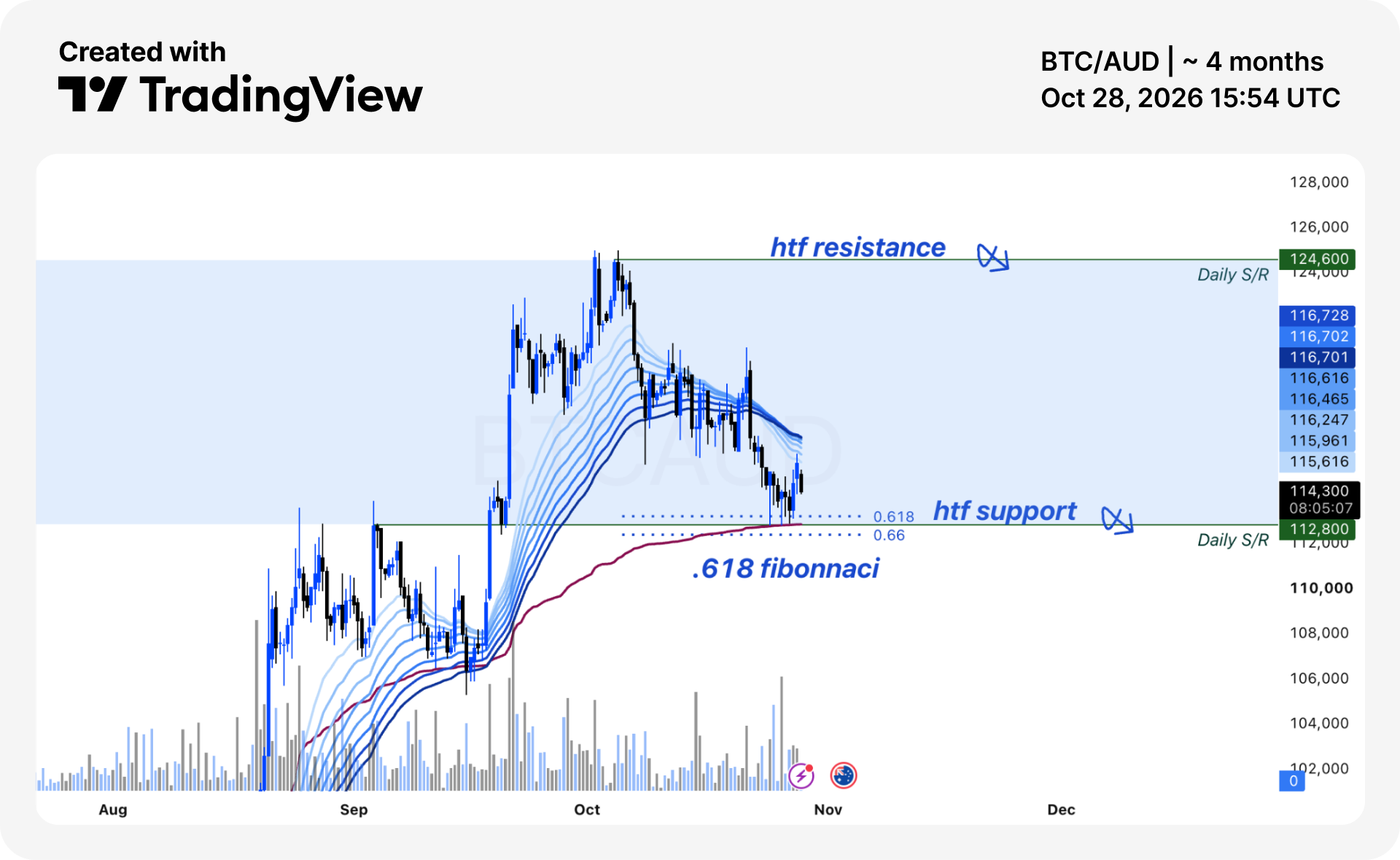
Bitcoin is currently testing a higher-timeframe support zone aligned with the 0.618 Fibonacci retracement, making this a key area to monitor for the next directional move.
If buyers defend this confluence, price could rotate towards higher-timeframe resistance while remaining within its current trading range. A sustained rebound would also help preserve the existing bullish structure of higher highs and higher lows.
However, stronger buying volume and follow-through would be needed to support a sustained recovery. If price breaks below support and fails to reclaim it, the probability of a deeper correction could increase, potentially exposing lower areas of interest.
For now, the reaction around the 0.618 Fibonacci level remains key, with both a confirmation will help determine which scenario gains strength in the coming weeks.
Aziz for CoinJar
Want more chart analysis? Follow CoinJar on TradingView for regular technical analysis from our team:
https://www.tradingview.com/broker/CoinJar/publications-ideas/
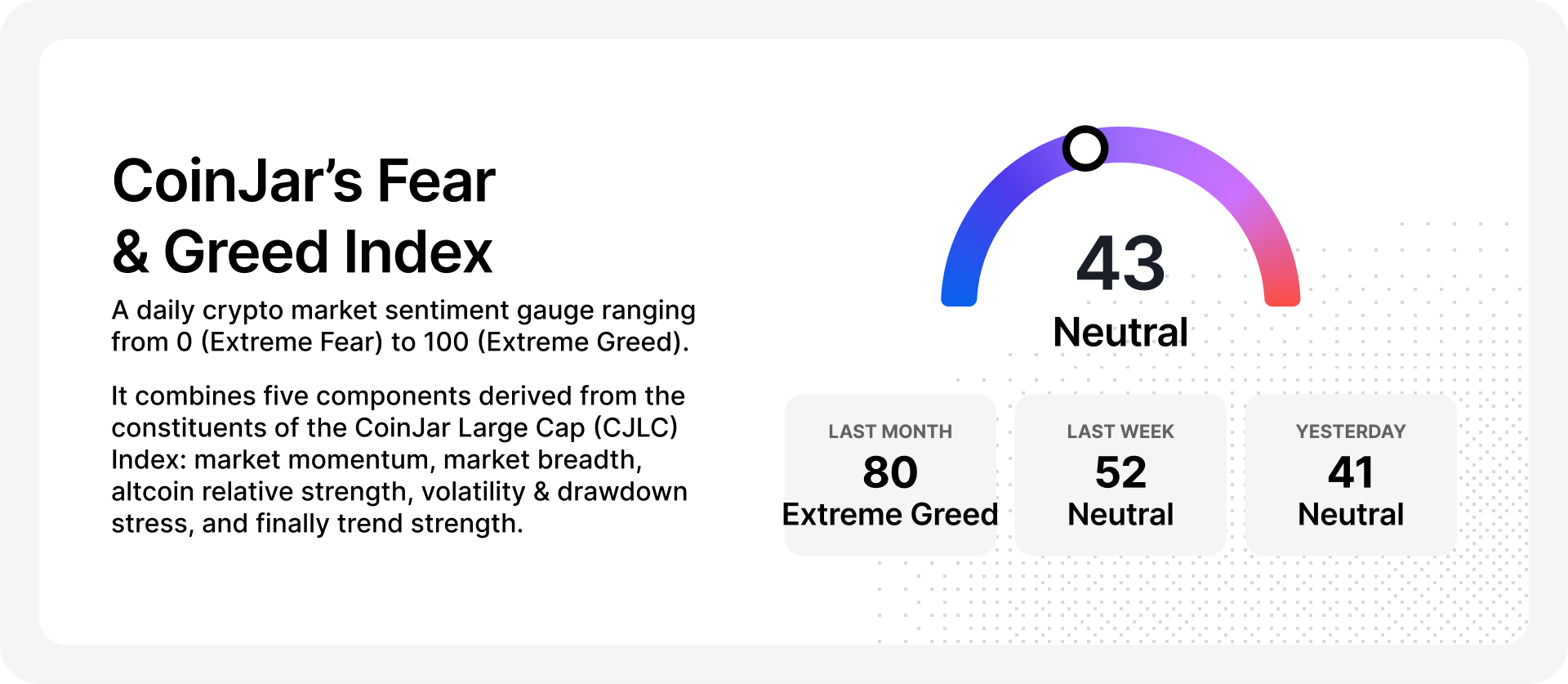
The latest Fear & Greed index from CoinJar
Don’t invest unless you’re prepared to lose all the money you invest. This is a high‑risk investment and you should not expect to be protected if something goes wrong. Take 2 mins to learn more.
The article is an opinion expressed by the author at a point in time and does not represent the views of CoinJar UK Limited or CoinJar Australia Pty Ltd. Take care to consider the date of this article and be aware that this opinion is based on circumstances at the time of publishing. No responsibility or liability is accepted for any errors of fact or omission expressed therein. Past performance is not a reliable indicator of future results.
This above article is not to be read as investment, legal or tax advice and it takes no account of particular personal or market circumstances; all readers should seek independent investment advice before investing in cryptocurrencies.
We recommend you obtain financial advice before making a decision to use your credit card to purchase cryptoassets or to invest in cryptoassets.In the UK, it's legal to buy, hold, and trade crypto, however cryptocurrency is not regulated in the UK. It's vital to understand that once your money is in the crypto ecosystem, there are no rules to protect it, unlike with regular investments.
You should not expect to be protected if something goes wrong. So, if you make any crypto-related investments, you're unlikely to have recourse to the Financial Services Compensation Scheme (FSCS) or the Financial Ombudsman Service (FOS) if something goes wrong.
Cryptoassets traded on CoinJar UK Limited are largely unregulated in the UK, and you are unable to access the Financial Service Compensation Scheme or the Financial Ombudsman Service. We use third party banking, safekeeping and payment providers, and the failure of any of these providers could also lead to a loss of your assets. We recommend you obtain financial advice before making a decision to use your credit card to purchase cryptoassets or to invest in cryptoassets. Capital Gains Tax may be payable on profits.
CoinJar’s digital currency exchange services are operated in the United Kingdom by CoinJar UK Limited (company number 8905988), registered by the Financial Conduct Authority as a Cryptoasset Exchange Provider and Custodian Wallet Provider in the United Kingdom under the Money Laundering, Terrorist Financing and Transfer of Funds (Information on the Payer) Regulations 2017, as amended (Firm Reference No. 928767).