
Buy Jupiter
JUPFigures shown refer to the past. Past performance is not a reliable indicator of future results. Pricing data is provided by CoinJar.
What is Jupiter?
Jupiter is a group of trading and decentralised finance apps built on the Solana blockchain. It started as a swap aggregator. When you trade one Solana token for another, Jupiter compares prices across many decentralised exchanges and routes the order through whichever path gives the best result. It has since added limit orders, recurring buys, perpetual futures, lending through Jupiter Lend, a mobile wallet and other products.
JUP is Jupiter's token. It launched in January 2024 through an airdrop to people who had used the platform. Buying JUP gives you exposure to Jupiter as a whole rather than to any single product.
What JUP is, and what it isn't
At the contract level, JUP is a standard SPL token on Solana. Its mint and freeze authorities have been removed, so no new JUP can be created and nobody can freeze holders' tokens. Supply can still fall, because burns remove tokens permanently.
You don't need JUP to use Jupiter. Swaps, perpetual futures and lending are paid for in Solana or in the tokens being traded, not in JUP.
JUP's main role is governance. Holders who stake it can vote in the Jupiter DAO and earn rewards for taking part. Holding JUP gives you no equity in the companies behind Jupiter and no direct share of its fees, as Jupiter's token documentation explains. JUP cannot be staked directly on CoinJar.
How the Litterbox Trust works
Jupiter links JUP to platform activity through a buyback. A share of its onchain revenue is used to buy JUP on the open market, and those tokens go into the Litterbox Trust, a long-term reserve.
The tokens are held, not paid out to holders. What happens to them is decided separately. In November 2025 DAO voters approved burning the tokens the trust had collected up to that point, and any further burn needs a further decision. The share of revenue used for buybacks is not fixed by code and can change.
Staking and governance
Staking JUP lets you vote on DAO proposals, which mostly cover how community token reserves are used and how many new tokens are released. Stakers who vote earn Active Staking Rewards, paid in JUP. Unstaking is not instant: there is a cooldown before you can claim your tokens, explained in Jupiter's staking guide.
Governance has been uneven. In June 2025 the Jupiter team paused all DAO votes for the rest of the year, saying the structure had led to a breakdown in trust, as CoinDesk reported.
In 2026 the DAO approved a "net-zero emissions" plan, meaning no net increase in circulating JUP. It suspended new team token issuance, postponed the annual airdrop and committed Jupiter to buy back tokens to offset unlocks by early investors.
Who controls Jupiter
Jupiter was co-founded by a pseudonymous developer known as Meow and by Siong Ong. The Jupiter interface is provided by Block Raccoon S.A., and its terms of use are governed by the laws of Panama.
The core team builds and runs the apps and the onchain programs behind them. DAO votes cover token matters, not day-to-day product decisions. Team and community token allocations sit in multisig wallets rather than on a schedule fixed by code, so when those tokens are released depends on team decisions and DAO votes.
Track record
Jupiter has become one of the most used apps on Solana. Its history also includes several setbacks:
- Supply reset, January 2025. Jupiter burned a large part of the unreleased team and community allocation, almost all of it tokens that had not yet entered circulation. A community audit lists the transactions.
- Social media hack, February 2025. Attackers took over Jupiter's main X account and used it to promote scam memecoins. People who bought those coins lost money. The incident involved social media accounts, not Jupiter's onchain programs. CoinMarketCap covered what happened.
- Jupiter Lend dispute, December 2025. Jupiter had described the vaults in its lending product as isolated, with no risk of losses spreading between them. A rival Solana lending protocol challenged this. Kash Dhanda, Jupiter's COO, later said the claim was not fully correct and confirmed that collateral is reused within the protocol, while defending how the vaults are designed. FinanceFeeds covered the dispute.
- Airdrop postponed, February 2026. The DAO voted 75.3% in favour of postponing the annual airdrop to limit new supply. The 700 million JUP set aside for it went back to a community-controlled wallet and can't be used without another DAO vote.
Risks to understand
- Volatility. JUP's price can move sharply in both directions, and it tends to follow trading activity on Solana.
- No revenue right. Buybacks go into a reserve rather than to holders, and their size depends on Jupiter's revenue and on decisions that can change.
- Unreleased reserves. Large team and community allocations have not yet been released. Pausing emissions was a DAO decision, and a later vote could release tokens again.
- Concentrated control. A small team runs the products, has strong influence over governance and has paused voting before.
- Product risk. Jupiter runs perpetual futures, lending and other complex products. A failure in any of them could damage the platform and the token.
- Regulatory risk. Jupiter does not serve some countries, including the United States, and rules for DeFi platforms continue to change.
Send JUP on the right network
JUP is a Solana token. Use the network CoinJar specifies for deposits and withdrawals, and only send it to a wallet that supports Solana tokens. Fake tokens using the Jupiter name are common, so check the contract address rather than the ticker. Click here for the he genuine JUP mint address.
Our guides to transferring crypto on the wrong network and setting up a Phantom wallet explain what to check.
Buying JUP on CoinJar
CoinJar has operated since 2013 and lists JUP against British pounds, so you can buy, sell and hold it without converting through another cryptocurrency first. Current charges are on our fees page, and live British pound rates are on our cryptocurrency prices page.
Cash, credit or crypto?
Buy Jupiter using Visa or Mastercard. Get cash in your account with Faster Payments Service (FPS). Convert crypto-to-crypto with a single click.


How to buy Jupiter with CoinJar
Start your cryptocurrency portfolio with CoinJar by following these steps.
Download the app
Get the CoinJar app on iOS or Android.
Create an account
Create an account with CoinJar and verify your ID.
Make a purchase
Buy more than 60 cryptos using Faster Payments or a debit card.
Finder Awards Winner 2024
CoinJar was named the Best Exchange for Value in the UK as part of Finder's Crypto Trading Platform Awards - second year running! Check out our blog to see why Finder chose us over the competition.
See why Finder chose CoinJarFinder Awards Winner 2024
CoinJar was named the Best Exchange for Value in the UK as part of Finder's Crypto Trading Platform Awards - second year running! Check out our blog to see why Finder chose us over the competition.
See why Finder chose CoinJar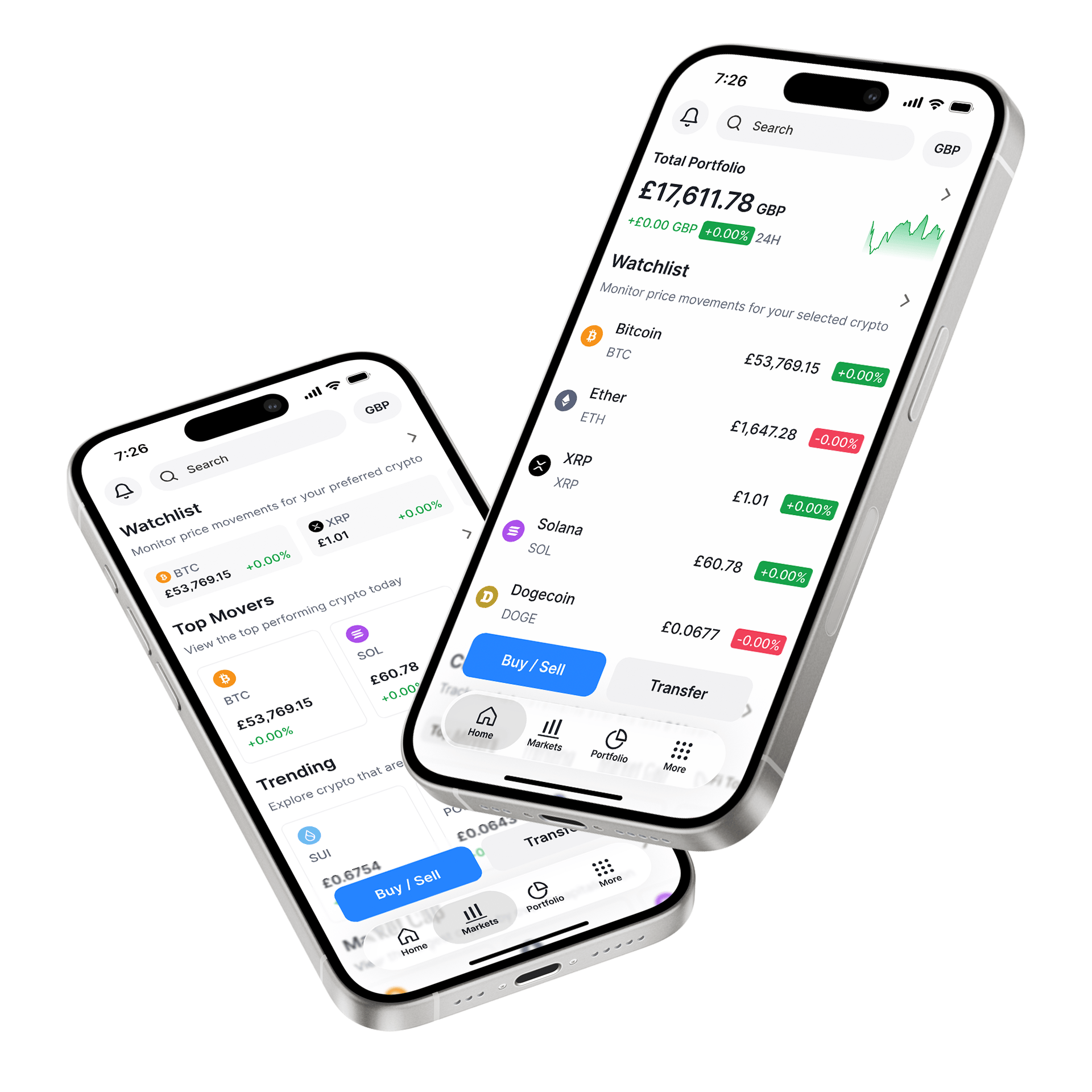
CoinJar App
Buy, sell and send your crypto with our cryptocurrency app.
Get the CoinJar appCoinJar App
Buy, sell and send your crypto with our cryptocurrency app.
Get the CoinJar appPast performance is not a reliable indicator of future results. Figures shown are for illustrative purposes only and are not actual market data.
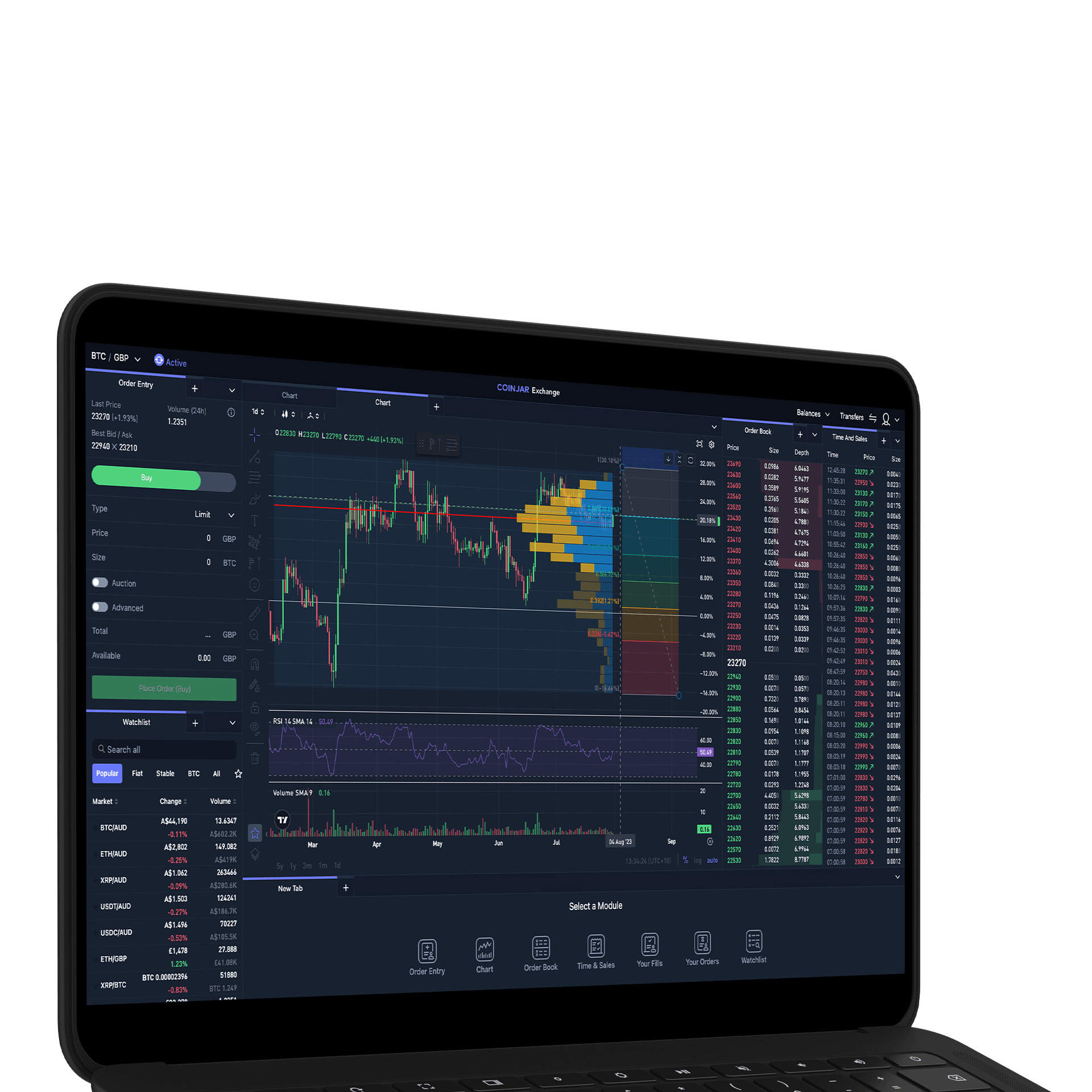
CoinJar Exchange
Purpose-built for institutions, market makers and professional traders, CoinJar Exchange offers 0%-0.1% fees, personalised trading layouts and ability to trade crypto with GBP and stablecoins.
Explore CoinJar ExchangeCoinJar Exchange
Purpose-built for institutions, market makers and professional traders, CoinJar Exchange offers 0%-0.1% fees, personalised trading layouts and ability to trade crypto with GBP and stablecoins.
Explore CoinJar Exchange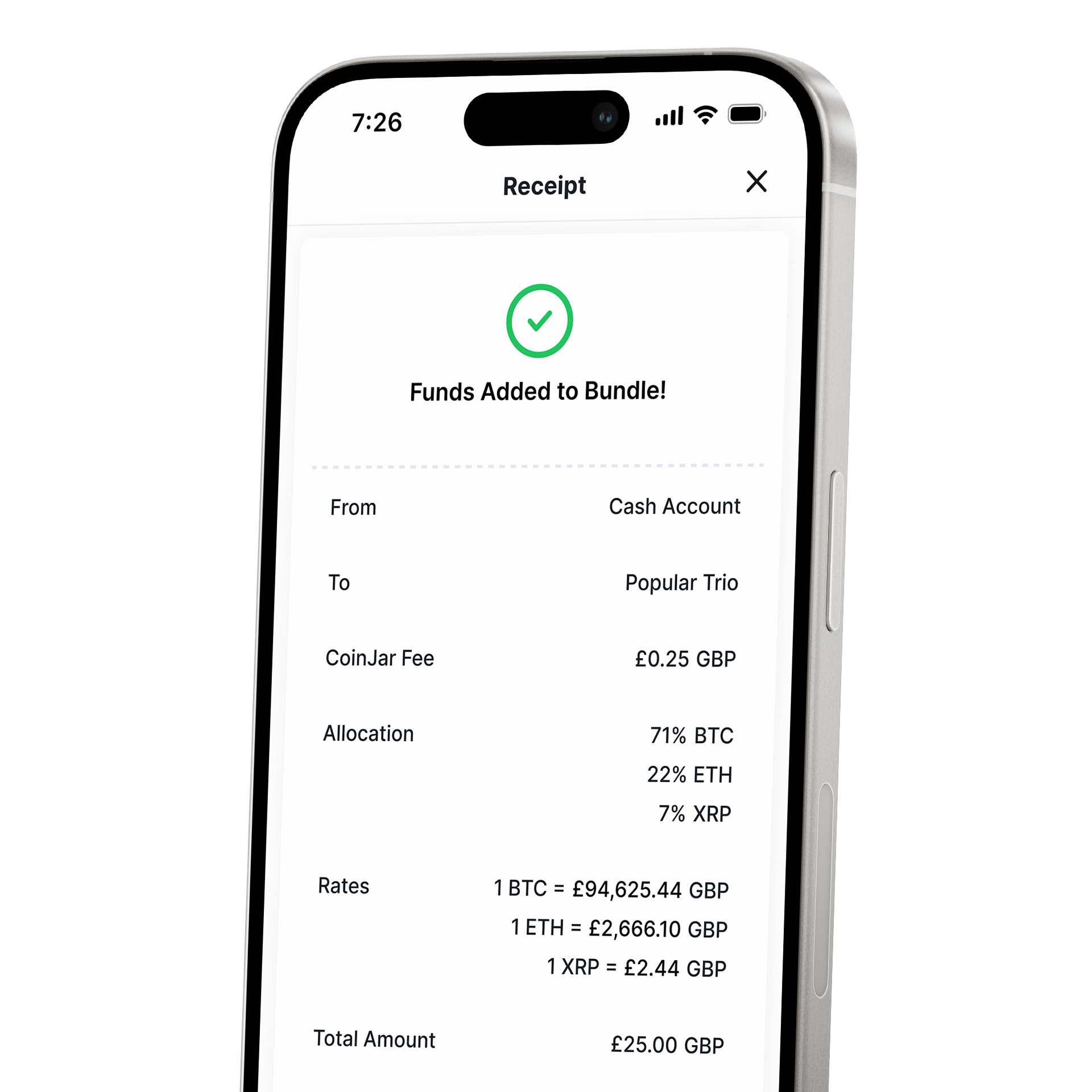
CoinJar DCA & Bundles
Dollar Cost Average (DCA) into individual cryptocurrencies or CoinJar Bundles. Choose your assets or Bundles with themed baskets of crypto in the CoinJar app. Use Recurring Buy to set up automated weekly, fortnightly, or monthly purchases at your chosen rate.
DCA with Recurring BuyCoinJar DCA & Bundles
Dollar Cost Average (DCA) into individual cryptocurrencies or CoinJar Bundles. Choose your assets or Bundles with themed baskets of crypto in the CoinJar app. Use Recurring Buy to set up automated weekly, fortnightly, or monthly purchases at your chosen rate.
DCA with Recurring BuyFrequently Asked Questions
Standard Risk Warning: The above article is not to be read as investment, legal or tax advice and it takes no account of particular personal or market circumstances; all readers should seek independent investment advice before investing in cryptocurrencies.
The article is provided for general information and educational purposes only, no responsibility or liability is accepted for any errors of fact or omission expressed therein. Past performance is not a reliable indicator of future results.
We use third party banking, safekeeping and payment providers, and the failure of any of these providers could also lead to a loss of your assets. We recommend you obtain financial advice before making a decision to use your credit card to purchase cryptoassets or to invest in cryptoassets. Capital Gains Tax may be payable on profits.
CoinJar's digital currency exchange services are operated in the UK by CoinJar UK Limited (company number 8905988), registered by the Financial Conduct Authority as a Cryptoasset Exchange Provider and Custodian Wallet Provider in the United Kingdom under the Money Laundering, Terrorist Financing and Transfer of Funds (Information on the Payer) Regulations 2017, as amended (Firm Reference No. 928767). In the UK, it's legal to buy, hold, and trade crypto, however cryptocurrency is not regulated in the UK.
It's vital to understand that once your money is in the crypto ecosystem, there are no rules to protect it, unlike with regular investments. You should not expect to be protected if something goes wrong. So, if you make any crypto-related investments, you're unlikely to have recourse to the Financial Services Compensation Scheme (FSCS) or the Financial Ombudsman Service (FOS) if something goes wrong.
The performance of most cryptocurrency can be highly volatile, with their value dropping as quickly as it can rise. Past performance is not an indication of future results. Remember: Don't invest unless you're prepared to lose all the money you invest. This is a high-risk investment and you should not expect to be protected if something goes wrong. Take 2 mins to learn more at: https://www.coinjar.com/uk/risk-summary.
UK residents are required to complete an assessment to show they understand the risks associated with what crypto/investment they are about to buy, in accordance with local legislation. Additionally, they must wait for a 24-hour "cooling off" period, before their account is active, due to local regulations. If you use a credit card to buy cryptocurrency, you would be putting borrowed money at a risk of loss.
We recommend you obtain financial advice before making a decision to use your credit card to purchase cryptoassets or to invest in cryptoassets.
Specific risks associated with DeFi tokens Decentralised Finance (or 'DeFi') tokens (e.g. UNI, AAVE) are crypto-assets linked to financial applications and protocols built on decentralised blockchain technology. DeFi tokens carry the following risks:
Smart contract risk: DeFi relies heavily on smart contracts. Even a minor coding error or oversight can lead to a contract being exploited, potentially resulting in significant losses for DeFi tokens.
Regulatory risk: DeFi operates in a decentralised manner, often without intermediaries or financial crime controls. Regulatory bodies across jurisdictions might introduce new regulations impacting the use, value, or legality of certain DeFi protocols or assets.
Rug-pulls / Exit scams: Some DeFi projects might be launched by anonymous or pseudonymous teams, increasing the risk of "rug pulls" where developers abandon the project and withdraw funds, leaving investors with worthless tokens.
Data/oracle risk: DeFi protocols often rely on external data sources or 'oracles. Manipulation or inaccuracies in these data sources can lead to unintended financial outcomes within the protocols. Protocol complexity: The complexity of some DeFi protocols can make it difficult for average users to fully understand the mechanisms and associated risks.
Specific risks associated with meme coins:
'Meme coins' (e.g. DOGE, SHIB, PEPE) are crypto-assets whose value is driven primarily by community interest and online trends.
Meme coins carry the following risks:
Volatility risk: Meme coins can have extreme price volatility, often experiencing rapid and unpredictable price fluctuations within short periods. The value of meme coins can be influenced by social media trends, celebrity endorsements, and other factors unrelated to traditional investment fundamentals. Lack of utility: Meme coins often lack intrinsic value or utility, being primarily driven by community interest, online trends, and speculative trading.
Market manipulation: Meme coins may be susceptible to increased risk of market manipulation including 'pump-and-dump' schemes, where the price is artificially inflated followed by a sudden crash.
Lack of transparency: Meme coins may have limited available information about their development teams, goals, and financials. This lack of transparency can make it challenging to assess the credibility and potential of a meme coin accurately.
Emotional investing: Meme coins often garner strong emotional reactions from investors, leading to impulsive decisions. Emotional trading activity can amplify losses.
Specific risks associated with stablecoins:
There is a risk that any particular stablecoin may not hold their value as against any fiat currency; or may not hold their value as against any other asset. Stablecoins carry the following risks:
Depegging events: Depegging events may occur with stablecoins that fail to maintain adequate controls and risk mitigants. A depegging event is when the value of the stablecoin no longer matches the value of the underlying asset. This could result in a loss of some or all of your investment.
Counterparty risk: Counterparty risk arises when an asset is backed by collateral, involving a third party maintaining the collateral, which introduces risk if the party becomes insolvent or fails to maintain it.
Redemption risk: Redemption risk refers to the possibility that an asset's ability to be redeemed for underlying collateral may not be as anticipated during market fluctuations or operational issues.
Collateral risk: Collateral risk refers to the possibility of the collateral's value declining or becoming volatile, potentially impacting the asset's stability, particularly when it is another crypto-asset.
Exchange rate fluctuations: Stablecoins, often denominated in US Dollars, expose investors to fluctuations in the USD:GBP exchange rate. Algorithmic risk: Algorithm risk refers to the possibility of an asset's stability being compromised due to unexpected failure or behaviour of the underlying algorithm, potentially leading to loss of value.
CoinJar does not endorse the content of, and cannot guarantee or verify the safety of any third-party websites. Visit these websites at your own risk.

CoinJar
Get the app.