
Buy Lighter
LITFigures shown refer to the past. Past performance is not a reliable indicator of future results. Pricing data is provided by CoinJar.
What is Lighter?
Lighter is a decentralised exchange focused mainly on perpetual futures, contracts that let traders take leveraged positions on an asset's price with no expiry date. It runs on its own application-specific zero-knowledge (ZK) rollup, a layer 2 network that settles on Ethereum. Lighter generates cryptographic proofs for its order matching and liquidations and posts them to Ethereum, so the exchange's results can be checked rather than taken on trust.
LIT is Lighter's token. It launched in December 2025 as an ERC-20 token on Ethereum and was issued directly by the US company behind Lighter rather than by a separate foundation, according to CoinDesk's launch coverage. Lighter's terms of service name that company as Elliot Technologies, Inc. Lighter was founded in 2022 by Vladimir Novakovski, who began his career at hedge fund Citadel and spent almost 15 years as an engineer and trader before founding Lighter, and has raised venture funding from investors including Founders Fund, Ribbit Capital and Haun Ventures, as Fortune reported.
Do you need LIT to use Lighter?
No. Trading on Lighter is margined mainly in USDC, with a small number of other assets accepted through multi-asset margin, and standard accounts pay no maker or taker fees, so you can use the exchange without ever holding LIT. The token matters mainly to high-volume traders using Premium accounts, who can stake LIT for fee discounts, and to anyone who wants to deposit into the Lighter Liquidity Pool or earn staking rewards.
LIT staking takes place off-platform on Lighter's own exchange, which Lighter's terms say is not available to UK residents. According to Lighter's documentation, staking LIT:
- gives access to the Lighter Liquidity Provider (LLP) pool, which is reserved for LIT stakers
- earns staking rewards, which Lighter pays in LIT
Lighter's fees page also says staking LIT discounts trading fees on Premium accounts, an opt-in account type. Unstaking is subject to a three-day lockup before tokens are released. For background on how this works in general, see our guide to staking. Staking LIT is not available at CoinJar
What does holding LIT entitle you to?
LIT isn't a share in Elliot Technologies, the company behind Lighter. It doesn't pay dividends or give you a legal claim on Lighter's revenue, and Lighter's documentation doesn't describe any voting rights for holders. So far, the company has made and announced the key decisions about the token itself. LIT holders can benefit in two main ways:
- Buybacks: Lighter uses trading fee revenue to buy LIT on the open market. Since mid-2026, it has burned these tokens, which removes them from circulation permanently. More than 18 million LIT has been burned so far. A smaller supply doesn't guarantee a higher price, though.
- Staking rewards: If you lock up ("stake") your LIT, you currently earn a percentage yield in extra LIT. The rewards come from a reserve of tokens Lighter set aside, not from trading fees, and the company can change the rate at its discretion.
Who controls Lighter?
Lighter is a company-run exchange. The company operates the sequencer and matching engine that order and execute trades, and it controls upgrades to the rollup's smart contracts. L2BEAT, which tracks Ethereum layer 2 networks, rates Lighter as Stage 0, its earliest category of decentralisation. L2BEAT notes that regular upgrades are subject to a delay, but a security council can cut that delay to zero in an emergency, so users have no guaranteed window to exit before an unwanted upgrade. Guardian roles can also pause batch processing and withdrawals for limited periods.
The main safeguard is an escape hatch, explained in the FAQs below. In 2026, L2BEAT said it had independently regenerated all of Lighter's ZK circuits from source code, so users can check that the escape hatch works without relying on the Lighter team, as ETH Daily reported.
Track record
Lighter has grown quickly, but its short history includes real stress points:
- Outage during the October 2025 crash. On 10 October 2025, during one of the largest liquidation events in crypto history, Lighter was down for about four and a half hours, which L2BEAT attributes to database growth issues. Traders could not manage their positions during that window. Lighter said it would compensate affected traders with a mix of stablecoins and points, and later distributed points to affected users.
- Withdrawal problems at token launch, December 2025. LIT went live on 30 December 2025, and some users reported they could not withdraw funds on the same day.
- Tokenomics change, 2026. Lighter moved from holding repurchased LIT to burning it and drew on its ecosystem reserve to fund staking rewards, as The Defiant reported. The change was announced by the company rather than decided by a holder vote.
- US licence plans, 2026. Lighter has said it plans to apply for a derivatives licence from the US Commodity Futures Trading Commission, as Crypto Briefing reported. Treat this as an intention. A filing does not mean approval, and regulatory processes can take a long time.
Risks to understand
- Upgrade and pause powers. Lighter's contracts can be upgraded without a guaranteed exit window, and guardian roles can temporarily halt withdrawals. A bug or a harmful upgrade could put funds on the exchange at risk.
- Centralised operation. A single operator orders trades. L2BEAT notes the operator could in theory exploit that position to front-run users, and the October 2025 outage showed how much depends on the company's infrastructure.
- Value capture is a policy, not a right. Buybacks and burns depend on exchange revenue and company decisions. If trading volume falls or the policy changes, the support they give LIT changes with it.
- Token unlocks. Team and investor allocations were locked for one year from launch and then vest over three years, so these tokens begin entering circulation from late December 2026, according to CoinDesk.
- Competition. Lighter competes with many other perpetual futures exchanges, both centralised and decentralised. Standard accounts pay no fees, so revenue depends on fee-paying account types, integrations and overall trading volume holding up.
- Regulatory uncertainty. Lighter's terms exclude users in several countries, including the United States and the United Kingdom, and leveraged derivatives draw close regulatory attention. Rule changes could affect where and how Lighter operates.
Send LIT on the right network
LIT is an ERC-20 token on Ethereum. Inside the Lighter exchange, balances sit on Lighter's own layer 2 network, which is a separate environment from Ethereum mainnet. Only send LIT to CoinJar on the network CoinJar specifies for your deposit or withdrawal, and be wary of fake LIT tokens and unsolicited airdrop claims. Our guides to transferring crypto on the wrong network and avoiding airdrop scams explain what to check.
Buying LIT on CoinJar
CoinJar has operated since 2013 and lists LIT against British pounds, so you can buy, sell and hold it without converting through another cryptocurrency first. Current charges are on our fees page, and live British pound rates are on our cryptocurrency prices page.
Cash, credit or crypto?
Buy Lighter using Visa or Mastercard. Get cash in your account with Faster Payments Service (FPS). Convert crypto-to-crypto with a single click.


How to buy Lighter with CoinJar
Start your cryptocurrency portfolio with CoinJar by following these steps.
Download the app
Get the CoinJar app on iOS or Android.
Create an account
Create an account with CoinJar and verify your ID.
Make a purchase
Buy more than 60 cryptos using Faster Payments or a debit card.
Finder Awards Winner 2024
CoinJar was named the Best Exchange for Value in the UK as part of Finder's Crypto Trading Platform Awards - second year running! Check out our blog to see why Finder chose us over the competition.
See why Finder chose CoinJarFinder Awards Winner 2024
CoinJar was named the Best Exchange for Value in the UK as part of Finder's Crypto Trading Platform Awards - second year running! Check out our blog to see why Finder chose us over the competition.
See why Finder chose CoinJar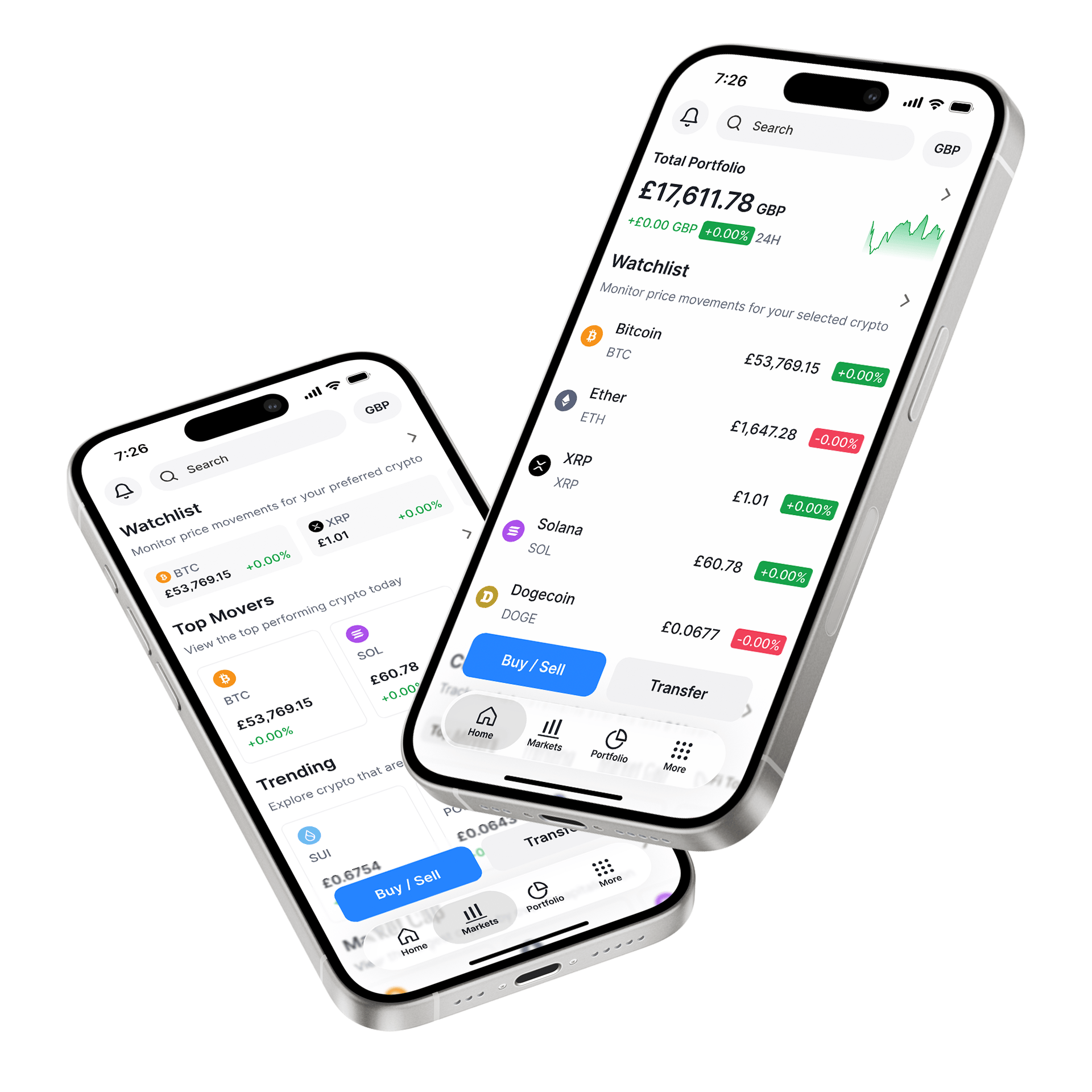
CoinJar App
Buy, sell and send your crypto with our cryptocurrency app.
Get the CoinJar appCoinJar App
Buy, sell and send your crypto with our cryptocurrency app.
Get the CoinJar appPast performance is not a reliable indicator of future results. Figures shown are for illustrative purposes only and are not actual market data.
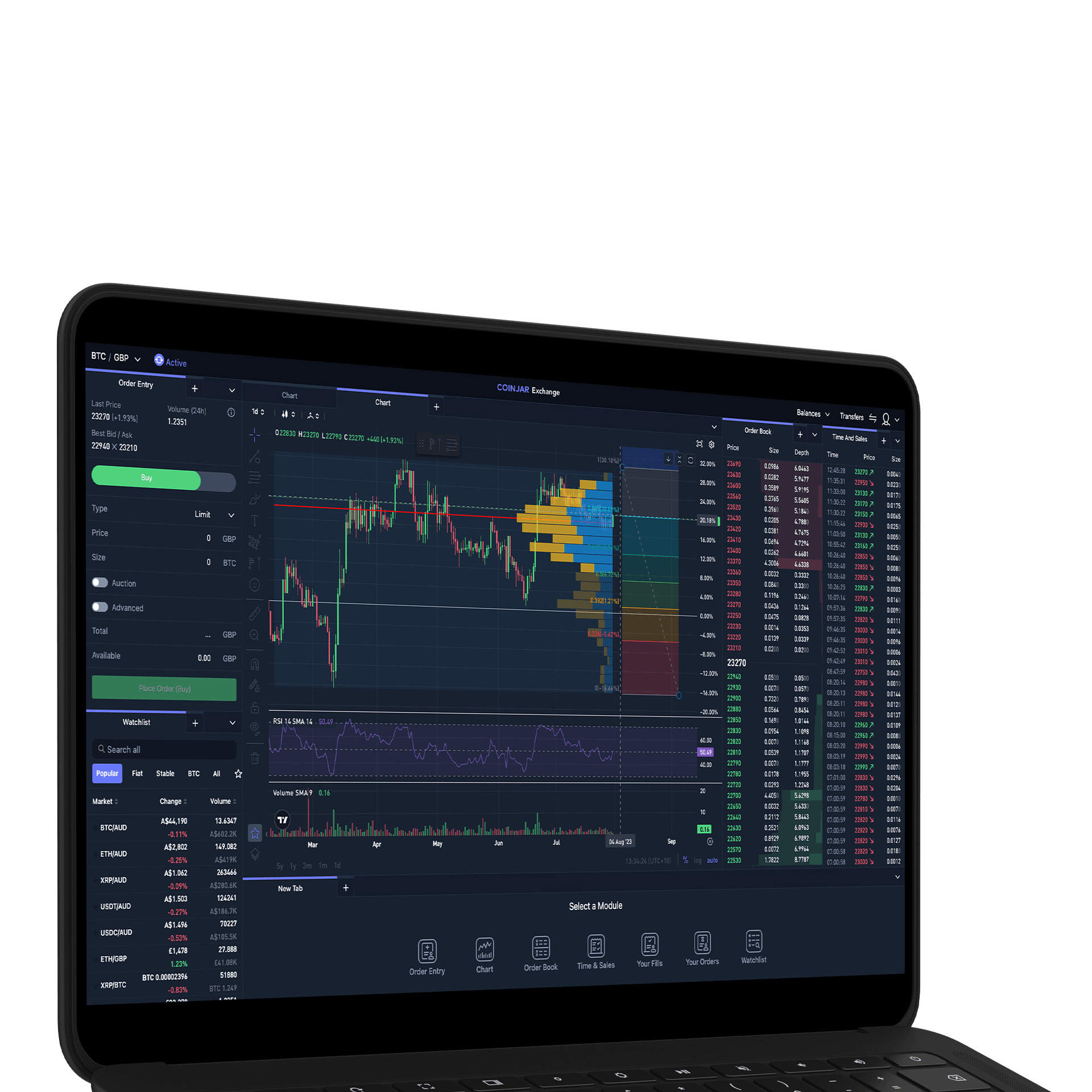
CoinJar Exchange
Purpose-built for institutions, market makers and professional traders, CoinJar Exchange offers 0%-0.1% fees, personalised trading layouts and ability to trade crypto with GBP and stablecoins.
Explore CoinJar ExchangeCoinJar Exchange
Purpose-built for institutions, market makers and professional traders, CoinJar Exchange offers 0%-0.1% fees, personalised trading layouts and ability to trade crypto with GBP and stablecoins.
Explore CoinJar Exchange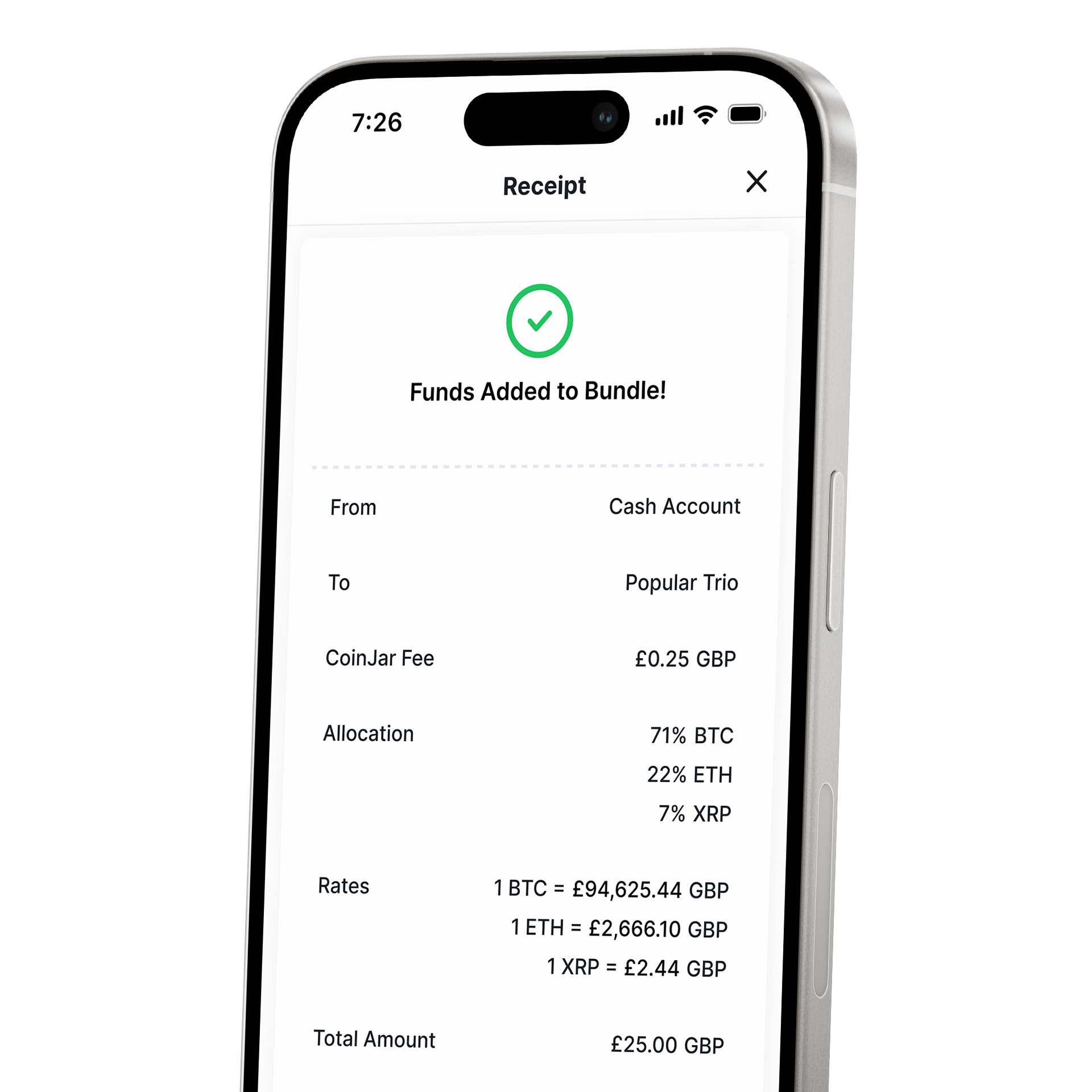
CoinJar DCA & Bundles
Dollar Cost Average (DCA) into individual cryptocurrencies or CoinJar Bundles. Choose your assets or Bundles with themed baskets of crypto in the CoinJar app. Use Recurring Buy to set up automated weekly, fortnightly, or monthly purchases at your chosen rate.
DCA with Recurring BuyCoinJar DCA & Bundles
Dollar Cost Average (DCA) into individual cryptocurrencies or CoinJar Bundles. Choose your assets or Bundles with themed baskets of crypto in the CoinJar app. Use Recurring Buy to set up automated weekly, fortnightly, or monthly purchases at your chosen rate.
DCA with Recurring BuyFrequently Asked Questions
Standard Risk Warning: The above article is not to be read as investment, legal or tax advice and it takes no account of particular personal or market circumstances; all readers should seek independent investment advice before investing in cryptocurrencies.
The article is provided for general information and educational purposes only, no responsibility or liability is accepted for any errors of fact or omission expressed therein. Past performance is not a reliable indicator of future results.
We use third party banking, safekeeping and payment providers, and the failure of any of these providers could also lead to a loss of your assets. We recommend you obtain financial advice before making a decision to use your credit card to purchase cryptoassets or to invest in cryptoassets. Capital Gains Tax may be payable on profits.
CoinJar's digital currency exchange services are operated in the UK by CoinJar UK Limited (company number 8905988), registered by the Financial Conduct Authority as a Cryptoasset Exchange Provider and Custodian Wallet Provider in the United Kingdom under the Money Laundering, Terrorist Financing and Transfer of Funds (Information on the Payer) Regulations 2017, as amended (Firm Reference No. 928767). In the UK, it's legal to buy, hold, and trade crypto, however cryptocurrency is not regulated in the UK.
It's vital to understand that once your money is in the crypto ecosystem, there are no rules to protect it, unlike with regular investments. You should not expect to be protected if something goes wrong. So, if you make any crypto-related investments, you're unlikely to have recourse to the Financial Services Compensation Scheme (FSCS) or the Financial Ombudsman Service (FOS) if something goes wrong.
The performance of most cryptocurrency can be highly volatile, with their value dropping as quickly as it can rise. Past performance is not an indication of future results. Remember: Don't invest unless you're prepared to lose all the money you invest. This is a high-risk investment and you should not expect to be protected if something goes wrong. Take 2 mins to learn more at: https://www.coinjar.com/uk/risk-summary.
UK residents are required to complete an assessment to show they understand the risks associated with what crypto/investment they are about to buy, in accordance with local legislation. Additionally, they must wait for a 24-hour "cooling off" period, before their account is active, due to local regulations. If you use a credit card to buy cryptocurrency, you would be putting borrowed money at a risk of loss.
We recommend you obtain financial advice before making a decision to use your credit card to purchase cryptoassets or to invest in cryptoassets.
Specific risks associated with DeFi tokens Decentralised Finance (or 'DeFi') tokens (e.g. UNI, AAVE) are crypto-assets linked to financial applications and protocols built on decentralised blockchain technology. DeFi tokens carry the following risks:
Smart contract risk: DeFi relies heavily on smart contracts. Even a minor coding error or oversight can lead to a contract being exploited, potentially resulting in significant losses for DeFi tokens.
Regulatory risk: DeFi operates in a decentralised manner, often without intermediaries or financial crime controls. Regulatory bodies across jurisdictions might introduce new regulations impacting the use, value, or legality of certain DeFi protocols or assets.
Rug-pulls / Exit scams: Some DeFi projects might be launched by anonymous or pseudonymous teams, increasing the risk of "rug pulls" where developers abandon the project and withdraw funds, leaving investors with worthless tokens.
Data/oracle risk: DeFi protocols often rely on external data sources or 'oracles. Manipulation or inaccuracies in these data sources can lead to unintended financial outcomes within the protocols. Protocol complexity: The complexity of some DeFi protocols can make it difficult for average users to fully understand the mechanisms and associated risks.
Specific risks associated with meme coins:
'Meme coins' (e.g. DOGE, SHIB, PEPE) are crypto-assets whose value is driven primarily by community interest and online trends.
Meme coins carry the following risks:
Volatility risk: Meme coins can have extreme price volatility, often experiencing rapid and unpredictable price fluctuations within short periods. The value of meme coins can be influenced by social media trends, celebrity endorsements, and other factors unrelated to traditional investment fundamentals. Lack of utility: Meme coins often lack intrinsic value or utility, being primarily driven by community interest, online trends, and speculative trading.
Market manipulation: Meme coins may be susceptible to increased risk of market manipulation including 'pump-and-dump' schemes, where the price is artificially inflated followed by a sudden crash.
Lack of transparency: Meme coins may have limited available information about their development teams, goals, and financials. This lack of transparency can make it challenging to assess the credibility and potential of a meme coin accurately.
Emotional investing: Meme coins often garner strong emotional reactions from investors, leading to impulsive decisions. Emotional trading activity can amplify losses.
Specific risks associated with stablecoins:
There is a risk that any particular stablecoin may not hold their value as against any fiat currency; or may not hold their value as against any other asset. Stablecoins carry the following risks:
Depegging events: Depegging events may occur with stablecoins that fail to maintain adequate controls and risk mitigants. A depegging event is when the value of the stablecoin no longer matches the value of the underlying asset. This could result in a loss of some or all of your investment.
Counterparty risk: Counterparty risk arises when an asset is backed by collateral, involving a third party maintaining the collateral, which introduces risk if the party becomes insolvent or fails to maintain it.
Redemption risk: Redemption risk refers to the possibility that an asset's ability to be redeemed for underlying collateral may not be as anticipated during market fluctuations or operational issues.
Collateral risk: Collateral risk refers to the possibility of the collateral's value declining or becoming volatile, potentially impacting the asset's stability, particularly when it is another crypto-asset.
Exchange rate fluctuations: Stablecoins, often denominated in US Dollars, expose investors to fluctuations in the USD:GBP exchange rate. Algorithmic risk: Algorithm risk refers to the possibility of an asset's stability being compromised due to unexpected failure or behaviour of the underlying algorithm, potentially leading to loss of value.
CoinJar does not endorse the content of, and cannot guarantee or verify the safety of any third-party websites. Visit these websites at your own risk.

CoinJar
Get the app.