
Buy SushiSwap
SUSHIFigures shown refer to the past. Past performance is not a reliable indicator of future results. Pricing data is provided by CoinJar.
What is SushiSwap?
Why investors buy SushiSwap: SushiSwap, a decentralised exchange (DEX), has been making waves in the crypto world. But what exactly is it, and why are investors interested in it? Let’s take a look at SushiSwap’s popularity and why it is an interesting investment choice.
One-Stop shop for passive income
SushiSwap offers a diverse range of passive income opportunities, setting it apart from other DEXs.
Here’s how it works.
Liquidity pools
SushiSwap allows investors to provide liquidity by participating in liquidity pools. These pools enable users to earn fees on the exchange for tokens listed on the platform. What’s unique is that SushiSwap operates on 14 different blockchains, making it an extremely robust offering.
Yield farming
Liquidity providers receive LP tokens, which they can use for yield farming. Yield farming involves staking LP tokens to earn additional SUSHI tokens. Unlike Uniswap, SushiSwap supports this functionality, making it a go-to platform for yield-seeking investors.
Utility token
SUSHI is not just a governance token; it’s a utility token. Investors benefit from its practical use within the ecosystem.
Gas-efficient borrowing
The BentoBox smart contract acts as a token vault. By depositing tokens into BentoBox, users earn more tokens over time. The key advantage? Gas-efficient interactions with decentralised applications (dApps).
Gas fees are transaction fees on the Ethereum blockchain. BentoBox minimises gas costs, making it an attractive feature for investors.
Flexibility
The decentralised exchange operates without intermediaries. Users trade directly with liquidity pools via non-custodial wallets. This design reduces the risk of hacks and provides flexibility in coin selection.
Conclusion
SushiSwap’s unique features and utility token make it an appealing choice for investors. As the crypto industry continues to grow, SUSHI's value is expected to rise.
Cash, credit or crypto?
Buy SushiSwap using Visa or Mastercard. Get cash in your account with Faster Payments Service (FPS). Convert crypto-to-crypto with a single click.



How to buy SushiSwap with CoinJar
Start your cryptocurrency portfolio with CoinJar by following these steps.
Download the app
Get the CoinJar app on iOS or Android.
Create an account
Create an account with CoinJar and verify your ID.
Make a purchase
Buy more than 60 cryptos using Faster Payments or a debit card.
Finder Awards Winner 2024
CoinJar was named the Best Exchange for Value in the UK as part of Finder's Crypto Trading Platform Awards - second year running! Check out our blog to see why Finder chose us over the competition.
See why Finder chose CoinJarFinder Awards Winner 2024
CoinJar was named the Best Exchange for Value in the UK as part of Finder's Crypto Trading Platform Awards - second year running! Check out our blog to see why Finder chose us over the competition.
See why Finder chose CoinJar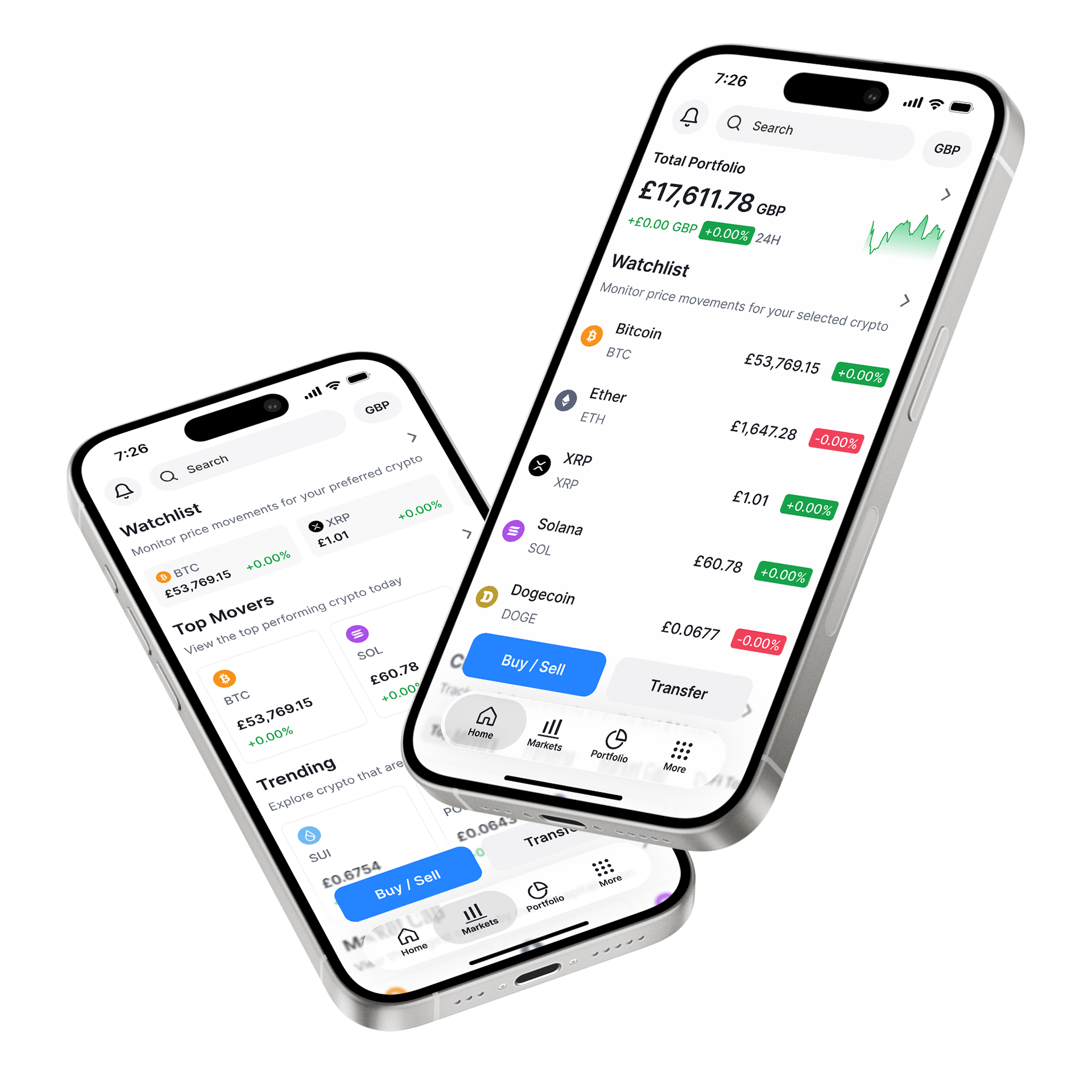
CoinJar App
Buy, sell and send your crypto with our cryptocurrency app.
Get the CoinJar appCoinJar App
Buy, sell and send your crypto with our cryptocurrency app.
Get the CoinJar appPast performance is not a reliable indicator of future results. Figures shown are for illustrative purposes only and are not actual market data.
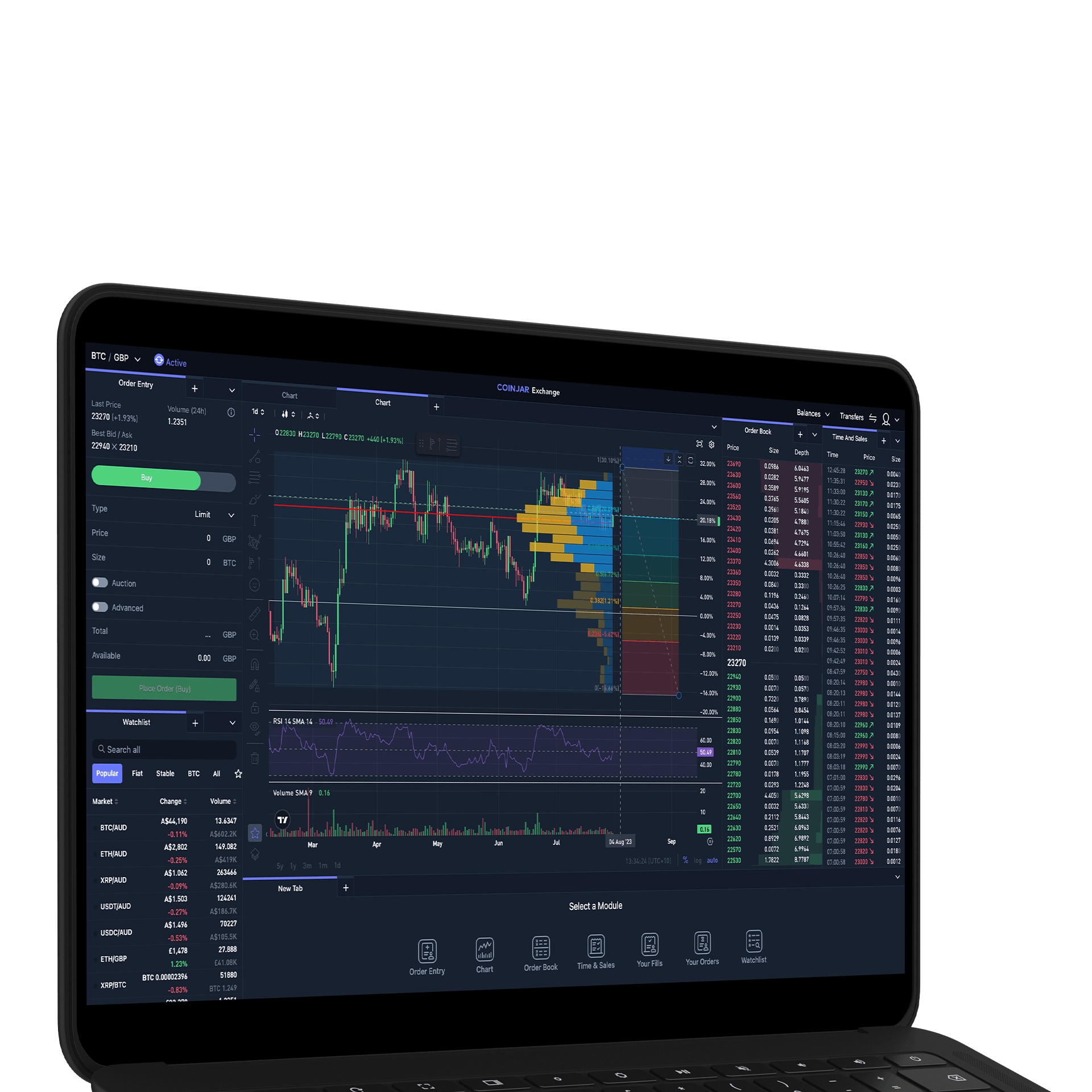
CoinJar Exchange
Purpose-built for institutions, market makers and professional traders, CoinJar Exchange offers 0%-0.1% fees, personalised trading layouts and ability to trade crypto with GBP and stablecoins.
Explore CoinJar ExchangeCoinJar Exchange
Purpose-built for institutions, market makers and professional traders, CoinJar Exchange offers 0%-0.1% fees, personalised trading layouts and ability to trade crypto with GBP and stablecoins.
Explore CoinJar Exchange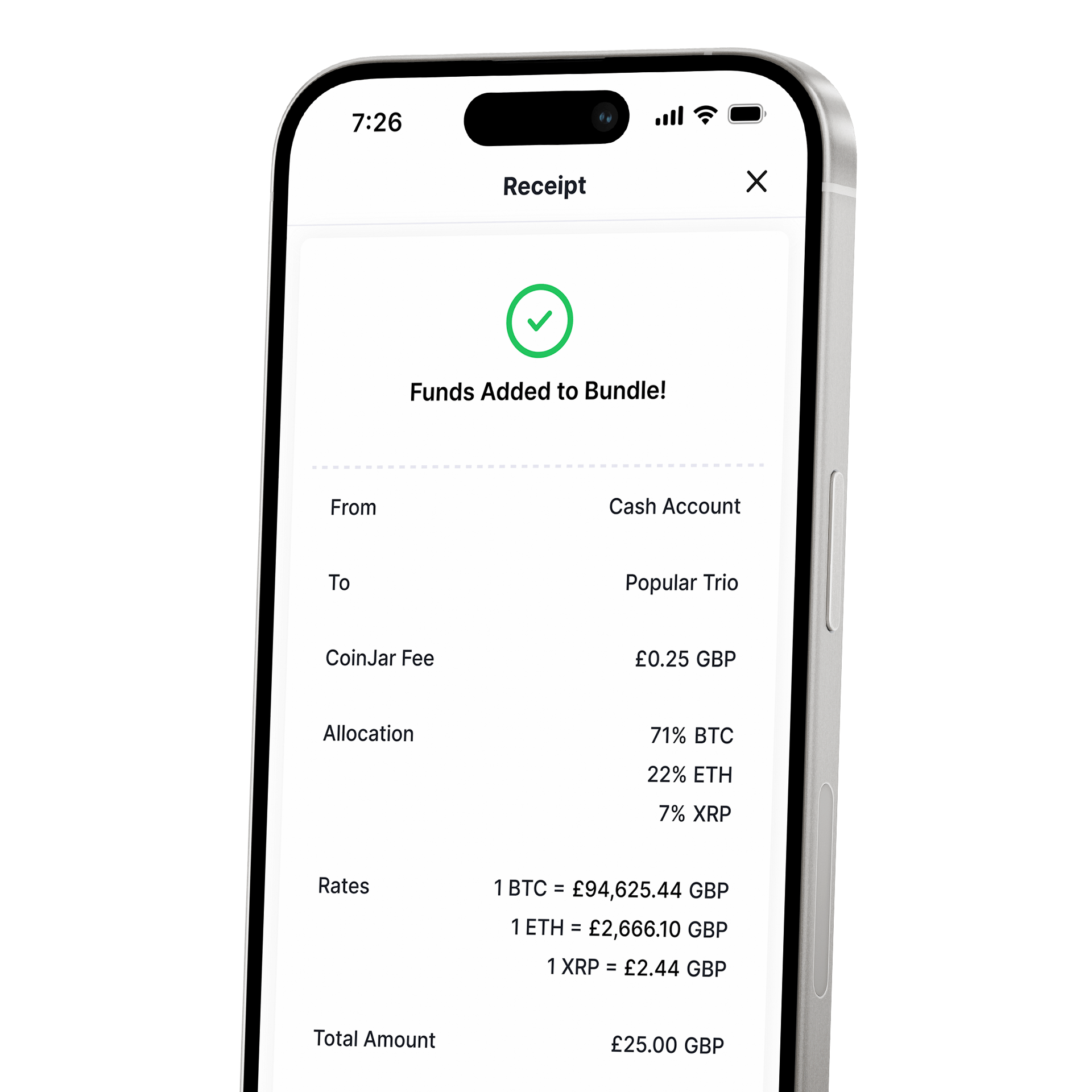
CoinJar DCA & Bundles
Dollar Cost Average (DCA) into individual cryptocurrencies or CoinJar Bundles. Choose your assets or Bundles with themed baskets of crypto in the CoinJar app. Use Recurring Buy to set up automated weekly, fortnightly, or monthly purchases at your chosen rate.
DCA with Recurring BuyCoinJar DCA & Bundles
Dollar Cost Average (DCA) into individual cryptocurrencies or CoinJar Bundles. Choose your assets or Bundles with themed baskets of crypto in the CoinJar app. Use Recurring Buy to set up automated weekly, fortnightly, or monthly purchases at your chosen rate.
DCA with Recurring BuyStandard Risk Warning: The above article is not to be read as investment, legal or tax advice and it takes no account of particular personal or market circumstances; all readers should seek independent investment advice before investing in cryptocurrencies.
The article is provided for general information and educational purposes only, no responsibility or liability is accepted for any errors of fact or omission expressed therein. Past performance is not a reliable indicator of future results.
We use third party banking, safekeeping and payment providers, and the failure of any of these providers could also lead to a loss of your assets. We recommend you obtain financial advice before making a decision to use your credit card to purchase cryptoassets or to invest in cryptoassets. Capital Gains Tax may be payable on profits.
CoinJar's digital currency exchange services are operated in the UK by CoinJar UK Limited (company number 8905988), registered by the Financial Conduct Authority as a Cryptoasset Exchange Provider and Custodian Wallet Provider in the United Kingdom under the Money Laundering, Terrorist Financing and Transfer of Funds (Information on the Payer) Regulations 2017, as amended (Firm Reference No. 928767). In the UK, it's legal to buy, hold, and trade crypto, however cryptocurrency is not regulated in the UK.
It's vital to understand that once your money is in the crypto ecosystem, there are no rules to protect it, unlike with regular investments. You should not expect to be protected if something goes wrong. So, if you make any crypto-related investments, you're unlikely to have recourse to the Financial Services Compensation Scheme (FSCS) or the Financial Ombudsman Service (FOS) if something goes wrong.
The performance of most cryptocurrency can be highly volatile, with their value dropping as quickly as it can rise. Past performance is not an indication of future results. Remember: Don't invest unless you're prepared to lose all the money you invest. This is a high-risk investment and you should not expect to be protected if something goes wrong. Take 2 mins to learn more at: https://www.coinjar.com/uk/risk-summary.
UK residents are required to complete an assessment to show they understand the risks associated with what crypto/investment they are about to buy, in accordance with local legislation. Additionally, they must wait for a 24-hour "cooling off" period, before their account is active, due to local regulations. If you use a credit card to buy cryptocurrency, you would be putting borrowed money at a risk of loss.
We recommend you obtain financial advice before making a decision to use your credit card to purchase cryptoassets or to invest in cryptoassets.
Specific risks associated with DeFi tokens Decentralised Finance (or 'DeFi') tokens (e.g. UNI, AAVE) are crypto-assets linked to financial applications and protocols built on decentralised blockchain technology. DeFi tokens carry the following risks:
Smart contract risk: DeFi relies heavily on smart contracts. Even a minor coding error or oversight can lead to a contract being exploited, potentially resulting in significant losses for DeFi tokens.
Regulatory risk: DeFi operates in a decentralised manner, often without intermediaries or financial crime controls. Regulatory bodies across jurisdictions might introduce new regulations impacting the use, value, or legality of certain DeFi protocols or assets.
Rug-pulls / Exit scams: Some DeFi projects might be launched by anonymous or pseudonymous teams, increasing the risk of "rug pulls" where developers abandon the project and withdraw funds, leaving investors with worthless tokens.
Data/oracle risk: DeFi protocols often rely on external data sources or 'oracles. Manipulation or inaccuracies in these data sources can lead to unintended financial outcomes within the protocols. Protocol complexity: The complexity of some DeFi protocols can make it difficult for average users to fully understand the mechanisms and associated risks.
Specific risks associated with meme coins:
'Meme coins' (e.g. DOGE, SHIB, PEPE) are crypto-assets whose value is driven primarily by community interest and online trends.
Meme coins carry the following risks:
Volatility risk: Meme coins can have extreme price volatility, often experiencing rapid and unpredictable price fluctuations within short periods. The value of meme coins can be influenced by social media trends, celebrity endorsements, and other factors unrelated to traditional investment fundamentals. Lack of utility: Meme coins often lack intrinsic value or utility, being primarily driven by community interest, online trends, and speculative trading.
Market manipulation: Meme coins may be susceptible to increased risk of market manipulation including 'pump-and-dump' schemes, where the price is artificially inflated followed by a sudden crash.
Lack of transparency: Meme coins may have limited available information about their development teams, goals, and financials. This lack of transparency can make it challenging to assess the credibility and potential of a meme coin accurately.
Emotional investing: Meme coins often garner strong emotional reactions from investors, leading to impulsive decisions. Emotional trading activity can amplify losses.
Specific risks associated with stablecoins:
There is a risk that any particular stablecoin may not hold their value as against any fiat currency; or may not hold their value as against any other asset. Stablecoins carry the following risks:
Depegging events: Depegging events may occur with stablecoins that fail to maintain adequate controls and risk mitigants. A depegging event is when the value of the stablecoin no longer matches the value of the underlying asset. This could result in a loss of some or all of your investment.
Counterparty risk: Counterparty risk arises when an asset is backed by collateral, involving a third party maintaining the collateral, which introduces risk if the party becomes insolvent or fails to maintain it.
Redemption risk: Redemption risk refers to the possibility that an asset's ability to be redeemed for underlying collateral may not be as anticipated during market fluctuations or operational issues.
Collateral risk: Collateral risk refers to the possibility of the collateral's value declining or becoming volatile, potentially impacting the asset's stability, particularly when it is another crypto-asset.
Exchange rate fluctuations: Stablecoins, often denominated in US Dollars, expose investors to fluctuations in the USD:GBP exchange rate. Algorithmic risk: Algorithm risk refers to the possibility of an asset's stability being compromised due to unexpected failure or behaviour of the underlying algorithm, potentially leading to loss of value.
CoinJar does not endorse the content of, and cannot guarantee or verify the safety of any third-party websites. Visit these websites at your own risk.

CoinJar
Get the app.