
Until morale improves, or so I hope.
Story One
L2s are pointless
Tweets the guy who advocated for them as part of the Ethereum scaling roadmap. Perhaps to deflect from his selling of ETH, Vitalik has started to tweet an awful lot recently. After sharing his vision for creator coins, he moved on to dissing L2s.
Layer 2s were envisioned as a mechanism to increase Ethereum throughput by outsourcing large volumes from the mainnet to these other layers, which would be connected via a two-way bridge. However, as the mainnet began scaling, there’s little reason to use an L2 for lower transaction fees or for scaling alone.

Already when L2s first got started, there was a notion of them being parasitic, or at least useless if one were to take scaling the L1 seriously. It seems we’ve now reached the point where this becomes mainstream knowledge.
While not entirely useless, Vitalik says chains need value propositions. At least one project read the room. As if in response to this tweet, ENS Labs has announced that they’re not launching their Namechain L2 but will rebuild on mainnet instead.
Takeaway: Common sense might still exist. Layers needing a value proposition… crazy idea, but maybe that’s the benefit of a bear market. Forcing people to actually think about infra beyond infra’s sake.
Story Two
Prices aren’t the only thing dropping
Unless you’ve been shorting Bitcoin these past days, you’re likely regretting the day you got into trading. If your portfolio is having a bad day, at least you can rejoice in not having made as bad losses as Saylor’s Strategy, which posted a loss of $12.6 billion in Q4 ‘25, thanks to a falling Bitcoin price.
But Saylor’s financials aren’t the only thing in decline in the Bitcoin ecosystem. Bitcoin mining difficulty has dropped by 11.6%, the most it has fallen since China banned Bitcoin mining in 2021. At the same time, hashrate went down 20% due to miners stopping operations, and the winter storm in the US forcing them offline.
Both together indicate that miners are facing tough times. While reduced hashrate and mining difficulty should make it easier to mine Bitcoins, if the price continues to fall, there’s little return to be made. According to onchain data the average cost of mining 1 BTC sits at $87k. There’s no girl-mathing that into a profitable endeavor, unless..

Takeaway: As bad as it feels, it’s beautiful that the system just tries to regulate itself like that.
Story Three
Among the carnage, one company is printing money
Quite literally. Tether, the issuer of the USDT stablecoin, published its market report for Q4 2025, highlighting how it’s still the dominant game in town. It noted a 35 million users increase and a market cap hike of $12.4 billion in that quarter alone, making it one of the most obviously profitable crypto businesses (excluding CEXs).
While Tether has often been accused of opaque reserve practices, holders might sleep better now knowing that the company has invested $23 billion in gold to add to its reserves. If recent weeks taught us anything, digital gold is nice, but in hard times, it’s still the analogue traders flee to.
To further its gold exposure, the stablecoin company bought gold.com shares to establish an end-to-end gold ecosystem, once again showing that the appeal of gold to men is timeless. And, as recent weeks highlight, investing in real metal would not have been such a bad idea.
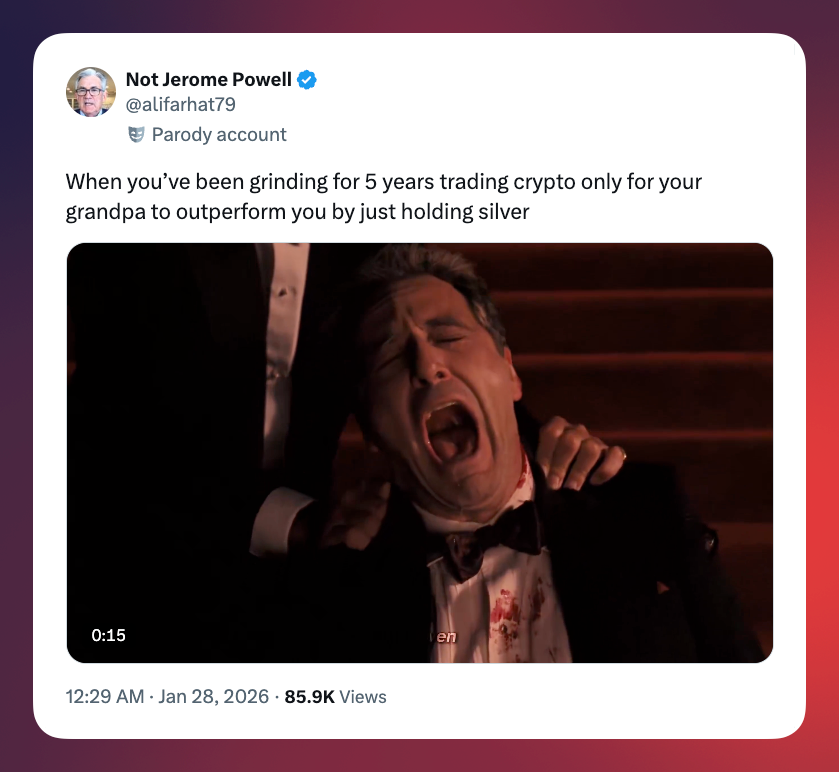
Takeaway: I think it says a lot about us that one of the longest-standing, most successful businesses is one that says, “trust me, bro, I have $1 worth for each digital dollar I give you in my vault.” It’s also funny that we’re somehow returning to gold-backed dollars.
Fact of the Week: Speaking of gold, there was a time when it was all the rage to put gold into food. It didn’t spare the Germans’ favorite midnight snack either, gifting us a Kebab that costs 35 Euro (the normal price is around 7-8), gold leaf included. Still, the crown for the most expensive Kebab goes to London, where they’re selling a Döner that costs nearly as much as 1 ETH.
Naomi for CoinJar
CoinJar Australia Pty Ltd ACN 648 570 807 is a registered Virtual Asset Service Provider (VASP) with the Australian Transaction Reports and Analysis Centre (AUSTRAC) in accordance with the Anti-Money Laundering and Counter-Terrorism Financing Act 2006 (Cth).
CoinJar Card is a prepaid Mastercard issued by EML Payment Solutions Limited ABN 30 131 436 532 AFSL 404131 pursuant to license by Mastercard. CoinJar Australia Pty Ltd is an authorised representative of EML Payment Solutions Limited (AR No 1290193). We recommend you consider the Product Disclosure Statement and Target Market Determination before making any decision to acquire the product. Mastercard and the circles design are registered trademarks of Mastercard International Incorporated.
Google Pay is a trademark of Google LLC. Apple Pay is a trademark of Apple Inc.
This site is protected by reCAPTCHA and the Google Privacy Policy and Terms of Service apply.