
Buy Pax Dollar
PAXPast performance is not indicative of future results. All prices are sourced from CoinJar Indices.
What is Pax Dollar?
Pax Dollar is a stablecoin: a cryptocurrency designed to hold a value of one United States dollar rather than to rise and fall with the market. USDP is its ticker, and the token is issued by Paxos, a regulated financial institution in the United States, which holds reserves against every token in circulation.
That last point is the whole product. USDP has no mining, no staking, no governance and no protocol revenue. Its value rests on the reserves behind it and on the issuer's willingness and ability to redeem it at one dollar. Our guide to stablecoins explains the category, and our guide to Ethereum covers the network most USDP lives on.
Who issues USDP and what backs it
USDP is issued by Paxos Trust Company, N.A. Paxos began as a New York state chartered trust company supervised by the New York State Department of Financial Services, and in December 2025 it converted to a national trust bank charter, so its trust activities are now supervised federally by the Office of the Comptroller of the Currency. The Office of the Comptroller of the Currency publishes its chartering decisions and supervisory materials.
Paxos states that USDP reserves are held entirely in cash and cash equivalents, kept in segregated accounts for the benefit of token holders rather than mixed with the company's own money, and that tokens are redeemable one for one. Paxos publishes monthly reserve reports, examined by an independent accounting firm, on its transparency page.
Segregation matters more than most marketing language about stablecoins. It is the mechanism intended to keep reserve assets out of reach of the issuer's creditors if the issuer fails. It is not the same thing as government deposit insurance, and it has never been tested in an insolvency of a major stablecoin issuer.
From Paxos Standard to Pax Dollar
USDP launched in 2018 as Paxos Standard, ticker PAX, and was one of the first stablecoins approved for issuance by a state regulator. In August 2021 Paxos renamed it Pax Dollar and changed the ticker to USDP so the name made the asset's purpose obvious.
That was a branding change. The token contract, the reserve model and the redemption promise carried across. Older articles, wallets and price sites that still refer to PAX are describing the same asset, and holders were never required to swap anything.
How the peg actually holds
There are two layers to a fiat backed stablecoin, and confusing them is the source of most misunderstanding.
The first is issuance and redemption. Verified Paxos customers can create USDP by depositing dollars and redeem USDP for dollars at one for one, subject to identity checks, jurisdiction eligibility and any minimum amounts. That direct channel is what anchors the price.
The second is the open market. On exchanges, USDP trades at whatever buyers and sellers agree, which is usually very close to a dollar but not fixed at it. When the market price drifts, participants with direct Paxos access have an incentive to buy the cheap token and redeem it, or mint new tokens and sell them, which pulls the price back. The peg is an economic outcome of that arbitrage, not a rule enforced by the token itself.
Most people never touch the direct channel. If you hold USDP through an exchange, your practical exit is selling it on that exchange at the market price.
USDP, PYUSD, USDG, BUSD and Pax Gold
Paxos issues or has issued several tokens, and they are separate assets with separate terms.
USDP. Paxos's own dollar stablecoin, the subject of this page. PYUSD. PayPal USD, a dollar stablecoin Paxos issues for PayPal. USDG. Global Dollar, issued out of Paxos's Singapore entity for a consortium of firms, with reserve economics shared with network partners. BUSD. The Binance branded dollar stablecoin Paxos issued until the New York regulator directed it to stop minting in February 2023. It has been wound down. PAXG. Pax Gold, which is backed by physical gold rather than dollars and is not a dollar stablecoin at all.
Holding USDP gives you no claim on any of the others. The BUSD history is worth knowing for a different reason: it shows that a regulator can stop a Paxos issued token from being created, while still allowing existing holders to redeem.
Which network is your USDP on?
USDP is issued natively on Ethereum as an ERC-20 token and on Solana. Bridged or wrapped representations have also appeared on other networks over the years.
These are not interchangeable at the address level. Sending USDP to an address on a network that the receiving wallet or exchange does not support is one of the most common ways people permanently lose stablecoins, and it usually cannot be reversed. Before any transfer, confirm which network the destination expects and make sure the network you are sending from matches. Our guide to sending crypto on the wrong network covers what can and cannot be recovered.
What Paxos can do to your tokens
Regulated fiat backed stablecoins are centrally controlled by design, and USDP is no exception. Under the Paxos stablecoin terms and conditions, Paxos can freeze balances, comply with seizure and forfeiture directives from courts, regulators and law enforcement, pause the contract, and upgrade it.
Paxos says it uses those powers in limited circumstances, generally when it receives a formal legal directive. The point is not that Paxos is likely to freeze an ordinary holder's tokens. The point is that the capability exists, it sits with one company, and it is a real difference between a regulated stablecoin and a permissionless asset like bitcoin.
Regulation is still being built
The United States enacted a federal law for payment stablecoins in July 2025, which sets out reserve, disclosure and licensing requirements for issuers. The agencies responsible, including the Office of the Comptroller of the Currency, have been consulting on and issuing the detailed rules since.
Two things follow. Stablecoin issuers now have a clearer federal path than they did, which is part of the context for Paxos becoming a nationally chartered trust bank. But the detailed regime is still being implemented, so specific requirements around reserves, reporting and permitted issuers can change. Treat any description of the rules, including this one, as a snapshot.
What are the risks of holding USDP?
Issuer risk. USDP is a claim on a company. If Paxos failed, was unable to access reserves or was prevented from redeeming, the token's value would depend on how that situation was resolved. Reserve and banking risk. Reserves sit with banks and in short term instruments. Problems at a reserve bank or counterparty can affect a stablecoin, as the market saw with other issuers in 2023. Redemption is not open to everyone. Direct one for one redemption requires a verified Paxos account and eligibility. For most holders the exit is the open market, at the market price. Peg risk on exchanges. USDP can and does trade slightly away from a dollar, and in a stressed market that gap can widen. Freezing and blacklisting. Balances can be frozen or seized under legal directive, and the contract can be paused or upgraded by the issuer. Smart contract risk. USDP depends on token contracts on Ethereum and Solana, and on bridges if you move it. Contracts and bridges can fail or be exploited. Network mismatch. Sending USDP to the wrong network is a common and usually permanent loss. No yield, and inflation. Holding USDP pays you nothing. Paxos earns on the reserves, not you, and a dollar held over time loses purchasing power. No deposit protection. USDP is not a bank deposit and is not a financial product covered by the Australian Government's Financial Claims Scheme. Crypto assets are high risk, your capital is at risk, and you should be prepared to lose the money you put in.
Buying USDP with Australian dollars on CoinJar
CoinJar has operated since 2013 and lists USDP against Australian dollars, so you can buy, sell and hold it without converting through another cryptocurrency first. Current charges are on our fees page, and live Australian dollar rates are on our cryptocurrency prices page.
CoinJar Australia Pty Ltd is registered with AUSTRAC as a digital currency exchange provider, Registration Number DCE100749118-001.
How is USDP taxed in Australia?
The ATO generally treats USDP as a capital gains tax asset. A CGT event can occur when you sell it for Australian dollars, exchange it for another cryptocurrency, spend it or give it away. A stablecoin is not exempt from this simply because its value does not move much.
The ATO explains these rules on its crypto asset investments guidance page. Our guide to crypto tax in Australia provides a practical overview. This is general information, not tax advice. Consider speaking to a registered tax agent about your circumstances.
Fund Your Account Your Way
Buy Pax Dollar instantly using Visa or Mastercard, or deposit Australian dollars via bank transfer, PayID or PayPal. Buy, sell and convert between supported cryptocurrencies through your CoinJar account.


How to buy Pax Dollar with CoinJar
Start your portfolio with Australia's longest-running crypto exchange with these simple steps.
Sign up to CoinJar
Get the CoinJar app on iOS or Android, create an account and verify your ID.
Deposit funds
Deposit AUD fee-free via PayID, Osko or bank transfer. You can also use PayPal or pay instantly by card.
Buy your first crypto
Buy Pax Dollar and other popular cryptos using cash or credit card in minutes.




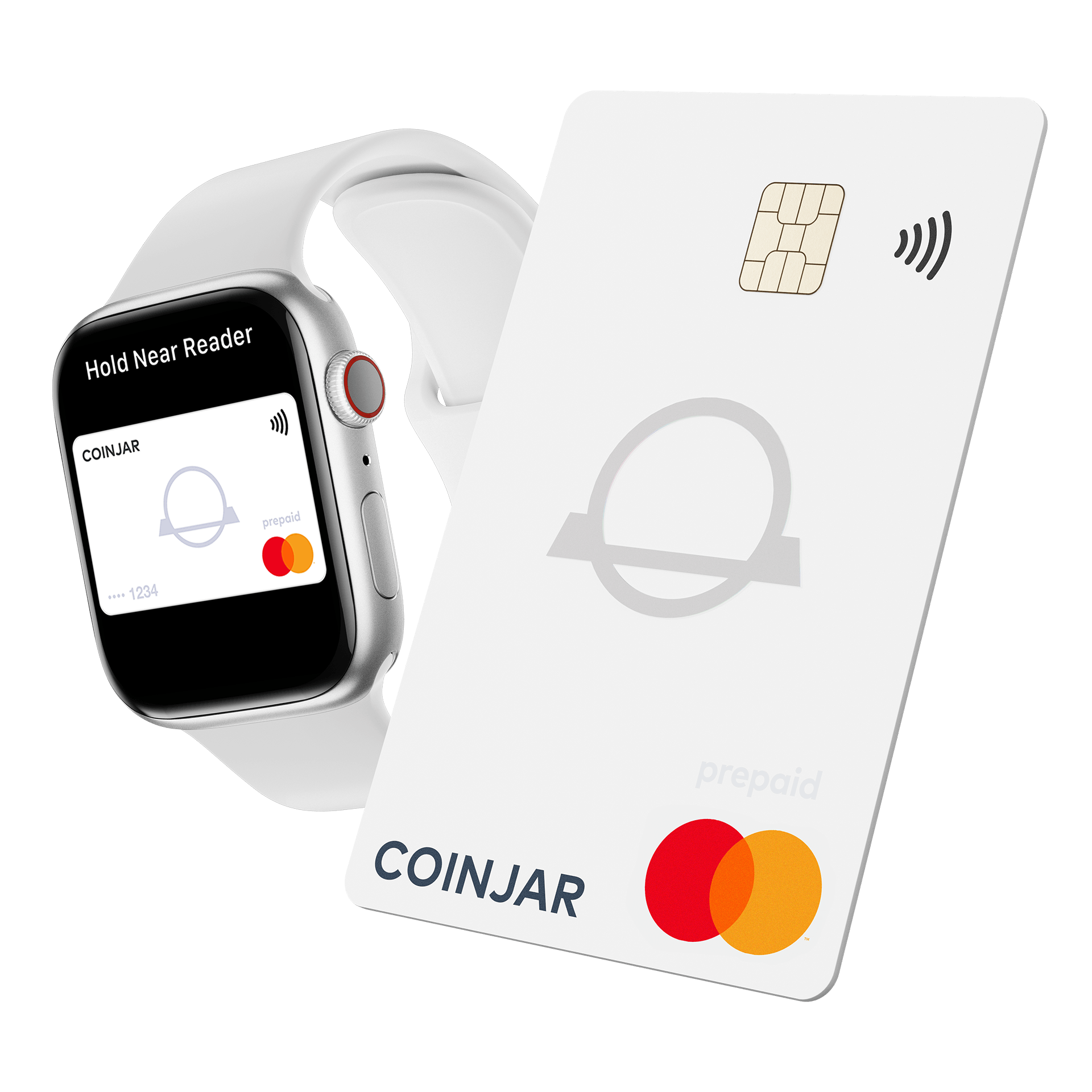
CoinJar Card
Use CoinJar Card, powered by Mastercard, for purchases online and in store, including through Apple Pay and Google Pay. No setup or monthly fee. A 1% purchase fee applies and is returned as CoinJar Rewards points, with one point earned per $1 spent. Available in Australia only.
Get your CoinJar Card for freeCoinJar Card
Use CoinJar Card, powered by Mastercard, for purchases online and in store, including through Apple Pay and Google Pay. No setup or monthly fee. A 1% purchase fee applies and is returned as CoinJar Rewards points, with one point earned per $1 spent. Available in Australia only.
Get your CoinJar Card for free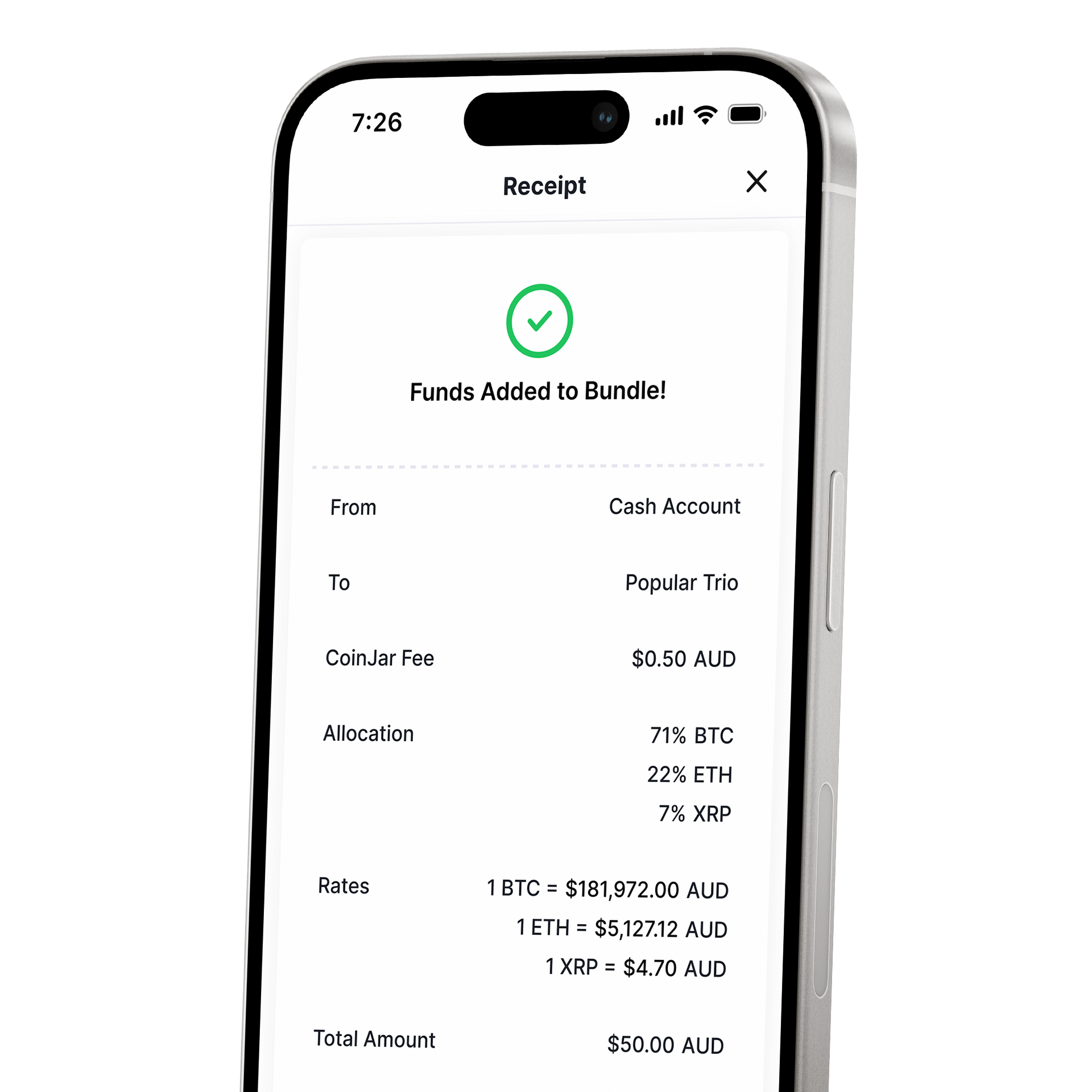
CoinJar Recurring Buy
Schedule automatic purchases weekly, fortnightly or monthly to dollar-cost average into individual cryptocurrencies or CoinJar Bundles. Manage your investment amount and schedule, with the flexibility to adjust or pause purchases as your circumstances change.
DCA with Recurring BuyCoinJar Recurring Buy
Schedule automatic purchases weekly, fortnightly or monthly to dollar-cost average into individual cryptocurrencies or CoinJar Bundles. Manage your investment amount and schedule, with the flexibility to adjust or pause purchases as your circumstances change.
DCA with Recurring Buy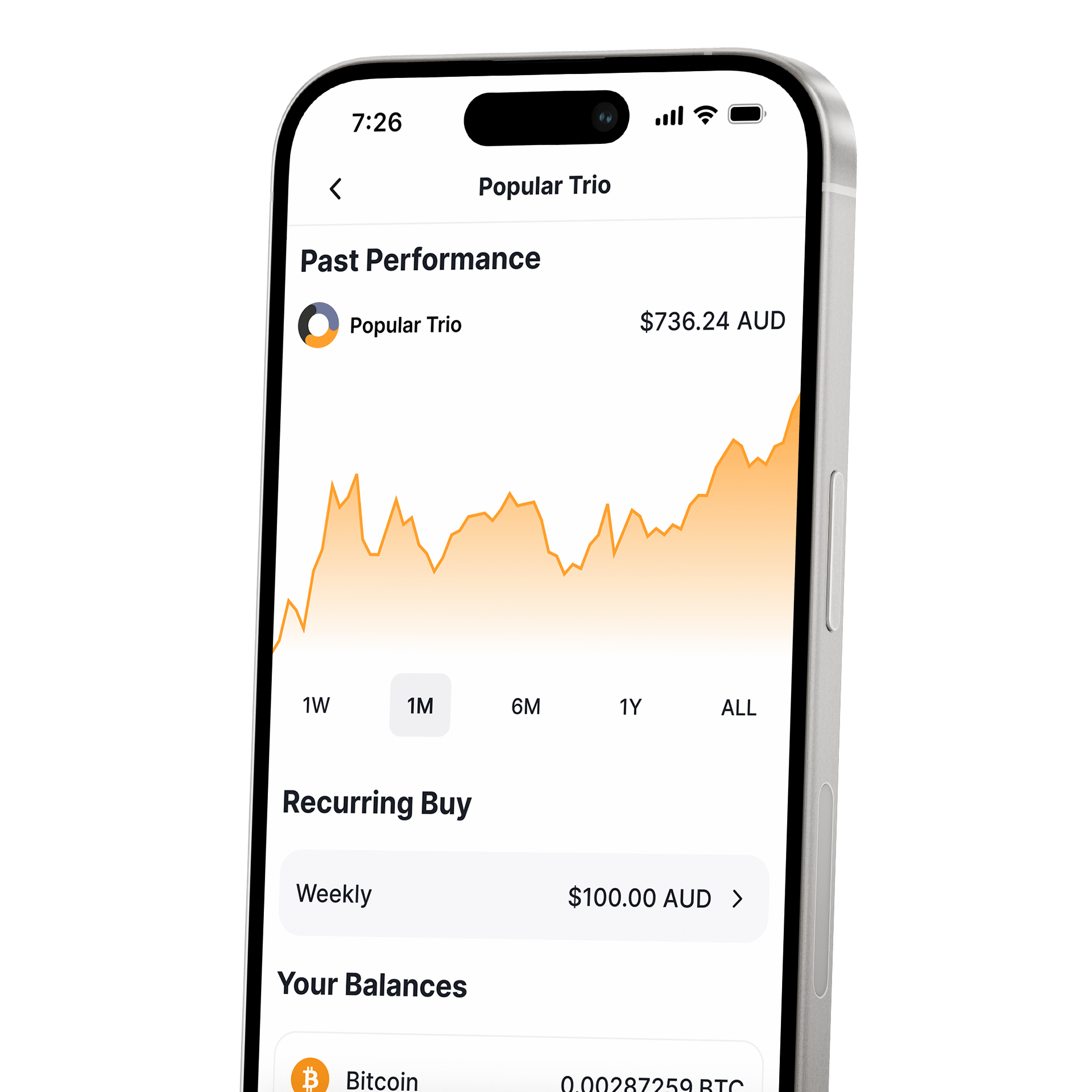
CoinJar Bundles
Pick your Bundle in the CoinJar app. Review each Bundle’s asset allocation, add to your holdings and rebalance when required. Sell your Bundle or unbundle it to manage the assets individually.
Learn moreCoinJar Bundles
Pick your Bundle in the CoinJar app. Review each Bundle’s asset allocation, add to your holdings and rebalance when required. Sell your Bundle or unbundle it to manage the assets individually.
Learn more
CoinJar Exchange
Trade with fees from 0-0.1%, using market, limit and stop-limit orders. Connect to TradingView to trade directly from your charts, or use CoinJar Exchange’s high-performance interface, built for active traders, market makers and institutions.
Explore CoinJar ExchangeCoinJar Exchange
Trade with fees from 0-0.1%, using market, limit and stop-limit orders. Connect to TradingView to trade directly from your charts, or use CoinJar Exchange’s high-performance interface, built for active traders, market makers and institutions.
Explore CoinJar Exchange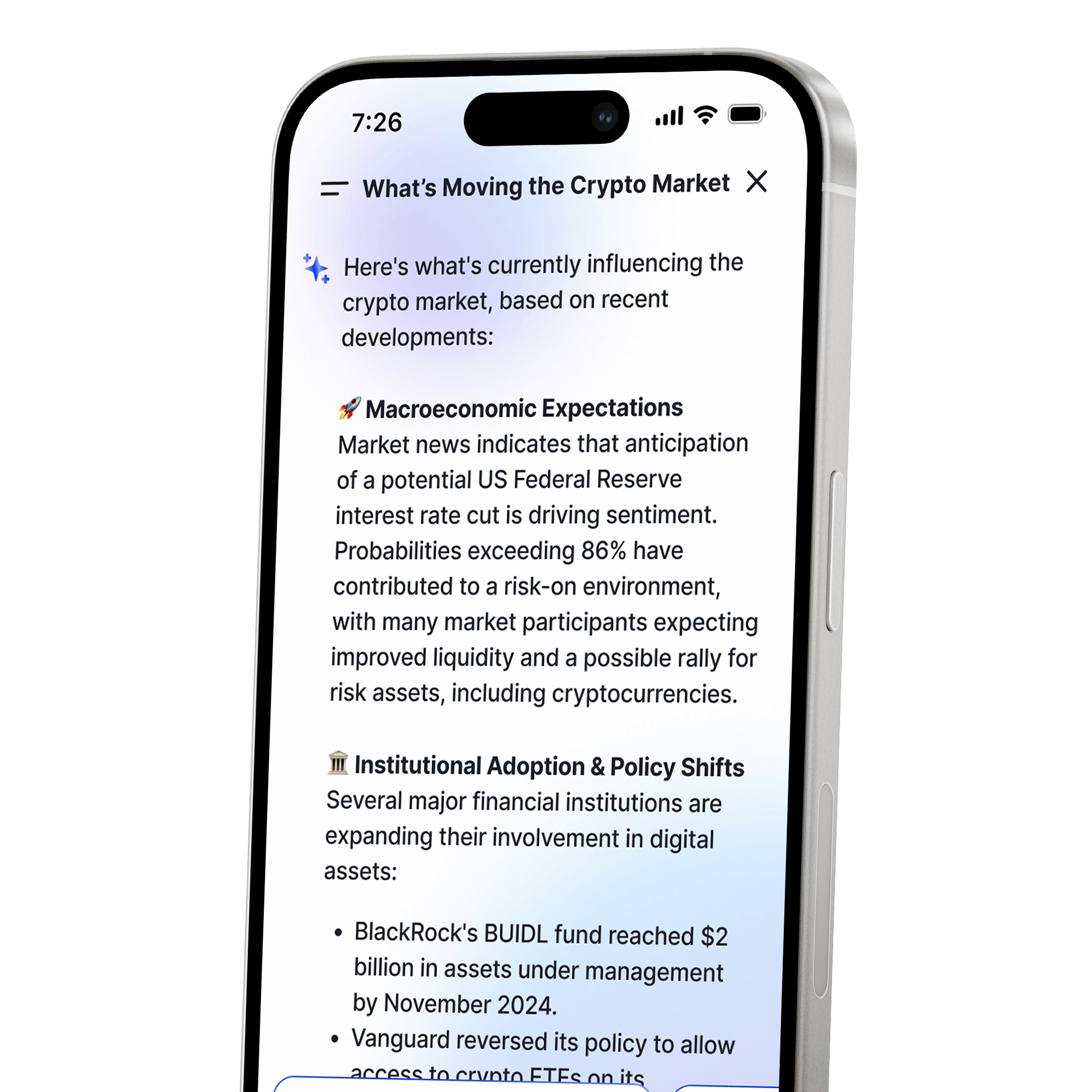
CoinJar AI
Access information about your holdings and the wider cryptocurrency market through CoinJar AI. Ask questions about portfolio changes, market developments or individual cryptocurrencies, with responses informed by your CoinJar holdings.
Learn moreCoinJar AI
Access information about your holdings and the wider cryptocurrency market through CoinJar AI. Ask questions about portfolio changes, market developments or individual cryptocurrencies, with responses informed by your CoinJar holdings.
Learn more
CoinJar OTC
For cryptocurrency trades above $50,000, CoinJar’s OTC desk provides personalised service and access to globally sourced liquidity. Work directly with a dedicated team to arrange and execute your purchase or sale. Discover OTC Services
Learn moreCoinJar OTC
For cryptocurrency trades above $50,000, CoinJar’s OTC desk provides personalised service and access to globally sourced liquidity. Work directly with a dedicated team to arrange and execute your purchase or sale. Discover OTC Services
Learn moreCoinJar does not endorse the content of, and cannot guarantee or verify the safety of any third-party websites. Visit these websites at your own risk.

CoinJar
Get the app.