
Buy Arbitrum
ARBPast performance is not indicative of future results. All prices are sourced from CoinJar Indices.
What is Arbitrum?
Arbitrum is a layer two network built on Ethereum. It runs transactions on its own chains and posts the data back to Ethereum, which remains the place where everything ultimately settles. The result is faster and cheaper transactions than Ethereum alone, using the same wallets, addresses and contract code.
The technology is built by Offchain Labs and the network is governed by the Arbitrum DAO, a token holder organisation. Two points matter before anything else: fees on Arbitrum are paid in ETH, not in ARB, and ARB is a governance token rather than a claim on the network's earnings. Our guide to blockchain layers explains where networks like this sit, and our guide to Ethereum covers the network Arbitrum settles to.
How does Arbitrum work?
Arbitrum is an optimistic rollup. The name refers to the security model rather than the outlook.
A sequencer receives transactions and orders them, which is why the network feels instant. The transactions are compressed and published to Ethereum, and a commitment to the resulting state is posted alongside them without a proof that it is correct. Ethereum does not re-run the work. It stores the data and acts as the court of appeal.
If someone believes a state commitment is wrong, they can challenge it. Rather than replaying the whole disputed history on Ethereum, which would be prohibitively expensive, the two parties narrow their disagreement step by step until it comes down to a single instruction, and an Ethereum contract settles that one instruction. In principle a single honest participant is enough to defend the correct result.
That process was upgraded in February 2025 by a system called BoLD, short for Bounded Liquidity Delay. It did two things: it opened proposing and challenging to anyone rather than a permitted list, and it put a ceiling on how long a dispute can be dragged out, which had been a genuine attack vector. The default challenge period is about 6.4 days. The Arbitrum documentation explains the design.
What is the ARB token for?
It is not the gas token. Transaction fees on Arbitrum are paid in ETH. It is not staked to secure the network. Arbitrum is not a proof of stake chain, and it has no validator set that ARB holders bond to. It carries no claim on revenue. Holding ARB does not entitle you to fees, profit or the assets of any entity. It votes. ARB is the voting token of the Arbitrum DAO, which controls treasury spending, protocol upgrades, governance rules and the election of the Security Council.
The supply was set at ten billion ARB when the token launched in March 2023, alongside one of the largest airdrops in the sector. The largest single allocation went to the DAO treasury, with further allocations to the team and contributors, investors, airdrop recipients, the Arbitrum Foundation and other projects building on the network. Governance can approve issuance of up to two per cent a year, so the supply is a governance decision rather than a fixed cap.
Where does Arbitrum's revenue go?
This is worth understanding precisely, because it is where most misunderstandings about ARB come from.
Arbitrum earns money. Users pay fees in ETH. An ordering system called Timeboost auctions a short head start in an express lane, and the proceeds on Arbitrum One go back to the DAO. Separately, teams that launch their own Arbitrum chains agree under the Arbitrum Expansion Program to pass a defined share of their net revenue back to the DAO treasury and to a developer guild.
None of that is paid to ARB holders. It goes to a treasury that governance decides how to spend, usually on grants, incentives and ecosystem programmes. Holding ARB gives you a vote over that spending. It does not give you a share of it.
Arbitrum One, Nova and the other Arbitrum chains
Arbitrum One is the main chain and the one most activity runs on. Fees are in ETH and all the data needed to reconstruct it is published to Ethereum.
Arbitrum Nova is a cheaper variant that does not post all its data to Ethereum, relying instead on a small committee to keep it available. That is a meaningfully weaker security model, and the DAO has voted to wind Nova down to a maintenance state and encourage users to move to Arbitrum One.
Arbitrum chains, previously branded Orbit, are dedicated networks that other companies launch using Arbitrum's technology, with their own configuration and sometimes their own gas token. Robinhood launched one in 2026. These chains are not Arbitrum One and do not inherit its security properties.
Stylus is a separate strand of work that lets developers write contracts in Rust, C and C plus plus alongside the usual Solidity, with both able to call each other.
How decentralised is Arbitrum?
Better than most of the category, with two specific caveats.
Independent research site L2BEAT classifies Arbitrum One as a Stage 1 rollup. Data is published on Ethereum, and since BoLD anyone can propose a state commitment and anyone can challenge one.
The first caveat is the sequencer. A single operator orders transactions, which means it can in principle censor or extract value from ordering, and an outage stops the fast path. Users can force a transaction in through Ethereum directly, but that route can take up to about a day.
The second is upgrades. The ordinary path is genuinely slow by design, running through a timelock on Arbitrum, the challenge period and a further timelock on Ethereum, which gives users roughly ten days in which they can exit before a change they dislike takes effect. But a Security Council of twelve members, nine of whom must agree, can act in an emergency with no delay and no exit window. That is the residual trust assumption, and it is the same shape as every other major layer two.
How is Arbitrum governed, and what went wrong the first time?
The DAO operates under a written constitution. The Security Council is elected by token holders in two cohorts of six, with one cohort replaced every six months.
The first major proposal, in April 2023, went badly. It bundled the Foundation's powers with a budget of 750 million ARB, and while it was being debated the community discovered the tokens had already been moved, with a portion lent out and some converted to cash. The proposal was withdrawn and broken up. It is worth knowing about, not as ancient history but because it illustrates a structural feature of DAO governance: a token vote can be the last step in a process rather than the first, and later disputes over large treasury programmes have repeated the pattern in milder form.
What are the risks of holding ARB?
Weak value accrual. ARB has no fee claim, no yield and no revenue share. The network can grow substantially without any of that reaching the token. This is the central argument against it. Revenue goes to a treasury, not to you. Sequencer fees, ordering auctions and payments from other Arbitrum chains flow to the DAO, which spends them. Supply. Large team, investor and foundation allocations vest over time, and governance can approve further issuance. Centralised sequencer. Ordering depends on one operator, and the fallback path is slow. Arbitrum has had outages. Emergency upgrade power. A small council can change the contracts holding bridged assets immediately, with no window to exit first. Nova's committee. Nova relies on a small group to keep data available and is being wound down. Anything held there needs attention. Governance credibility. Voting power is concentrated in a limited number of delegates, and the project's governance history includes serious missteps. Competition. Arbitrum competes with Optimism and Base, with zero knowledge rollups, with alternative layer ones, and with Ethereum's own improvements, which narrow the gap layer twos exist to fill. Bridge risk. Moving assets between Ethereum and Arbitrum depends on contracts, and bridges have been among the most exploited components in cryptocurrency. Regulatory uncertainty. How governance tokens are treated varies by jurisdiction and is still developing. Volatility. ARB is not a stablecoin. Its value moves sharply and can fall substantially. No consumer protection. Cryptoassets are not covered by the Financial Claims Scheme and are not protected in the way a bank deposit is. You should be prepared to lose the money you put in.
Buying ARB with Australian dollars on CoinJar
CoinJar has operated since 2013 and lists ARB against Australian dollars, so you can buy, sell and hold it without converting through another cryptocurrency first. Current charges are on our fees page, and live Australian dollar rates are on our cryptocurrency prices page.
CoinJar is registered with AUSTRAC as a digital currency exchange provider, Registration Number DCE100749118-001. That registration covers anti money laundering and counter terrorism financing obligations. It is not an endorsement of any cryptoasset listed on the platform.
How is ARB taxed in Australia?
The ATO generally treats ARB as a capital gains tax asset. A disposal can occur when you sell it for Australian dollars, exchange it for another cryptoasset, spend it or give it away.
The ATO sets out its approach on its crypto asset investments pages. Our guide to crypto tax in Australia provides a practical overview. This is general information, not tax advice. Consider speaking to a registered tax agent about your circumstances.
Fund Your Account Your Way
Buy Arbitrum instantly using Visa or Mastercard, or deposit Australian dollars via bank transfer, PayID or PayPal. Buy, sell and convert between supported cryptocurrencies through your CoinJar account.


How to buy Arbitrum with CoinJar
Start your portfolio with Australia's longest-running crypto exchange with these simple steps.
Sign up to CoinJar
Get the CoinJar app on iOS or Android, create an account and verify your ID.
Deposit funds
Deposit AUD fee-free via PayID, Osko or bank transfer. You can also use PayPal or pay instantly by card.
Buy your first crypto
Buy Arbitrum and other popular cryptos using cash or credit card in minutes.




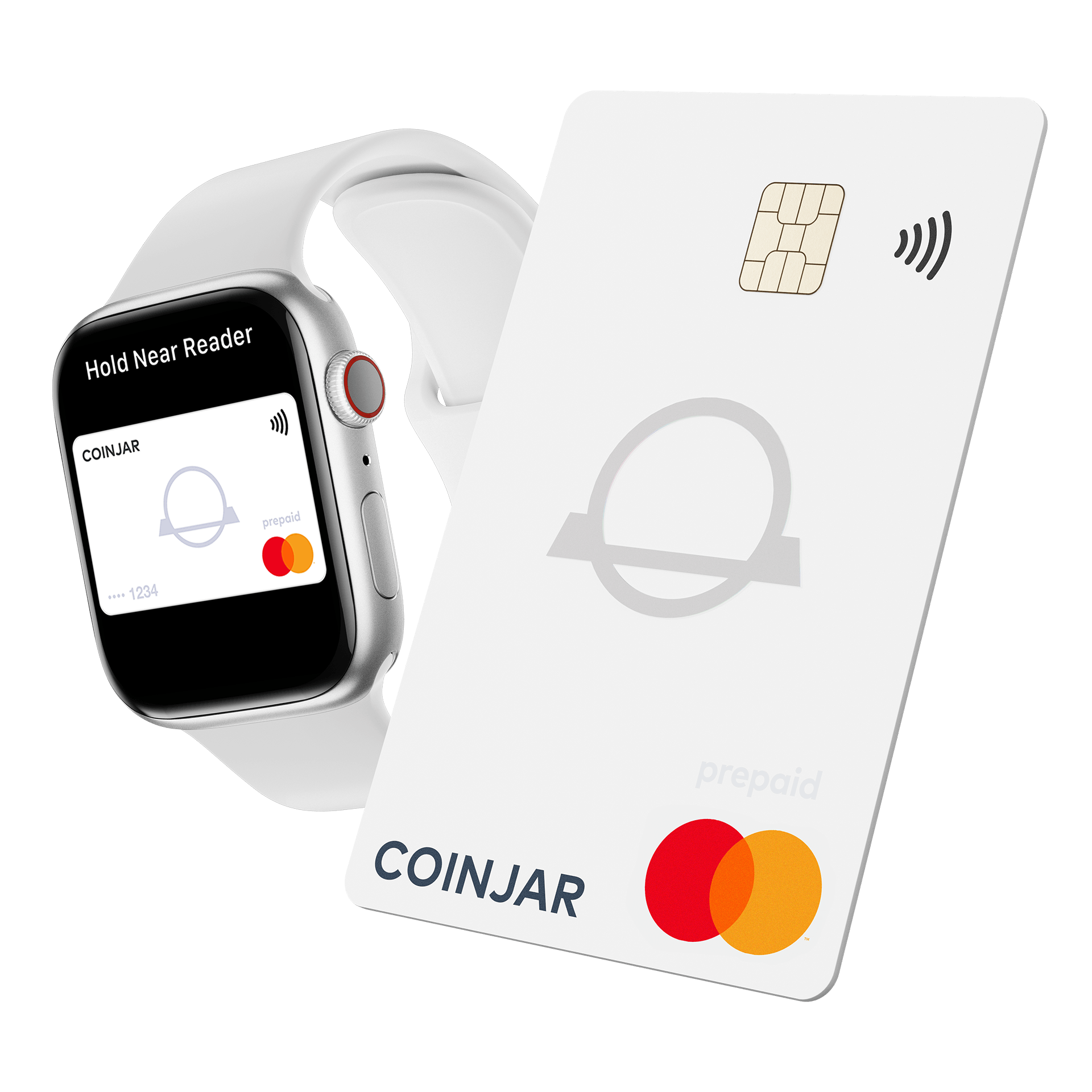
CoinJar Card
Use CoinJar Card, powered by Mastercard, for purchases online and in store, including through Apple Pay and Google Pay. No setup or monthly fee. A 1% purchase fee applies and is returned as CoinJar Rewards points, with one point earned per $1 spent. Available in Australia only.
Get your CoinJar Card for freeCoinJar Card
Use CoinJar Card, powered by Mastercard, for purchases online and in store, including through Apple Pay and Google Pay. No setup or monthly fee. A 1% purchase fee applies and is returned as CoinJar Rewards points, with one point earned per $1 spent. Available in Australia only.
Get your CoinJar Card for free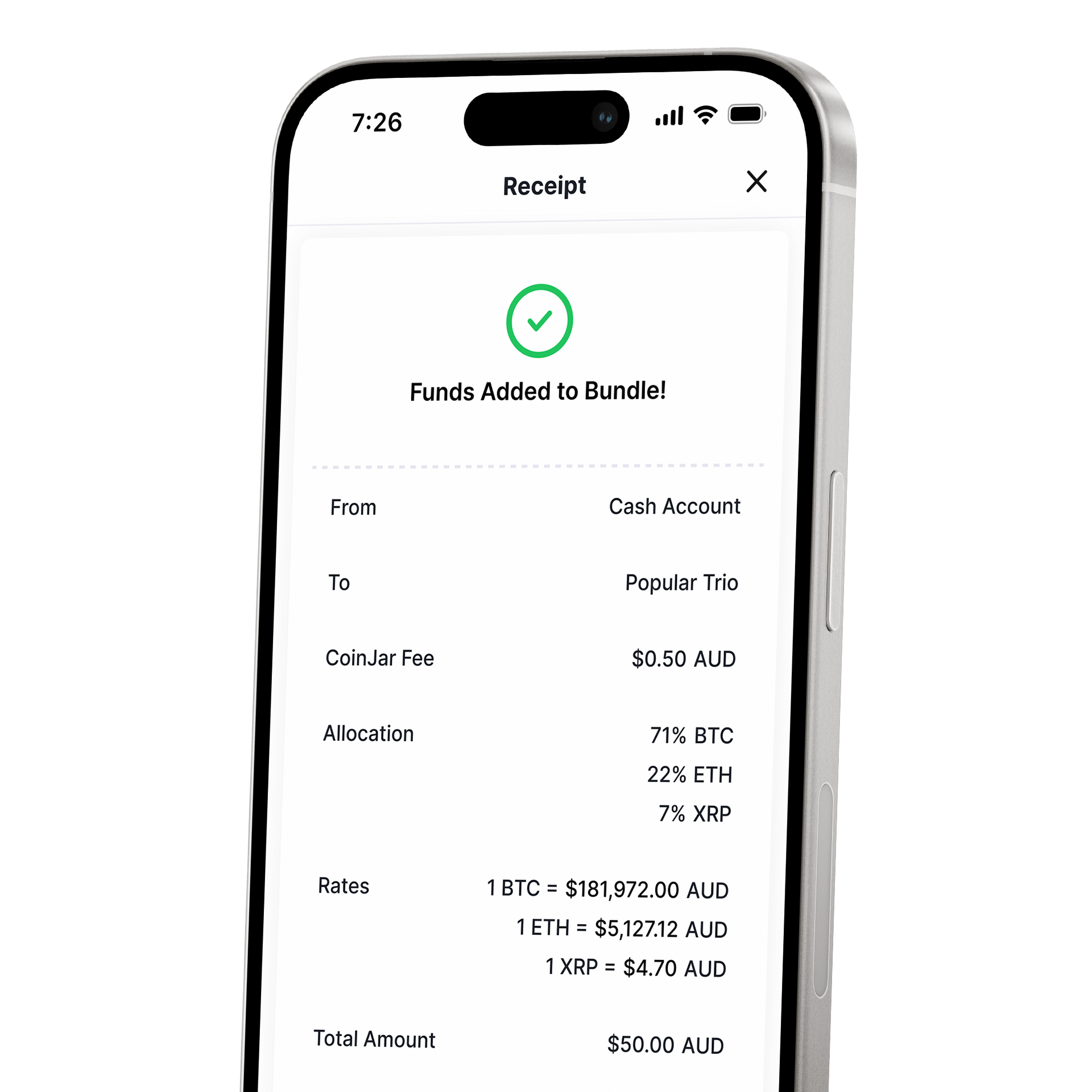
CoinJar Recurring Buy
Schedule automatic purchases weekly, fortnightly or monthly to dollar-cost average into individual cryptocurrencies or CoinJar Bundles. Manage your investment amount and schedule, with the flexibility to adjust or pause purchases as your circumstances change.
DCA with Recurring BuyCoinJar Recurring Buy
Schedule automatic purchases weekly, fortnightly or monthly to dollar-cost average into individual cryptocurrencies or CoinJar Bundles. Manage your investment amount and schedule, with the flexibility to adjust or pause purchases as your circumstances change.
DCA with Recurring Buy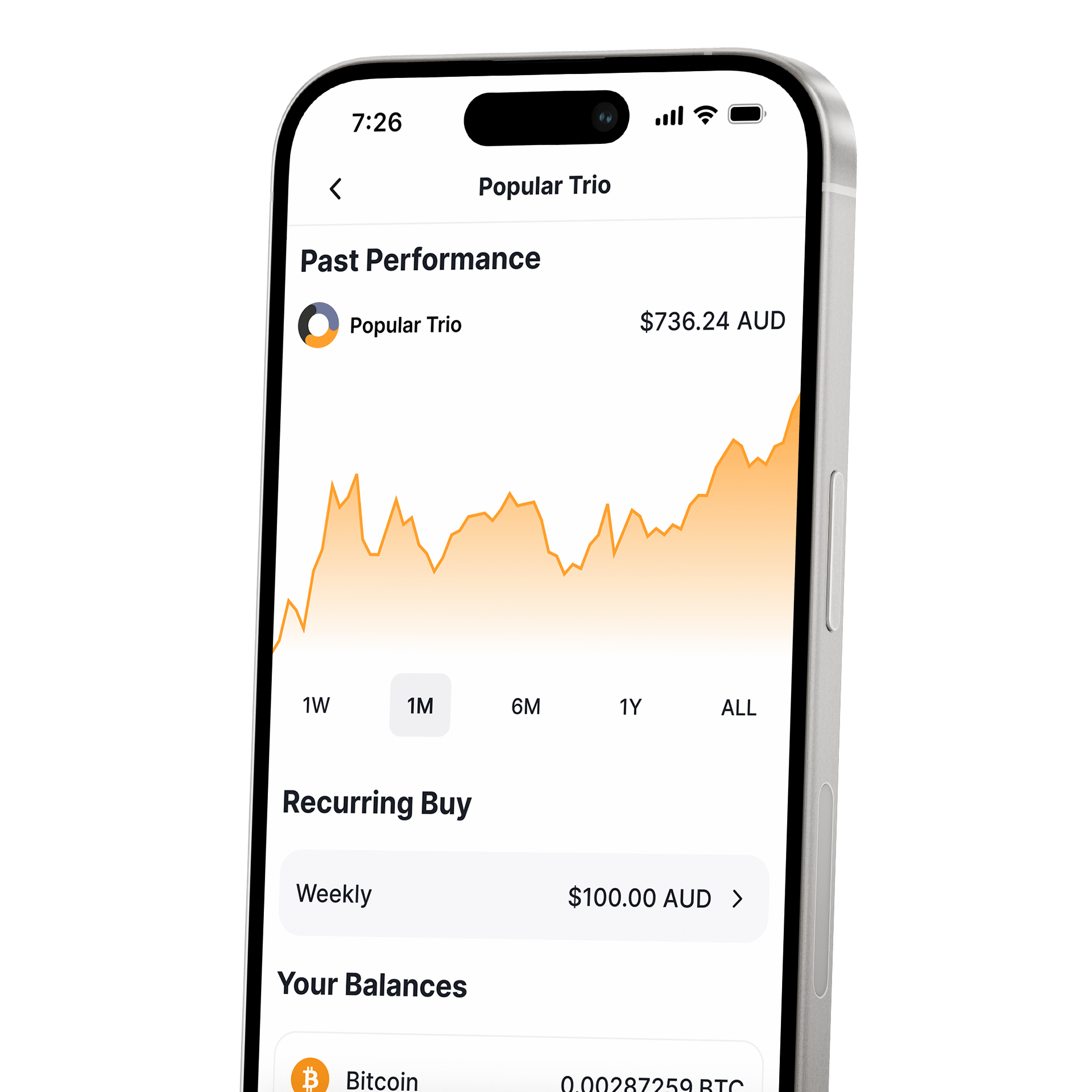
CoinJar Bundles
Pick your Bundle in the CoinJar app. Review each Bundle’s asset allocation, add to your holdings and rebalance when required. Sell your Bundle or unbundle it to manage the assets individually.
Learn moreCoinJar Bundles
Pick your Bundle in the CoinJar app. Review each Bundle’s asset allocation, add to your holdings and rebalance when required. Sell your Bundle or unbundle it to manage the assets individually.
Learn more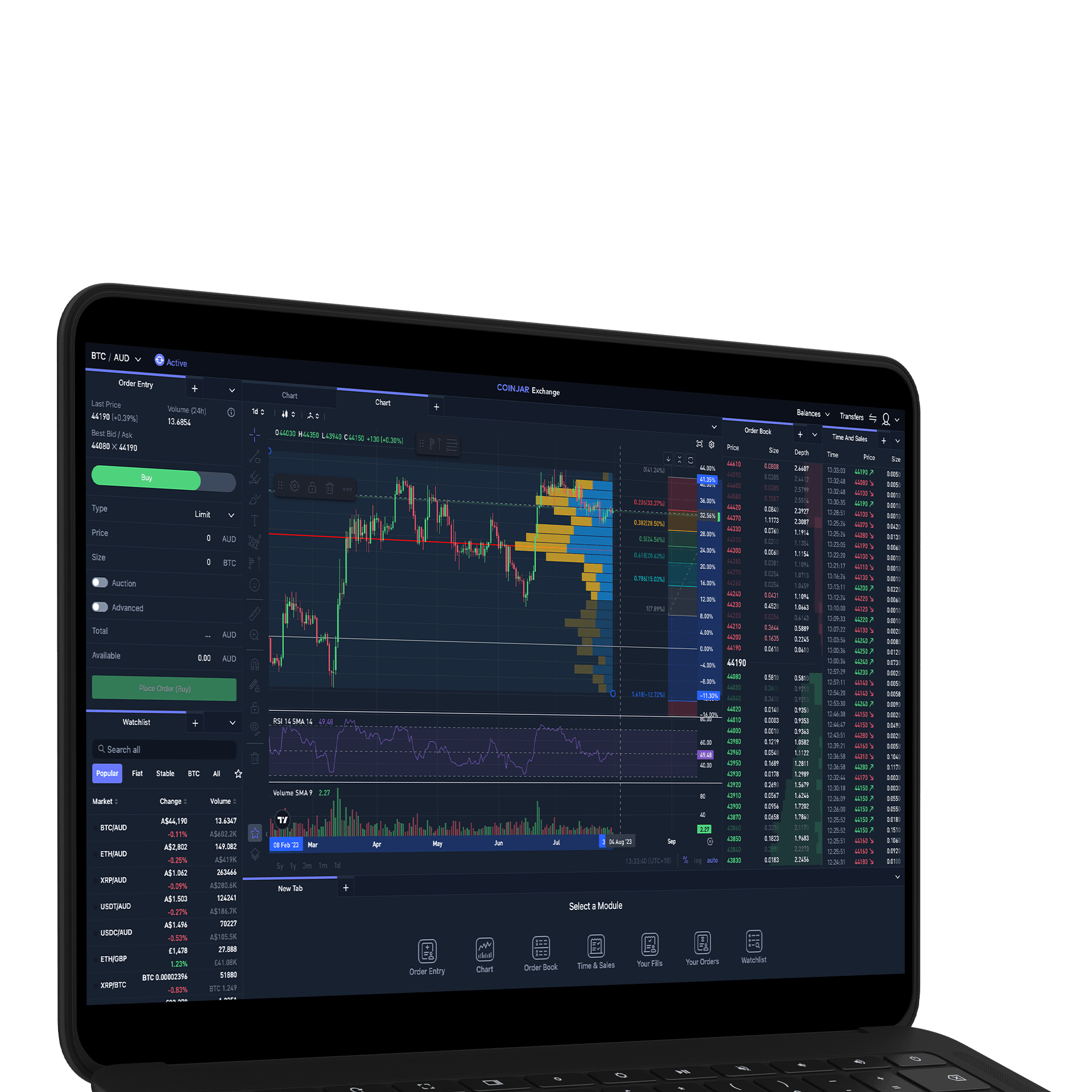
CoinJar Exchange
Trade with fees from 0-0.1%, using market, limit and stop-limit orders. Connect to TradingView to trade directly from your charts, or use CoinJar Exchange’s high-performance interface, built for active traders, market makers and institutions.
Explore CoinJar ExchangeCoinJar Exchange
Trade with fees from 0-0.1%, using market, limit and stop-limit orders. Connect to TradingView to trade directly from your charts, or use CoinJar Exchange’s high-performance interface, built for active traders, market makers and institutions.
Explore CoinJar Exchange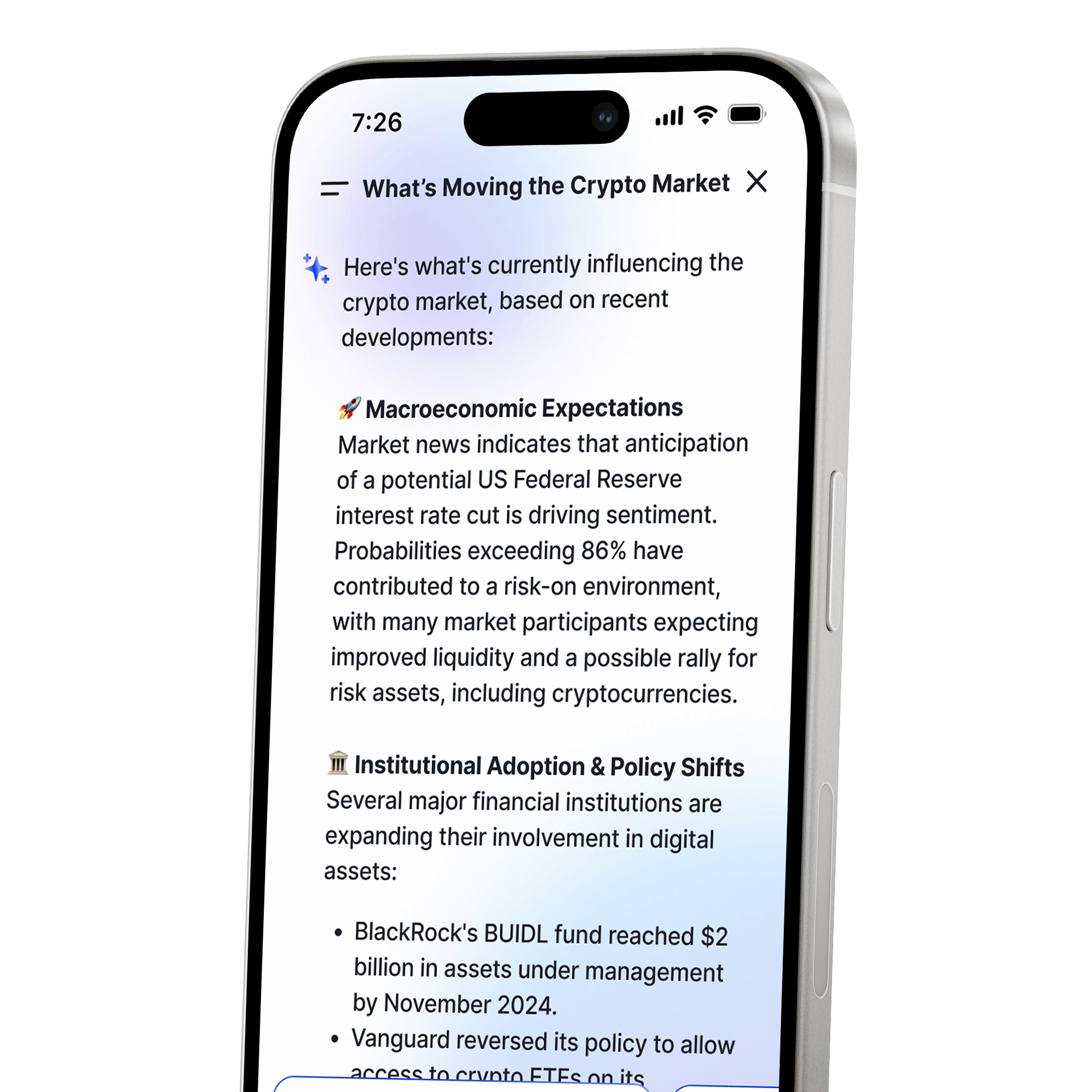
CoinJar AI
Access information about your holdings and the wider cryptocurrency market through CoinJar AI. Ask questions about portfolio changes, market developments or individual cryptocurrencies, with responses informed by your CoinJar holdings.
Learn moreCoinJar AI
Access information about your holdings and the wider cryptocurrency market through CoinJar AI. Ask questions about portfolio changes, market developments or individual cryptocurrencies, with responses informed by your CoinJar holdings.
Learn more
CoinJar OTC
For cryptocurrency trades above $50,000, CoinJar’s OTC desk provides personalised service and access to globally sourced liquidity. Work directly with a dedicated team to arrange and execute your purchase or sale. Discover OTC Services
Learn moreCoinJar OTC
For cryptocurrency trades above $50,000, CoinJar’s OTC desk provides personalised service and access to globally sourced liquidity. Work directly with a dedicated team to arrange and execute your purchase or sale. Discover OTC Services
Learn moreCoinJar does not endorse the content of, and cannot guarantee or verify the safety of any third-party websites. Visit these websites at your own risk.

CoinJar
Get the app.