
Buy Loopring
LRCPast performance is not indicative of future results. All prices are sourced from CoinJar Indices.
What is Loopring?
Loopring was an Ethereum layer two network built for trading, payments and non-fungible tokens. It used zero-knowledge proofs to process activity away from Ethereum and publish enough information back to Ethereum for users to verify balances and withdraw.
That description is now historical. Loopring shut down its exchange and layer two infrastructure in June 2026, after closing its mobile wallet and decentralised finance products in 2025. Its official website states that Loopring is no longer operational. LRC remains an ERC-20 token on Ethereum and can still trade, but the protocol that gave it staking, fee and governance utility has ended. Our guide to blockchain layers explains how layer two networks relate to Ethereum, and our guide to Ethereum covers the network where LRC still exists.
What was Loopring?
Daniel Wang founded Loopring in 2017 as a protocol for decentralised exchanges. The original idea was that orders could be collected away from the blockchain, matched in rings and settled through Ethereum contracts without an exchange taking custody of the assets.
Loopring later became one of the first production zkRollups. Its operator batched transactions, generated a zero-knowledge proof that the state transition was valid and submitted the proof and transaction data to Ethereum.
The product expanded into an order-book exchange, an automated market maker, payments, NFT minting and a smart-contract wallet with social recovery. GameStop used Loopring for its NFT marketplace before closing that marketplace in 2024.
Wang left day-to-day leadership and went on to co-found Taiko, a separate Ethereum layer two project. Steve Guo took over Loopring leadership. Taiko was related through people and technology, but it was never a renamed Loopring or a destination for converting LRC.
What exactly shut down?
The closure happened in stages.
Loopring Wallet, 30 June 2025. The mobile application stopped operating and receiving updates. The underlying smart-wallet contracts remained onchain, but ordinary users lost the official interface and support needed to manage them easily.
Loopring DeFi, 31 July 2025. Products including Portal, Dual Investment and Block Trade were retired across supported networks.
Loopring exchange and layer two, June 2026. Loopring announced the decentralised exchange sunset on 27 June. Normal operation stopped after a contract upgrade on 29 June, deposits ended and the relayer went offline.
The current Loopring website says the project is no longer operational. Historical data can still be reconstructed from Ethereum and queried through third-party indexing, but the former exchange, explorer and application programming interfaces are not running as a service.
What happened to assets on Loopring layer two?
Loopring announced a return process rather than leaving every user to operate the old withdrawal machinery. ETH and ERC-20 balances held on layer two were distributed to corresponding Ethereum addresses in batches. NFTs required a separate return process.
Smart-wallet users and some NFT holders had to contact Loopring because the owner address visible to the contracts was the smart wallet itself rather than the person's new wallet. Loopring set 15 August 2026 as the final deadline for those manual claims and said the support mailbox would become unavailable afterwards.
That deadline has passed. Anyone who believes an asset was not returned should treat old social-media replies, direct messages and recovery websites as high-risk. A closed protocol creates an ideal setting for impersonation and phishing, and there is no official continuing service that CoinJar can use to reverse an old layer two balance.
Why did Loopring close?
Loopring said it had struggled to turn its early technical lead into durable adoption and a sustainable business. General-purpose layer two networks became cheaper and easier for developers to use, while large decentralised exchanges and wallets built their own routing and trading experiences.
The project tried a multi-network strategy, placing Loopring DeFi products on networks such as Taiko and Base and proposing specialised layer three deployments. That did not reverse the decline.
Closing the wallet removed its main consumer interface. Retiring the DeFi business removed newer revenue products. By the time the dedicated layer two closed, the remaining exchange no longer justified operating the relayer, infrastructure and support systems.
This is not a temporary pause or an announced migration. There is no replacement Loopring network, reopening date or conversion of LRC into another token.
What does LRC do now?
Very little at protocol level.
Historically, LRC could be staked for a share of protocol fees. Exchange operators were expected to stake it, and balances could support fee discounts, governance, an insurance fund and token burning.
Those functions depended on an operating Loopring exchange and fee stream. With the exchange, relayer, wallet and DeFi products closed, there is no current Loopring service generating the former protocol rewards.
I found no continuing official LRC staking programme, buyback, revenue distribution or active governance system after the shutdown. Holding LRC does not provide a claim on Taiko, the former Loopring company, any returned user assets or the remaining Ethereum contracts.
The token itself has not been migrated or cancelled. An ERC-20 contract keeps functioning as long as Ethereum does, even when the project associated with it has stopped.
Is LRC still fixed supply?
LRC was created with a maximum supply of approximately 1.374 billion tokens. The protocol included burning mechanisms that reduced the available supply, and there is no ongoing inflation schedule creating new LRC beyond the original maximum.
A fixed supply does not preserve utility or value. Scarcity matters only if somebody wants the asset, and the services that once created demand for LRC are no longer operating.
The shutdown also means old explanations of a fee split among stakers, the DAO and burns should not be described in the present tense. They explain the former tokenomics rather than a live system.
What was the relationship between Loopring and Taiko?
Taiko is a separate general-purpose Ethereum layer two network. Daniel Wang moved from Loopring to work on it, and Loopring later planned to deploy its trading technology above Taiko as a specialised layer three.
That plan created persistent confusion. LRC did not become TAIKO, and TAIKO holders did not receive ownership of Loopring. The two assets have separate contracts and economics.
No official conversion ratio or migration exists. Any website offering to swap LRC for TAIKO as part of the Loopring closure should be treated as fraudulent unless both projects publish independently verifiable instructions, which they had not done at the time of writing.
Taiko continuing to operate does not restore LRC's old utility. Shared founders and technical history are not a revenue or ownership link.
How did Loopring's layer two work?
Loopring used a zkRollup. A central operator ordered transactions and produced blocks, while zero-knowledge proofs demonstrated to Ethereum that the resulting balances followed the rollup's rules.
Transaction data was published to Ethereum, which meant balances could be reconstructed even if Loopring's own servers disappeared. Users also had forced-withdrawal and emergency-exit mechanisms intended to let them leave through Ethereum.
Those protections had limits. The operator could delay or censor normal activity, forced withdrawals cost Ethereum gas and contract upgrades were controlled by a small multisignature group. L2BEAT documented a two-of-three upgrade multisig with no mandatory delay, creating a serious trust assumption while the system was live.
The final shutdown shows the difference between data availability and service availability. Ethereum preserved the data needed to identify balances, but the trading interface, relayer, support operation and convenient withdrawal process could still disappear.
Security history
Loopring's most significant recent incident affected its smart wallet in June 2024. An attacker compromised Loopring's official Guardian service and used it to bypass social-recovery protections for wallets that relied on only that guardian. Approximately 5 million US dollars of assets were taken from affected wallets.
Wallets with multiple independent guardians were not affected in the same way. Loopring paused the Guardian and related recovery services while investigating.
The incident exposed a central dependency inside a product marketed as self-custodial. A smart contract can be non-custodial while a recovery service, interface or upgrade key still creates a concentrated point of failure.
The 2026 shutdown was not itself described as a hack. It was an operational and commercial closure followed by an asset-return process.
Governance and control
Loopring described LRC as a governance asset and maintained DAO-related fee allocations, but strategic and technical control remained concentrated in the core team.
The layer two relied on a central relayer to sequence transactions and produce proofs. Core contracts could be upgraded by a small multisignature arrangement without a mandatory delay. The team controlled the official wallet, exchange interface, APIs and shutdown process.
Token holders did not vote the project back into operation or choose a new operator. The team decided to close services and organise distributions.
This does not mean the zero-knowledge proofs were meaningless. They protected state correctness while the system operated. It means cryptographic correctness did not decentralise the business decisions and operational infrastructure around the rollup.
Regulatory position
I found no current enforcement action naming Loopring or LRC as the issuer of an unlawful asset in the sources reviewed for this page.
LRC was not among the crypto assets named as digital commodities in the joint interpretation published by the United States Securities and Exchange Commission and Commodity Futures Trading Commission on 17 March 2026. That is not a finding against LRC. It means the asset was not addressed either way.
The more immediate issue is operational rather than regulatory: the protocol and its products have closed, so former functionality should not be used to justify the token today.
What are the risks of holding LRC?
The project has shut down. Loopring's official site states that it is no longer operational. There is no active exchange, wallet, relayer or DeFi product. Utility has disappeared. Protocol staking, fee discounts, operator bonds and DAO economics depended on services that no longer run. No migration or successor. LRC has not converted into TAIKO or another asset. Holding it does not provide exposure to a replacement Loopring network. No ongoing development commitment. Historical contracts and data remain on Ethereum, but there is no team commitment to build new LRC utility. Residual trading is speculative. An ERC-20 token can continue trading after its project closes. Market availability is not evidence that the protocol is active. Claim and phishing risk. The official manual asset-claim deadline has passed. Fraudsters can imitate recovery services or invent a token migration. Concentration. A low-liquidity market can be moved sharply by remaining large holders. Historical key and operator risk. Loopring depended on a central relayer, a small upgrade multisig and the official Guardian service. Security history. The 2024 Guardian compromise caused material losses and showed that wallet recovery infrastructure could be attacked. Liquidity. LRC trades thinly compared with major assets, which can widen spreads and make it difficult to exit. Volatility. LRC is not a stablecoin. Its value can move sharply and fall substantially even without new protocol news. No consumer protection. Crypto assets are not covered by the Australian Government's Financial Claims Scheme, and AUSTRAC registration is not an endorsement of any asset listed on an exchange. You should be prepared to lose the money you put in.
Buying LRC with Australian dollars on CoinJar
CoinJar has operated since 2013 and lists LRC against Australian dollars, so you can buy, sell and hold it without converting through another cryptocurrency first. Current charges are on our fees page, and live Australian dollar rates are on our cryptocurrency prices page.
CoinJar Australia Pty Ltd is registered with AUSTRAC as a digital currency exchange provider, Registration Number DCE100749118-001.
How is LRC taxed in Australia?
The ATO generally treats LRC as a capital gains tax asset. A disposal can occur when you sell it for Australian dollars, trade it for another crypto asset, spend it or give it away.
The ATO sets out its approach in its crypto asset investments guidance. Our guide to crypto tax in Australia provides a practical overview. This is general information, not tax advice. Consider speaking to a qualified tax adviser about your circumstances.
Fund Your Account Your Way
Buy Loopring instantly using Visa or Mastercard, or deposit Australian dollars via bank transfer, PayID or PayPal. Buy, sell and convert between supported cryptocurrencies through your CoinJar account.


How to buy Loopring with CoinJar
Start your portfolio with Australia's longest-running crypto exchange with these simple steps.
Sign up to CoinJar
Get the CoinJar app on iOS or Android, create an account and verify your ID.
Deposit funds
Deposit AUD fee-free via PayID, Osko or bank transfer. You can also use PayPal or pay instantly by card.
Buy your first crypto
Buy Loopring and other popular cryptos using cash or credit card in minutes.


CoinJar Card
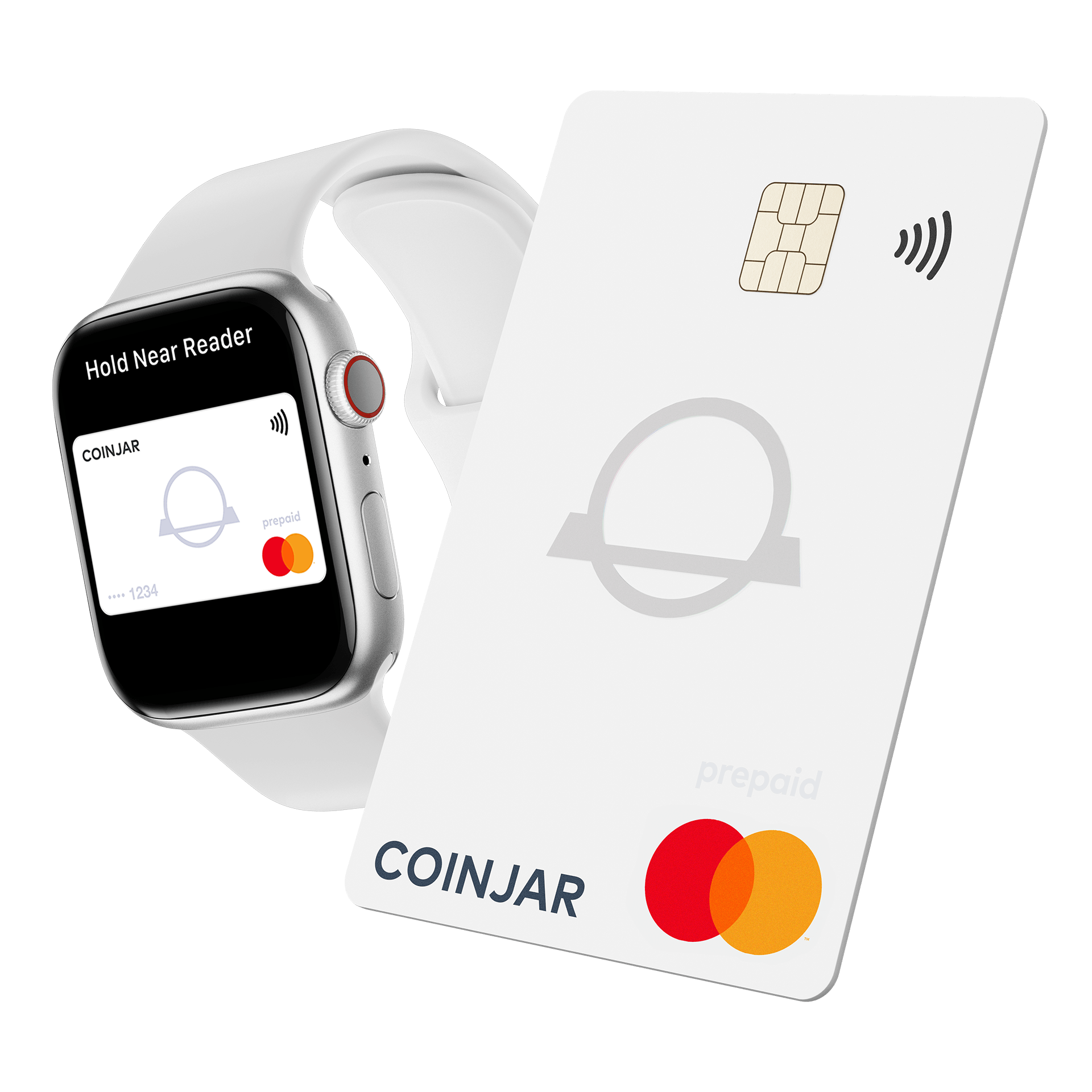
Use CoinJar Card, powered by Mastercard, for purchases online and in store, including through Apple Pay and Google Pay. No setup or monthly fee. A 1% purchase fee applies and is returned as CoinJar Rewards points, with one point earned per $1 spent. Available in Australia only.
Get your CoinJar Card for freeCoinJar Card
Use CoinJar Card, powered by Mastercard, for purchases online and in store, including through Apple Pay and Google Pay. No setup or monthly fee. A 1% purchase fee applies and is returned as CoinJar Rewards points, with one point earned per $1 spent. Available in Australia only.
Get your CoinJar Card for free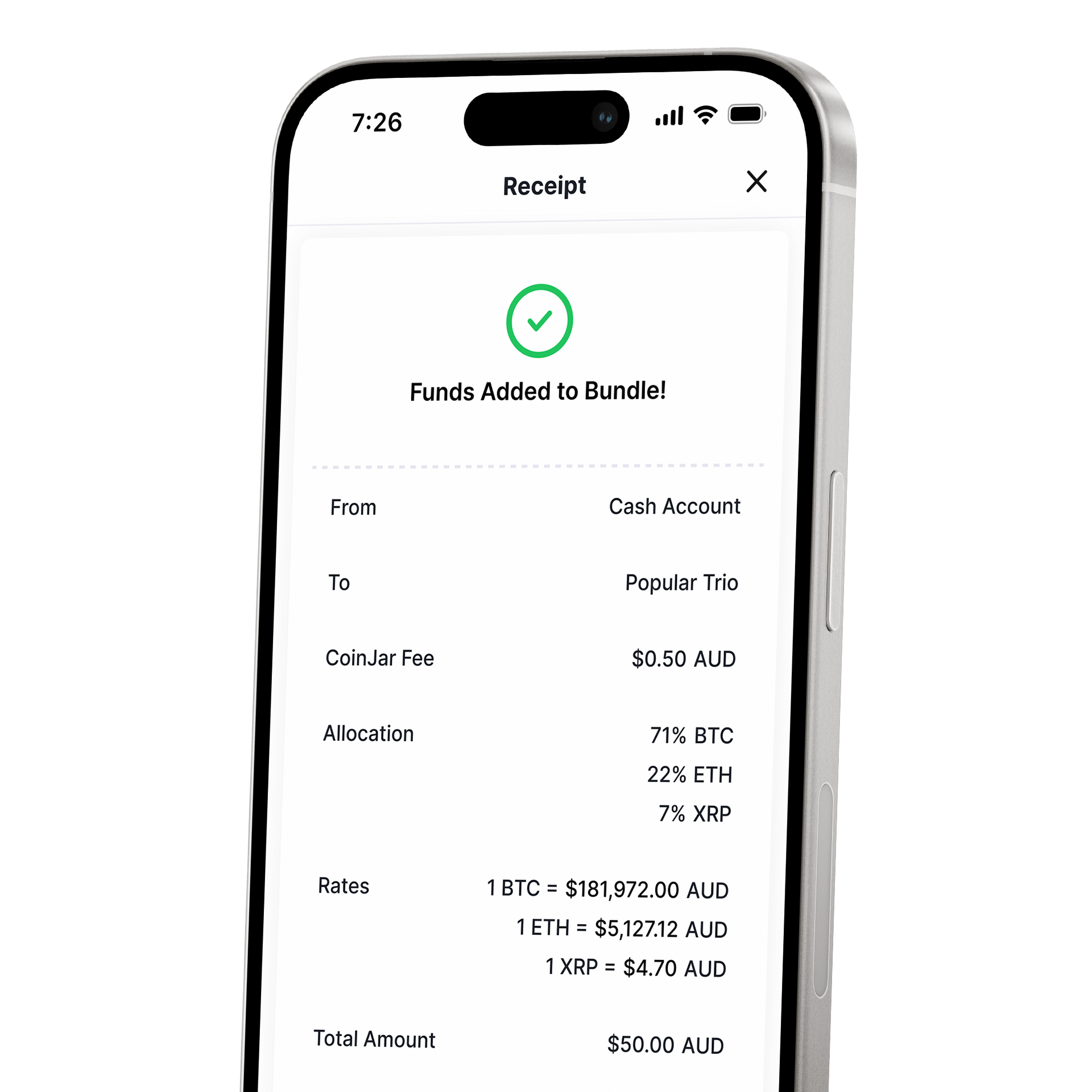
CoinJar Recurring Buy
Schedule automatic purchases weekly, fortnightly or monthly to dollar-cost average into individual cryptocurrencies or CoinJar Bundles. Manage your investment amount and schedule, with the flexibility to adjust or pause purchases as your circumstances change.
DCA with Recurring BuyCoinJar Recurring Buy
Schedule automatic purchases weekly, fortnightly or monthly to dollar-cost average into individual cryptocurrencies or CoinJar Bundles. Manage your investment amount and schedule, with the flexibility to adjust or pause purchases as your circumstances change.
DCA with Recurring Buy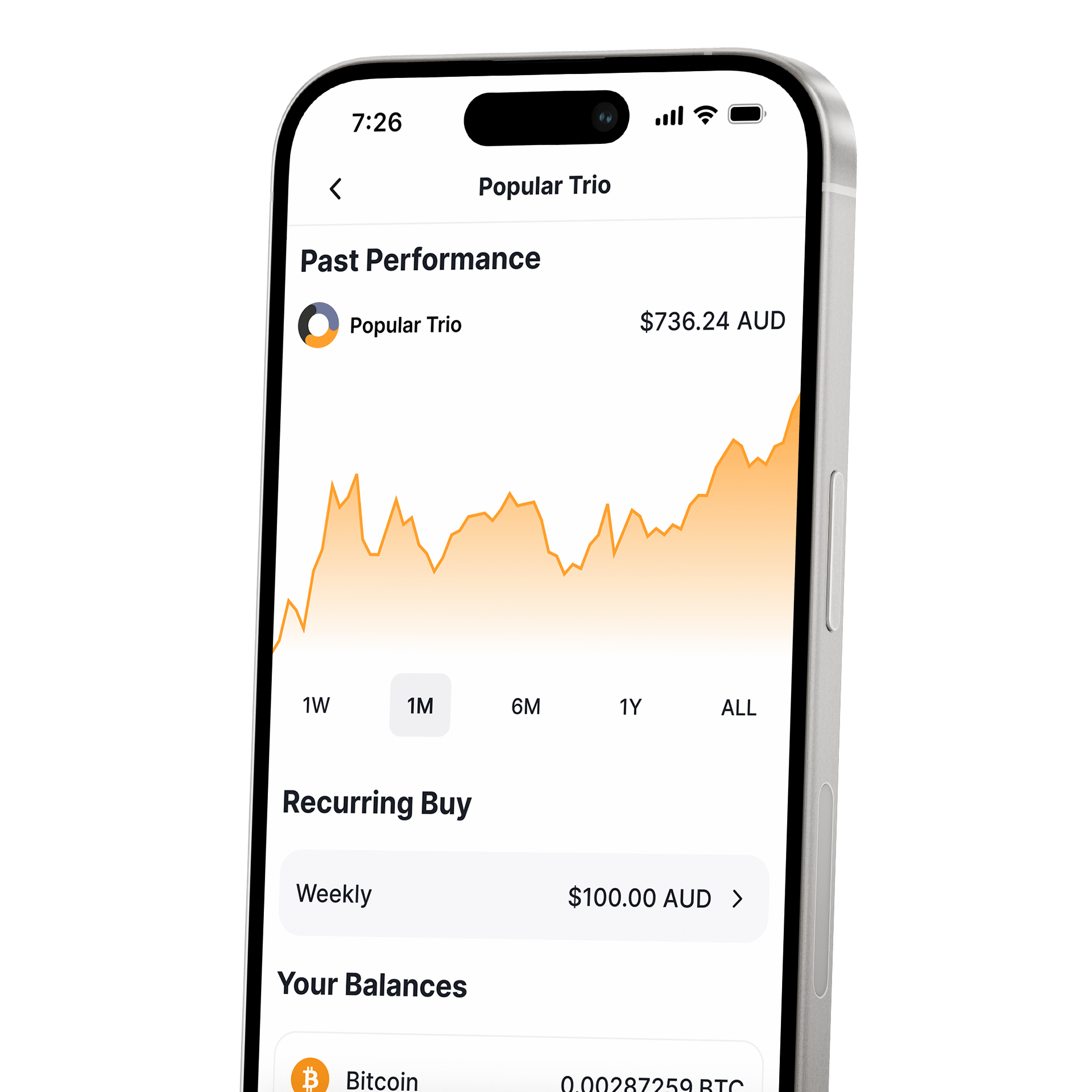
CoinJar Bundles
Pick your Bundle in the CoinJar app. Review each Bundle’s asset allocation, add to your holdings and rebalance when required. Sell your Bundle or unbundle it to manage the assets individually.
Learn moreCoinJar Bundles
Pick your Bundle in the CoinJar app. Review each Bundle’s asset allocation, add to your holdings and rebalance when required. Sell your Bundle or unbundle it to manage the assets individually.
Learn more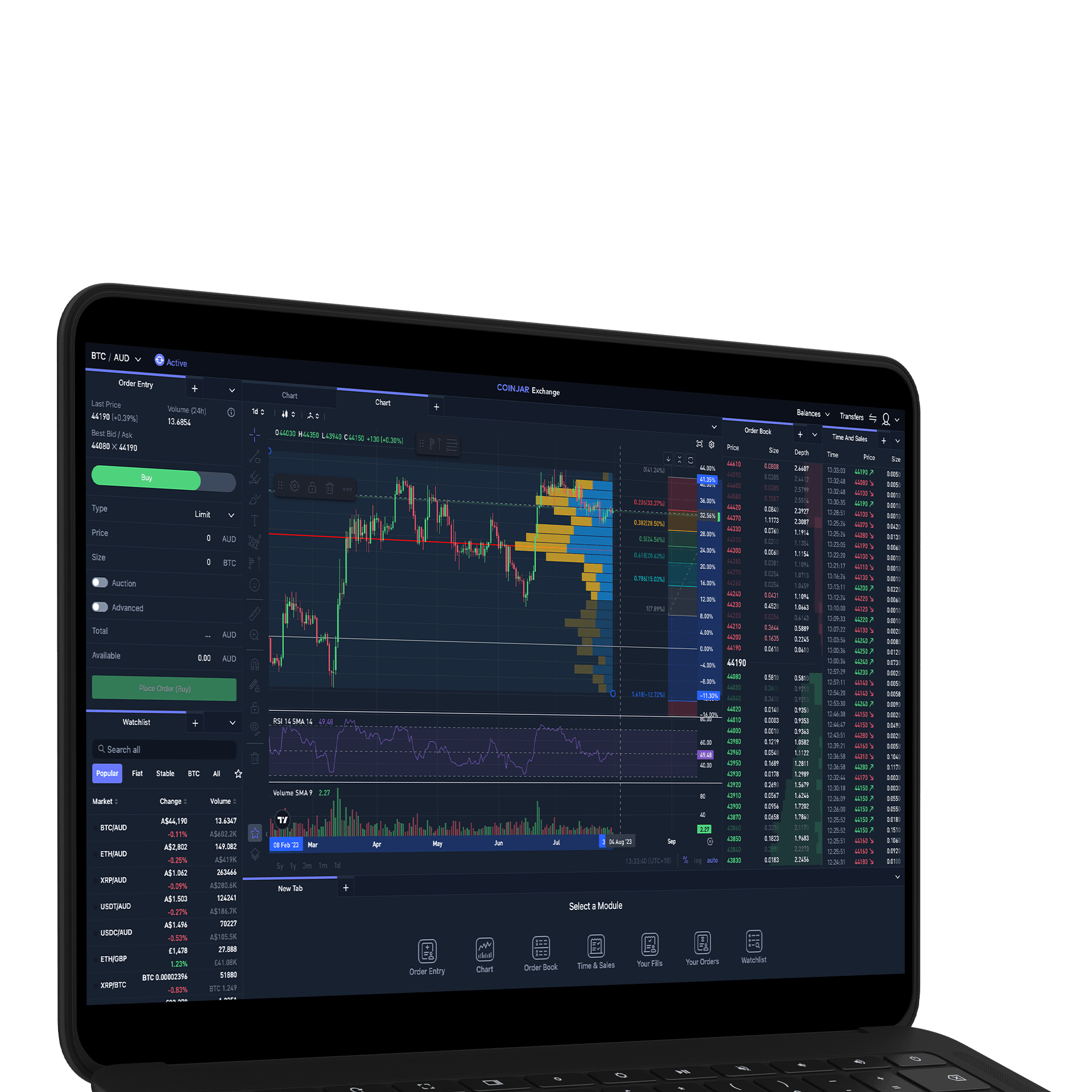
CoinJar Exchange
Trade with fees from 0-0.1%, using market, limit and stop-limit orders. Connect to TradingView to trade directly from your charts, or use CoinJar Exchange’s high-performance interface, built for active traders, market makers and institutions.
Explore CoinJar ExchangeCoinJar Exchange
Trade with fees from 0-0.1%, using market, limit and stop-limit orders. Connect to TradingView to trade directly from your charts, or use CoinJar Exchange’s high-performance interface, built for active traders, market makers and institutions.
Explore CoinJar Exchange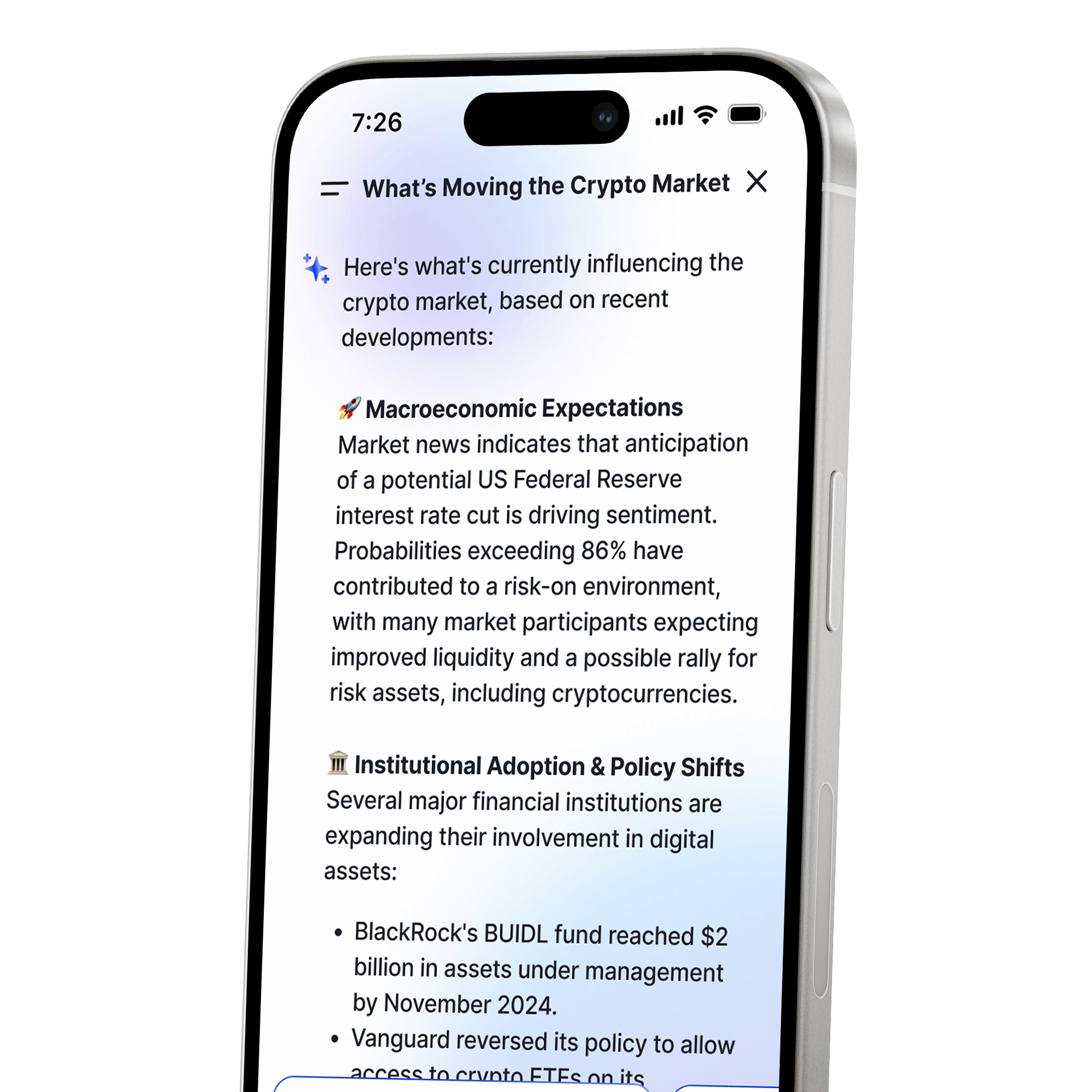
CoinJar AI
Access information about your holdings and the wider cryptocurrency market through CoinJar AI. Ask questions about portfolio changes, market developments or individual cryptocurrencies, with responses informed by your CoinJar holdings.
Learn moreCoinJar AI
Access information about your holdings and the wider cryptocurrency market through CoinJar AI. Ask questions about portfolio changes, market developments or individual cryptocurrencies, with responses informed by your CoinJar holdings.
Learn more
CoinJar OTC
For cryptocurrency trades above $50,000, CoinJar’s OTC desk provides personalised service and access to globally sourced liquidity. Work directly with a dedicated team to arrange and execute your purchase or sale. Discover OTC Services
Learn moreCoinJar OTC
For cryptocurrency trades above $50,000, CoinJar’s OTC desk provides personalised service and access to globally sourced liquidity. Work directly with a dedicated team to arrange and execute your purchase or sale. Discover OTC Services
Learn moreCoinJar does not endorse the content of, and cannot guarantee or verify the safety of any third-party websites. Visit these websites at your own risk.

CoinJar
Get the app.