
It’s just one crisis after another these days, from the exploits threatening DeFi to the existential threat of being overtaken by the suits.
Story One
Told you so
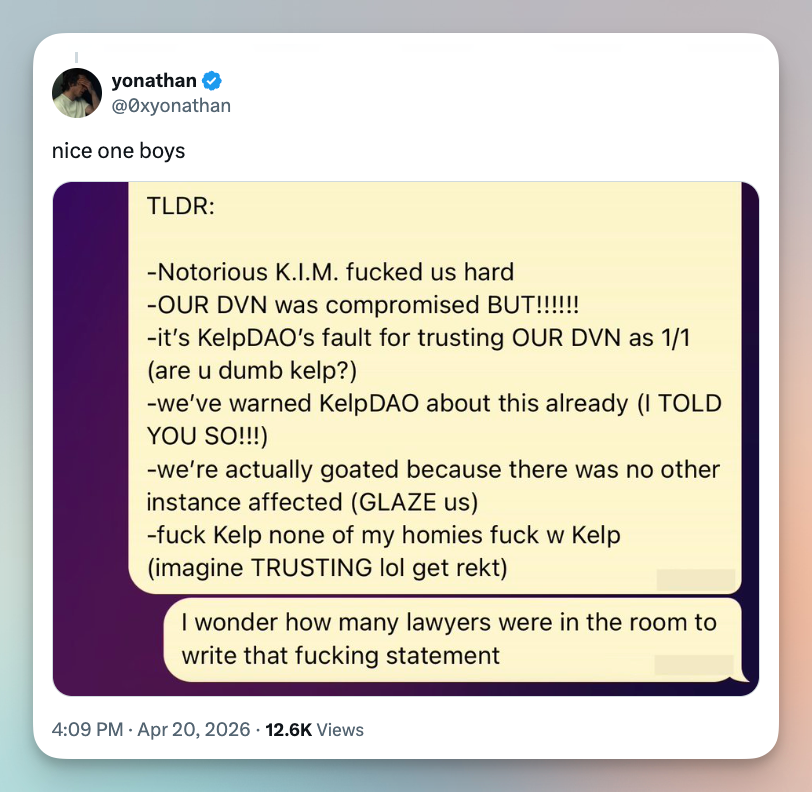
That was LayerZero’s defense when confronted with a distressed LiquidStaking Protocol, accusing them of having caused an exploit. North Korean Hackers upped their KPIs and they’re crushing it. On April 18th, Kelp DAO’s rsETH bridge lost $293 Million in ETH to them.
Instead of using social engineering, the hackers compromised two of LayerZero’s verifier network nodes. By DDOSing the remaining verifier nodes, they routed queries to the compromised nodes, enabling them to issue a fabricated message that released $292 million worth of rsETH. They swiftly moved on to Aave and started borrowing $200 million in wETH against that uncollateralized rsETH.
The finger-pointing quickly began, with LayerZero publishing a long statement that boils down to “we told you not to use a 1 of 1 verifier setup.” Meanwhile, defendants argue that this shouldn’t have been allowed in the first place.
In the meantime, Aave has bigger fish to fry, as the protocol faces $200 million in bad debt by allowing the attackers to borrow against rsETH. Their token dropped 18%, and the initial confidence that their umbrella module would cover the fallout has faded.
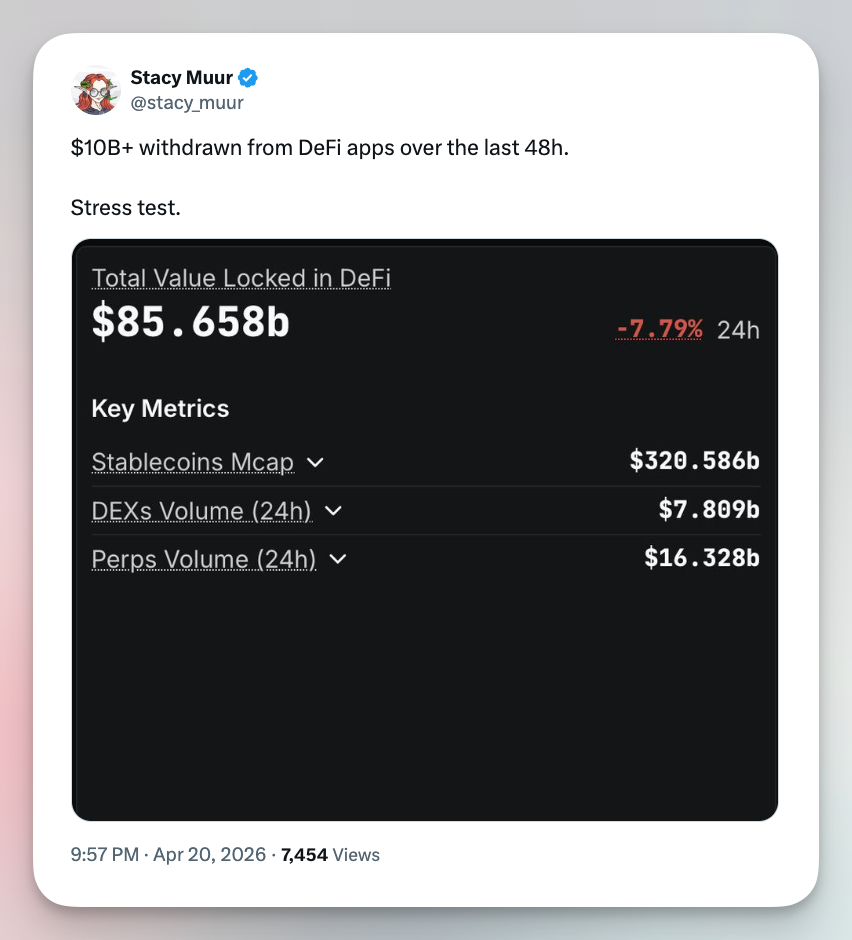
What followed was a broader reckoning as TVL started leaving DeFi en masse.
Takeaway: Despite the perks of composability in DeFi, recent exploits have shown its downside. Not last because proper risk management is still work in progress, and crisis response leaves much to be desired.
Story Two
The suits are here
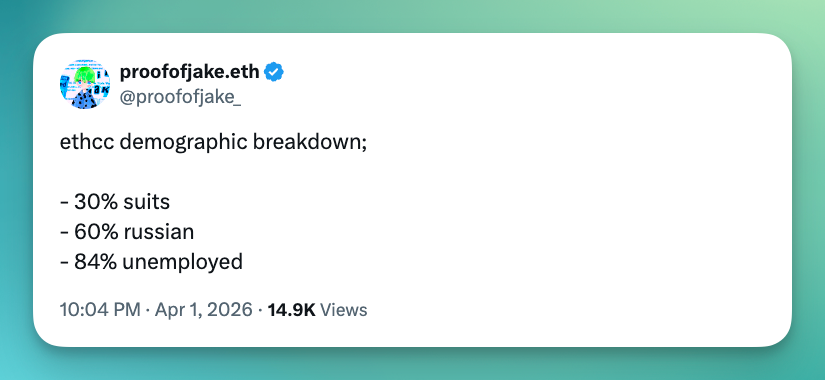
Whether we like it or not, the sight at crypto conferences is changing. Suddenly, it’s all people in suits and ties who know how to use deodorant. And it’s not just the sight at conferences, it’s also the makeup of crypto market participants that is evolving.
A few days ago, Morgan Stanley launched yet another Bitcoin ETF, aggressively undercutting the competition on fees to capture market share. Next up, they plan to use their 15,000-person-strong network of wealth advisors to go wild (by their standards, that means pitching their clients crypto ETFs).
The institution is far from the only suited-up group gazing at crypto. According to Nomura's most recent digital asset institutional survey, nearly 4 out of 5 plan on deploying 2 - 5% of their portfolio into crypto. This drive is facilitated by clearer regulatory frameworks and a desire to diversify. Unsurprisingly, they’re looking at DeFi yields and derivatives too. After all, where else is an institution to get an edge these days?
Takeaway: We always wanted to be seen by the grown-ups. But what if the cost is becoming them?
Story Three
Drift Bailout
It seems only consequential that the arrival of the TradFi crowd would also spell the start of our bailout era. Remember, it was a bank bailout that triggered Satoshi Nakamoto so badly, he included the financial crisis headline in the first bitcoin block.
Anyway, this time the bailed-out party is Solana perpetual exchange Drift, which was the first to be exploited in Q2, losing $285 million. Their TVL collapsed, and the token price fell by 77%, putting them in a bad spot to ever make affected users whole.
Fortunately for them, stablecoin issuer Tether stepped up to the challenge and offered a credit facility to get the protocol back on its feet. What might have propelled them to do this wasn’t benevolence but likely a desire to capture market share on Solana. While Tether is leading in global stablecoin adoption, historically, Solana has been a USDC-dominated chain.
As such, the bailout comes with strings attached. Drift has to switch its whole settlement infrastructure from USDC to USDT. On top of that, this is a line of credit that requires establishing a recovery pool to be funded by future trading revenues.

Takeaway: One man’s crisis is another’s opportunity.
Fact of the Week: If you now feel inspired to step up your suit game, you might wonder why, despite having multiple jacket buttons, usually only one is fastened. That’s a custom going back all the way to Edward VII of England, who found fastening the last button of his waistcoat uncomfortable and quickly set a new trend.
Naomi for CoinJar
CoinJar Australia Pty Ltd ACN 648 570 807 is a registered Virtual Asset Service Provider (VASP) with the Australian Transaction Reports and Analysis Centre (AUSTRAC) in accordance with the Anti-Money Laundering and Counter-Terrorism Financing Act 2006 (Cth).
This material is general information only and does not consider your objectives, financial situation or needs. You should consider the Product Disclosure Statement and Target Market Determination (TMD) relating to the CoinJar Card product before making any decision. The CoinJar Card is a prepaid, reloadable Mastercard issued by EML Payment Solutions Limited ABN 30 131 436 532 AFSL 404131 (EML). CoinJar Australia Pty Ltd ABN 75 648 570 807 (Authorised Representative Number 1290193) is involved in the promotion and distribution of the Card and is a Corporate Authorised Representative of EML. Please consider the Financial Services Guide.
Apple Pay is a trademark of Apple Inc., registered in the U.S. and other countries. Google Pay is a trademark of Google LLC. Mastercard and the circles design are registered trademarks of Mastercard International Incorporated.
This site is protected by reCAPTCHA and the Google Privacy Policy and Terms of Service apply.