
Buy Quant
QNTPast performance is not indicative of future results. All prices are sourced from CoinJar Indices.
What is Quant?
Quant is a British software company that builds technology for connecting blockchains to each other and to the systems banks and governments already run. QNT is the cryptocurrency tied to that business. It is not a coin with its own blockchain. QNT is an ERC-20 token that lives on Ethereum.
The company is Quant Network Ltd, registered in England and Wales with company number 09798383 and incorporated on 28 September 2015. Its founder and chief executive is Gilbert Verdian, who came from a background in health, government and payments technology rather than from cryptocurrency. QNT was distributed through a token sale in mid 2018.
Quant's product is called Overledger. The clearest way to describe it is enterprise interoperability software: an application programming interface gateway that sits above existing public, permissioned and private distributed ledgers. Overledger does not replace those ledgers, does not run its own consensus and does not produce blocks. This distinction matters, because Overledger is routinely described as a blockchain in places it should not be, and buyers who expect Quant to behave like a layer 1 network are working from the wrong model.
How does Overledger work?
Traditional blockchains each have their own transaction format, address scheme, signing rules and query language. A bank that wants to touch three of them normally has to build and maintain three separate integrations, then rebuild them whenever any of those networks changes.
Overledger's approach is to abstract that away. An application talks to one set of standardised APIs, and Overledger translates those instructions into whatever each underlying network expects. Quant describes the model in layers: a transaction layer that deals with the individual ledgers, a messaging layer that handles the data moving between them, a filtering and ordering layer, and an application layer where the customer's software actually sits.
Two things follow from that design.
- The underlying networks stay in charge. If a transaction is written to Ethereum, Ethereum's validators still confirm it under Ethereum's rules. Overledger is a gateway, not a settlement layer of its own. Our guide to blockchain explains what those base networks actually do.
- The integration burden moves to one place. Instead of maintaining connections to many chains, a customer maintains one connection to Overledger and Quant maintains the rest.
Quant's official website sets out the current product range.
What is QNT used for?
QNT is an access and payment token rather than a network fuel token. You do not need QNT to send Ethereum transactions or to run a node on any public chain.
- Licensing and platform access. QNT was designed as the token used to pay for Overledger licences and platform services. Quant's own materials indicate that platform fees can be settled in conventional currency as well as in QNT, so QNT is one route to paying for the software rather than the only one.
- Network participation. Quant has described QNT as the mechanism used by operators who run infrastructure on its network, staking tokens as a condition of taking part.
- A traded asset. In practice, most QNT changes hands on exchanges rather than being spent on software licences.
The honest framing is that demand for QNT is linked to Quant's commercial success but is not a direct claim on it. Holding QNT gives you no share of Quant Network Ltd, no dividend, no revenue share and no vote in how the company is run. QNT sits in the broader altcoin category rather than being a payments coin or a stablecoin.
Where does Quant fit in financial infrastructure?
Quant's positioning is aimed at regulated institutions rather than retail crypto users, and it has spent much of its life inside standards and public sector work.
- Blockchain standards. Verdian says he initiated the effort that led to ISO technical committee 307, the international committee for blockchain and distributed ledger standards. The committee itself was formed in 2016. He has also held convenor and chair roles in interoperability working groups connected to that work.
- Central bank experimentation. Quant was part of the vendor team on Project Rosalind, a retail central bank digital currency application programming interface prototype run by the Bank for International Settlements Innovation Hub with the Bank of England, which reported in June 2023. The published Rosalind report describes what was built. It was an experiment, not a live currency, and no decision to issue a digital pound followed from it.
- Asset tokenisation. The wider theme Quant sells into is moving traditional financial instruments onto ledgers while keeping them connected to existing systems. Our guide to real world asset tokenisation covers that market.
Read these as credentials and pilots, not as revenue. Being selected for a prototype, joining an innovation programme or sitting on a standards committee is not the same as a production deployment, and the two are frequently blurred together in coverage of QNT.
How is Quant different from other interoperability projects?
Several projects work on connecting blockchains, and they take very different routes.
| Quant | Polkadot | Cosmos | Chainlink CCIP | |
|---|---|---|---|---|
| Core approach | Software gateway above existing ledgers | Purpose built chains sharing one security layer | Independent chains connected by a common messaging protocol | Oracle network providing a cross chain messaging service |
| Runs its own blockchain | No | Yes | Yes | No |
| Where the token lives | Ethereum, as an ERC-20 | Its own chain | Its own chain | Ethereum and other chains |
| Connects to networks it does not control | Yes, including permissioned and private ledgers | Mainly through bridges | Mainly through chains that adopt its protocol | Yes |
| Primary customer | Banks, governments and large enterprises | Blockchain projects | Blockchain projects | Applications and institutions |
| Open source | Largely commercial software | Yes | Yes | Partly |
The practical difference is that Quant is trying to sell software to institutions that already have infrastructure, while most of its comparators are trying to attract developers to build on a new chain. Our guide to decentralised finance explains the developer facing side of that market.
How is new QNT created, and is the supply capped?
Quant sold QNT in 2018 and burned the unsold portion, destroying 9,545,765 tokens on 14 September 2018. That left a total supply of 14,612,493 QNT, which is very small by cryptocurrency standards.
You will still see 45,467,000 quoted as the QNT supply. That is the pre burn maximum recorded in the token contract, not the amount that actually exists, and it is one of the most persistent errors about the asset.
Quant has not reported issuing further QNT since the burn, and there is no mining or staking emission schedule adding new tokens the way there is on a proof of work or proof of stake chain. Treat the supply as fixed in practice rather than as an unbreakable protocol rule, since the ERC-20 contract is company controlled rather than governed by a public network.
A small supply is not the same as scarcity value. A token with 14 million units and one with 14 billion can be worth the same in total. What matters is how much of the supply actually trades, and QNT's small float means individual transactions can move the price more than they would on a deeper market.
What should Australian customers consider before buying QNT?
QNT is volatile and has had very large drawdowns in past market cycles. Consider the following before you buy.
- The token and the company are separate. Quant Network Ltd can win business without QNT rising, and QNT can rise without the company winning business. There is no legal link between the two.
- Fees can be paid in other ways. If enterprise customers can settle in conventional currency, then commercial growth does not automatically translate into buying pressure for the token.
- Adoption is hard to verify from outside. Quant sells to institutions under commercial terms, and its customers are generally not named. Announcements about pilots, vendor panels and framework selections are easy to over read.
- Overledger is commercial software. It is not a public network you can inspect, so you cannot audit usage the way you can count transactions on an open blockchain.
- The supply is concentrated. A small total supply held partly by the company and early participants means the tradeable float is smaller again, which cuts both ways on price.
- Competition is real and well funded. Interoperability is a crowded field, and the standards and messaging approaches that eventually win may not be Quant's.
- Narrative risk. QNT attracts a lot of unverified claims about official standards status and central bank contracts. Check the primary source before acting on any of it.
- No government protection. QNT is not covered by the Australian Government's Financial Claims Scheme, which protects certain bank deposits and insurance policies but does not extend to cryptoassets.
Quant on CoinJar in Australia
CoinJar has operated since 2013 and lists QNT against Australian dollars, so you can buy, sell and hold it without converting through another cryptocurrency first. QNT is also listed against Australian dollars on CoinJar Exchange. Current charges are on our fees page, and live Australian dollar rates are on our cryptocurrency prices page.
QNT sits alongside the rest of our supported cryptocurrency list, and you can withdraw it to any wallet that supports Ethereum and ERC-20 tokens. Our guide to crypto transfers explains what to check before you send, and our guide to Ethereum covers the network QNT actually moves on.
QNT you hold with CoinJar is kept in our custody infrastructure, where private keys are split across offline and hardware protected systems so no single party can move assets on its own. You can read how that works on our security page.
CoinJar is registered with AUSTRAC as a digital currency exchange provider, Registration No. DCE100749118-001. Registration is a legal requirement for exchanges operating in Australia. It is not a government endorsement of CoinJar or of QNT.
How is QNT taxed in Australia?
The ATO generally treats QNT as a capital gains tax asset. A CGT event can occur when you sell it for Australian dollars, exchange it for another cryptoasset, spend it or give it away.
The ATO explains these rules on its official guidance page. Our guide to crypto tax in Australia provides a practical overview. This is general information, not tax advice. Consider speaking to a registered tax agent about your circumstances.
Fund Your Account Your Way
Buy Quant instantly using Visa or Mastercard, or deposit Australian dollars via bank transfer, PayID or PayPal. Buy, sell and convert between supported cryptocurrencies through your CoinJar account.


How to buy Quant with CoinJar
Start your portfolio with Australia's longest-running crypto exchange with these simple steps.
Sign up to CoinJar
Get the CoinJar app on iOS or Android, create an account and verify your ID.
Deposit funds
Deposit AUD fee-free via PayID, Osko or bank transfer. You can also use PayPal or pay instantly by card.
Buy your first crypto
Buy Quant and other popular cryptos using cash or credit card in minutes.




CoinJar Card
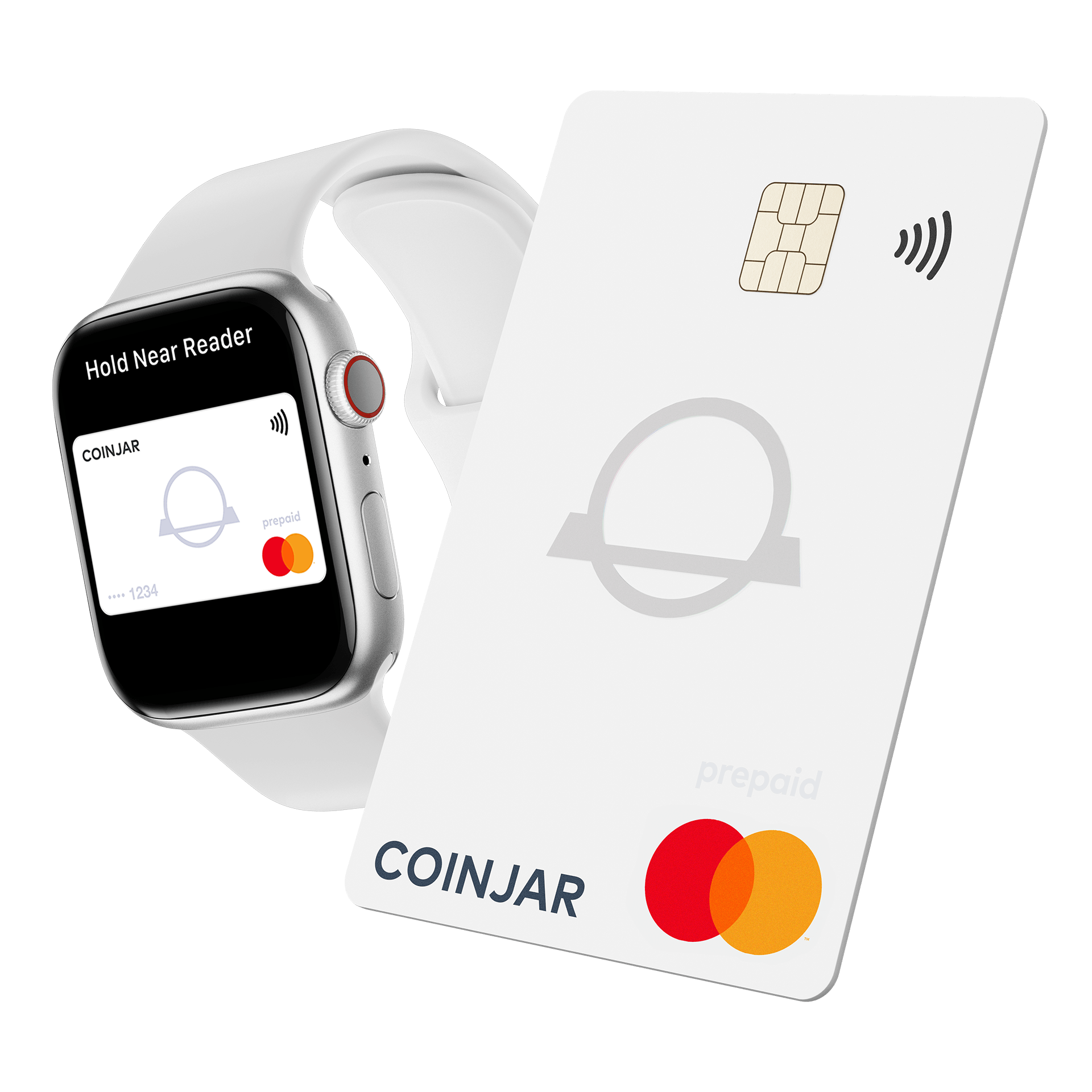
Use CoinJar Card, powered by Mastercard, for purchases online and in store, including through Apple Pay and Google Pay. No setup or monthly fee. A 1% purchase fee applies and is returned as CoinJar Rewards points, with one point earned per $1 spent. Available in Australia only.
Get your CoinJar Card for freeCoinJar Card
Use CoinJar Card, powered by Mastercard, for purchases online and in store, including through Apple Pay and Google Pay. No setup or monthly fee. A 1% purchase fee applies and is returned as CoinJar Rewards points, with one point earned per $1 spent. Available in Australia only.
Get your CoinJar Card for free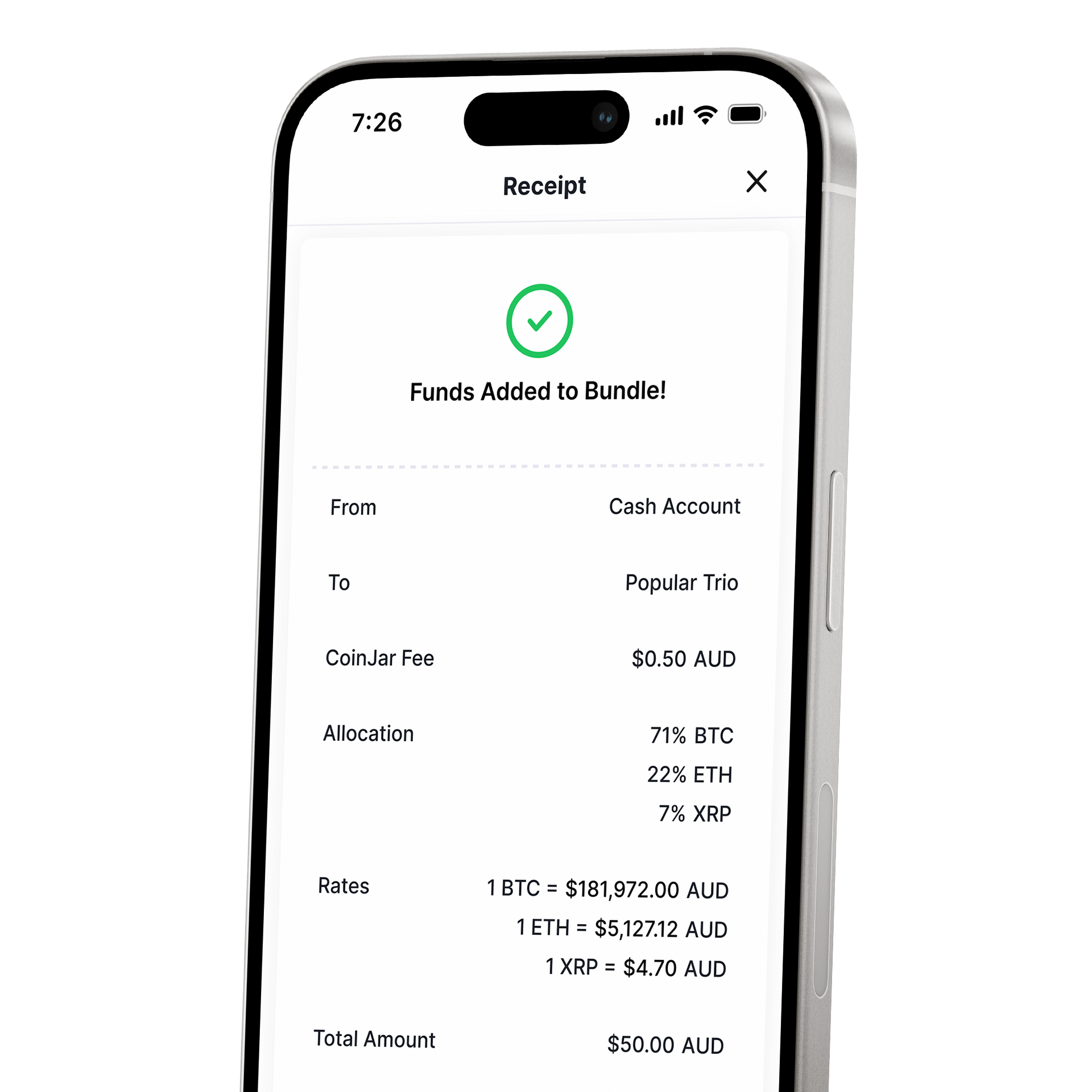
CoinJar Recurring Buy
Schedule automatic purchases weekly, fortnightly or monthly to dollar-cost average into individual cryptocurrencies or CoinJar Bundles. Manage your investment amount and schedule, with the flexibility to adjust or pause purchases as your circumstances change.
DCA with Recurring BuyCoinJar Recurring Buy
Schedule automatic purchases weekly, fortnightly or monthly to dollar-cost average into individual cryptocurrencies or CoinJar Bundles. Manage your investment amount and schedule, with the flexibility to adjust or pause purchases as your circumstances change.
DCA with Recurring Buy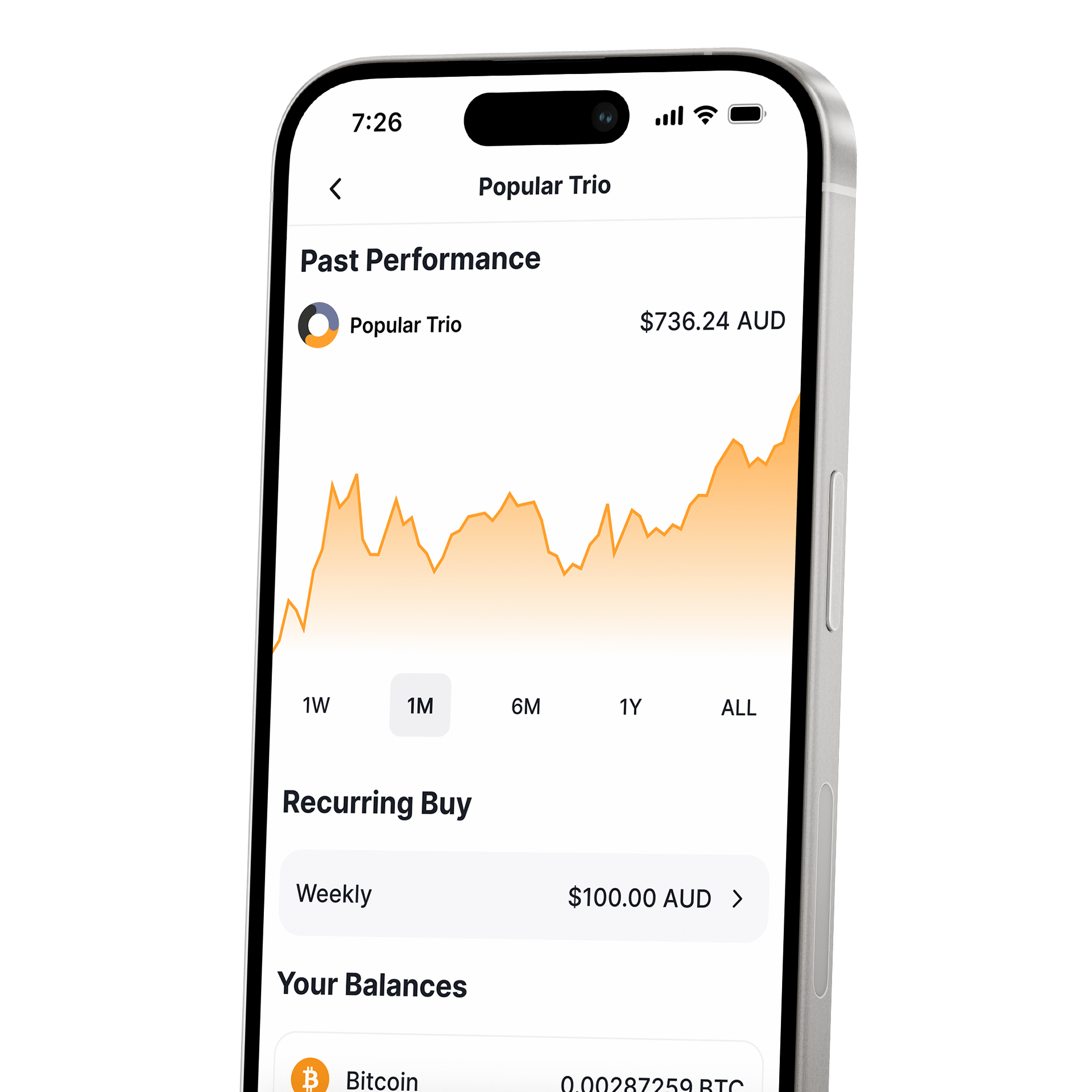
CoinJar Bundles
Pick your Bundle in the CoinJar app. Review each Bundle’s asset allocation, add to your holdings and rebalance when required. Sell your Bundle or unbundle it to manage the assets individually.
Learn moreCoinJar Bundles
Pick your Bundle in the CoinJar app. Review each Bundle’s asset allocation, add to your holdings and rebalance when required. Sell your Bundle or unbundle it to manage the assets individually.
Learn more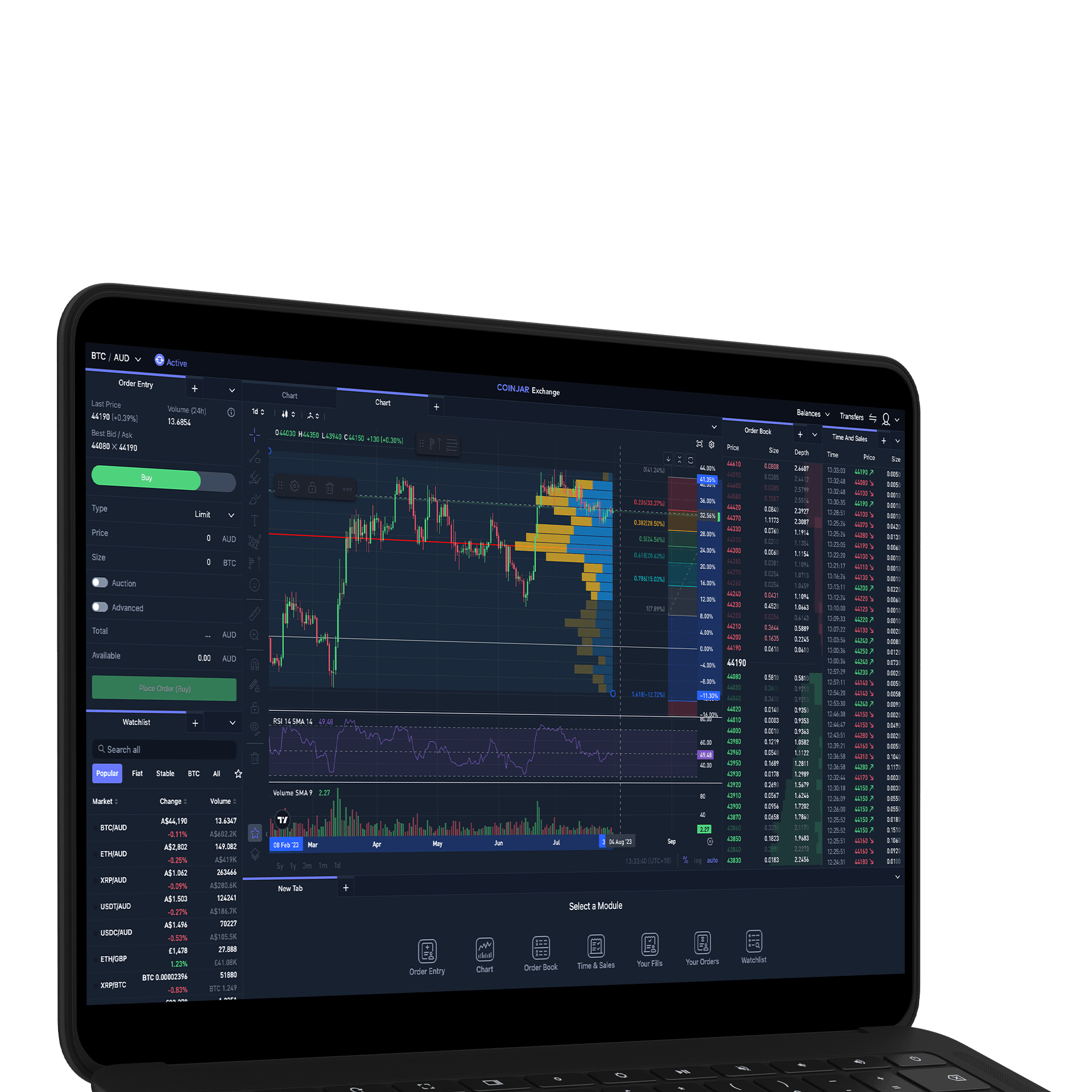
CoinJar Exchange
Trade with fees from 0-0.1%, using market, limit and stop-limit orders. Connect to TradingView to trade directly from your charts, or use CoinJar Exchange’s high-performance interface, built for active traders, market makers and institutions.
Explore CoinJar ExchangeCoinJar Exchange
Trade with fees from 0-0.1%, using market, limit and stop-limit orders. Connect to TradingView to trade directly from your charts, or use CoinJar Exchange’s high-performance interface, built for active traders, market makers and institutions.
Explore CoinJar Exchange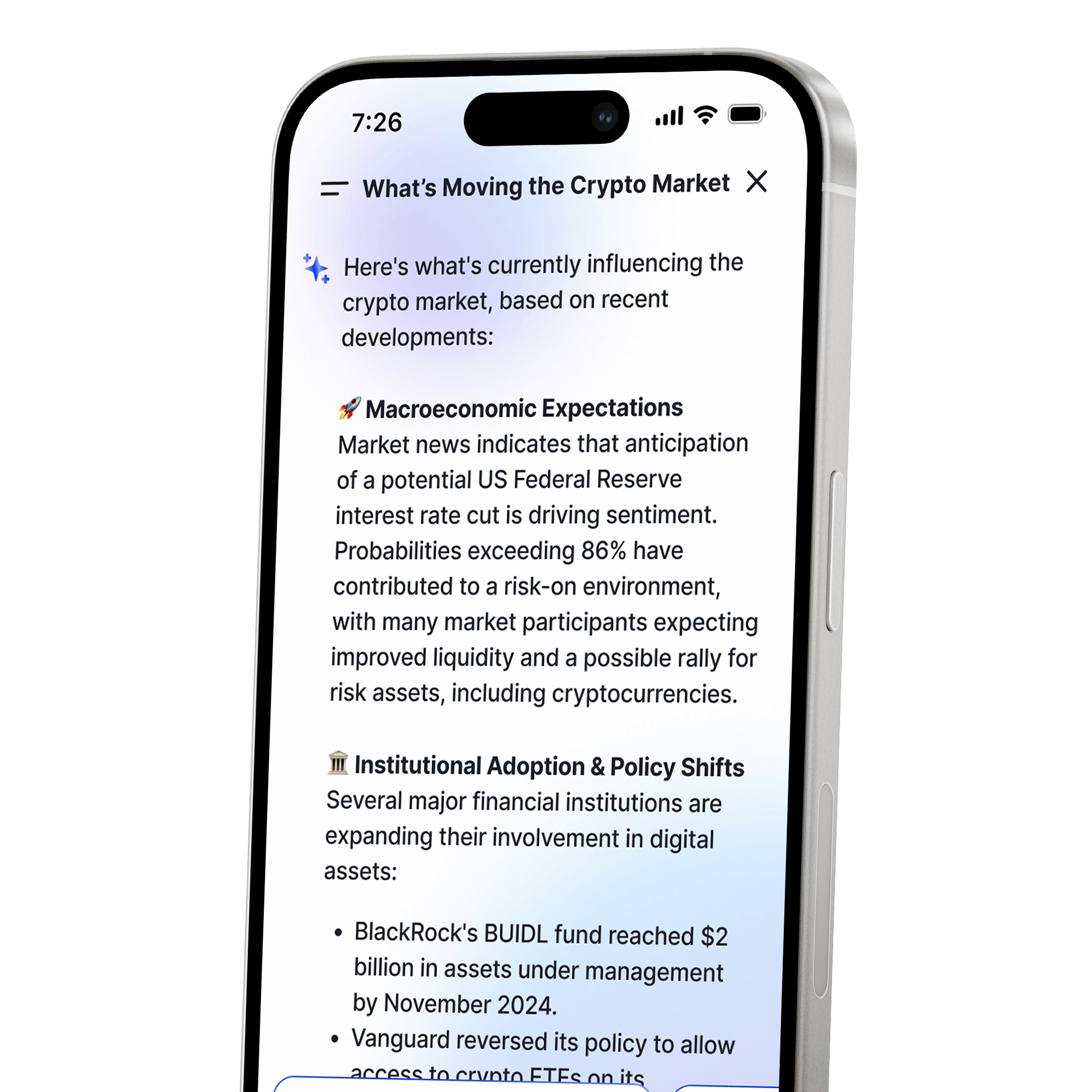
CoinJar AI
Access information about your holdings and the wider cryptocurrency market through CoinJar AI. Ask questions about portfolio changes, market developments or individual cryptocurrencies, with responses informed by your CoinJar holdings.
Learn moreCoinJar AI
Access information about your holdings and the wider cryptocurrency market through CoinJar AI. Ask questions about portfolio changes, market developments or individual cryptocurrencies, with responses informed by your CoinJar holdings.
Learn more
CoinJar OTC
For cryptocurrency trades above $50,000, CoinJar’s OTC desk provides personalised service and access to globally sourced liquidity. Work directly with a dedicated team to arrange and execute your purchase or sale. Discover OTC Services
Learn moreCoinJar OTC
For cryptocurrency trades above $50,000, CoinJar’s OTC desk provides personalised service and access to globally sourced liquidity. Work directly with a dedicated team to arrange and execute your purchase or sale. Discover OTC Services
Learn moreCoinJar does not endorse the content of, and cannot guarantee or verify the safety of any third-party websites. Visit these websites at your own risk.

CoinJar
Get the app.