

This week saw the biggest crypto heist in history. North Korean hackers stole around $6.3bn from Binance in roughly 20 minutes, knocking Bitcoin below $77,000 and wiping out more than $1.5bn in leveraged positions.
Add a split Fed and Bitcoin’s second losing October in a row, and it’s been a bruising week.
Here are the top stories you need to know:
Headlines of the week
- Bitcoin fell 3.4% on the week, sliding from a high of $81,890 on Thursday to a low of $76,141 on Friday after news of the Binance hack broke.
- US spot Bitcoin ETFs posted $202.4m in net outflows between 26th and 30th October, after a $643.2m exit on the 30th, the biggest single-day outflow since June. Ethereum ETFs lost $432m, their fifth straight week of outflows.
- Keystone is destroying 18,835 brand-new hardware wallets, after hackers stole the key it uses to prove its devices are genuine. Seed phrases weren’t exposed, but devices received after 20th October need extra checks before use.
- Bitwise raised its 2036 Bitcoin price target to $1.6m, up from $1.3m, implying 34% annualised returns. A bold call in a week when Bitcoin fell below $77,000.
- Galaxy says Bitcoin’s bear market ended in June, with one catch: a weekly close below $76,540 that isn’t recovered within a month would undo the call. Bitcoin dipped to $76,141 on Friday, which is cutting it fine.
The biggest crypto heist in history

On the afternoon of 29th October, hackers drained around $6.3bn from Binance in roughly 20 minutes, across 10 blockchains. That makes it the largest crypto theft on record, about four times the size of last year’s $1.5bn Bybit hack. Binance CEO Richard Teng said attackers got into the exchange’s hot wallet, and the breach has been linked to a compromised staff laptop.
On 31st October, the FBI confirmed North Korea was behind the attack, naming the TraderTraitor group, part of the wider Lazarus operation. The clean-up was unusually fast, though. Tether, Circle and others froze around $3bn of the stolen funds within hours, mostly stablecoins, while Binance paused withdrawals and pledged to cover every loss from its own funds.
By Sunday, Binance said 95% of user losses had been covered, and withdrawals began reopening network by network, starting with Bitcoin. It has also promised to publish a proof of reserves. Even so, the episode is an uncomfortable reminder that the world’s biggest exchange is only as secure as the laptops its staff use.
A split Fed keeps December in play

The Fed held rates at 3.75% to 4.00% on 28th October, as expected. But the vote was split 10 to 2, with Governor Lisa Cook and Cleveland Fed President Beth Hammack both wanting another hike, and Fed Chair Kevin Warsh said inflation remains elevated.
The data backed the hawks up. US GDP grew 3.4% in the third quarter, while September’s PCE inflation came in at 3.6%, with core at 3.1%. Dallas Fed President Lorie Logan said at least two more hikes are needed, and by Friday CME FedWatch put the chance of a December hike at around 76%.
For Bitcoin, it capped off a disappointing month. It closed October down about 7%, its second losing October in a row, in a month that has historically been one of its strongest.
Prediction markets save the quarter
Earnings season showed just how quiet crypto trading has been. Robinhood’s crypto revenue fell 55% year-on-year to $120m in the third quarter. Its event contracts business, which covers prediction markets, brought in $173m, more than six times what it made a year earlier, helping Robinhood to a record $1.42bn in total revenue.
Coinbase told a similar story. It posted a $719m profit for the quarter, but around $715m of that came from gains on the crypto it holds as an investment, leaving just $78m without them. Revenue came in at $1.22bn, down 35% on a year ago.
Both firms are leaning hard on prediction markets to fill the gap. Coinbase CFO Alesia Haas said they are “adding another revenue stream and are less correlated to crypto volatility”. In other words, when crypto trading goes quiet, the exchanges would like you to bet on something else instead.
Final takeaway: The biggest hack in crypto history put Binance and stablecoin issuers to the test, the Fed is edging towards a December hike, and prediction markets are carrying the exchanges.
Caleb for CoinJar
Hyperliquid: $76 Support Holds as Price Eyes the $100 Level
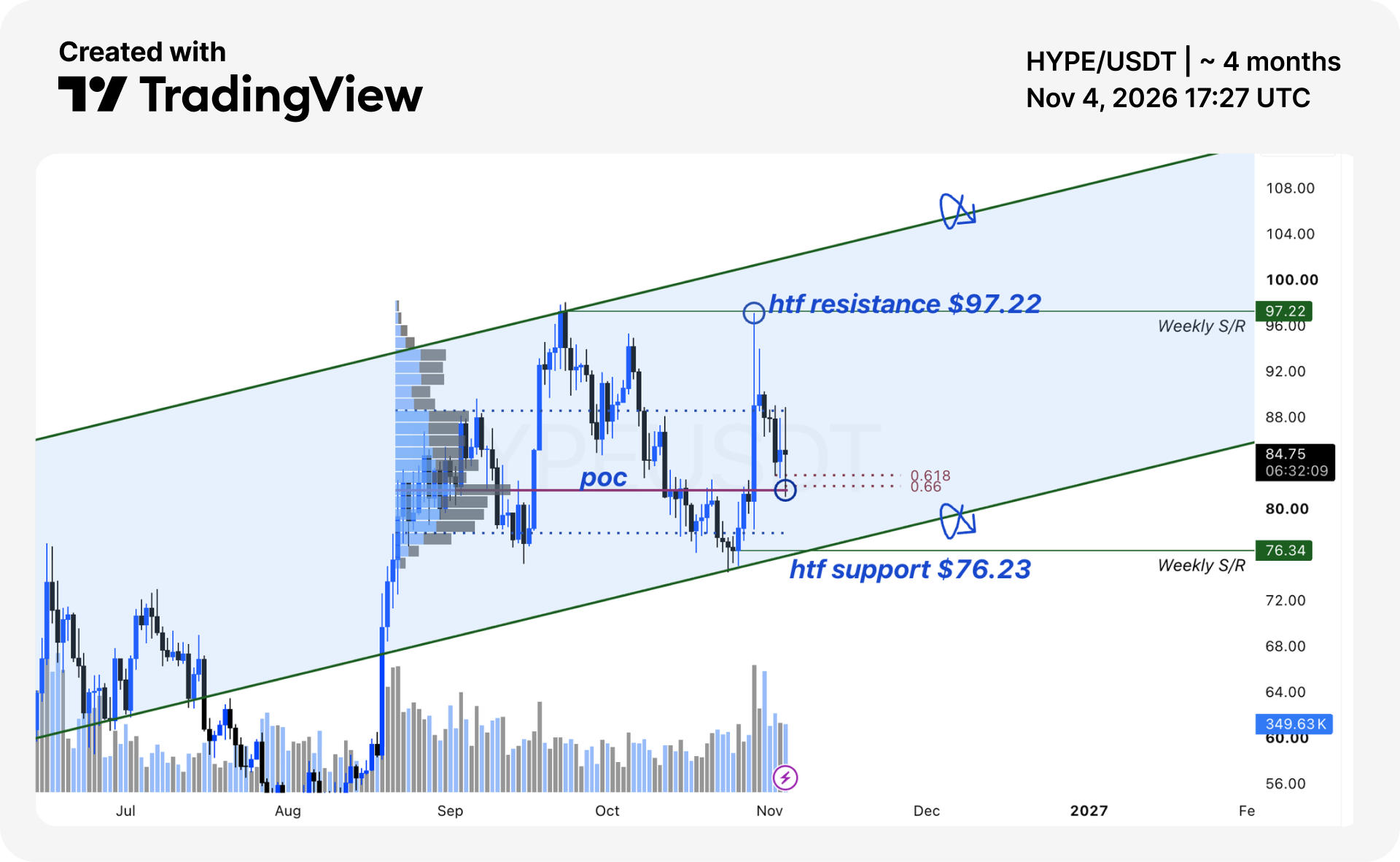
Hyperliquid has maintained a relatively impulsive price structure, although recent price action has encountered rejection from higher-timeframe resistance at $97.22. Following this rejection, buyers have shown interest around the Point of Control (POC), which sits in technical confluence with the 0.618 Fibonacci retracement. This confluence creates an important area of support that could influence the next directional move.
As long as price action continues to hold above $76.23, the possibility of further upside continuation remains in play. A sustained recovery from this region could bring higher-timeframe resistance back into focus, with the previous rejection zone at $97.22 acting as an initial level to reclaim. Beyond this, the upper boundary of the descending channel becomes another area of interest, sitting above the psychological $100 mark.
However, a failure to maintain support above $76.23 could weaken the current bullish structure and introduce the possibility of a deeper corrective move. Monitoring how price reacts around the POC and Fibonacci confluence will therefore be important in assessing whether buyers retain control.
For those looking to trade Hyperliquid, it is available to trade directly through TradingView via CoinJar and CoinJar Exchange, with access for users in Australia, the United States and the UK.
Aziz for CoinJar
Want more chart analysis? Follow CoinJar on TradingView for regular technical analysis from our team:
https://www.tradingview.com/broker/CoinJar/publications-ideas/
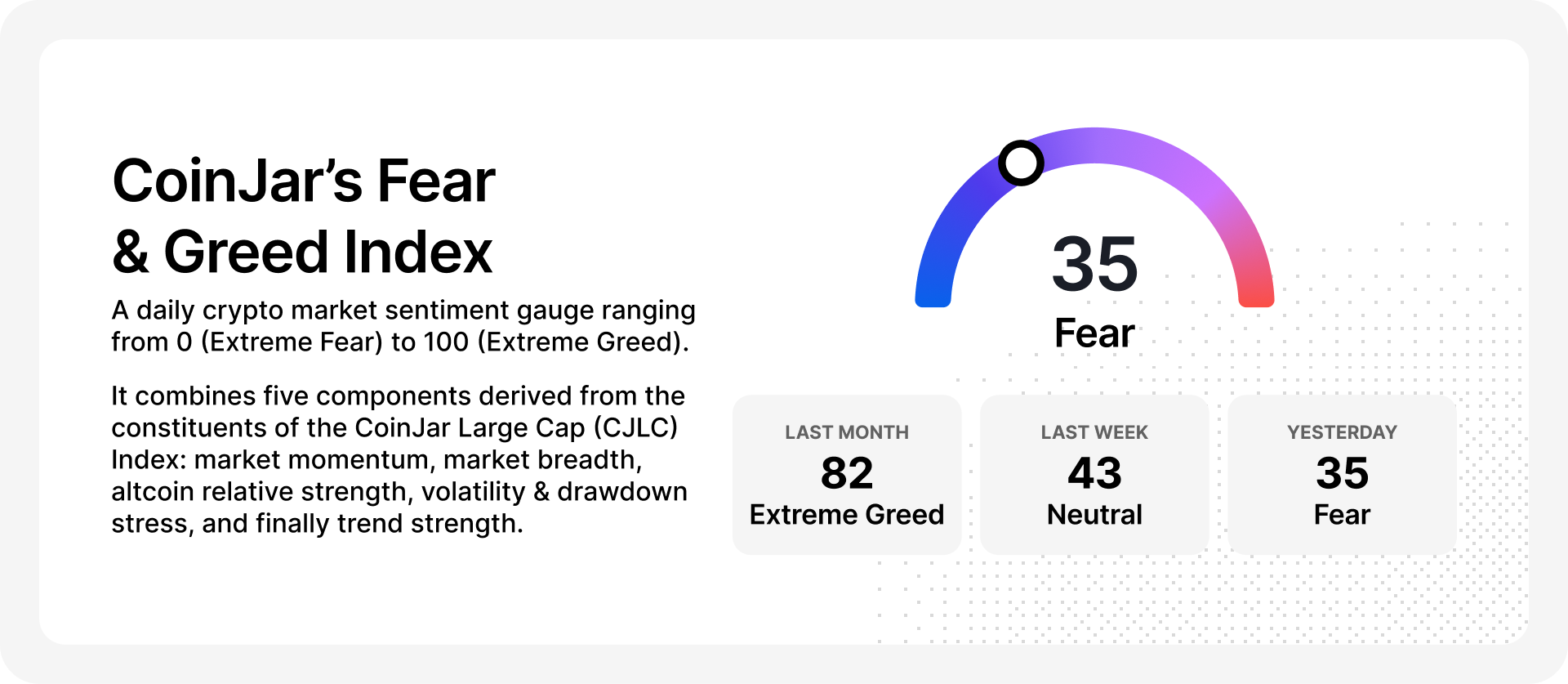
The latest Fear & Greed index from CoinJar
The above article is not to be read as investment, legal or tax advice and takes no account of particular personal or market circumstances; all readers should seek independent investment, legal and tax advice before investing in cryptocurrencies. This article is provided for general information and educational purposes only. No responsibility or liability is accepted for any errors of fact or omission expressed therein. CoinJar, Inc. makes no representation or warranty of any kind, express or implied, regarding the accuracy, validity, reliability, availability, or completeness of any such information. Past performance is not a reliable indicator of future results.