
Buy Aave
AAVEPast performance is not indicative of future results. All prices are sourced from CoinJar Indices.
What is Aave?
Aave is a decentralized lending protocol. It lets people deposit cryptocurrency to earn interest, or use their cryptocurrency as collateral to borrow other assets, without a bank or broker in the middle. AAVE is the token used to govern it.
It began as ETHLend in 2017, a peer to peer lending project founded by Stani Kulechov, and relaunched as Aave on Ethereum in January 2020. The name is Finnish for ghost. It now runs on Ethereum and a number of other networks compatible with the Ethereum Virtual Machine. Our guide to decentralized finance covers the wider category Aave belongs to, and our guide to centralized finance explains the model it was built as an alternative to.
How does lending on Aave work?
Aave does not match individual lenders to individual borrowers. Deposits go into shared pools, and borrowers draw from those pools. That is what makes it work at scale: you do not have to wait for a counterparty.
- Supplying. Deposit an asset and you receive an interest bearing token in return, which represents your position in the pool and increases as interest accrues. You can redeem it for the underlying asset.
- Borrowing. You must post collateral worth more than you borrow. How much you can borrow against a given asset is set per asset by governance, because volatile collateral supports less debt than stable collateral.
- Interest rates. Rates are not set by a committee. They move algorithmically with pool utilization, so the more of a pool that is borrowed, the more expensive borrowing becomes and the more suppliers earn.
- Liquidation. Every borrowing position has a health factor. If collateral falls in value or debt grows until that health factor drops below one, anyone can repay the debt and take the collateral at a discount. Liquidation is automatic, permissionless and mostly performed by bots.
Aave has been rebuilt several times. Aave V4 introduced a Hub and Spoke design: a Liquidity Hub holds the pooled assets and enforces system wide limits, while Spokes are the individual markets that connect to it, each with its own collateral types, risk settings and liquidation rules. Capital supplied through one Spoke becomes available to every Spoke on that Hub, which is intended to stop liquidity fragmenting across chains and asset types. Earlier V3 markets continue to operate alongside it. The official Aave documentation is the primary technical source.
One thing to correct, because it is still widely repeated: Aave used to offer a choice between stable and variable borrowing rates. Stable rate borrowing was disabled in November 2023 after a vulnerability was disclosed, and it has since been deprecated. Borrowing on Aave is variable rate.
What is a flash loan?
A flash loan is an uncollateralized loan that must be borrowed and repaid inside a single blockchain transaction. If it is not repaid, the entire transaction reverts as though it never happened, so the lender cannot be left short. Aave introduced the mechanism in 2020.
The legitimate uses are mostly professional: arbitraging a price difference between venues, swapping the collateral behind a loan without closing it, refinancing debt from one protocol to another, and funding liquidations.
They are also, fairly, a documented criticism of decentralized finance. Flash loans have been used as the funding tool in attacks on other protocols, typically by borrowing a large amount to distort a price feed within a single transaction. The loan itself is not the vulnerability, but it lowers the capital required to attempt one, and European regulators have noted the pattern.
What does the AAVE token do?
AAVE is a governance token. Holding it lets you vote on proposals that change the protocol, including which assets are listed, how much can be borrowed against each one, and how revenue is used. Holders can vote directly or delegate their voting power to someone who votes actively.
Governance has also approved using protocol revenue to buy AAVE on the open market, which is how value generated by the protocol is directed back toward the token rather than paid out as a dividend. The mechanics of that program are set by governance and have changed more than once, so the Aave governance forum is the place to see what is currently in force.
Buying AAVE is not the same as lending on Aave
This is the most common misunderstanding, and it is worth being direct about.
When you buy AAVE, you are buying a governance token. You are not depositing into a lending pool, you are not earning the protocol's lending interest, and you have not taken out a loan. AAVE held in a CoinJar account does not accrue interest from Aave's borrowers, because it is not supplied to the protocol.
Supplying assets to earn interest is a separate activity that happens on the protocol itself, through a self-custody wallet, and it carries its own risks including smart contract failure. Buying AAVE is exposure to the governance token of a lending protocol. It is not a deposit account and it is not a yield product.
What is GHO?
GHO is a stablecoin native to Aave, designed to track the US dollar and created by borrowing it against collateral in Aave markets rather than by a company holding cash reserves. Interest paid by GHO borrowers flows to the Aave treasury rather than to a private issuer, and its parameters are set by governance. Our guide to stablecoins explains how the different backing models compare.
What are the risks of holding AAVE?
- Smart contract risk. Aave is code holding a large amount of value. It is heavily audited and runs a bug bounty, but audits reduce risk rather than remove it.
- Oracle risk. Borrowing and liquidation depend on external price feeds. If a feed is wrong or manipulated, positions can be liquidated incorrectly or debt can go unbacked.
- Bad debt. If collateral cannot be sold fast enough during a liquidation, the protocol can be left with debt it cannot recover. This has happened.
- Governance risk. Voting power is concentrated among large holders and delegates. Decisions that change risk settings, revenue use or token mechanics are made by that process, not by you individually.
- Competition and dependence. Aave competes with other lending protocols, and its markets depend heavily on stablecoins as collateral. Problems in a major stablecoin would transmit into Aave.
- Regulatory attention. Decentralized lending is an active area of regulatory interest in multiple jurisdictions, and rule changes could affect how the protocol operates or who may access it.
- Volatility. AAVE is not a stablecoin. Its value moves sharply and can fall substantially.
- No federal protection. Digital assets held with CoinJar are not deposits and are not insured by the FDIC, and they are not protected by SIPC. If you lose value, there is no compensation scheme to fall back on.
Buying AAVE with US dollars on CoinJar
CoinJar has operated since 2013 and lists AAVE against US dollars, so you can buy, sell and hold it without converting through another cryptocurrency first. Current charges are on our fees page, and live US dollar rates are on our cryptocurrency prices page.
CoinJar, Inc. is registered with FinCEN as a money services business, NMLS ID 2492913, and holds money transmitter licenses in a growing number of states. Before you sign up, check whether CoinJar operates in your state.
How is AAVE taxed in the US?
The IRS generally treats AAVE as property. A taxable disposal can occur when you sell it for US dollars, exchange it for another digital asset or spend it.
The IRS explains these rules on its digital assets guidance page. Our guide to exporting your transaction history for tax purposes shows how to pull the records you will need. This is general information, not tax advice. Consider speaking to a qualified tax professional about your circumstances.
Bank transfer (ACH and wire), or crypto?
Buy Aave instantly with your bank account via ACH or deposit with wire transfer. Easily buy with ACH, wire cash to your account, or swap one cryptocurrency for another in a single click.


How to buy Aave with CoinJar
Start your cryptocurrency portfolio with CoinJar by following these simple steps.
Download the app
Get the CoinJar app on iOS or Android.
Create an account
Sign up and verify your ID – it only takes a couple of minutes.
Make a purchase
Buy Aave and more than 60 other cryptos using ACH or wire transfer.
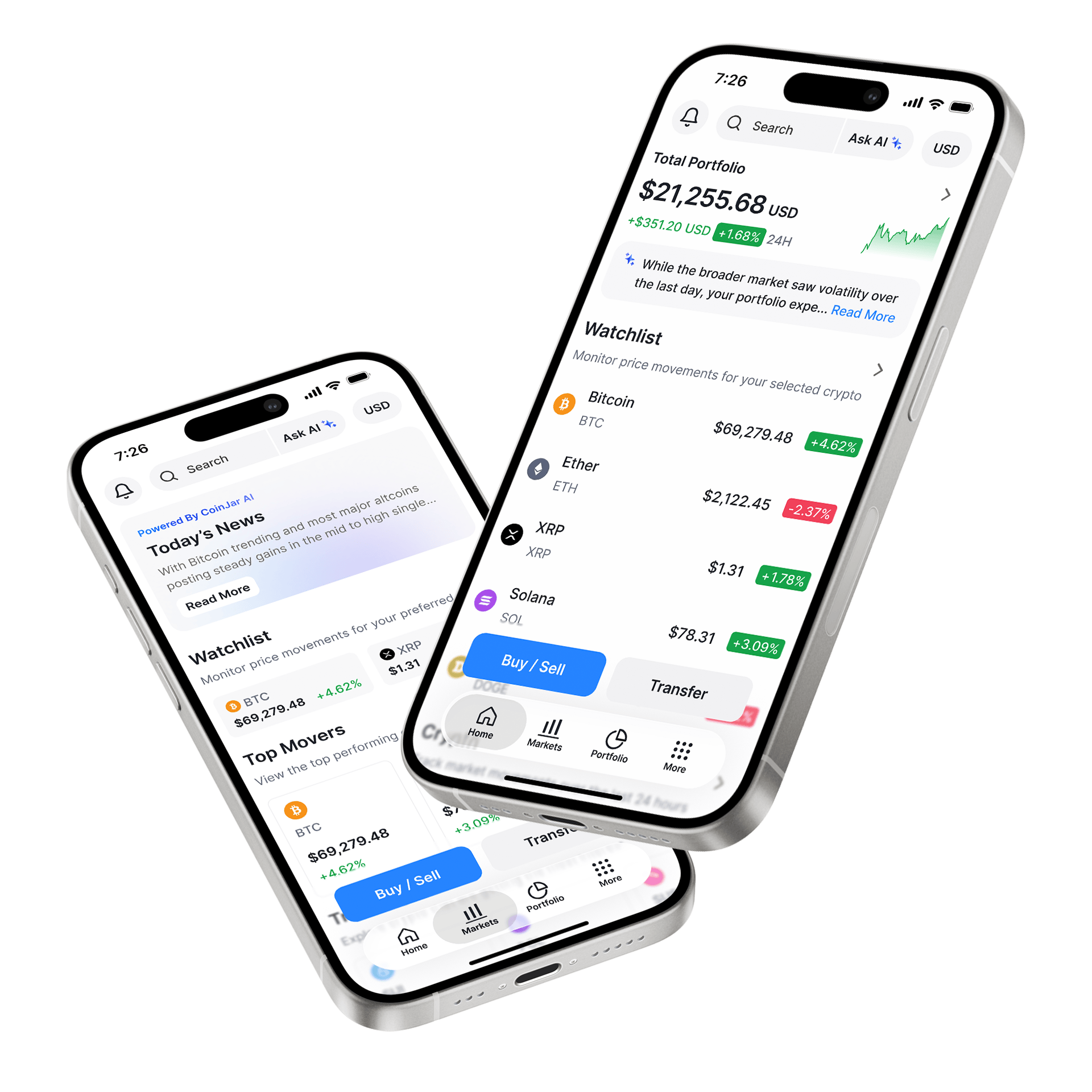
CoinJar App
Buy, sell and send your crypto with the favorite cryptocurrency app in the US.
Get the CoinJar appCoinJar App
Buy, sell and send your crypto with the favorite cryptocurrency app in the US.
Get the CoinJar app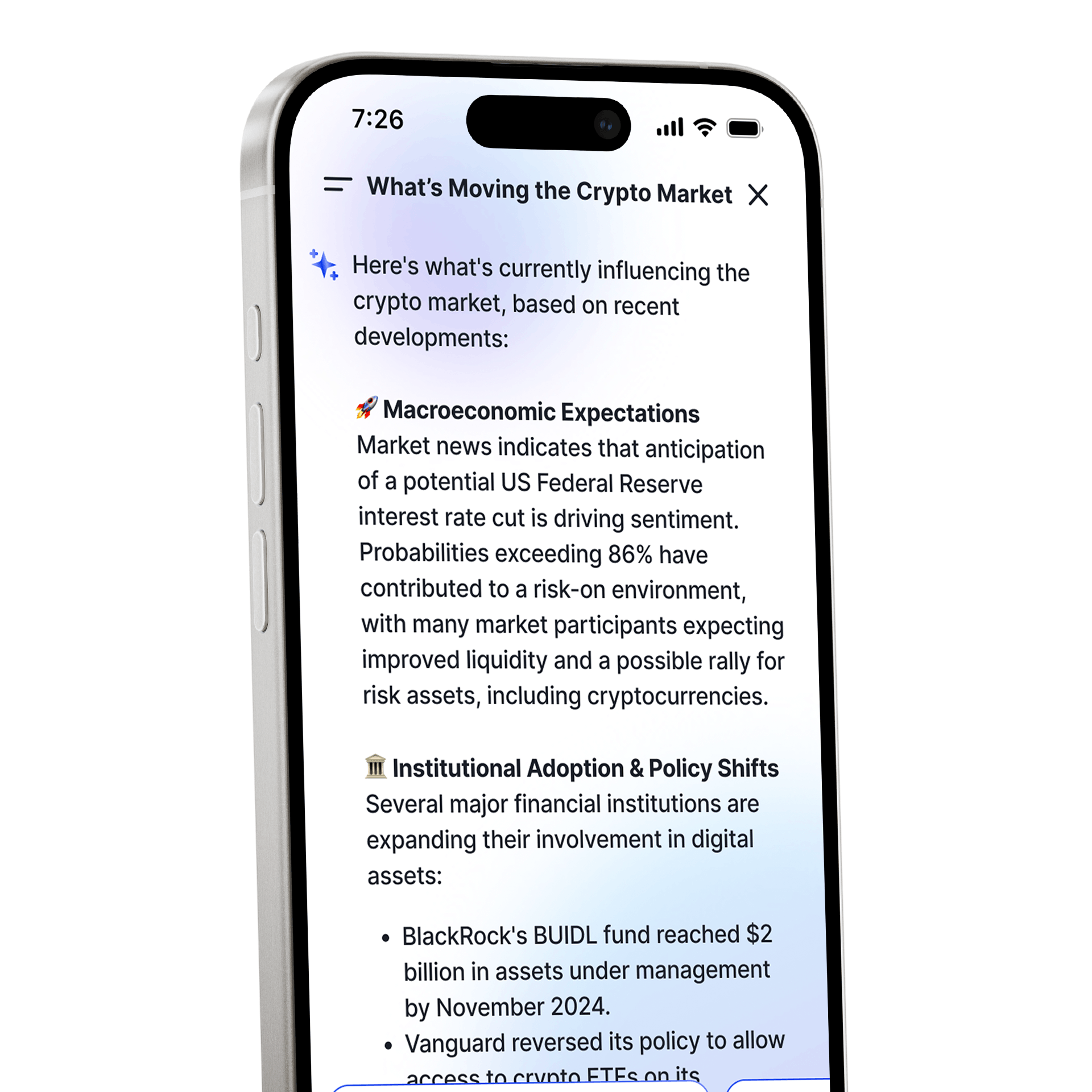
CoinJar AI
CoinJar AI understands your portfolio, tracks the market, and gives you insights that matter. Instead of searching for answers, simply ask a question to get the specific information you need.
Learn moreCoinJar AI
CoinJar AI understands your portfolio, tracks the market, and gives you insights that matter. Instead of searching for answers, simply ask a question to get the specific information you need.
Learn moreBuying, selling, and holding cryptocurrencies is subject to high market risk. The volatile and unpredictable nature of the price of cryptocurrencies may result in a significant loss. CoinJar, inc. is not responsible for any loss that you may incur from price fluctuations when you buy, sell, or hold cryptocurrencies. CoinJar, Inc. does not provide any investment, tax or legal advice; before making the decision to buy, sell or hold any cryptocurrencies, you should conduct your own due diligence and consult your financial, tax and/or legal advisor.
It is your responsibility to determine whether any investment, investment strategy or related transaction is appropriate for you according to your personal investment objectives, financial circumstances, and risk tolerance. Enter into a transaction only if you fully understand its nature, the contractual relationship into which you are entering, all relevant terms and conditions, and the nature and extent of your exposure to loss. Past performance is not a reliable indicator of future results. Geographic restrictions may apply. CoinJar does not endorse the content of, and cannot guarantee or verify the safety of any third party websites. Visit these websites at your own risk.

CoinJar
Get the app.