
Buy Stellar
XLMPast performance is not indicative of future results. All prices are sourced from CoinJar Indices.
What is Stellar?
Stellar is an open source blockchain network built to move money between currencies and across borders quickly and cheaply. It launched on July 31, 2014, and was co-founded by Jed McCaleb and Joyce Kim. The network is supported by the Stellar Development Foundation, a nonprofit organization that funds development and adoption. The protocol is open source and its validators include independent organizations.
Stellar and XLM are not the same thing. Stellar is the network. XLM, also called the lumen, is the network's native digital asset. You will often see the two blended together as "Stellar Lumens", which is a common shorthand rather than the official naming used in Stellar's own documentation.
What is XLM used for?
XLM has three jobs on the Stellar network, and none of them involve mining.
- Paying transaction fees. Every operation on Stellar costs a small fee paid in XLM. The protocol minimum is 0.00001 XLM, so fees are typically a tiny fraction of a cent.
- Meeting the minimum balance requirement. Every Stellar account must hold a small XLM balance, currently 1 XLM for a basic account, which rises slightly for each extra asset an account holds. This deposit exists to stop the ledger being flooded with junk accounts. The exact figure is set by validator vote and changes only rarely.
- Acting as a bridge asset. Stellar has a decentralized exchange built into the protocol. When two currencies have no direct market between them, a payment can be routed through XLM automatically, which is why lumens are described as a bridge between other assets.
How does Stellar reach agreement without mining?
Stellar uses the Stellar Consensus Protocol, a form of federated Byzantine agreement designed by Stanford computer scientist David Mazières. There is no mining, no proof of work and no staking.
Instead, each participating server chooses which other servers it trusts. Those trust relationships overlap into quorums, and the network votes in rounds until enough of it agrees on the next ledger. New ledgers close in roughly three to five seconds, and validators receive no block reward for taking part. You can read the technical description in Stellar's consensus documentation.
The trade-off is deliberate. The protocol is built to stop rather than split if it cannot reach agreement, which is what happened for around an hour in May 2019 when several validators went offline at once. No funds were lost and the chain did not fork, but it shows that availability depends on a healthy, well distributed validator set.
What are anchors and issued assets on Stellar?
Anchors are the regulated businesses that connect Stellar to the traditional financial system. An anchor accepts a deposit of ordinary money, issues a matching token on Stellar, and redeems that token for cash when someone wants to cash out.
Because anyone can issue an asset on Stellar, the network carries stablecoins and tokenized real world assets alongside XLM. USDC is issued natively on Stellar, and tokenized money market funds and payment pilots also run on it. If you hold one of these tokens rather than XLM itself, you are relying on the issuer to honor it, which is a counterparty risk that does not exist when holding a network's own asset. Our explainers on stablecoins and real world asset tokenization cover how these assets are structured.
What is Stellar used for in practice?
Stellar is designed for payments and asset issuance. Common uses include:
- Cross-border transfers and remittances. Payments settle in seconds for a fraction of a cent, which can make Stellar practical for smaller transfers where traditional wire fees would be disproportionate.
- Stablecoin payments. Businesses move regulated stablecoins on Stellar to settle between currencies without waiting for banking hours.
- Tokenized funds and assets. Asset managers have used Stellar to issue tokenized money market funds, and clearing and settlement firms have connected tokenization services to it.
- Aid disbursement. United Nations agencies have used Stellar to deliver cash assistance directly to recipients' digital wallets.
What is Soroban?
Soroban is Stellar's smart contract platform, which went live on the public network in February 2024. Contracts are written in Rust and compiled to WebAssembly, which lets developers build lending, exchange and tokenization applications directly on Stellar rather than bolting them on elsewhere.
Smart contracts add capability and risk at the same time. Code holding value can contain bugs, and a flaw in a contract can be exploited regardless of how sound the underlying network is.
How many XLM are there?
All 100 billion lumens were created when the network launched in 2014, so XLM was never mined. For the first five years supply grew by 1% a year through a protocol level inflation mechanism, which validators voted to remove in October 2019.
In November 2019 the Stellar Development Foundation permanently removed about 55 billion XLM by sending them to an address nobody can spend from. That leaves a total supply of roughly 50 billion lumens, and no new XLM can be created. Transaction fees are collected into a locked fee pool rather than paid to validators.
Total supply and circulating supply are different numbers. A large allocation is still held by the Stellar Development Foundation for ecosystem funding and enters circulation gradually, which is worth understanding before drawing conclusions from supply figures. Stellar publishes the current breakdown in its lumen documentation.
Stellar compared with XRP Ledger and Bitcoin
| Stellar | XRP Ledger | Bitcoin | |
|---|---|---|---|
| Native asset | XLM (lumen) | XRP | BTC |
| Launched | 2014 | 2012 | 2009 |
| Consensus | Stellar Consensus Protocol, federated agreement | Ripple consensus protocol, federated agreement | Proof of work mining |
| Typical settlement | Around 3 to 5 seconds | A few seconds | About 10 minutes per block |
| Supply | About 50 billion, fixed, created at launch | 100 billion, created at launch | 21 million maximum, released through mining |
| Common uses | Payments, issued assets and smart contracts | Payments, tokenization and trading | Peer-to-peer value transfer and settlement |
Stellar and XRP are often confused because Jed McCaleb co-founded Ripple before leaving to start Stellar, and early Stellar code came from Ripple's codebase. That code was replaced in 2015 when the Stellar Consensus Protocol was introduced, so the two networks are separate today. For background on how public blockchains differ, see our guide to what Bitcoin is.
Stellar on CoinJar in the US
CoinJar has operated since 2013 and lists XLM against US dollars, so you can buy, sell and hold lumens without converting through another cryptocurrency first. XLM also has a US dollar market on CoinJar Exchange. Current charges are on our fees page, and live US dollar rates are on our cryptocurrency prices page.
XLM sits alongside the rest of our supported cryptocurrency list.
Lumens held with CoinJar are kept within our custody infrastructure, which uses multisignature and multiparty computation technology so no single party can move assets on its own. You can read more about our controls on the CoinJar security page. You can also withdraw XLM to a compatible wallet you control.
CoinJar, Inc. is registered with FinCEN as a money services business, NMLS ID 2492913, and holds money transmitter licenses in a growing number of states. Registration and licensing are legal requirements, not government endorsement of CoinJar or Stellar. Availability varies by location, so check whether CoinJar operates in your state.
What should US customers consider before buying XLM?
XLM is a volatile asset and its price has fallen sharply in past market cycles. Consider the following before you buy:
- Price risk. Payment activity on Stellar does not necessarily create equivalent demand for XLM because transfers can use issued assets such as stablecoins instead of lumens.
- Validator concentration. Consensus depends on a relatively small set of trusted validators, and the 2019 halt showed the network stops when that set is disrupted.
- Issuer risk. Tokenized assets on Stellar are only as reliable as the anchor that issues them.
- Supply distribution. A significant share of lumens is still held by the Stellar Development Foundation and released over time.
- No FDIC or SIPC protection. XLM held through a cryptocurrency exchange is not a bank deposit and is not insured by the Federal Deposit Insurance Corporation. It is also not protected by the Securities Investor Protection Corporation.
How is Stellar taxed in the United States?
The IRS generally treats XLM as property for federal tax purposes. A taxable event can occur when you sell it for US dollars, exchange it for another cryptoasset or spend it on goods or services. A genuine gift is generally treated differently and does not usually create an income tax gain or loss for the giver, although separate gift tax reporting rules may apply.
The IRS explains these rules on its official digital assets page. This is general information, not tax advice. Consider speaking to a qualified tax professional about your circumstances.
Bank transfer (ACH and wire), or crypto?
Buy Stellar instantly with your bank account via ACH or deposit with wire transfer. Easily buy with ACH, wire cash to your account, or swap one cryptocurrency for another in a single click.


How to buy Stellar with CoinJar
Start your cryptocurrency portfolio with CoinJar by following these simple steps.
Download the app
Get the CoinJar app on iOS or Android.
Create an account
Sign up and verify your ID – it only takes a couple of minutes.
Make a purchase
Buy Stellar and more than 60 other cryptos using ACH or wire transfer.
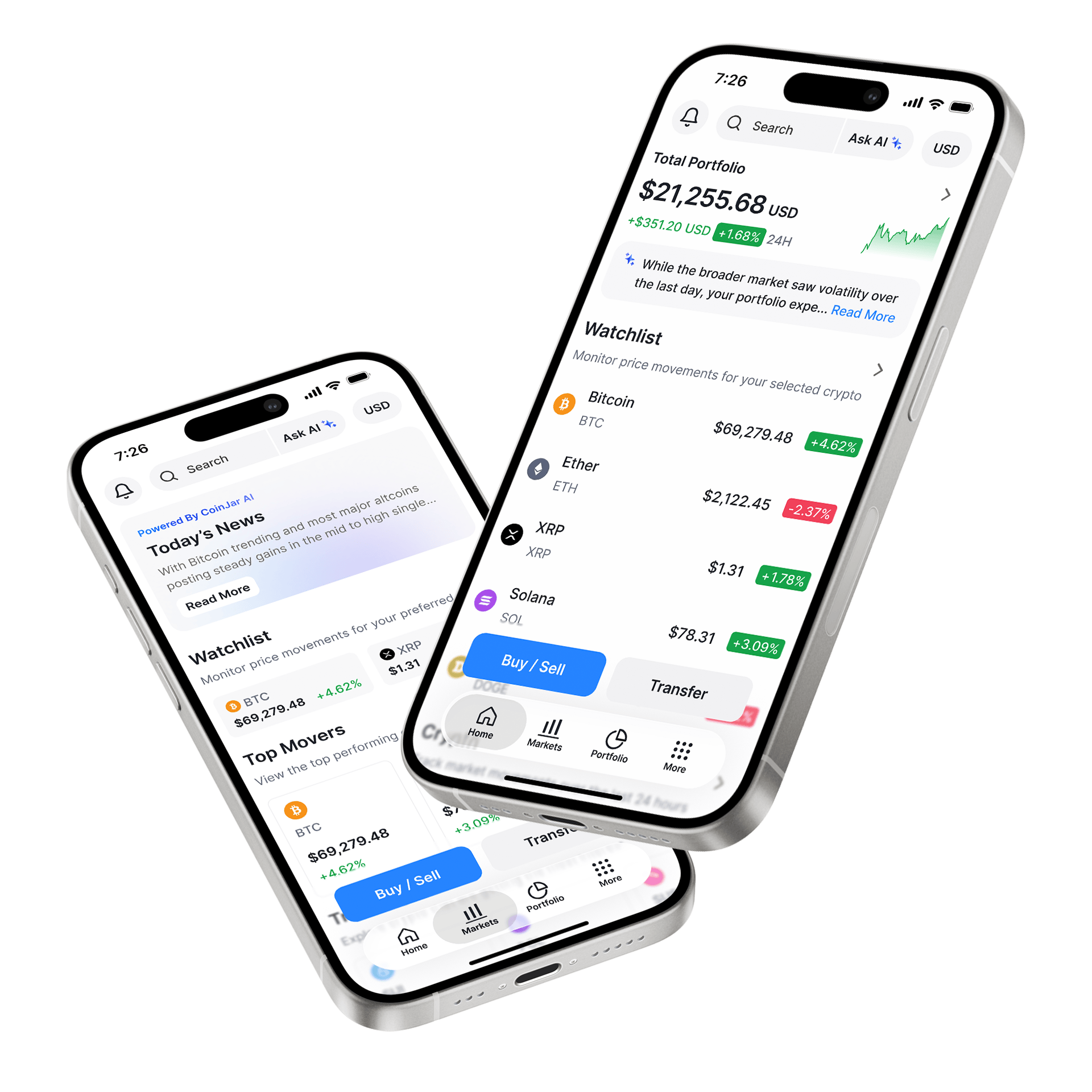
CoinJar App
Buy, sell and send your crypto with the favorite cryptocurrency app in the US.
Get the CoinJar appCoinJar App
Buy, sell and send your crypto with the favorite cryptocurrency app in the US.
Get the CoinJar app
CoinJar AI
CoinJar AI understands your portfolio, tracks the market, and gives you insights that matter. Instead of searching for answers, simply ask a question to get the specific information you need.
Learn moreCoinJar AI
CoinJar AI understands your portfolio, tracks the market, and gives you insights that matter. Instead of searching for answers, simply ask a question to get the specific information you need.
Learn moreBuying, selling, and holding cryptocurrencies is subject to high market risk. The volatile and unpredictable nature of the price of cryptocurrencies may result in a significant loss. CoinJar, inc. is not responsible for any loss that you may incur from price fluctuations when you buy, sell, or hold cryptocurrencies. CoinJar, Inc. does not provide any investment, tax or legal advice; before making the decision to buy, sell or hold any cryptocurrencies, you should conduct your own due diligence and consult your financial, tax and/or legal advisor.
It is your responsibility to determine whether any investment, investment strategy or related transaction is appropriate for you according to your personal investment objectives, financial circumstances, and risk tolerance. Enter into a transaction only if you fully understand its nature, the contractual relationship into which you are entering, all relevant terms and conditions, and the nature and extent of your exposure to loss. Past performance is not a reliable indicator of future results. Geographic restrictions may apply. CoinJar does not endorse the content of, and cannot guarantee or verify the safety of any third party websites. Visit these websites at your own risk.

CoinJar
Get the app.