
Buy 1inch
1INCHPast performance is not indicative of future results. All prices are sourced from CoinJar Indices.
What is 1inch?
1inch is a decentralized exchange aggregator. Rather than holding a pool of liquidity itself, it searches the exchanges that do, splits a trade across whichever combination gives the best result, and executes it. If you have ever swapped tokens inside a self custodial wallet and wondered where the price came from, there is a reasonable chance it came from 1inch.
1INCH is the network's governance and utility token. It is not a share in the business, and understanding the distance between the two is most of what a buyer needs. Our guide to decentralized finance covers the category, our guide to exchange liquidity explains the problem 1inch exists to solve, and our guide to altcoins explains where tokens like 1INCH sit relative to Bitcoin.
Where did 1inch come from?
1inch was built by Sergej Kunz and Anton Bukov at an ETHGlobal hackathon in New York in May 2019, over a couple of sleepless days. It grew quickly, because the problem it solved was real: liquidity in decentralized finance is scattered across dozens of venues, and finding the best route by hand is impractical.
The founding partnership has since broken up. 1inch says Bukov stopped contributing to the project from December 2025. Bukov's own account is that he was removed at the end of November 2025, retaining his co-founder title and half the shares but losing access to operations, product architecture and protocol security. He has since started a separate project. 1inch says the departure did not affect the network's operation, strategy or roadmap. Kunz remains, and the company has spent the period since reorganizing itself around selling infrastructure to other businesses rather than chasing retail users.
What does 1inch actually do?
Aggregation. The routing engine, Pathfinder, looks at available liquidity across venues, weighs price impact against gas costs, and splits an order across multiple pools and intermediate tokens where that produces a better outcome. You keep custody throughout. 1inch never holds your assets.
Limit orders. The Limit Order Protocol lets a user sign an order that sits off chain until someone chooses to fill it, with conditions attached, at no gas cost until it executes.
Fusion and intents. Fusion inverted the usual model. Instead of submitting a transaction, you sign a statement of what you want, and professional market makers called resolvers compete in a Dutch style auction to fill it. The resolver submits the transaction and covers the gas. That is where the description of Fusion swaps as gasless comes from, though it depends on the mode and the route.
Cross chain swaps. Fusion+ extends the same idea across networks using escrows, cryptographic conditions and timelocks, so a swap either completes on both sides or unwinds, without handing assets to a bridge operator. That is a better design than custodial bridging. It is not the absence of risk.
Infrastructure for other companies. The Swap API and the 1inch Business portal sell routing, execution, wallet and market data services to wallets, trading applications and institutions. This is now the company's main commercial focus and, on its own account, its main source of revenue.
The network operates across Ethereum and around a dozen other chains, including BNB Chain, Polygon, Arbitrum, Optimism, Base, Avalanche, Gnosis, Linea, Unichain, Sonic, zkSync Era and, since 2025, Solana. Our guide to blockchain layers explains how those networks relate to Ethereum.
What is Aqua?
Aqua is the product the team has been building toward, launched publicly on 28 July 2026 and described by 1inch as a shared liquidity layer.
The idea is that a liquidity provider no longer deposits assets into a pool and gives up control of them. Instead the assets stay in their own wallet, and the same balance can back several positions at once, with no lock up. If one position is used, the others adjust. The pitch is capital efficiency: the same money doing more than one job.
Whether it works commercially is unproven, and it is a meaningful change in what 1inch is. Aggregation is a service business. Running a liquidity layer means competing directly with the exchanges 1inch has spent six years routing orders to. The Aqua product page is the company's own description.
What does the 1INCH token do?
1INCH launched on 25 December 2020 with an airdrop to people who had used the protocol. Its maximum supply is 1.5 billion tokens, and the ability to create more was destroyed in April 2022, so the supply cannot be increased. The original vesting schedule for investors, contributors and the growth fund ran to the end of 2024 and is finished, which means there is no large scheduled unlock still to come.
What the token does:
Staking for Unicorn Power. You stake 1INCH and receive governance weight called Unicorn Power. The amount depends on how much you stake and for how long, and it decays as the term runs down, in the same general shape as other lock based systems. Governance. Unicorn Power votes on proposals, with a published threshold to submit one and a quorum required to pass. Resolver delegation. Unicorn Power can be delegated to Fusion resolvers rather than used for voting. A resolver needs a minimum share of delegated power to be eligible to fill orders, so resolvers compete for delegation and may offer incentives for it. This is the closest thing 1INCH has to a yield, and it comes from resolvers, not from the protocol.
What the token does not do is give you a claim on anything 1inch earns. There is no fee switch directing swap revenue to holders, no dividend and no contractual entitlement to the business's income. Reports of treasury purchases of 1INCH have circulated, but a standing, committed buyback program is not something a buyer should assume.
The gap between the business and the token
This is the honest center of the page.
1inch has a real business. It processes large volumes, it sells infrastructure to companies that would otherwise have to build routing themselves, and it says that business funds the operation. But the revenue from routing flows to the entities that operate the products, not to 1INCH holders. The token governs a DAO and a treasury, and it gates access to the resolver system. Those are genuine functions. They are not ownership of the cash flow.
Governance itself is thinly traded in practice. Voting power is concentrated among those willing to lock tokens for long periods, quorum requirements are high, and turnout on most proposals is modest. The governance forum is public, and reading a few threads is a faster way to understand how much control the token confers than any summary.
What has gone wrong before?
March 2025: the legacy resolver exploit. An obsolete version of the Fusion contracts, left deployed and still in use by a third party resolver, contained a flaw introduced during a code refactor. An attacker corrupted the data passed into the contract and drained roughly five million US dollars from that resolver. End user funds were not at risk. Most of the money was returned after negotiation, with the attacker keeping around ten percent as a self declared bounty. The code had been audited repeatedly and the flaw survived.
May 2026: the same resolver, again. TrustedVolumes, the market maker hit in 2025, was drained of roughly six million US dollars. Security firms attributed it to the same entity. 1inch said its own protocol had not been exploited. Resolvers are independent businesses, and their failures are not 1inch's failures, but they are part of the system users rely on.
October 2024: a compromised third party library. A widely used animation library was tampered with upstream and served malicious wallet prompts on sites that included it. The 1inch DAO later proposed compensating affected users out of the treasury, subject to identity checks and proof of loss. Nothing in the protocol was broken. The attack came in through the website.
1inch joined an industry whitehat safe harbor arrangement in August 2026, which makes it easier for security researchers to intervene during an active exploit.
What are the risks of holding 1INCH?
No claim on revenue. The token carries governance rights and resolver access, not a share of what the business earns. Value accrual is the open question. 1inch's commercial pivot is toward selling infrastructure to companies. It is not obvious how a successful version of that business makes 1INCH more valuable. Key person and structure risk. A co-founder's departure is disputed in public, the operating entities are private companies in offshore jurisdictions, and the DAO and the companies are not the same thing. Aggregation is a competitive, low margin business. Other aggregators, wallet native routing and exchange owned routers all compete for the same order flow, and switching costs for integrators are low. Resolver dependence. Fusion and Fusion+ rely on professional market makers choosing to fill your order. Auctions can expire unfilled, and resolvers have proven to be a point of failure. Legacy code risk, demonstrated. Deprecated contracts left on chain caused a real loss despite repeated audits. Third party and front end risk. The most damaging incident for ordinary users came through a compromised software dependency, not the protocol. Cross chain risk. Atomic settlement reduces bridge custody risk. It does not remove smart contract, timelock, liquidity or resolver risk. Governance concentration and low turnout. High quorums and long lock requirements mean a small group of committed holders decides most outcomes. Regulatory uncertainty. The network restricts access from sanctioned jurisdictions, and rules for decentralized trading are unsettled in most major markets. Volatility. 1INCH is not a stablecoin. Its value moves sharply and can fall substantially. No consumer protection. Crypto assets held on a trading platform are not bank deposits. 1INCH is not covered by FDIC deposit insurance or by SIPC protection. You should be prepared to lose the money you put in.
Buying 1INCH with US dollars on CoinJar
CoinJar has operated since 2013 and lists 1INCH against US dollars, so you can buy, sell and hold it without converting through another cryptocurrency first. Current charges are on our fees page, and live US dollar rates are on our cryptocurrency prices page.
CoinJar, Inc. is registered with FinCEN as a money services business, NMLS ID 2492913, and holds money transmitter licenses in a growing number of states. You can check whether CoinJar operates in your state before signing up.
How is 1INCH taxed in the United States?
The IRS treats digital assets such as 1INCH as property. A taxable disposal can occur when you sell it for US dollars, trade it for another cryptocurrency, spend it or give it away.
The IRS sets out its approach on its digital assets page. Our guide to reporting your transaction history explains how to get the records you need. This is general information, not tax advice. Consider speaking to a qualified tax adviser about your circumstances.
Bank transfer (ACH and wire), or crypto?
Buy 1inch instantly with your bank account via ACH or deposit with wire transfer. Easily buy with ACH, wire cash to your account, or swap one cryptocurrency for another in a single click.


How to buy 1inch with CoinJar
Start your cryptocurrency portfolio with CoinJar by following these simple steps.
Download the app
Get the CoinJar app on iOS or Android.
Create an account
Sign up and verify your ID – it only takes a couple of minutes.
Make a purchase
Buy 1inch and more than 60 other cryptos using ACH or wire transfer.
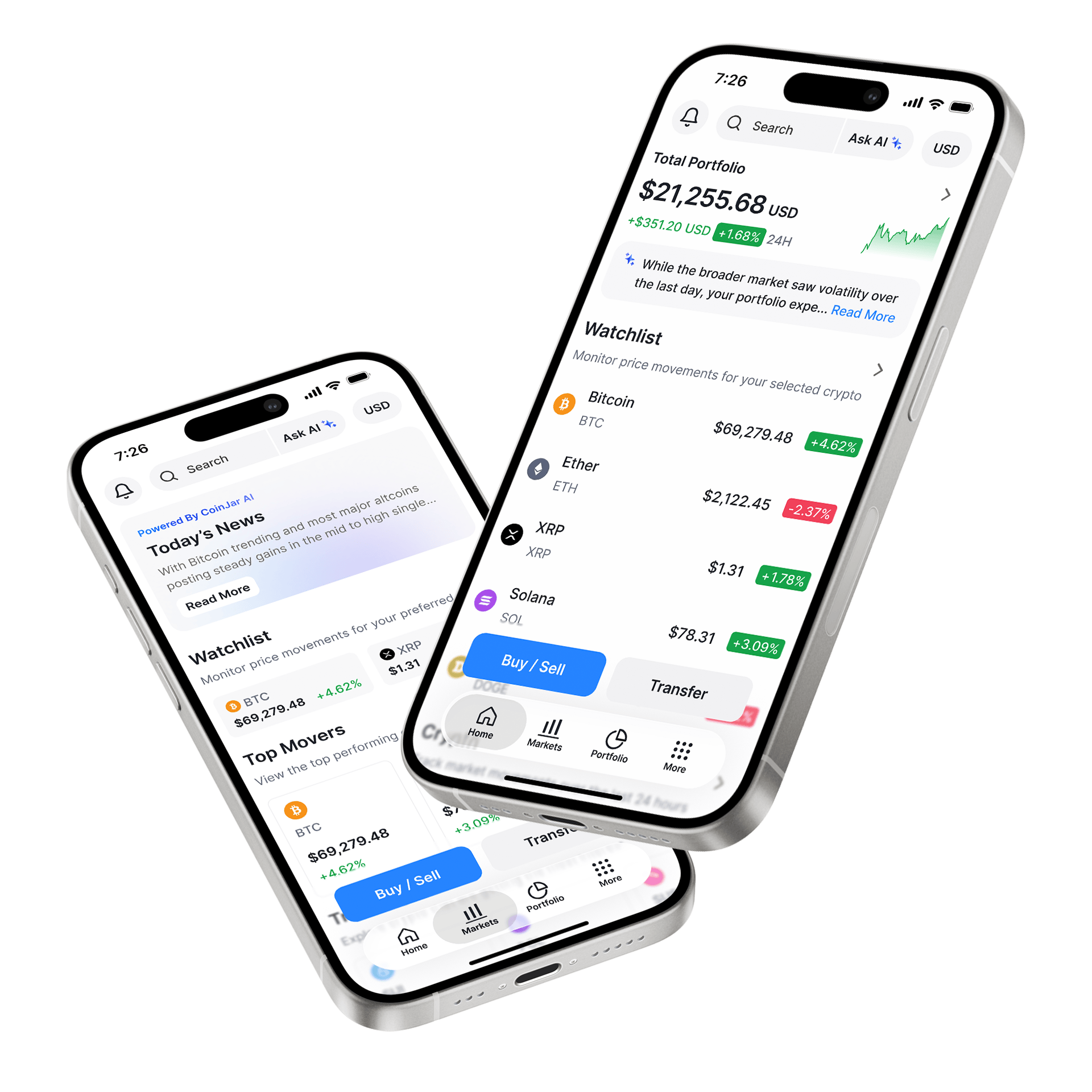
CoinJar App
Buy, sell and send your crypto with the favorite cryptocurrency app in the US.
Get the CoinJar appCoinJar App
Buy, sell and send your crypto with the favorite cryptocurrency app in the US.
Get the CoinJar app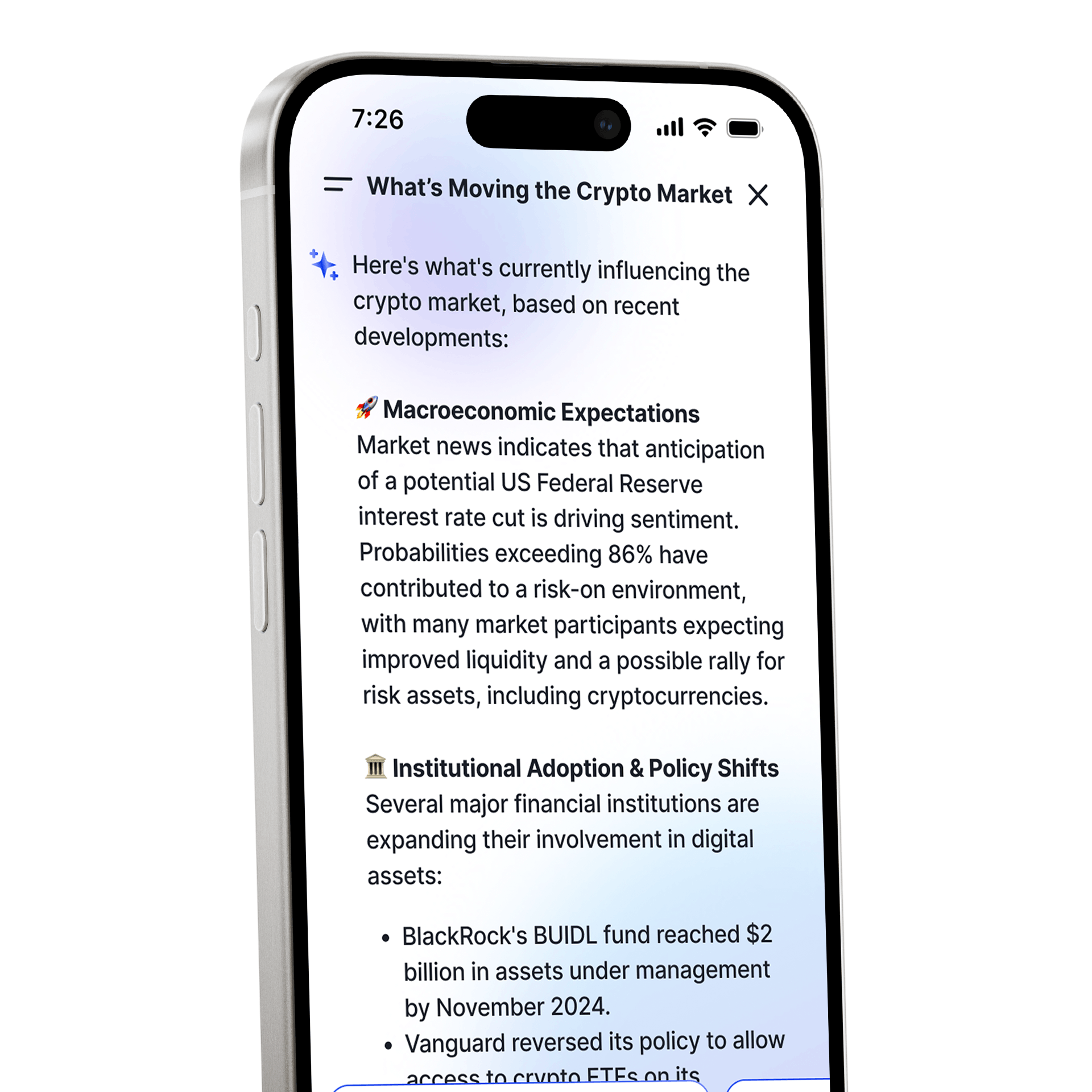
CoinJar AI
CoinJar AI understands your portfolio, tracks the market, and gives you insights that matter. Instead of searching for answers, simply ask a question to get the specific information you need.
Learn moreCoinJar AI
CoinJar AI understands your portfolio, tracks the market, and gives you insights that matter. Instead of searching for answers, simply ask a question to get the specific information you need.
Learn moreBuying, selling, and holding cryptocurrencies is subject to high market risk. The volatile and unpredictable nature of the price of cryptocurrencies may result in a significant loss. CoinJar, inc. is not responsible for any loss that you may incur from price fluctuations when you buy, sell, or hold cryptocurrencies. CoinJar, Inc. does not provide any investment, tax or legal advice; before making the decision to buy, sell or hold any cryptocurrencies, you should conduct your own due diligence and consult your financial, tax and/or legal advisor.
It is your responsibility to determine whether any investment, investment strategy or related transaction is appropriate for you according to your personal investment objectives, financial circumstances, and risk tolerance. Enter into a transaction only if you fully understand its nature, the contractual relationship into which you are entering, all relevant terms and conditions, and the nature and extent of your exposure to loss. Past performance is not a reliable indicator of future results. Geographic restrictions may apply. CoinJar does not endorse the content of, and cannot guarantee or verify the safety of any third party websites. Visit these websites at your own risk.

CoinJar
Get the app.