
Buy yearn.finance
YFIPast performance is not indicative of future results. All prices are sourced from CoinJar Indices.
What is yearn.finance?
Yearn.finance is a collection of decentralized finance vaults. A user deposits a crypto asset into a vault, receives shares in return, and the vault allocates the asset to one or more strategies intended to earn a return. YFI is Yearn's governance and revenue-participation token. It is not a vault share and is not required to deposit into Yearn.
The simple description hides an important risk. Yearn V3 is permissionless infrastructure, so anyone can deploy a vault using its code. A contract built with Yearn technology is not automatically selected, reviewed or guaranteed by Yearn. Buyers of YFI and users of a vault need to distinguish the protocol, the official registry and a third party's strategy. Our guide to decentralized finance explains the wider category, and our guide to Ethereum covers the network YFI was issued on.
Where did Yearn come from?
Developer Andre Cronje launched the system that became Yearn in July 2020. He had been moving his own stablecoins between lending markets to find better rates and automated the process into a product other people could use.
YFI became famous for what was described as a fair launch. There was no sale to investors and no founder allocation. Thirty thousand tokens were distributed to people providing liquidity to Yearn pools, and Cronje said the token had no financial value even as the market assigned one.
The original cap did not survive. In 2021 governance approved minting another 6,666 YFI, partly for contributor vesting and partly for the treasury, taking the full minted supply to 36,666. No further inflation schedule is currently operating.
Cronje handed control to the community early and is not the person running Yearn in 2026. He went on to build other protocols, and Yearn is maintained by contributors working through its DAO and funded structures.
How Yearn V3 vaults work
Yearn V3 separates vaults from the strategies that do the work.
Allocator vaults. A user deposits an asset and receives ERC-4626 shares representing a proportional claim on the vault. The allocator can spread capital across several approved strategies. Tokenized strategies. A strategy can operate as its own ERC-4626 vault or be plugged into a larger allocator vault. It might lend an asset, provide liquidity or use another decentralized protocol. Accounting. The share value rises or falls according to the assets and liabilities reported by the strategies, after fees. Withdrawals. A withdrawal can require strategies to return liquidity. Users or integrations can specify a maximum acceptable loss, and the transaction may fail if the required assets cannot be recovered within that limit.
A vault does not promise a fixed yield or principal protection. If a strategy is exploited, liquidated, badly managed or unable to sell an asset at its recorded value, the price of the vault shares can fall.
V3 is Yearn's current architecture. The Yearn V3 documentation describes it as modular infrastructure that anyone can build on.
What does permissionless mean here?
Yearn publishes factory contracts that allow anyone to deploy a vault or strategy. That openness makes integration easier but creates a naming problem: a third party can truthfully say its product uses Yearn V3 code without Yearn's DAO having approved its settings or management.
An endorsed vault appears in Yearn's registry and may be surfaced through official interfaces. A permissionless deployment outside that registry may have different administrators, strategies, fees, withdrawal rules and emergency controls.
The distinction became especially important on 24 August 2026, when Term Finance suffered an estimated 8.5 million US dollar loss involving its Meta Vaults. Those contracts used Yearn V3 architecture, but Yearn said the issue involved Term's custom governance and wrapper contracts rather than standard Yearn V3 vaults. Term permanently stopped deposits into the affected product.
Shared code does not mean shared control. Before using any vault, the exact address, operator, registry status and strategy contracts matter more than the label.
Are Yearn V1 and V2 still operating?
V1 belongs to the protocol's early history and should be treated as obsolete.
V2 vaults remain onchain and some are still used, particularly for older liquidity positions. They are legacy infrastructure rather than the direction of new development. V2 predates the ERC-4626 vault standard and is less modular than V3.
A legacy vault is not automatically unsafe, but it may receive less development attention and can depend on strategies or external protocols whose economics have changed. Users should not assume an old Yearn page describes the current preferred product.
The same warning applies to older governance terms. veYFI and dYFI have been deprecated and replaced by the newer stYFI system.
What happened to yETH?
yETH was a separate, self-governing basket of Ethereum liquid staking tokens. It was not a standard Yearn V2 or V3 vault, and its launch documents deliberately separated its governance and risk from ordinary YFI governance.
On 1 December 2025 an arithmetic flaw in the yETH weighted pool allowed an attacker to deposit a tiny amount and mint an effectively unlimited quantity of yETH. The attacker drained approximately 9 million US dollars from associated Balancer and Curve pools.
Yearn's incident disclosure said its V2 and V3 vaults were not affected. Governance later considered an optimistic recovery plan for affected users, but the incident remains a direct example of Yearn-branded experimental code failing catastrophically.
The distinction between products matters for diagnosis, not for dismissing the event. A user saw Yearn branding, a contract failed, and funds were lost. It shows why each product's contracts and governance must be assessed separately.
What does YFI do in 2026?
YFI has two current functions.
Governance. Staked YFI provides voting power over Yearn proposals, treasury decisions and protocol direction.
Revenue participation. The current stYFI system is designed to direct a share of Yearn protocol revenue to aligned YFI stakers. A more passive route, stYFIx, delegates voting while retaining exposure to the system.
The system includes a 14-day linear cooldown for unstaking and withdrawal. Revenue is variable, depends on actual protocol income and can be changed by governance. It is not a dividend and does not create ownership of Yearn.
Simply holding YFI in a wallet earns nothing. A person must interact with the governance staking contracts and accept contract, cooldown and governance risks.
Is YFI required to use Yearn?
No. A vault user deposits the asset the vault accepts, such as a stablecoin, wrapped ETH or a liquidity token. They receive that vault's shares, not YFI.
YFI is the coordination token for governance and revenue participation. Yearn can attract deposits and earn fees without any depositor buying it.
The link to token value is therefore indirect. Protocol revenue can be directed to stakers under governance-approved rules, but vault usage does not create an automatic purchase of YFI for every deposit.
There is no current token migration, replacement ticker or active plan to mint beyond the 36,666 already created. Older tokenomics involving buyback-and-build, veYFI gauges and dYFI should not be presented as the live design.
Who controls Yearn?
Yearn governance works through Yearn Improvement Proposals, known as YIPs. YFI voters approve major changes, budgets and governance arrangements.
Daily operations are more concentrated. Multisignature wallets, guardians, vault managers, strategists and contributors can hold specific powers over registries, endorsed vaults, strategies and emergency actions. The exact control structure differs by vault.
Yearn's 2025 governance overhaul reduced costs and reorganized contributors around a leaner model. It also introduced stYFI to replace veYFI. That was a restructuring intended to focus on revenue and accountability, not a shutdown.
Permissionless deployments sit outside much of this structure. Their creators may retain administrative rights that Yearn governance cannot exercise. Reading the vault address and permissions is therefore essential.
Security history
Yearn has survived several material incidents.
April 2023. A flaw in a legacy iEarn contract was used to mint excessive yUSDT and drain roughly 11.6 million US dollars from connected liquidity. Current Yearn V2 and V3 vaults were not the affected contract.
September 2023. A configuration error during work on yETH caused an unintended movement of treasury-owned liquidity. Yearn said customer funds were not affected, but the treasury incurred a loss.
December 2025. The yETH weighted-pool exploit caused approximately 9 million US dollars in losses across associated pools. It did not compromise standard V2 or V3 vaults.
August 2026. Term Finance's custom Meta Vaults, built using Yearn V3 architecture, were exploited through Term's governance and wrapper design. Yearn's standard vaults were not reported as affected.
These distinctions prevent one incident being falsely attributed to every vault, but they also show the layered risk. A Yearn position can depend on Yearn code, a strategy, an external protocol, governance permissions, price feeds and market liquidity at the same time.
Regulatory position
I found no current enforcement action naming Yearn or YFI as the issuer of an unlawful asset in the sources reviewed for this page.
YFI was not among the crypto assets named as digital commodities in the joint interpretation published by the United States Securities and Exchange Commission and Commodity Futures Trading Commission on 17 March 2026. That is not a finding against YFI. It means the asset was not addressed either way.
Vaults can interact with lending, derivatives and tokenized financial products that have their own regulatory risks. A change affecting an underlying protocol can reduce a strategy's viability even when Yearn itself is not targeted.
What are the risks of holding YFI?
Indirect value capture. Vault users do not need YFI. The token benefits only through governance-approved revenue mechanisms and demand for voting or staking. Revenue variability. stYFI returns depend on protocol income, expenses and governance. They can fall or be redirected. Smart contract risk. YFI staking, vaults and strategies rely on contracts that can contain defects or be misconfigured. Permissionless deployment risk. Anyone can build with Yearn V3. A third-party vault may use the brand or architecture without Yearn endorsement. Strategy risk. A vault can lose money through lending defaults, liquidation, impermanent loss, oracle failure or an exploit in an external protocol. Governance and key-person risk. Day-to-day control depends on contributors, managers, guardians and multisignature signers. Token voting does not perform every operational task. Security history. Legacy iEarn, yETH and related products have suffered serious failures. Separating products does not reimburse losses. Low supply concentration. Only 36,666 YFI exist, and treasury or large-holder decisions can have an outsized market and governance effect. Competition. Yearn competes with Morpho vaults, Beefy, Enzyme, direct lending positions and products built by major DeFi protocols. Liquidity. YFI trades thinly compared with major assets, which can widen spreads and increase the cost of getting out. Volatility. YFI is not a stablecoin. Its value moves sharply and can fall substantially. No consumer protection. Crypto assets held on a trading platform are not bank deposits. YFI is not covered by FDIC deposit insurance or by SIPC protection. You should be prepared to lose the money you put in.
Buying YFI with US dollars on CoinJar
CoinJar has operated since 2013 and lists YFI against US dollars, so you can buy, sell and hold it without converting through another cryptocurrency first. Current charges are on our fees page, and live US dollar rates are on our cryptocurrency prices page.
CoinJar, Inc. is registered with FinCEN as a money services business, NMLS ID 2492913, and holds money transmitter licenses in a growing number of states. You can check whether CoinJar operates in your state before signing up.
How is YFI taxed in the United States?
The IRS treats digital assets such as YFI as property. A taxable disposal can occur when you sell it for US dollars, trade it for another cryptocurrency, spend it or give it away.
The IRS sets out its approach on its digital assets page. Our guide to reporting your transaction history explains how to get the records you need. This is general information, not tax advice. Consider speaking to a qualified tax adviser about your circumstances.
Bank transfer (ACH and wire), or crypto?
Buy yearn.finance instantly with your bank account via ACH or deposit with wire transfer. Easily buy with ACH, wire cash to your account, or swap one cryptocurrency for another in a single click.


How to buy yearn.finance with CoinJar
Start your cryptocurrency portfolio with CoinJar by following these simple steps.
Download the app
Get the CoinJar app on iOS or Android.
Create an account
Sign up and verify your ID – it only takes a couple of minutes.
Make a purchase
Buy yearn.finance and more than 60 other cryptos using ACH or wire transfer.
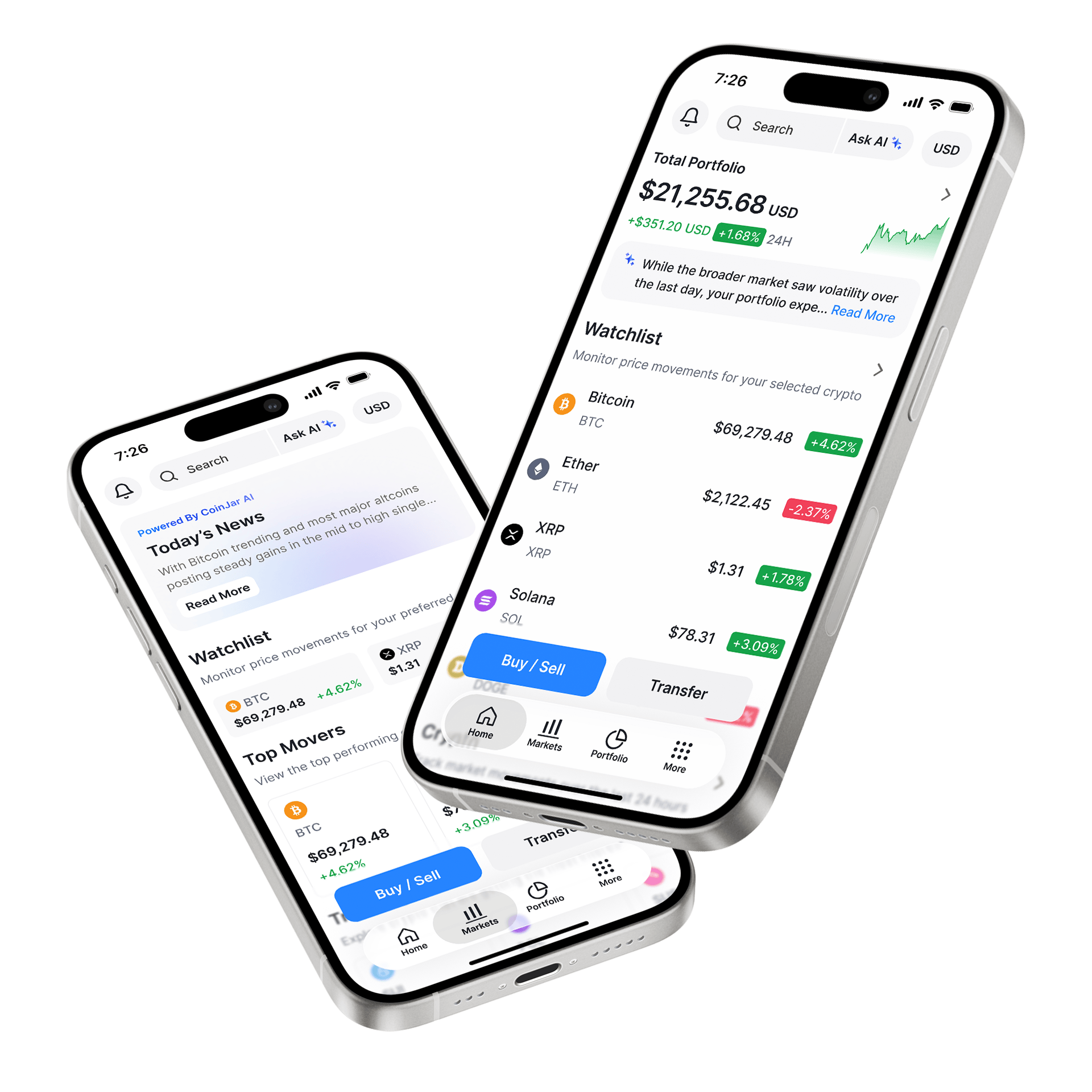
CoinJar App
Buy, sell and send your crypto with the favorite cryptocurrency app in the US.
Get the CoinJar appCoinJar App
Buy, sell and send your crypto with the favorite cryptocurrency app in the US.
Get the CoinJar app
CoinJar AI
CoinJar AI understands your portfolio, tracks the market, and gives you insights that matter. Instead of searching for answers, simply ask a question to get the specific information you need.
Learn moreCoinJar AI
CoinJar AI understands your portfolio, tracks the market, and gives you insights that matter. Instead of searching for answers, simply ask a question to get the specific information you need.
Learn moreBuying, selling, and holding cryptocurrencies is subject to high market risk. The volatile and unpredictable nature of the price of cryptocurrencies may result in a significant loss. CoinJar, inc. is not responsible for any loss that you may incur from price fluctuations when you buy, sell, or hold cryptocurrencies. CoinJar, Inc. does not provide any investment, tax or legal advice; before making the decision to buy, sell or hold any cryptocurrencies, you should conduct your own due diligence and consult your financial, tax and/or legal advisor.
It is your responsibility to determine whether any investment, investment strategy or related transaction is appropriate for you according to your personal investment objectives, financial circumstances, and risk tolerance. Enter into a transaction only if you fully understand its nature, the contractual relationship into which you are entering, all relevant terms and conditions, and the nature and extent of your exposure to loss. Past performance is not a reliable indicator of future results. Geographic restrictions may apply. CoinJar does not endorse the content of, and cannot guarantee or verify the safety of any third party websites. Visit these websites at your own risk.

CoinJar
Get the app.